Centring Audiences

Check out our most recent publication about a method for mapping audiences to design for people’s access and inclusion needs…

Image
Screenshot of the title, authors, and part of the abstract of our newest publication in The Historic Environment: Policy & Practice about the strengths and many weaknesses of mapping audiences to design for better access to and inclusion in UK heritage. For those without academic access, you can download a full version of the paper here.

Our first formal publication based on 3 years of work with audiences on the Unpath’d Waters project is out, co-authored with Katrina Foxton, Katrina Gargett and Lawrence Northall. For those with academic access, you can read it at the publisher’s site – The Historic Environment.

The full paper is open access and downloadable via MOLA’s repository at the British Library.

Assuming you are busy and may not have the time to read the article, here are the highlights:

  • We committed from the outset of our research to centre the access and inclusion needs of three key audiences: visually-impaired people, non-coastal communities, and cross-disciplinary researchers.
  • We want to reduce duplication and wastefulness in data practices. A huge amount of audience data are already available across the heritage sector, which testify to the same trends. We used these data as our starting point.
  • We worked with 18 institutions who supplied 60 data sets, which allowed us to identify six major trends in how audiences are understood and grouped. These include: paid segmentation exercises, demographics, geography, personal/professional research interest, organisational affiliation and means of engagement.
  • We compared our Unpath’d Waters’ audience research methodology to approaches used in commercial contexts by MOLA, both of which testify to the need to engage with people on their own terms rather than as homogenised groups.
  • We flag a lack of innovation with evaluation methodologies, which continue to depend on approaches that privilege highly literate, verbal, visual, social and motivated English speakers.
  • In other words, audience evaluation in heritage tends to conform to long-held norms divorced from the interests and requirements of the majority of people.
  • We suggest that until we seriously revamp these methods, it is problematic to carry on collecting more audience data: they will continue to reflect the same findings.

For those using screen readers or with other access needs, please email me for a copy!

Thanks to our funders, the AHRC and Towards a National Collection, and to the excellent leadership of Barney Sloane and team at Historic England, for making this research possible ++

Job! Researcher for Transforming Data Reuse in Archaeology Project

Come join me and the team at MOLA as a Research Associate on our new European project TETRARCHs….

I’m over the moon to have received Arts & Humanities Research Council funding via the European CHANSE scheme for the 3-year project Transforming Data Reuse in Archaeology (TETRARCHs). Starting in October 2022, TETRARCHs is an international collaboration between myself and colleagues at MOLA, and some of my favourite scholars in the world at the University of York (Dr Holly Wright, Dr Colleen Morgan, Dr James Taylor), the Research Centre for the Slovenian Academy of Sciences and Arts (Dr Dr Edisa Lozić, Dr Benjamin Štular), Lund University (Dr Nico Dell’Unto), the University of Antwerp (Dr Hélène Verreyke, Dr Piraye Hacigüzeller), Ghent Centre for Digital Humanities (Dr Christophe Verbruggen), and Vilnius University (Dr Rimvydas Laužikas).

We seek to examine how archaeological methodologies in the field, the lab and the archive can be changed to support storytelling with archaeological data. And we aim to fundamentally modify archaeology’s standard processes to enable more and better re-use of data, priming these data from the earliest possible moment to tell stories and share findings in ways that are democratic, engaging and just.

TETRARCHs doesn’t officially start until next week – so there’s much to come (including a dedicated website) – but in the first instance I’m looking for a Research Associate to join us. Do you know anyone with a background in human-centred design or expertise in ethnography and audience evaluation? If so, please get in touch!

The post runs for 2.5 years at £35,433 per annum. It is based out of our London office, but flexible working options are available. We would welcome applications from people outside of the UK using the Global Talent Visa method of entry.

Please view the full job description here and apply here, and email me with questions. I have copied the advertisement for the role below.

Do you have a passion for digital heritage, digital humanities, or the critical use of cultural data to benefit different audiences? Keen on the potentials of storytelling to transform how we understand the world around us? Interested to experiment with how we can embed creativity directly into data records, associated metadata, and controlled vocabularies?

We are seeking an enthusiastic and talented candidate, ideally educated to PhD level, to join the CHANSE-funded Transforming Data Reuse in Archaeology (TETRARCHs) Project, led by Dr Sara Perry, Director of Research & Engagement at MOLA.

The successful post holder will have a track record of developing and applying human-centred design methodologies in different contexts with multiple audiences, as well as supporting others in their use and evaluation. You will have demonstrable experience of gathering quantitative and qualitative data, as well as experience in analysing qualitative data and conveying it in forms that are meaningful to different constituencies. 

Whilst supporting the Project Leader in implementing and monitoring key project work packages related to User-Centred Development and Evaluation, Storytelling and Creative Reuse, and Communications, you will:

  • Collaboratively develop and implement a human-centred design and evaluation methodology to enable TETRARCHs’ partners and collaborators to prime archaeological data for storytelling, and evaluate the efficacy of the approach with key audiences over the life of the project
  • Assist with compiling and monitoring the values and ethical frameworks under which the project will operate
  • Develop or support others in the development of knowledge exchange, communications, promotions, and educational material for the project, with a focus on reaching the project’s key audiences (creative practitioners, memory institutions and their constituencies)
  • Liaise with international partners and internal MOLA colleagues on the delivery of their project activities, as well as supporting the project’s Critical Friends’ User Group and Ethical Advisory Board

The successful candidate will have proven experience of critically applying research techniques and methodologies related to user-centred design, ethnography, and/or audience profiling and evaluation. You will have skills in working with people with multiple needs and people who may be facing a range of barriers to participation in heritage.

You will be skilled in communicating with – and listening to – people from a range of backgrounds in sensitive and supportive ways, and in preparing associated media to convey information in appropriate formats to targeted audiences. Competency with collaborative tools such as Miro, Google Jamboards or Padlet is required, as is self-motivation and a desire to go beyond the state of the art. A passion for matters of equality, diversity and inclusion is also a must.

This job will offer the opportunity to work both with MOLA’s own archaeological experts, and with partners and interested researchers around the world – networking, publishing, and presenting at conferences, as well as developing testimonials and content for wider audiences.

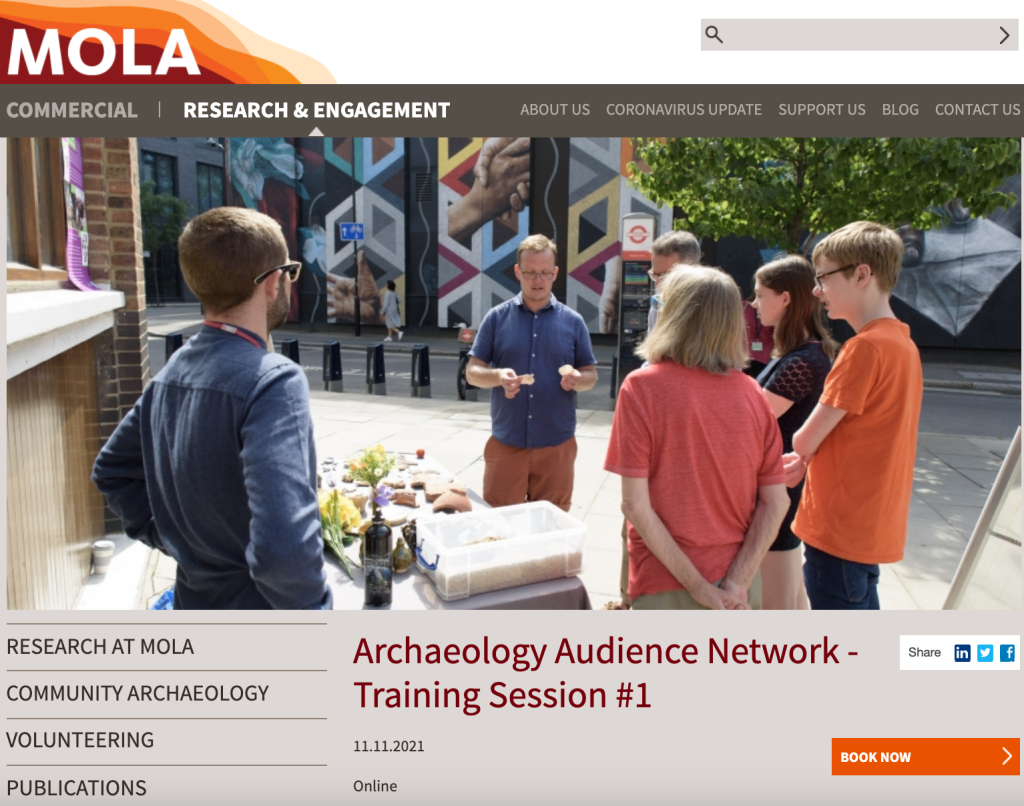
Archaeology’s Audiences: The first public event of the Archaeology Audience Network (AAN)

Join us Thursday 11 November 2021 for our first AAN training session

Screenshot of MOLA webpage advertising the first Archaeology Audience Network event on 11 November 2021. The image shows a group of 6 people surrounding an archaeological handling kit.
https://www.mola.org.uk/archaeology-audience-network-training-session-1

I hope you might join us Thursday, 11 November, 2021 at either 16:00-18:00 GMT or 18:00-20:00 GMT for the first Archaeology Audience Network (AAN) training session. This free event is for all of you interested in audiences and public engagement with archaeology, which I imagine would be everyone working in, studying, and otherwise keen on the discipline – as well as those involved in the wider heritage sector. More information on the session and some of the underpinning evidence for it is available on MOLA’s website. We are running it twice to accommodate demand

The AAN is a collaboration between archaeological organisations in England working to bring together, learn from, and improve our use of data about audiences in order to achieve more meaningful impacts. Collaborators include MOLAthe Archaeology Data Servicethe Council for British ArchaeologyDigVenturesOxford ArchaeologyWessex Archaeology, and York Archaeological Trust, alongside a series of supporters from different professional and academic bodies. The Network will grow over time and we aim for it to be self-sustaining by the end of its formal two years of funding. This essential funding comes from the Department for Digital, Culture, Media & Sport (DCMS) and The National Lottery through The Heritage Fund’s Digital Skills for Heritage initiative.

It’s hard for me to express how much and for how long I’ve been keen to see this type of collaboration realised. My MOLA colleague Magnus Copps (Head of Programming and Partnerships) and I began to work on the proposal as soon as the funding opportunity was announced last year. We reached out to our close working partners and affiliates who we believed would be equally enthusiastic (they were!), and from there the Network was born. The funding from DCMS and The National Lottery has been pivotal to making it possible – it allows us to collate existing data, use lessons learned (both from the categories of data being collected and from the data themselves) to formulate and test out new approaches to engagement with different citizens, and create new models for good practice around audience data, building on the long-standing good practice work of the ADS.

Our first outward-facing event associated with the Network is next week’s introductory training session on Archaeology’s Audiences. We’ve had to re-jig the schedule for the event a couple of times already, both because this is a learning experience for us, and because this first session is important for us in ensuring we fully lay out the foundations for the Network, present its context, highlight its evolving nature (which is designed to be responsive to themes and trends as they emerge), and gauge interest and reactions from different individuals and groups.

Per above, we are running the same session twice on the same day (11 Nov, 16:00-18:00 GMT and 18:00-20:00 GMT), and recording the first (less interactive) part of the session for wider dissemination afterwards. The demand we’ve witnessed for this event perhaps further reinforces not just how much interest there is in the subject matter, but also how much need exists for amalgamation of existing/past work, and alignment of future thinking and practice on matters of audience data and audience evaluation in archaeology.

As we mentioned in our Digital Skills for Heritage application, public archaeology as it is practiced within the context of the UK planning process forms a significant avenue for audiences to access ‘live’ archaeological investigations and contribute hands-on insights into UK heritage. It has access to relatively substantial sources of funding outside of the usual research and charitable grant streams. It takes place around and under the living and working spaces of all demographics in the UK. And it tends to be grounded in activities that can generate short and long-term human outcomes but that lack the enduring physical presence that comes from capital investment in buildings, restoration, or static interpretation. In other words, it is a very special field of practice, with much insight about audience engagement to share—and with tremendous potential to shape archaeological and heritage research and practice in all its manifestations.

We hope you’ll follow along with the work of the Network (email: [email protected], hashtag: #archaeoAN) and join us for the first session on 11 November 2021.

Image