TRT: Sleeveless Knit Top

There is actually some thought into my fabric selections. I mean for all the garments I’ve been making.  I’m wanting to use up yardages that will not make 3rd layers, long sleeve tops or full length trousers/jeans. At the same time, I don’t want to fill my closet with garments  which won’t be worn because they don’t have  coordinating piece(s). My summer wardrobe is pretty balanced right now. I could deviate into some creative sewing but I’m sticking with this sewing plan a little longer because some of the garments I decided  wearable were …. uh-hmmm ….  a little snug.  Now I’m wanting  to replace those items.  Fabric selected for this top is a black and cream printed slinky about 5 years old.

Image
Neckline finished with FOE, armscyes turned and blind-hem stitched.

With a little over a yard of fabric, I opted to use my most fabric conserving pattern, the Tabula Rasa Tee made sleeveless. I’d prepared the tissue pieces several weeks ago just before I got side-tracked  working with the Mixit Top. This would be the trial run.

Image

Apparently, I didn’t think it through too well. Well the front and back are fine, it’s the side pieces that caused me anxiety.  They were about 3″ short. As drafted and cut, the armscye would have been below my bra band.  Not a look I want to exhibit. My first impulse was to cut new side pieces at the corrected length. No dice. Not enough fabric.  2nd thought, patch at the hem.  Looked terrible. I just couldn’t stand it. I ended up cutting off the patch and finishing the sides bottom edges with FOE.  Aligning the side not with the hem but with the desired armscye depth, I reattached the side pieces.

Image

I’ve seen this look both in patterns and RTW.  I’m not really a fan. Maybe it will grow on me because it did solve my problem and looks intentional rather than a fix.

Another issue was the side piece being too wide at the armscye.  I pinched then stitched a dart.  Good enough for this version.

I’m OK with this top. It isn’t my best work but is certainly wearable and definitely not the least bit snug. The tissue has been tested and minor alterations (length and width at underarm) fixed on the side piece. Good to go!


Circle Top

I made my first version of McCalls 6510 nearly 2 years ago.

Image

At the time I noted how easy to sew and how surprisingly nice it looked.   Well that hasn’t changed.

My first  was in a crepe fabric.  I’ve managed to remove all the crepe’s from my stash.  I didn’t like trying to sew with fabrics that crawl away faster than I  can cut.  For this version  I chose a polyester crinkle.  It is light weight weight, drapes well and can be worn directly from the dryer. The later has become an important factor for me as it is impossible for me to spend long hours pressing or even touching up my clothing. I also liked the summery feel of the pastels on white background but admit that the darker color scheme of the first pair may be a little more flattering.

Image

Love the floaty feel and effect!  I used white FOE to finish the necky, white rolled hem for the other edges.  Once again, I was so impressed with myself for having kept an older serger which I press into service as a rolled hem machine.  A serger rolled hem is a perfect replacement for a narrow hem.  Takes far less time and looks beautiful

Image

I chose to use McCalls 6510 because it  was easy and successful for me before and also because I know the designers have worked out at lot of issues.  It has angled shoulders and  2 lines of angled top stitching along the sides which secures the back and front together. Together the make a more flattering garment.  The only change I made this time, was to move the top stitchout out on each side about 3/8″, to accomodate my Chemo-added bulk. (I also ripped the top stitching of Version 1 and moved it).  I do love this simple shape. So much so that I have a Pinterest Board with  variations on the idea. Here’s one that doesn’t need pattern:


Image

Someday I may even try some of the other variations.

Pleated Neckline

I made minor corrections to my extended shoulder version of the Mixit Top.  I marked the armscye point and then smoothed that curve. Next I rotated the dart so the legs were a little further down on the side.

Then I made a copy. This lovely came across my Pinterest feed:

Image

With its white background and flowers, I was reminded of a 4-way stretch, knit fabric already in my stash. I thought the neckline was kewl but decided against working out the sleeve. So I made a copy of the extended shoulder front pattern piece and then rotated the bust dart to the neckline but -get this- I slashed the neckline in 2 places because I could see 4 pleats and wanted the pattern to spread for all of them.

This pattern is getting easy to sew. I spent the largest block of time carefully folding and pinning the pleats before pressing them into place

Image

In retrospect I wish I had spread the neckline slashes in the tissue further apart.  At 1/2″ deep the pleats  aren’t that noticeable.

I bound the neckline with self fabric.  The sleeves are finished as the last extended shoulder i.e. turned up 3/4″ and top stitched. I used the knit, blind hem stitch on my machine for hemming. A little steam and the whole thing looks excellent.

Image Image

Interestingly, this is the same type fabric (4-way stretch knit) that I’ve used in the last 5 tops. However it doesn’t seem to have as much stretch.  I stitched it up with 3/4″ side seams. Didn’t check fit, just took final pics.  I think it could look nicer if the  the seams were 5/8″ instead of 3/4″. Feels wonderful and I think looks cheerful.  Love it!

Extended Shoulder

For many years, I had 3 patterns that were my Goto’s for summer tops. They were Louise Cutting’s

Image Pure and Simple Shell

ImageYour Everyday Drifter (top)

and

Relax A Little (top)Image

Besides having been easy to fit (and wear) they shared the characteristics of body skimming, maybe a little boxy and what I think of as an extended shoulder.  I’m probably not using the correct term.  Essentially the shoulder line is made longer and the side seam is joined to the new shoulder end-point, forming what looks like a long, armscye-less side seam. When sewn, the armscye is formed by leaving the side seam open at the top.

Alas, my body has continued to “mature” (now helped along by chemo)  and I became unable to fit these patterns to my satisfaction.  I tried multiple times but just didn’t want to wear the results. I did not understand why I could not fit the patterns.

I hate reinventing the wheel, but decided I might successfully recreate these favorite patterns  by starting with my fitted block.  So I copied my block (the Mixit Top) and proceeded to extend the shoulder and redraw the side seam similar to the diagram below.

Image Note the PAS, YED,  & RAL do not have this much waist shaping!

I again chose a recent purchase from Gorgeous Fabrics. A  4-way stretch fabric with an animal print.  I laid out  fabric and my new pattern and cut the fabric. To give it a more summery look, I cut the neckline 1″ wider (on each side) and to a depth of 7″ in the front.  I was unsure of the changes I made. I knew if worst came to worst, I could simply take apart the pieces and recut making this a sleeveless top instead of extended shoulder top. I worried enough to completely serge finish all the edges and baste the front and back together.   My only fitting change was making the “armscye”  longer.

Image

I finished the neckline with FOE. For the armscyes, I used an idea Louise Cutting shared. All the edges were serged finished, shoulders are sewn and then  the armscye area is turned up  the same depth as the side seams  and top stitched.


Image

I was  particularly interested and pleased that I did not see diagonal lines that indicate the shoulder slope is incorrect as when I made the tissue I slightly altered the shoulder slope.

Image

Again no diagonal wrinkles!  I feel like singing.  Something I did really notice is the roundness of my neck.  My head is really forward.  Must add new exercise to my routine.

I do love this top. As I said on the index page, if it were not for my chemoed, haystack hair I would love the full silhouette pics.

ImageImage

When I was checking fit and taking final pics, I thought the “sleeve” was too long i.e. I had extended the shoulder too far.  But looking at the final pics I see that shoulder/hip balance that I love. Granted in the  front view I am  slightly angled but the back view is fully squared to the camera. The back view  beautifully shows the desired balance.  Love the ballet neckline which resulted from trying to make the top more summery. Just love everything about this top.

For future versions, I will mark the new armscye depth on the tissue and make 1 additional change .  Because the “armscye” begins about 3/4″ above the bust dart legs,   I will rotate the dart from it’s very horizontal inclination to an angle along the side seam. Bust point remains the same, but the legs will be lower along the seam line.


Cap Sleeves: Cut-On

I want to tackle the cut-on cap sleeve.  I’ve added a cut-on sleeve to another pattern, but it’s been a while and I’ve lost my notes.  So the first thing I did was scour my  Pinterest Board  for some directions.

ImageImage

Well those look easy enough.  So I copied my Mixit Block then extended the shoulder  2″ and drew a curve back to the armscye notches. Pattern Done!

My fabric is a recent purchase from Gorgeous fabrics. A 4-way stretch that reminds me of India.  (I don’t really understand why I think of India. Maybe the colors?) I laid my fabric out so that I had two folds one for the front piece the other for the back piece.  I cut and serge finished all edges before sewing the dart and basting front to back. I took pics, of course I did.  I wanted to see what my cap sleeve looked like. Well I looked at it and thought “Why did I bother?”

ImageImage

To me, it looked like the shoulder line of my first Mixit i.e. before I altered the armscye to give me a sleeveless style.

So that required some thinking. Could I do something to fix it? Cut the cap sleeve off and have it sleeveless?  Cut the cap sleeve off and use the sleeve pattern piece to cut a sleeve?  Well cutting a sleeve wouldn’t work because I bought just enough fabric for a tank style top. Just cutting the cap sleeve off would have been disappointing, I really wanted the cap sleeve.  Could I add a piece? Patch it into a longer cap sleeve? I could but if that piece were noticeable I’d have another “Becky Home-ecky look”. Didn’t want to go there. Finally I remembered my Home Dec teacher from way back in High School saying “If you can’t cover it up, make a feature of it.” So I cut a 2″ strip, twice as long as the cap sleeve portion. Setting the serger’s differential to 2, made it easy to gather the strip to the cap sleeve.

Then I finished.  I used FOE for neckline, sleeve and underarm finishes. Cr@p, I was short 2″ of FOE on the underarm. I patched it with a near match

Image

The patch and the primary FOE are really close in color. I bet you wouldn’t have noticed if I hadn’t drawn those arrows. Still I’m glad it’s at the underarm where it is unlikely to ever been seen, let alone remarked upon.

Image Image

In retrospect, not sure I love the ruffle but it did what I wanted i.e. visually balancing the hip and the shoulder line.  As a plus, my arms look more in proportion to my body. (I had noticed in the sleeveless styles that my arms suddenly looked huge compared to the rest of my body.)

Before I put my new pattern away, I extended the cap sleeve 3″, total of 5″. If 5″ is too my, I can always trim the excess.

Yes, I do like this top and will be happy to wear it anywhere.


Style Arc Besharl Jacket

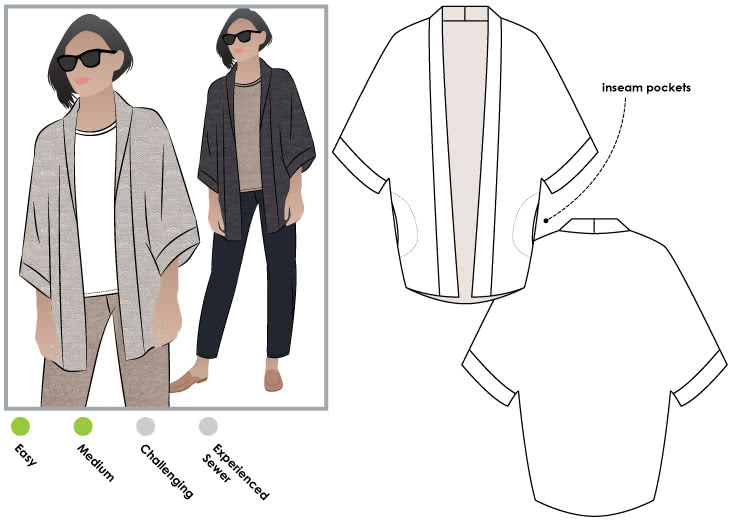
When I needed to replace some of my summer wraps this year, I thought of Style Arc’ s Besharl Jacket.

Image

The pattern  has 5 pieces, front, back, neckband, cuff and pocket.  I skipped the pocket for this version. I never like to make pockets until I’ve settled  fit. Also this version is made from a tissue-weight, lace knit and I hate the way knit pockets can wad together.

Image

I checked the envelope for size recommendation and then measured across the hip area.  I thought there was enough ease I could cut a straight 18.  I traced the pattern pieces and made my round-back alteration then contemplated a possible narrow shoulder alteration.  I nearly always need these 2 alterations plus shoulder slope and  back-waist length alterations. I wasnt sure where to make the narrow shoulder  or shoulder slope alterations. Decided you always make a muslin, even if they are wearable, so this would be my muslin and I could decide later about the other alterations.

Image

This is a serger garment all the way and would be a great choice for the person with a new serger. I finished in 2.5 hours (not counting time to trace pattern).  WOW Instant Gratification Jacket, for sure.

Image

I interfaced the neck band and cuffs with a sheer, fusible tricot.

My jacket is comfortable but a little body-con partly because this fabric wants to drape close to the body. There are a few folds on the back just below the waist which are probably indicating needed ease. (I thought 4″ ease across the hip would be fine. Don’t think so now.)  Also my cuffs are a little tighter than I would like. Both good  reasons to try the next size up, not that I won’t happily wear this version.

One other thing I’d like to work on which is not an error at  just a personal preference, is  the jacket is elbow length.  I was hoping for at least 3 quarter.  I prefer full length sleeves because when I get into the freezer section my full arm is cold. Not sure how I can make a longer sleeve.  Something to think about……


Nova Midi, Version 2

I chose another 4-way stretch  fabric for this version because I wanted to eliminate fabric as a factor in different fit.  Also  because it had the full required 3.5 yards length.  I didn’t like it and the final dress for a couple of reasons. I liked the colors but not the design; motif; pattern.  It required a lot of work to match the pattern through the bodice and all 3 tiers. I didn’t make that effort and the dress looks well “home made”.

But, as I wrote, I made some important progress.  I ditched the idea of making the dress exactly as drafted.  I had felt there were massive amounts of fabric which made my large sized body look even more massive.  I didn’t like how long the bodice was nor indeed the entire garment length.  I grabbed ruler, pencil and paper and started calculating.

I trimmed 2″ from the bodice length. I hesitated because I thought the fabric might be stretching and making the bodice longer than if it were made with a non-stretch or 2-way stretch fabric.  On my tissue, I’ve made a 1″ BWL and noted the bodice length.

I asked DH to measure me for some critical points:

  • Shoulder to just above waist (Nova Bodice length)
  • Shoulder to above the knee (preferred street length)
  • Shoulder to just above calf (a tea length)
  • Shoulder to just below calf (preferred tea length)

Once again wanting a long dress, I subtracted my bodice length from my preferred tea length. That is my skirt length for the Nova Midi. At first I divided the skirt into 3 equal parts or tiers. I reconsidered because I think part of the charm of the Nova Midi is the uneven tiers. I changed my tier widths to 9.5, 11.5 and 14″ (+1 to Tier 3 for the hem)

Then I contemplated length of the tiers.  As drafted a 1:1.4 and 1:1.6 ratio is used to determine the tier lengths. So Tier 1 would be 1.4 times longer than the bodice circumference; Tier 2 would be 1.4 times longer than Tier 1; and Tier 3 would be 1.6 times longer than Tier 2. I was reluctant to use those ratios because of my perception of massive amounts of fabric.  I settled upon the 1:1.25.  That’s still at lot of length on that 3rd layer. 97 inches to be exact.

Interesting note, when style for me (i.e. dress length and tier fullness) 2.5 yards of 56″ wide fabric was required instead of the 3.5 yards specified by the pattern instructions.

ImageImageImageImage

Because of the pattern placement,this will never be a garment I wear beyond the garbage bins. I just don’t like it. But I do like how the garment is fitting.  The bodice is near perfect for me.  I might make it a little closer fitting at the waist. The not quite empire line (above waist but not directly under the bust)  is perfect. I am unsure if there are still ‘massive’ amounts of fabric.  I’ll need to wear it a few times to  decide and to be sure that my dress does not trip me when traversing the stairs. It’s not a total loss. Once I’ve made those decisions, I can wear this when coloring my hair, taking out the garbage or similar activities.

*******

I’d say Ver 1 is not a loss either however I’m not going to fix it before next summer

Image

I’ve worn it and it feels both too long and like a whole lot of dress. Next year I’ll trim apart the tiers; shorten the bodice and change the length of the tiers.  Love the print and with those few changes, think I’d wear it many places.

I do think I will make this pattern multiple times.  I can see changing the number of tiers; even making a single tier i.e. skirt. Probably will use different necklines and like my other sleeveless tops, I think I will be adding cap sleeves. It is a great pattern.


Style Arc Nova Midi

I like a few dresses in summer. Try to make one ever year.  This year I fell in love with Style Arc’s Nova Midi and purchased it a few weeks ago.

Fitting was fantastically easy, something I don’t remember experiencing with previous SA patterns.  I started by checking the size recommendations, then compared my Mixit Top (non-stretch version) with the pattern.  I traced a size 18 across the shoulders and armscye tapering out to a size 20 for the waist and hips. I did not trace the tiers. They are all gathered rectangles.  I find it easiest to use my rotary cutter and a ruler to cut rectangles.  I measured and wrote down their dimensions.

I always need some pattern alterations. I added my 5/8″ round back and shoulder slope alterations.  For my asymmetrical shoulder, I stitched the right shoulder seam 1/4″ deeper.

Cutting was a challenge.  Oh not the bodice pieces.  They were easy.  It was the tiers that gave me fits. I chose an ITY for the ‘test version’ which has a pretty design and some gold foiling.  Unfortunately it had a flaw. A few tiny holes in the fabric.Initially I thought I could cut around the holes. No matter how I calculated, I needed that section of fabric because I simply didn’t have enough yardage. I think my hole fix is hardly visible on the public side.

Image
Fixed Holes
Image
Face side where holes were fixed

And, I made a boo boo.  I started cutting a strip the wrong width. Again needing  every square inch, I seamed the erroneous cut edges. Made a  seam on the second strip so they matched.  From the face, it looks as if I have inserted a narrow tier.

Image

Again, barely visible on the public side.  A busy print can hide a multitude of errors.

I had 2 yards of 54″ of 4 way stretch fabric. Pattern called for 2.5 yards on the 2 tiered view and 3.5 for the 3 tier view. I didn’t have enough fabric to cut the tiers exactly as drafted.  I calculated how long the strips were supposed to finish and by using every square inch, I cut fewer strips, only 2 tiers but the same net length and width as the 3 tiered view..

I had basted the bodice together first and decided the side seams needed to be a little deeper probably because I used a stretch fabric and the pattern is drafted for non-stretch.  My bodice side seams are 3/4″ insead of the 3/8″ drafted. I used a shirttail hem. –Not sure I like it, but at this point I didn’t want to shorten the dress or even add a hem facing..

ImageImageImage

All seems good, right? Except when I look at the dress, I’m not sure. It looks like just huge amounts of fabric.  I remember feeling like the I had massive amounts of fabric when I was gathering and joining the strips. Did “making it work” make it wrong?

Except, I have a problem.  Anymore, I don’t recognize myself in pictures. Chemo has put so much weight on me that I am no longer fluffy, I’m obese. So is there too much fabric or too much fat?

I am just not sure.


**************After thoughts

Final tissue alteration was to remove neck and shoulder seam allowances.  I loved the FOE finishes and decided to prep the tissue so they could always be used. I marked the tissue “NO SA” so that I wouldn’t trim it again and/or I would know to add a seam allowance if I desired facings.

After my calculations I used 2 yards of 54″ wide fabric.  Pattern calls for 2.5 yards on the 2 tiered dress version and 3.5 for the 3 tier version.  I saved some fabric by using FOE instead of  self-lining or facings. By  careful cutting to achieve tiers of same length  but fewer strips, I was able to use the available yardage.

Mixit V-Neck Loes Hinse Style

Very few changes were made for this version of my knit Mixit Top pattern

Image

Many years ago, I learned this V-neck finish from Loes Hines V-Neck tunic. Essentially it needs a front seam. The V-neck is finished first; then the center front seam sewn. So I added 1/4″ to the center front of y pattern. After cutting and serge finishing, I stitched the shoulders together and then applied FOE to the front and armscyes. Then I butted the center-front edges together and secured them with one of the joining stitches on my Dream Machine

Image
Unfortunately the stitching doesn’t show up in the pic.  It looks like railroad tracks.

After that it was quick and easy, stitch sides, hem the garment

Image Image

Image

I am really happy with the over all fit. I remembered to make my asymmetrical shoulder adjustment, this time. Also, I deliberately Fit this pattern so the shoulder ends where my body’s shoulder ends. However that makes my chemo-arms look really big

Image


OK, the chemo weight-gain has made me obese (I was fluffy before chemo).  Cut with the shoulder ending where it does, emphasises how narrow I am at the shoulders in comparison with the width of my hips.  I want sleevelessness during the hot weeks coming up so what to do?  I’ve decided the future versions this summer will include some type of cap-sleeve. That’s something for me to experiment with. So while I will be using the same basic TNT, I’ll have something new to interest me.

*******

PS that’s a -way stretch fabric purchased last year. The armscyes seemed to stretch on me after cutting but the rest did not. The pattern armscye measured 20″ the fabric 22″. But it turned out OK. Maybe the FOE is stretching even though I think I”m not???  This is one of the few fabrics I’ve had problems with starting my stitch from the edge and the top layer always wants to walk.  It requires several pins, careful starts and frequent stops to allow the layers to snap back in place.  I can understand why Linda Lee of The Sewing Workshop insists that a walking foot must be used.


Yellow Splotches and a wadder

I transferred most of the fitting changes of the first version to the tissue and promptly made a wadder..

ImageImagePics are from first fiting

I basted the front and back  together to  check the fit. Then took  apart the seams and  worked on finishing  the neckline. I designed a reverse facing for the front. A reverse facing is about what it sounds like. A facing which is stitched with the facing’s right side to the wrong side of the garment. Trim, clip and understitch before flipping to the outside and securing in place.

The reverse facing lends itself to embellishment.  In this case I had crafted an interesting angular shape and used a contrasting fabric.  Unfortunately, I didn’t take into account how low I wanted the front neckline. I’d put at least an hour into drafting, cutting, interfacing and stitching. I was annoyed with myself for not checking neckline depth before understitching and cutting. I didn’t want to put another hour into it and opted to trim away the facing and back neckline finish. I was stitching on  a simple FOE binding when I realized the back neckline had become horribly stretched.  I gave it the “old college try” but could not shrink it to size.  Now I was thoroughly  disgusted with both myself and the entire neckline.  I wadded it up and threw it in the trash before straightening my room and calling it a day.  Sometimes after I “cool down”, I can think of a fix. Unfortunately, DH collected and carried out all the trash the same day. So wadder it is.

Most importantly though, is that I think the fit is pretty  good for 40% 4-way- stretch knit fabrics.  I trimmed the pattern’s  shoulders half inch because I think they are still a little wider than I want.   From the stash came a recent purchase from Gorgeous Fabrics. I think it is supposed to be or represent tie dye. Mostly I see an interesting collection of yellows delivered in splotches on a knit fabric. —I love it. — I measured the stretch at 30% both ways. OK, my splotches fabric will stretch more than 30% but I didn’t like how it looked when stretched more than 30%.

I did baste the pieces together to check fit. Didn’t think I needed any changes so  I took the pieces apart and finished.  I’m pretty happy with this garment…

ImageImageImage

but it does have a couple of issues. One of the issues is self inflicted; the other has me puzzled.  First off, I did not do my asymmetrical shoulder adjustment. I can’t answer why. I guess typical brain fart. Result is the diagonal wrinkles seen both front and back which are clearly seen in the side photo.

The other issue is that the armscyes are too tight.  They felt and looked fine at the  fitting.  So something happened with the FOE finish.   I’m very careful to keep the FOE taunt but not stretched during sewing. Before sewing the side seams, I steam both the neckline and armscyes.  I’m wondering if the FOE shrunk during the steaming?  It’s most noticeable at the armscyes which are tight but also the neckline is higher than I was expecting.

Not sure when I will get around to fixing the armscyes. That involves opening side seams, trimming away the FOE and reapplying.  I won’t mess with the asymmetrical shoulder.  I’d have to take out armscyes and the neckline to fix. Sorry, just not up to it. Besides, I tend to rapidly ruin such light colored fabrics with spots and stains.