
Addams Family Pinball Tutorials

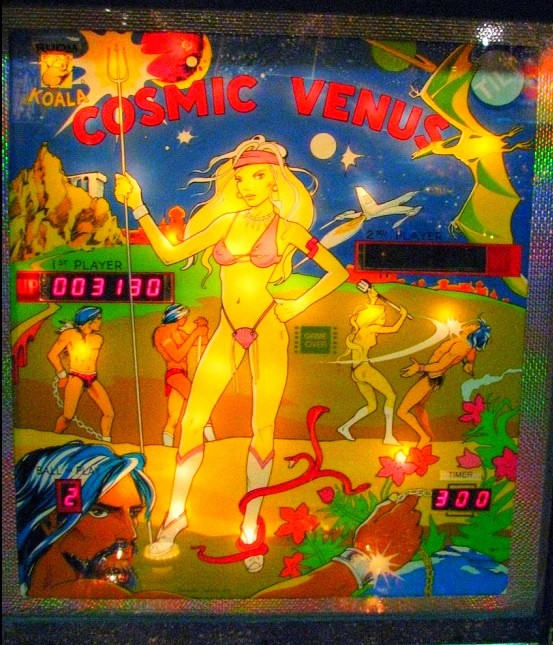
Last night at our weekly movie watch group we saw Tilt (1979), one of those fad exploitation movies that Hollywood used to make, about pinball hustling, and with a surprisingly sweet ending, which felt earned because the first half of the movie is pretty sleezy, with an aspiring musician getting the money to make a demo tape by exploiting the pinball talents of a young girl, played by Brooke Shields, who’s got a crush on him. Tilt, BTW, has a prop pinball machine called Cosmic Venus as the centerpiece of the last third of the film, which judging by its art is set on a planet mostly dedicated to stripping.
Image
The backglass to Cosmic Venus (from pinside.com), with typical bikini-wearing pinball centerpiece woman . Stay classy, Koala.

Anyway, that got me thinking about something to show after it, something from the world of real pinball. And I happened upon a promo tape that Bally made to promote the then-upcoming release of The Addams Family, which would go on to become the best-selling pinball machine of all time, with over 20,000 thousand tables sold. Meaning, if you’re going to learn to play any pinball table, Addams Family is still the one you’re the most likely to find out in the wild (although newer machines like Godzilla or Batman ’66 are also good bets).

Here is that tape (10 minutes):

When that was made, they didn’t know that, after designer Pat Lawlor’s earlier hits Earthshaker, Whirlwind and Funhouse, that his next game would become the greatest of all time.

Addams Family is a little simple compared to the games that would follow it, and especially the games released now by companies like Stern and Jersey Jack, but I think that adds to its appeal. It’s the perfect middle ground between the games that came before it, which were mostly about trying to achieve multiball as many times as possible, and current tables that devalue multiball, and push players towards very long games and wizard modes to get good scores.

AF has a wizard mode, Tour The Mansion, which you get by earning all 12 mansion rooms, but it also has a very lucrative multiball, and it’s the player’s choice if they want to focus on one, the other, or a combination of both. The Youtube channel of tournament organization PAPA has an excellent tutorial and demonstration of high level strategy and gameplay. (21 minutes)

But if a third of an hour is too much time to learn the rules of an excellent pinball machine, Quick Ass Pinball will teach you the basics in 4½ minutes:

Jamey Pittman’s Pac-Man Grouping Tutorial

Jamey Pittman is the creator of the foremost document on the workings of Pac-Man ever created, the Pac-Man Dossier. If you’ve never read it, but have any interest in playing classic Pac-Man, then you should go read it immediately. It will make so many things make sense to you.

Pac-Man has a reputation as a game of patterns, and seems designed in such a way as to enable patterns to work. The only randomness is in the behavior of the ghosts when they’re vulnerable, and even then, if the player has performed the same moves at the same times up to that point in the level, even their vulnerable behavior will be consistent. Its GCC-developed follow-up, Ms. Pac-Man, has the red and pink ghosts move randomly at the start of each board specifically to foil patterns.

But you don’t have to play Pac-Man as a pattern game. It is possible to play it “freestyle,” like a naive player would, reacting to the ghosts’ movements. You’re unlikely to make it to Pac-Man’s famous kill screen at board 256 that way, but you can still make it pretty far.

Key to doing that is keeping the ghosts as close to each other as you can. The ghosts are much more dangerous when they’re scattered around you, because they can block off all of your escape routes. Four ghosts piled up on the same spot not only can’t block off other corridors, but their AIs tend to continue to keep them together, at least when they’re far away from Pac-Man. Red and Orange behave identically when they’re at a distance, and Pink’s behavior appear to be more like Red’s the further away from Pac-Man it us. Blue has the most chance of diverging, but often moves the same way anyway.

Not only does keeping the ghosts clustered make survival easier, but it makes it much easier to eat all of them with a single Energizer. The ghosts only turn blue up to around the 4/6th Key board, but up to that point it’s basically impossible to get the maximum score from every Energizer if one hasn’t managed to herd the ghosts into a single, easy-to-gobble blob.

That’s where Jamey’s tutorial comes through. It presents a series of situations and techniques for getting the ghosts near each other and moving as one unit, whether it’s for avoiding them or getting the maximum points from an Energizer. It’s a bit much for casual play, but it can be very interesting to see how a true expert goes about doing it. Here, then, is the tutorial (27 minutes):

Caves of Qud Intro Videos

Caves of Qud, after over a decade of development, finally reached a 1.0 release and has, for now at least, become the toast of the more-enlightened gaming internet. Of course there will people who will look at its time-based graphics and look down on it, and go back to their games of Call of World of Fortnight Among Us Craft Duty League. But if you’re here, then there’s a good chance that you get what’s special about roguelikes. And not just roguelikes, but classic roguelikes: heavily randomized, turn- and tile-based, and challenging. Hence, Caves of Qud.

Honestly, the roguelike scene is so large now that no one person could reasonably be expected to keep track of all of it. But there is no need to; others hold aloft that particular torch. Here’s a couple of videos, then, on getting started in Caves of Qud.

Publisher Kitfox Games (who also publish the Steam release of Dwarf Fortress) sponsored a video with “Getting Started” right in its title. Here it is (18 minutes):

It contains information on the different modes, the best starting location for beginners (Joppa), basic controls, navigating around the starting town, how to get around the world map (reminiscent of Alphaman!), how to spend kill points, how to read things, how to examine Artifacts, how to experiment with things (even if it gets you killed sometimes), how to steal things, performing the water ritual, and some combat tips.

Another, slightly longer at 24 minutes, intro video is by Rogue Rat:

It covers ranged weapons, the town of Joppa, Truekin, what to do when you get lost, some different skills to learn, gaining levels from giving books to a specific NPC, using its Crawl-type Autoexplore feature and other topics. Rogue Rat did a longer, more basic, intro video (34m) last year that went over many of the same topics as the first video here.