
I wrote about angels in the architecture at Coventry.
Woodrow Hartzog & Jessica M. Silbey:
AI systems are built to function in ways that degrade and are likely to destroy our crucial civic institutions. The affordances of AI systems have the effect of eroding expertise, short-circuiting decision-making, and isolating people from each other. These systems are anathema to the kind of evolution, transparency, cooperation, and accountability that give vital institutions their purpose and sustainability. In short, current AI systems are a death sentence for civic institutions, and we should treat them as such.
Our guidelines for generative AI in music and audio are as follows:
- Music and audio that is generated wholly or in substantial part by AI is not permitted on Bandcamp.
- Any use of AI tools to impersonate other artists or styles is strictly prohibited in accordance with our existing policies prohibiting impersonation and intellectual property infringement.
Resistance is not futile; it is necessary. Some people understand that.
From an essay in Persuasion: “So here is our suggestion: Professors should actually teach the scholarly controversies on the issues that most divide them, and they should advertise their success at opening their classrooms to dissenting perspectives.” For academic humanists of my generation, what’s odd and funny and slightly disorienting is how many of the debates we’re having today simply repeat the ones we had in the late 80s and early 90s. For example: Gerald Graff’s essay “Teach the Conflicts” appeared in 1990, and was expanded into a very smart book that was widely discussed at the time. But the authors of the Persuasion essay appear not to know that history.

Glenn Gould: “I suppose it can be said that I’m an absent-minded driver. It’s true that I’ve driven through a number of red lights on occasion, but on the other hand, I’ve stopped at a lot of green ones but never gotten credit for it.”
It’s no mystery why professional musicians are having so much trouble making a living through our primary work. Recorded music is dominated by streaming - on its most recent report, the RIAA calculates that streaming accounts for 84% of all recorded music revenue. And streaming is directing all its revenue to 12% of tracks.
Speaking as someone from that rarified 12%, the actual numbers we receive are absurd in any case — Spotify’s average payout to record labels is $0.003 per stream, gross. That fraction is then divided up, with artists receiving anything from 15% of it ($0.00045) to a maximum of 50% ($0.0015). Or, if they are fortunate enough to own their own masters — as my bands do, and Taylor Swift does — we get the whole ball of wax, 1/3 of a penny per stream to share among all those who contribute to the music. That’s $3,000 per 1,000,000 streams. Good luck.
Robin Sloan on chatbots as “manic technology”:
I’m starting to think language models are a fundamentally manic technology, in part because they operate exclusively through logorrhea, the “yeah, yeah, YEAH!” of the all-nighter. […]
The “best” setting for a brain (and/or an economy) isn’t necessarily straight down the middle. A dip into the realm of mania can be useful, some times revelatory. I don’t know if many creative projects would ever get started if our brains didn’t some times relax the standards by which they light up.
Yet for a human mind and a human heart, one really good project is more nourishing than ten cruddy ones; that was true a hundred years ago, and it’s true today. The AI coding companions will never ever say: “Hey … whatever happened to that other thing you were working on?”
I suppose you still need friends for that, people who know you, who know when you’re talking too fast, and the gleam in your eye has taken on a hard edge.
Ready for action.

Earlier today I did Morning Moon, so now let me do Evening Sun (with amazing clouds).

Telling someone to love literature because reading is good for society is like telling someone to believe in God because religion is good for society. It’s a utilitarian argument for what should be a personal passion.
It would be better to describe reading not as a public duty but as a private pleasure, sometimes even a vice. This would be a more effective way to attract young people, and it also happens to be true. When literature was considered transgressive, moralists couldn’t get people to stop buying and reading dangerous books. Now that books are considered virtuous and edifying, moralists can’t persuade anyone to pick one up.


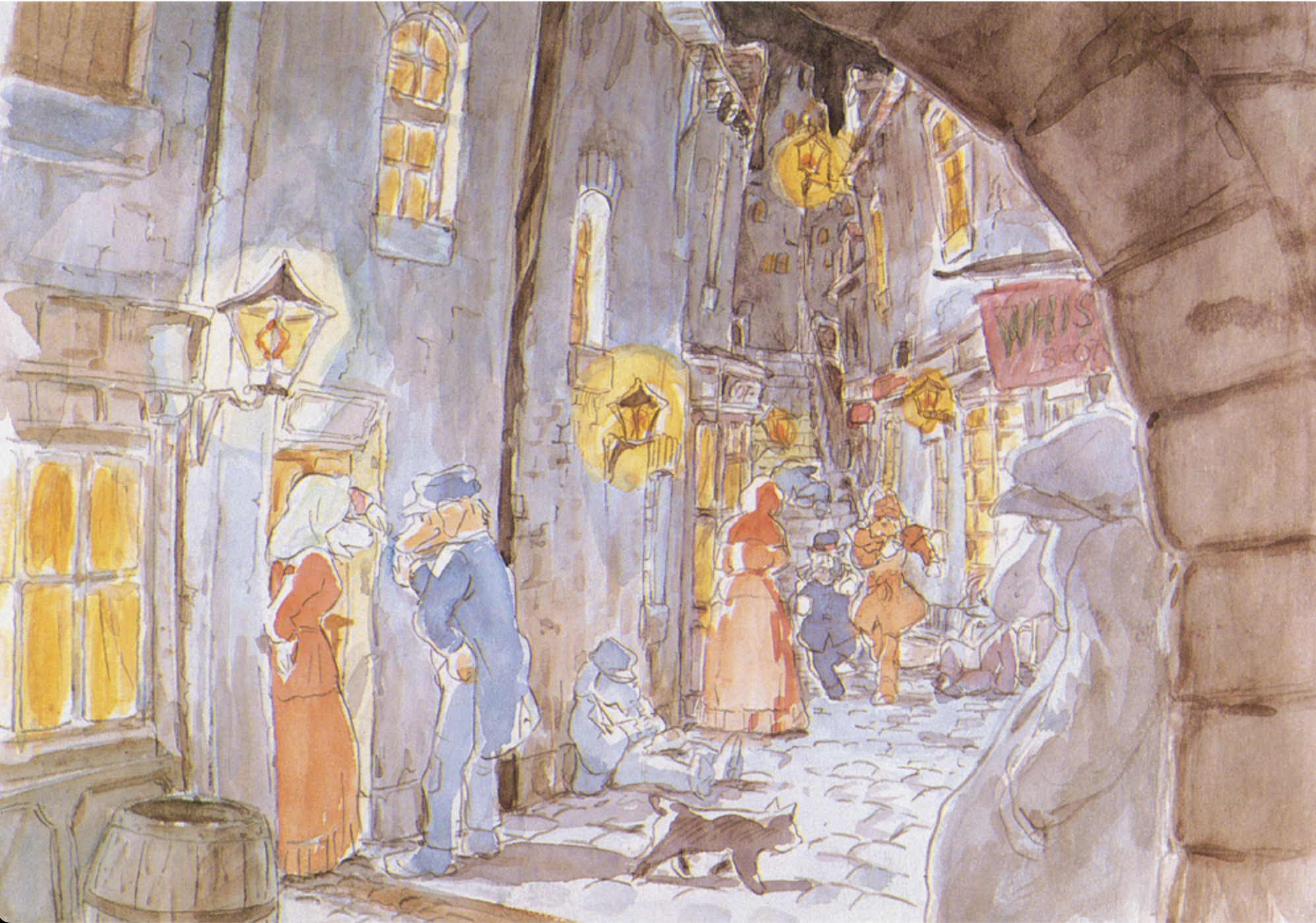
Miyazaki drawings for Sherlock Hound, via Austin Kleon.
On 21 years of using Markdown — and in hopes of at least 21 more.
The Last Days of the Southern Drawl:
Recent studies suggest I’m part of a trend: Young people are losing their southern accents. By the end of my life, there may be no one left who speaks like my father outside the hollers and the one-horse towns.
I’m part of the trend too: I certainly have a Southern accent, but it’s not as pronounced as it was when I was younger, and I profoundly regret that.
On the plus side, though, a Southern friend of mine sent me this: Redneck Shakespeare. A thing of great beauty.


Exotic Botany… (1804), by James Edward Smith
I wrote a post for my Buy Me a Coffee supporters on the importance of redundancy in one’s stupidity-prevention system.
I’ll be offline for the next week or so as I try to finish a complete draft of my Sayers biography, but as I ride into the sunset I’ll share the news that Dan Wang’s annual letter is back, after a year’s hiatus during which he published an excellent book. Ciao for now!
