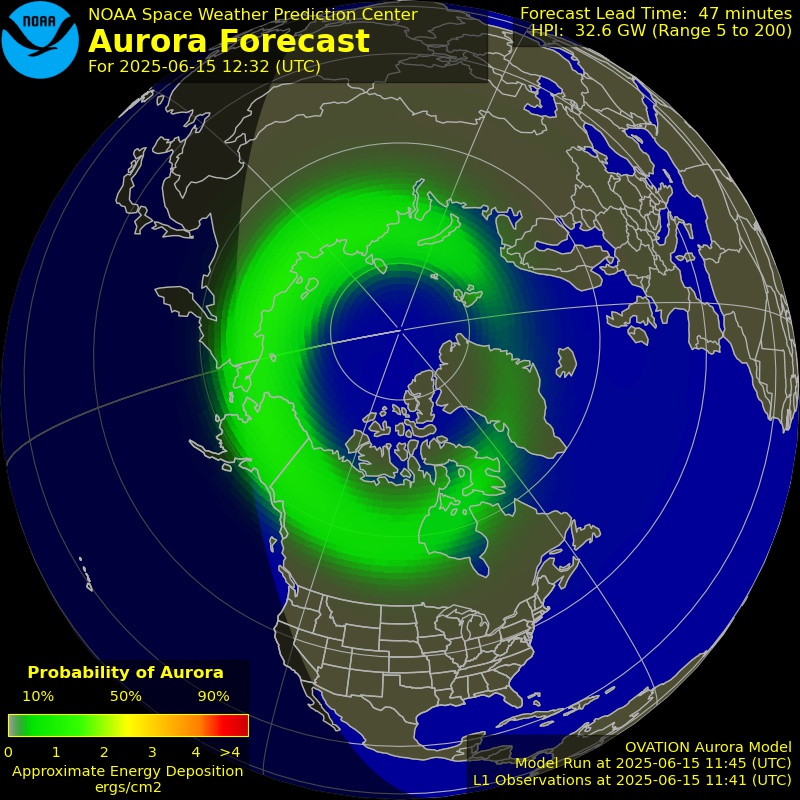
With the solar wind speed remaining at high levels (800-900 km/s) and the Bz/IMF component pointing south, Moderate (G2) to Strong (G3) geomagnetic storming persists heading into Tuesday evening (UTC). Aurora sky watchers at middle to high latitudes should remain alert once it is dark outside. For ham radio operators on 50 MHz, stations at higher latitudes are reporting aurora signals where it is dark outside or approaching local evening. Antennas to the north, (or many times the path is skewed NE-NW). Stay tuned to SolarHam for the latest details.
Geomagnetic Storm Update
January 20, 2026 @ 07:00 UTC (UPDATED)
The initial CME passage at 19:20 UTC Monday saw the Bz component of the interplanetary magnetic field (IMF) point -58 nT south, the strength (Bt) a whopping 91 nT and the solar wind speed above 1100 km/s. This brought on the rapid onset of Severe (G4) geomagnetic storming (9.68 Kp) and displays of aurora for many across Scandinavia, UK and parts of Europe.
The Bz then shifted to the north for a long duration which eventually brought conditions down to the minor (G1) storm level. Not great timing for aurora viewers in North America.
Currently the Bz has now finally shifted back to the south and the solar wind speed remains high above 900 km/s. Severe (G4) storming has flared up once again.
Aurora sky watchers should remain alert while it is still dark outside.
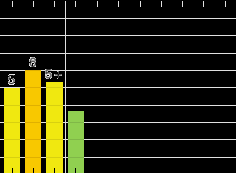
ALERT: Geomagnetic K-index of 8, 9-
Threshold Reached: 2026 Jan 20 0823 UTC
Synoptic Period: 0600-0900 UTC
Active Warning: Yes
NOAA Scale: G4 - Severe
The photo below is courtesy of Nikolas Cikala who captured this aurora display from Svinia, Slovakia around 10:40pm local time. Thanks for sharing!
CME Impact / Severe (G4) Storm in Progress
January 19, 2026 @ 19:50 UTC
The anticipated coronal mass ejection (CME) arrived earlier than expected. A geomagnetic sudden impulse measuring 97 nT was detected at 19:20 UTC marking the moment it swept past Earth. Solar wind speed data is currently contaminated because of the ongoing radiation storm, however the Bz component of the interplanetary magnetic field (IMF) if shifting wildly between sharply north and south. Plasma density saw a nice increase as well.
The Severe (G4) geomagnetic storm threshold was quickly reached at 19:38 UTC. Aurora sky watchers should be alert once it is dark outside. The photo below was captured this evening by Robin Nordlund who is located in southern Sweden. Thanks for sharing!
ALERT: Geomagnetic K-index of 8, 9-
Threshold Reached: 2026 Jan 19 1938 UTC
Synoptic Period: 1800-2100 UTC
Active Warning: Yes
NOAA Scale: G4 - Severe
Severe Radiation Storm: Just before the arrival of the CME, proton levels swelled past the severe (S4) radiation storm threshold. This is the first time this has happened since October 2003.
Severe Radiation Storm / G4 Storm Watch
January 19, 2026 @ 11:00 UTC (UPDATED)
The Strong (S3) radiation threshold was reached Monday morning. Energetic particles continue to stream past our planet following the X1.9 solar flare on Sunday. Main impacts include degraded or blacked out HF radio propagation through the polar regions and passengers and crew on high altitude flights may experience increasing radiation exposures. This is the first time since October 2003 that this level has been reached.
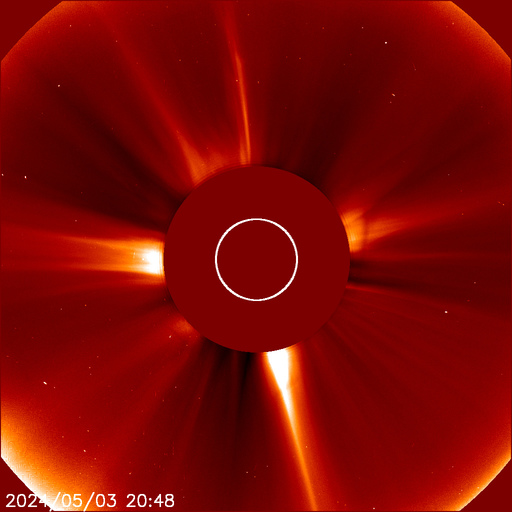
Also notice the many white specks in the latest LASCO imagery. This is caused by energetic particles saturating the sensor onboard the spacecraft.
As of this writing, an updated geomagnetic storm forecast and CME tracking model has not been made available by NOAA/SWPC, however Strong (G3) storm conditions may be possible during the next 24 hours once the CME passes Earth. Another update will be provided later today.
UPDATE: A Severe (G4) geomagnetic storm watch has been added for January 20th. Aurora sky watchers at middle to high latitudes should be alert beginning later tonight.
X-Flare / Earth Directed Halo CME
January 18, 2026 @ 18:25 UTC (UPDATED)
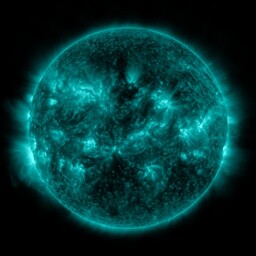
A strong X1.9 solar flare was observed around AR 4341 on Sunday (Jan 18) at 18:08 UTC and was associated with a Type II radio emission (693 km/s), along with a 10cm Radio Burst (TenFlare) lasting 122 minutes and measuring 3200 solar flux units (SFU). A noteworthy coronal mass ejection (CME) is associated and contains a full halo signature. It appears that the main bulk of plasma is headed just to the east, however with the halo present, an Earth directed component is almost for certain with an impact likely within 24-48 hours. I would expect a geomagnetic storm watch of at least the strong (G3) threshold to be issued once a tracking model is issued by NOAA/SWPC. More to come.
UPDATE: Proton levels streaming past Earth are creeping higher and a minor (S1) radiation storm watch is now in effect. Furthermore, an updated CME tracking model by NASA is showing a passage past Earth by 06:00 UTC on January 20th. Click HERE to watch.
Site Information
SolarHam.com launched on March 15, 2006 with the purpose of providing real time Space Weather news and data from various sources, all in one location for easy navigation. The site was created and is still maintained solely by amateur (HAM) radio station Kevin VE3EN.
Data Sources
This website relays data and imagery from the following sources.


 5
5  10
10