Disabled outrage is necessary and liberatory; it reveals the fissures in society and the consequences of structural oppression. It comes from a place of hurt and injustice. It is resistance against erasure.
The neurodiversity movements needs its shoes off, and fists up.
We have protests to stage, driven by the fuel of our righteous anger. We have speeches to make, written from the soaring pleas of our individual and collective trauma, and our wildest dreams of joy and freedom and love. We have cultural narratives to rewrite because they really do hate us and they really will kill us, and if we’re going to rewrite the narratives, then there’s no reason to hold ourselves back from our most radical and defiant rewritings. We have autistic children who need us to support them as architects of their own liberation against the schools and clinicians and institutions and police and prosecutors who would crush and destroy them.
We’re going to need our anger and our public celebrations of stimming and our complicated, imperfect, messy selves for this long and hard road, because we need all of us, and all of our tactics and strategies, to keep a movement going and ultimately, to win.
I, Victoria Lin Tanner, am just one of many people who discovered, after a lifetime of struggle, that I am autistic. This book is about my journey of self-discovery. It is also a scream into the cold, black void where no help is to be found for people like me. Autistic children become autistic adults, so why is there no support for us? I am here to shine a glaring spotlight on the ways that society has failed autistic adults. For many of the 5 million+ autistic Americans, and ~75 million worldwide, life would be made far more manageable and frankly, happier, if our struggles were supported in meaningful ways rather than through #autismawareness retweets and puzzle piece merchandise.
We are here, we are angry, and we are only going to get louder.
We are not okay. I say this with the utmost compassion. You have inherent value, no matter how often your invisible labor goes unnoticed and unrewarded. You deserve to live, to rest, and to be noticed. It’s a sad fact of life that we autistics have had to do the lion’s share of our own advocating, but those who don’t understand our struggle are simply not motivated enough to push for change. We cannot allow the majority voice to be that of cure-mongerers speaking over us. So, get louder. Get angrier. This is our movement, and we need more than visibility. We need accessible and meaningful support.
Because every single thing you hate about us, you will hate about yourself. And becoming us is a lot easier than you think it is.
The instant, almost the very instant, you become disabled, you cease to be seen as a reliable narrator of your own story to literally everybody else, except for disabled people.
Every single ableist stereotype that you’ve heard for your entire life that you’ve never evaluated, that will be the lens through which other people see you, including people that know you.
This is one of the many reasons why people need to do anti-ableism work. Because every single thing you hate about us, you will hate about yourself. And becoming us is a lot easier than you think it is.
This is what disability advocates have said all along, not that it usually sinks in: The able and the disabled aren’t two different kinds of people but the same people at different times.
This is what disability advocates have said all along, not that it usually sinks in: The able and the disabled aren’t two different kinds of people but the same people at different times.
Disability always has been and always will be a natural part of the human condition.
Simply a form of human variation, disability is universally present across racial, gender, age and socioeconomic lines. Moreover, disability represents the only minority group that anyone can join at any time and, when all human impairments are taken into account, people with disabilities by far encompass the largest minority group in the United States.
They don’t take Disability Studies classes. They don’t socialize with us. They don’t listen to us.
CW: medical trauma, medical ableism
I remember laying there, remembering that this experience I’m having is like the other times that I almost died.
And I can feel my life slipping away.
Is it worth it for me to call out and have someone save me?
That’s how traumatized that I’ve been by being in hospitals and in medical settings.
And I need for doctors and healthcare professionals to understand that many of us are traumatized like that.
It’s not abnormal for people like myself who have chronic illnesses, who have cancer, and have high touch and high interactions with medical professionals, to feel traumatized, to feel, is it worth it for me to go and get help for this experience that I’m having, for the possibility that something major is wrong?
Because for some of us waiting to see is worth the risk of possibly dying.
That’s how much we are no longer emotionally prepared to go to the hospital.
That’s how bad a physical experience it is for some of us.
#MedTwitter is shocked that disabled & chronically ill folks identify as their conditions because they’ve never actually been exposed to us except in medical textbooks & clinics. They don’t take #DisabilityStudies classes. They don’t socialize with us. They don’t listen to us.
Which means THEY actually reduce us to “nothing but our conditions” far more than we do. #MedTwitter But hey, wouldn’t want to tell the good doctors they’re ignorant.
Bodies ride the waves
Somebody's gonna have to pay
Bodies, living on the shore in their sandcastles
Bodies, sea is getting rough and the walls rattle
Bodies, come with the tide
Nowhere left to hideBodiesBodies
A thousand thoughts ride the waves
Can't save nobody, I'm too lateBodies, no one cares about the coming last battle
Bodies, wavеs crashing down and the ocean swallows
Bodies
Whеre you gonna hide the bodies?Bodies
Hey-oh-hey-oh
On the shore living in sandcastles
No one cares about the coming last battle
Sea is getting rough and the walls rattle
Waves crashing down and the ocean swallowsBodiesBodies
--Bodies by Rabbit Junk
Our movement needs nothing of respectability politics.
Respectability politics didn’t save me then, and they won’t save our community or movement now or in the future either.
Our movement, however, needs nothing of respectability politics. Accepting — conceding, surrendering, submitting to — that will only erode our movement until it crumbles entirely. Respectability politics is what’s gotten us into reliance on foundations and nonprofits, and elected officials and bureaucrats, and policies and programs that only benefit the most privileged and resourced members of our communities at the direct expense of the most marginalized. Radical, militant anger — and radical, militant hope, and radical, wild dreams, and radical, active love — that’s what’ll get us past the death machines of ableism and capitalism and white supremacy and laws and institutions working overtime to kill us.
I wanna see a feisty group of disabled people around the world…if you don’t respect yourself and if you don’t demand what you believe in for yourself, you’re not gonna get it.
Judith Heumann
The world doesn’t want us around and wants us dead. We live with that reality, so there’s always gonna be, uh, ‘Am I gonna survive? Am I gonna push back? Am I gonna fight to be here?’ that’s always true. So, if you wanna call that anger, I call it kind of drive. You know, you have to be willing to thrive or you’re not going to make it.
Corbett O’Toole
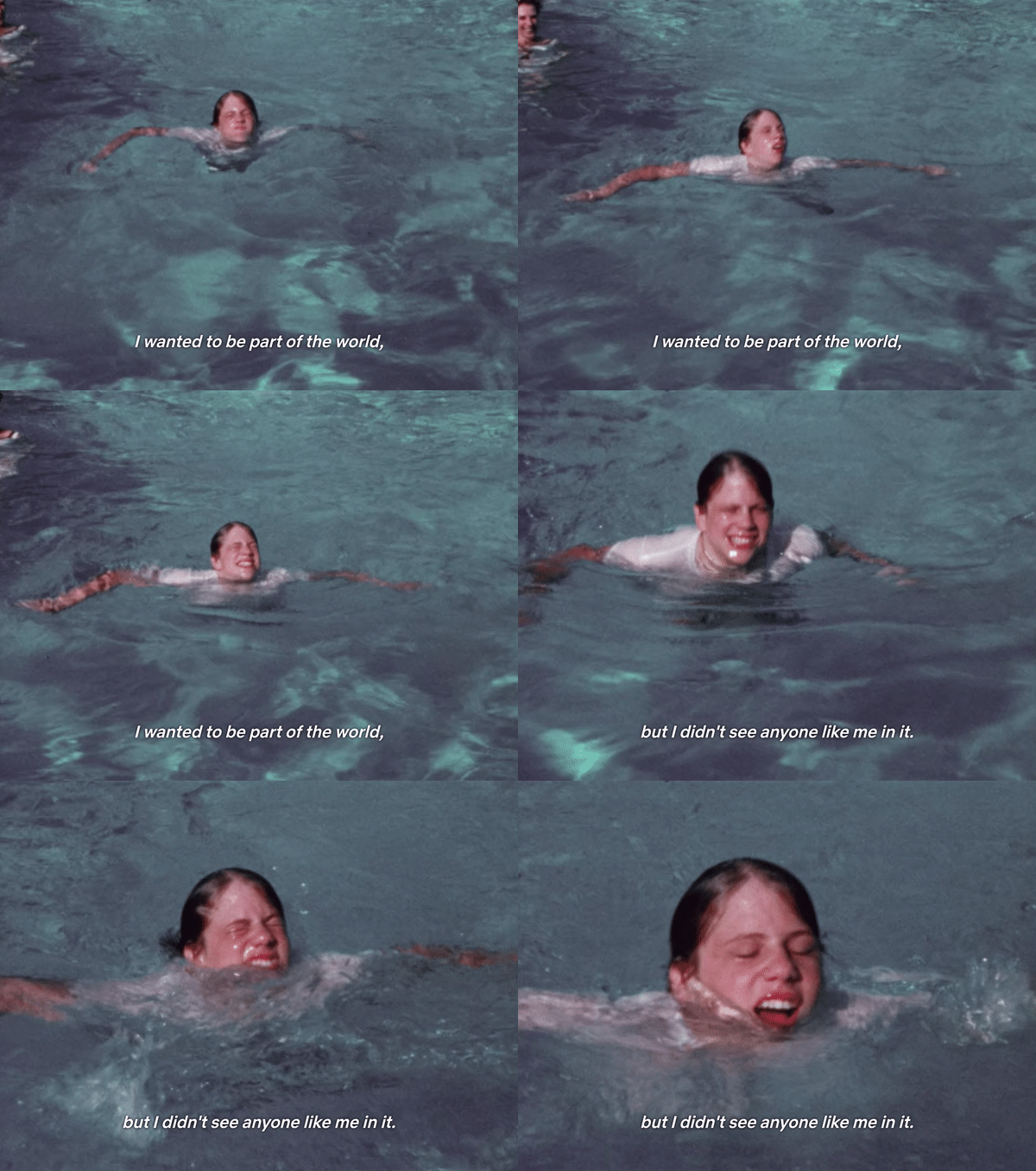
I wanted to be part of the world but I didn’t see anyone like me in it.
Jimmy Lebrecht
This isn’t just a story that disabled children will love; it’s a story about what is possible when we fight for ourselves and each other. It is a story about how tenacity, strength, the power of community, and the willingness to fight for what matters can start a revolution.
More quotes from the movie “Crip Camp: A Disability Revolution”
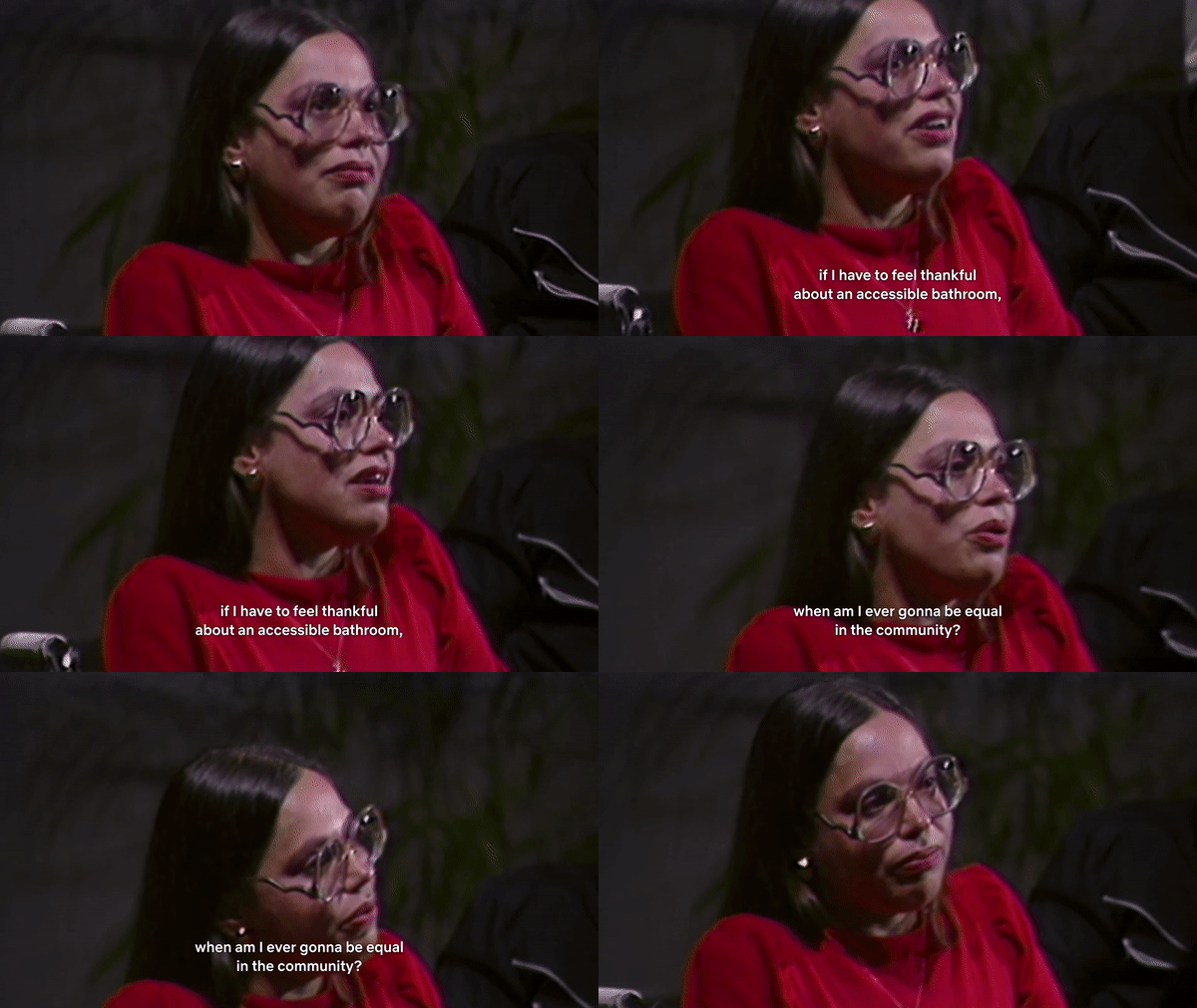
Crip Camp starts in 1971 at Camp Jened, a summer camp in New York described as a “loose, free-spirited camp designed for teens with disabilities”. Starring Larry Allison, Judith Heumann, James LeBrecht, Denise Sherer Jacobson, and Stephen Hofmann, the film focuses on those campers who turned themselves into activists for the disability rights movement and follows their fight for accessibility legislation.
What we saw at that camp was that our lives could be better. The fact of the matter is that you don’t have anything to strive for if you don’t know that it exists.
Jimmy Lebrecht
I had to try to adapt. I had to fit into this world that wasn’t built for me.
Jimmy Lebrecht
If I have to feel thankful about an accessible bathroom, when am I ever gonna be equal in the community?
NeurodiVenture : an inclusive non-hierarchical organisation operated by neurodivergent people that provides a safe and nurturing environment for divergent thinking, creativity, exploration, and collaborative niche construction.
NeurodiVentures create safe spaces for groups of autistic and otherwise neurodivergent to share knowledge, to cultivate collective intelligence, and to offer their gifts to the world in the form of genuinely innovative and unique services.
By definition, the main purpose of existence of a NeurodiVenture is the creation of a psychologically safe and egalitarian communal space for neurodivergent people.
The tailored core prosocial design principles we use:
Trusted relationships within the group and strong understanding of purpose (to support an open and inclusive neurodiverse and creative team)
Fair distribution of costs and benefits
Fair and inclusive decision-making
Fast and empathetic conflict resolution
Authority to self-govern
Appropriate relations with other groups
Tracking agreed upon behaviours (a working advice process minimises the need for tracking)
Graduated responses to transgressions to prevent a person or a subgroup from gaining power over others (appropriate focus on fair and inclusive distribution of resources minimises the need for coercion)
The eight prosocial design principles provide guidance for dealing with people who regularly ignore relevant advice (or consistently refuse to seek or give advice) and therefore regularly cause downstream problems for others as a result. Such situations are obvious for all involved. A persistent breakdown of collaboration either results in a significant change in behaviour once the downstream problems are recognised, or in the non-cooperative person leaving the organisation.
At the level of small (human scale) groups, the NeurodiVenture model provides a set of first principles for creative collaboration that can be implemented in appropriate ways to accommodate local needs. The prosocial principles (Atkins et al., 2019) that are part of the NeurodiVenture model not only provide guidance for collaboration within the group, but also for collaboration with other groups, and thereby they pave the path for the development of collaborative bioregional networks of NeurodiVentures and other human scale groups.
Individual competency networks are one of the three ingredients of the collaborative (not secret) sauce of good company. The other two essential ingredients that define the NeurodiVenture model include eight trust-reinforcing organisational principles and rituals and eight more generic tailored 8 prosocial core design principles.
The NeurodiVenture model is the result of incremental evolution. The eight trust-reinforcing principles and rituals are not unique to our approach and have proven their worth in various contexts to catalyse collective intelligence:
A clear purpose, a long term perspective, and revenue sharing instead of salaries ☞ resilience
Twenty-six critical thinking tools (backbone principles) to support the purpose ☞ an inclusive culture of thinking and learning
Employee ownership and zero debt ☞ no distractions by stakeholders with short term motivations and hidden agendas
An intensive 12-month induction and on-boarding process ☞ a foundation for mutual understanding
Organising around the talents and needs of specific people ☞ ability to benefit from an incredible diversity of talents
Relying entirely on equitable team-oriented incentives and zero individual incentives ☞ elimination of in-group competition
Operating an advice process instead of hierarchy ☞ maximising learning opportunities
Open source intellectual property ☞ no barriers to flows of tacit knowledge
At S23M we started with these eight complementary principles and rituals as an initial minimal viable operating model. Then several painful lessons from attempts of interfacing with the neuronormative social world prompted us to add a missing generic principle, to clamp down on toxic social power dynamics. The tailored core prosocial design principles we use:
Trusted relationships within the group and strong understanding of purpose (to support an open and inclusive neurodiverse and creative team)
Fair distribution of costs and benefits
Fair and inclusive decision-making
Fast and empathetic conflict resolution
Authority to self-govern
Appropriate relations with other groups
Tracking agreed upon behaviours (a working advice process minimises the need for tracking)
Graduated responses to transgressions to prevent a person or a subgroup from gaining power over others (appropriate focus on fair and inclusive distribution of resources minimises the need for coercion)
Our established undocumented practices meant that we already had implementations for 7 of the 8 prosocial principles (Atkins et al. 2019) identified by Elinor Ostrom (2015), Michael Cox and David Sloan Wilson, but we were missing the 8th principle “Graduated responses to transgressions”. We have qualified this principle as shown in the list above, to remind us to stick to an incremental approach when extending trust to candidates who are still in the on-boarding phase, and still in the process of unlearning W.E.I.R.D. social norms.
Applying evolutionary science to coordinate action, avoid disruptive behaviours among group members, and cultivate appropriate relationships with other groups in a multi-group ecosystem (the work of Elinor Ostrom, Michael Cox and David Sloan Wilson).
With the needs of autistic people in mind, the original pro-social design principles from Elinor Ostrom have been modified (a) to emphasise trusted relationships over strong group identity, and (b) to limit the legitimacy of coercion to a narrow use case.
NeurodiVentures create safe spaces for groups of autistic and otherwise neurodivergent to share knowledge, to cultivate collective intelligence, and to offer their gifts to the world in the form of genuinely innovative and unique services.
By definition, the main purpose of existence of a NeurodiVenture is the creation of a psychologically safe and egalitarian communal space for neurodivergent people.
NeurodiVenture is an organization run by neurodivergent people.
It provides a safe and nurturing environment for divergent thinking, creativity, exploration, and collaborative niche construction.
It is inclusive and non-hierarchical.
It operates on principles such as the advice process, psychological safety, self-determination theory, the prosocial framework, mutual trust, collaborative niche construction, open source, restorative practices, and transformative justice.
It is trauma and neurodiversity informed, using polyvagal theory and the neuroscience of community.
NeurodiVentures create safe spaces for groups of autistic and neurodivergent individuals.
These spaces allow for sharing knowledge, cultivating collective intelligence, and offering unique and innovative services to the world.
One Paragraph Summary
NeurodiVenture is an organization that is run by neurodivergent people. It aims to create a safe and supportive environment for different ways of thinking, creativity, exploration, and working together on specific interests. They use various methods and theories, such as the advice process, psychological safety, self-determination theory, prosocial framework, mutual trust, collaborative niche construction, open source, restorative practices, transformative justice, trauma-informed approaches, and neurodiversity-informed approaches. The goal is to provide a space where autistic and other neurodivergent individuals can come together, share knowledge, and use their unique skills and talents to create innovative and valuable services for the world.
Extended Summary
NeurodiVenture is an organization that is operated by neurodivergent individuals and aims to create a safe and nurturing environment for divergent thinking, creativity, exploration, and collaborative niche construction. It is an inclusive organization that values the contributions and perspectives of neurodivergent people.
The organization follows the principles of Teal organizations, which emphasize self-management and distributed decision-making. They use the advice process, where decisions are made by seeking advice from those who will be affected by the decision, rather than relying on a hierarchical structure.
Psychological safety is a key aspect of NeurodiVenture, ensuring that individuals feel safe to express themselves and share their ideas without fear of judgment or criticism. This fosters an environment that encourages open communication and collaboration.
The organization also follows the principles of self-determination theory, which focuses on supporting individuals’ autonomy, competence, and relatedness. This means that individuals have the freedom to make choices, develop their skills, and build meaningful relationships within the organization.
NeurodiVenture operates within the prosocial framework, which promotes behaviors that benefit others and society as a whole. This framework encourages cooperation, empathy, and compassion among members of the organization.
Mutual trust is another important aspect of NeurodiVenture. Trust is built through open and honest communication, reliability, and respect for each other’s perspectives and contributions.
Collaborative niche construction is a concept that involves creating and shaping environments that align with the unique strengths and abilities of neurodivergent individuals. This allows them to contribute their innovative and unique services to the world.
The organization also embraces open source principles, which means that knowledge, information, and resources are shared openly and freely. This fosters a culture of collaboration and continuous learning.
Restorative practices and transformative justice are approaches used by NeurodiVenture to address conflicts and restore relationships within the organization. These approaches focus on repairing harm, building understanding, and promoting healing.
NeurodiVenture takes a trauma-informed and neurodiversity-informed approach, recognizing and accommodating the unique needs and experiences of individuals who have experienced trauma or who are neurodivergent. This ensures that the organization is sensitive to their needs and provides a supportive environment.
Polyvagal theory and the neuroscience of community are used to understand and support the social and emotional well-being of individuals within NeurodiVenture. These theories provide insights into how the nervous system responds to social interactions and how to create environments that promote connection and belonging.
Overall, NeurodiVenture is a collaborative and inclusive organization that values the contributions of neurodivergent individuals. It provides a safe and nurturing environment for them to share their knowledge, cultivate collective intelligence, and offer innovative and unique services to the world.
AI Disclosure: The summaries above were created with the help of Elephas AI Assistant.
We’re co-creating Autistic collaboration at human scale.
The Stimpunks website is also an awesomely rich source of links! Semantic links rather than commercial advertisements are the life blood of the internet – the Autistic online habitat.
We’re co-recreating Autistic collaboration at human scale on a daily basis, in the many wide open cracks, in the cognitive blind spots of the algorithms of capital.
The limits of human scale, the capacity for cultural evolution, and the resultant cultural diversity are best appreciated as the most valuable and unique species level survival advantage of humans over all other primate species. Human societies that operate at human scales are highly resilient and adaptive. Bands of hunter gatherers could rely on the human capacity for flexible cooperation and collective intelligence that is unlocked by egalitarian social norms within small groups.
Whānau = extended family, family group, a familiar term of address to a number of people – the primary economic unit of traditional Māori society. In the modern context the term is sometimes used to include friends who may not have any kinship ties to other members.
There is the saying that “It takes a village to raise a child.” The Autistic translation of this saying is “For an Autistic person it takes an Autistic whānau to feel loved and alive.”Without the support of an Autistic whānau, Autistic life feels like a life in continuous emergency mode.
Whānau : extended family, family group, a familiar term of address to a number of people – the primary economic unit of traditional Māori society. In the modern context the term is sometimes used to include friends who may not have any kinship ties to other members.
Whānau are not powered by adrenalin but by love and mutual care. Most Autists are not born into healthy Autistic whānau.
Takiwātanga : Autistic ways of being, takiwātanga literally means “in their own space and time.”
We have to co-create our whānau in our own space and time. In many indigenous cultures children with unique qualities are recognised, are given adult mentors with similarly unique qualities, and grow up to fulfil unique roles in their local community, connected to others with unique knowledge and insights, perhaps even in other communities. If we are embedded in an ecology of care, we can thrive and share the pain and the joy of life.
Whānau is much more than the Western notion of “family”. It is a deep connection, a bond that you are born into that no one can take away from you.
An Autistic whānau could be conceptualised as a soul tribe, it is not an amorphous global Autistic community, but rather a human scale ecology of care, consisting of Autistic relationships between soul mates that are bonded through shared experiences and working together.
Closely related concepts:
Whanaungatanga : relationship, kinship, sense of family connection – a relationship through shared experiences and working together which provides people with a sense of belonging. It develops as a result of kinship rights and obligations, which also serve to strengthen each member of the kin group. It also extends to others to whom one develops a close familial, friendship or reciprocal relationship.
Whakawhanaungatanga : process of establishing relationships, relating well to others.
Whakapapa : the “genealogical descent of all living things from God to the present time. “Since all living things including rocks and mountains are believed to possess whakapapa, it is further defined as “a basis for the organisation of knowledge in the respect of the creation and development of all things”. Hence, whakapapa also implies a deep connection to land and the roots of one’s ancestry. In order to trace one’s whakapapa it is essential to identify the location where one’s ancestral heritage began; “you can’t trace it back any further”. “Whakapapa links all people back to the land and sea and sky and outer universe, therefore, the obligations of whanaungatanga extend to the physical world and all being in it”.
In a healthy culture Autistic children are assisted in co-creating their unique Autistic whānau, but in our “civilisation” this cultural knowledge has been lost and is suppressed. In mainstream society people don’t understand how Autistic people support each other, love each other, and care for each other in ways that go far beyond the culturally impaired neuronormative imagination.
There is the saying that “It takes a village to raise a child.” The Autistic translation of this saying is “For an Autistic person it takes an Autistic whānau to feel loved and alive.”
The foundation of our whakapapa is the ocean and the mountains. Via Autistic trauma peer support we are embarking on the journey of co-creating healthy Autistic whānau and Autistic culture all over the world.
A NeurodiVenture is an inclusive non-hierarchical organisation operated by neurodivergent people that provides a safe and nurturing environment for divergent thinking, creativity, exploration, and collaborative niche construction.
In Te Reo Māori the NeurodiVenture concept translates to Neurodivergent whānau. Indigenous languages like Te Reo Māori have important words for concepts that have been suppressed by colonialism.
Without the support of an Autistic whānau, Autistic life feels like a life in continuous emergency mode.
Many Artistic & Autistic people are unemployable by organisations that operate hierarchical structures. There is an urgent need to catalyse and co-create NeurodiVentures (worker co-ops) and healthy A♾tistic whānau all over the world.
Many Artistic & Autistic people are unemployable by organisations that operate hierarchical structures. There is an urgent need to catalyse and co-create NeurodiVentures (worker co-ops) and healthy A♾tistic whānau all over the world. A♾tistsdepend on assistance from others in ways that differ from the cultural norm – and that is pathologised in hypernormative societies. However, the many ways in which non-a♾tistic people depend on others is considered “normal”. The endless chains of trauma must be broken.
The technologies we develop and use tend to reflect the level of collaboration and competitiveness within our culture. In our role as conscious designers of technology, humans have the potential to influence the level of collaboration in our culture in profound ways, especially in a highly networked digital world.
The NeurodiVenture operating model not only raises neurodiversity as a top level concern for good company but by imposing a hard limit on group size (in the case of S23M enforced by our company constitution) it also ensures that every member of the team has spare cognitive capacity for building and maintaining trusted relationships with the outside world, whilst at the same time encouraging creative collaboration for life.
Beyond eliminating formal hierarchical structures the NeurodiVenture model also removes all incentives for the emergence of informal “power-over” structures via transparency of all individual competency networks for the benefit of everyone within the company. This is perhaps the most radical idea within the NeurodiVenture model.
Transparency of individual competency networks enables meta knowledge (who has which knowledge and who entrusts whom with questions or needs in relation to specific domains of knowledge) to flow freely within an organisation.
The conceptualisation of meta knowledge flows via individual competency networks assists the coordination of activities via the advice process outlined above and via regular Open Space workshops, and it acts as an effective dampener on the informal hierarchies that can easily come to plague hierarchical and “non-hierarchical” organisations.
NeurodiVentures are a concrete example of an emerging cultural species that provides safe and nurturing environments for divergent thinking, creativity, exploration, and collaborative niche construction.
NeurodiVentures are built on timeless and minimalistic principles for coordinating trusted collaboration that predate the emergence of civilisation. All members share a commitment to:
Visibly extend trust to people, to release the handbrake to collaboration.
At the level of small (human scale) groups, the NeurodiVenture model provides a set of first principles for creative collaboration that can be implemented in appropriate ways to accommodate local needs. The prosocial principles (Atkins et al., 2019) that are part of the NeurodiVenture model not only provide guidance for collaboration within the group, but also for collaboration with other groups, and thereby they pave the path for the development of collaborative bioregional networks of NeurodiVentures and other human scale groups.
The fact that human scale social operating systems can be constructed on top of corrupt infrastructure is a powerful message.
By focusing on the human scale outside the theatre we can reconnect with the physical and ecological niche that supports our human needs. The more collaborative, egalitarian, and accomodating of cultural diversity, the surrounding cultural environment becomes, the less NeurodiVentures will be perceived as unusual, and the more neurodivergent people will be able to spend significant time outside the protective islands of safety provided by a NeurodiVenture without getting overwhelmed.
The open source NeurodiVenture operating model for employee owned companies primarily consists of a set of first principles that can be adapted to the unique needs of a specific team of neurodivergent people. There is no need to be prescriptive about how to go about forming and operating a NeurodiVenture, because there is no right way or best way.
Autistic people with complementary talents and skills are ideally positioned to jointly design, develop, and offer highly unique products and services, without any need for external capital, and without any need for an employer or manager.
A NeurodiVenture offers the freedom to create products and services that do not necessitate continuous interaction with the neuronormative human social world.
Chosen families are nonbiological kinship bonds, whether legally recognized or not, deliberately chosen for the purpose of mutual support and love.
Today, many individuals find themselves navigating uncharted waters as they try to reconcile shaky relationships with blood relatives while simultaneously creating what’s commonly referred to as a “chosen family.”
According to the SAGE Encyclopedia of Marriage, Family, and Couples Counseling, “chosen families are nonbiological kinship bonds, whether legally recognized or not, deliberately chosen for the purpose of mutual support and love.” The term originated within the LGBTQ community and was used to describe early queer gatherings like the Harlem Drag Balls of the late nineteenth century.
The circumstances surrounding the birth of the first “chosen families”—intense loneliness and isolation faced by those rejected by their biological kin—continue today. Nearly 40 percent of today’s homeless youth identify as queer, and a recent study found that roughly 64 percent of LGBTQ baby boomers have built, and continue to rely on, chosen families.
“Chosen families,” though, can form as a result of any person’s experience with their biological family that leaves needs unmet. Friends who become your family of choice may provide you with a healthier family environment than the one in which you were raised, or their proximity may allow you to rely on them when your biological family isn’t located nearby. A chosen family can be part of a person’s growing network, and can help construct a wide foundation of support that continues to grow with time.
Tell me your story and I'll tell you mine
I'm all ears, take your time, we've got all night
Show me the rivers crossed, the mountains scaled
Show me who made you walk all the way here
Family of choice might seem like a contradiction but your ‘chosen’ family consists of those who accept you for who you are and they want the best for you. They support you in your chosen ventures, help you when you need to make decisions and tell you when you might be going down the wrong track! As in any other family, you might have your differences, but they are always there for you. If you can find yourself among a unit of supporters who love you unconditionally, will offer a place to you that allows you to be yourself, safely and without barriers, you might have found your ‘chosen’ family. This family might not be all in one place.
There is something very special about forming relationships with people who understand and accept you for who you are. You may hear the phrase ‘chosen family’ used by LGBTQIA+ people to describe these relationships – people they have met, formed bonds with, and chosen to have as their family separately to their ‘real’ family.
These types of relationships are especially important to LGBTQIA+ people. There is a long history of us being isolated from our ‘official’ family and friends due to our sexuality and gender, and so the idea of ‘found’ or ‘chosen’ family has a strong emotional meaning in the community. There are still people today whose family react badly to them coming out (as we discussed in the chapter on coming out), so relationships with other people in the LGBTQIA+ community are just as important as they ever were.
Even if your family is accepting and loving, relationships within the community can still be very important. They certainly have been for me.
I will also say this: I have never, not even for one single second, regretted it. I have never regretted doing the right thing or fighting for the health and wholeness of others even when it causes me pain and puts me at significant personal risk. I have lost nothing that I needed, because I had it all inside me. And the people that have now become my precious, chosen family are people I would never have met if I hadn’t been walking this path.
“In my phone contacts, I put emojis by their names. I put strawberries next to people who were super loving. I put seedling emojis by folks who taught me things that made me think or grow.”
Within a year of his making these changes in his life, many of Samuel’s “strawberry people” had become members of his found family. They had his back as he worked through therapy for PTSD and eating disorder recovery. The strawberry people even became friends with one another—Samuel writes that they all talk in a single group chat.
I finally realized that I was a dyke and had been for years. Since then, I have lived among dykes and created chosen families and homes, not rooted in geography, but in shared passion, imagination, and values.
“The troublemakers are the caged canaries.” “Their tendency to rebel against authority, was at the heart of what he called “autistic intelligence,” and part of the gift they had to offer society.” “Autistic people are best understood as the agents of a well functioning cultural immune system within human society.“
…at the same time, Asperger insisted that the non-compliance of his patients, and their tendency to rebel against authority, was at the heart of what he called “autistic intelligence,” and part of the gift they had to offer society.
We are marginalized canaries in a social coalmine and Rawlsian barometers of society’s morality. It is deeply subversive to live proudly despite being living embodiments of our culture’s long standing ethical failings.
Our non-compliance is not intended to be rebellious. We simply do not comply with things that harm us. But since a great number of things that harm us are not harmful to most neurotypicals, we are viewed as untamed and in need of straightening up.
Autists are like the canary in the coal mine of mainstream society. We are amongst the first who are affected by pathologically hyper-competitive cultures.
I think of the children who make trouble at school as miners’ canaries. I want us to imagine their behaviors—which are admittedly disruptive, hypervisible, and problematic—as both the loud sound of their suffering and a signal cry to the rest of us that there is poison in our shared air. That is, when a child is singing loudly—and sometimes more and more loudly, despite our requests for silence—we might hear that song as a signal that someone is refusing to hear her voice. And we might learn to listen, heeding her warning and searching our air for the toxin triggering her suffering, the harm that simultaneously silences her and forces her to scream out.
The troublemakers are the caged canaries, children who are more sensitive than their peers to the toxic environment of the classroom that limits their freedom, clips their wings, and mutes their voices. The canaries’ songs warn us of the dangers—dangers to children’s learning and development, to their self-worth, to their physical health and emotional well-being—as the misbehaving children struggle for visibility and voice in an institution that works to ensure their invisibility; as they work to be embraced by their classroom communities but behave in such a way that will ensure their exclusion; as they seek interdependence in a setting where the norms of independence prevail; as they raise their voices louder and louder hoping to be heard, but know they will be silenced.
Shalaby recognizes that seeing schools as primary sites for teaching love and learning freedom is countercultural, even revolutionary, and oppositional to the ways that schools are traditionally organized, contrary to the ways teachers are trained, evaluated, and rewarded, counter to the ways our society perceives and places value on children. It requires a radical reframing of the values and goals embedded in definitions of achievement and success in schools, a recasting of classroom rules, rituals, and pedagogies, a redrawing of the boundaries of community, and a reshaping of the hierarchies of power and authority in schools. Shalaby knows, and warns us, that the work of transforming our schools is hard and beautiful, tough and generous. It is filled with minefields and misunderstandings, breakthroughs and revelations. The work is one of re-imagining what a free and loving learning place might be, and children are the best source for beginning this envisioning and liberating project. They are, after all, the great imaginers: they will lead the way, the troublemakers at the front of the line. We must begin by listening to them.
Thinking of these troublemaking children as canaries in the mine is not my own idea. I learned it from Thomas, the father of a five-year-old boy who could not and would not comply with the behavioral expectations of his kindergarten teacher.2 Teachers, school administrators, medical doctors, and psychologists all searched for pathology in the mind and body of this child. Their assumption was that the arrangements of school were normal and good, so any child unable to tolerate those arrangements had to be abnormal and bad.
Though the child suffered from a mood disorder, a diagnosable brain illness, Thomas challenged the assumption that the disease made his son inherently broken or bad. Much like the canary’s fragile lungs, this child’s brain leaves him more susceptible to the harms of poison. He’s more sensitive to harm than the average child. Still, the problem is the poison—not the living thing struggling to survive despite breathing it. After all, in clean air, canaries breathe easily.
With this perspective, Thomas drew attention away from his son and instead toward the toxic air of life in schools—the daily harms that less susceptible children can breathe in more readily: being told what to do and exactly how to do it all day; the requirement to sit still for hours on end; the frustration of boring, disconnected, and irrelevant academic tasks; shockingly little time for free play; and few opportunities to build meaningful relationships in community with other children and loving adults. These were the daily realities his son complained about, reacted to in the extreme, and refused to tolerate. Yet they are all too common in the life of schools, invisible because of their everyday normalcy. Thomas’s son made them visible, signaling their danger with his hypersensitive reactions to the harm. He was a miner’s canary, warning us all about threats to freedom that we might not otherwise see.
Understanding supposedly broken children as miners’ canaries focuses our attention on the toxic social and cultural conditions of schools that threaten and imperil the hope of freedom. Our work as educators and as parents must become an effort to clean our air instead of condemning young people, forcing them and actively training them to tolerate the poison.
Neurodivergent people are hypersensitive to mindset and environment due to a greater number of neuronal connections. They have both a higher risk for trauma and a large capacity for sensing safety.
Hyper-plasticity predisposes us to have strong associative reactions to trauma. Our threat-response learning system is turned to high alert. The flip side of this hyper-plasticity is that we also adapt quickly to environments that are truly safe for our nervous system.
The stereotypes of meltdowns and self-harm in autism come from the fact that we frequently have stress responses to things that others do not perceive as distressing. Because our unique safety needs are not widely understood, growing up with extensive trauma has become our default.
Because of our different bio-social responses to stimulus, autistic people have significant barriers to accessing safety.
Imagine that you have a neurodevelopmental disability that gives you some challenges with social skills and possibly the occasional rigid adherence to things like truth and fairness. Chances are good that you’ve been explicitly and implicitly told that you are pedantic, rude, blunt and not considerate enough of others’ points of views for your whole life.
This is the clincher. You have to live up to autistic standards of honesty if you are to convince us to follow a different path or to change our minds.
If you aren’t willing to make sure that what you ask of us or want us to believe is reasonable, fair and true, then you won’t have our respect and the relationship is doomed.
The influences that distort the morality of those around us simply don’t penetrate our conscious minds.
To retain their sanity, autistic people consistently work against in-group competition, and they often suffer the consequences for doing so (Dexter 2020b].
Autistic people within human societies counteract what Steve Silberman has fittingly described as the “truth dysfunction” in non-autistic people.
Autism is a crucially, vitally, urgently needed human variation—a powerful corrective and counterbalance to the hierarchical, dominance-based mentality currently driving human society and the planet off the rails.
Autistic/neurodiverse thinking and collaborating styles have a critically important role to play as an antidote to the currently dominant neurotypical social-ranking/dominance approach—a critically important role to play in bringing modern society back into some kind of sustainable balance, functionality, social justice, and sanity.
Autistic people are best understood as the agents of a well functioning cultural immune system within human society.
Autists are essential to the future of homo sapiens.
We sense frequencies you’d never hear or think to pay attention to
And we can tell what’s on its way here, long before the train comes through

A transfiguration’s coming, a turning in the song
For the brutal static order they’ve depended on so long
This train will carry gamblers, it’ll carry us midnight ramblers too
A broken heart’s your ticket so be ready when the train comes through

But it’s the hidden and unspoken that will thunder when the train comes through

But the violent sheet of silence will be shattered when the train comes through
Autistic man Freestone Wilson suggested in the 1990s that autistic people are functioning as the “miners’ canaries” of civilisation. When the air in the mine is poisoned we do not prevent canaries being born in case they suffer from the poison and upset us: we clean the air or close the mine.
Hey girlfriend
I got a proposition, goes something like this
Dare ya to do what you want
Dare ya to be who you will
Dare ya to cry right out loud
"You get so emotional, baby"

Double dare ya, double dare ya

Double Dare Ya by Bikini Kill
This is a public service announcement… with guitar!
We have worked together for many years, and we made the disability rights movement. The disability rights movement is when disabled people fight back against ableism. We work to change society to be better for disabled people, and fight for our rights as people with disabilities.
Self-advocacy isn’t just speaking up for yourself. It can also mean speaking up for your whole community. The self-advocacy movement is when we all speak up together. The self-advocacy movement is part of the disability rights movement, where people with intellectual and developmental disabilities fight for our rights.
We still have a long way to go, since disabled people still get treated unfairly. We can’t always choose where we live or what help we get. We don’t always have the right to vote. We might not get to choose how we want to spend our money, or have control over who cares for us. But we are still fighting for our rights.
A motto of the self-advocacy movement is “Nothing About Us, Without Us!”. Lots of people talk about us without letting us talk. We should always be part of the conversation, and be in charge of our lives.
The Autistic Self Advocacy Network seeks to advance the principles of the disability rights movement with regard to autism. ASAN believes that the goal of autism advocacy should be a world in which autistic people enjoy equal access, rights, and opportunities. We work to empower autistic people across the world to take control of our own lives and the future of our common community, and seek to organize the autistic community to ensure our voices are heard in the national conversation about us. Nothing About Us, Without Us!
In a perfect world, we would all be guided by the presumption of competence, not just in regard to disability but in all human interaction. But we do not live in a perfect world. In the real world, no matter what skills I acquire—be they social, emotional, physical, or educational—there will be a sizable number of people who will presume me to be incompetent. Brace me for it. Make sure I know my rights. Let me know over and over again that I am so much more than the box some small-minded person wishes to fit me into. Practice with me the interactive tools I need to stand up in the face of those who do not believe in me.
The violent sheet of silence will be shattered, and the hidden and unspoken will thunder.
We Do The Truly Essential Work
We aspire to do the “truly essential work”.
What Lorde and other black feminists … realized was that the more dehumanized groups a person belongs to, the more their experience forces them to understand about the way society is structured: what and who it takes for granted, the truths about itself it chooses to ignore, who is doing the truly essential work.
We are literally just trying to take care of each other in our communities and we don’t have any fucking time for writing these 200-page long, detailed grant reports to prove that we’re really being honest because you know who doesn’t have to prove that?
Generationally wealthy people and extremely well-resourced organizations don’t have to worry about where their money is coming from. They don’t have to worry about who they’re asking for money from. And so they have the privilege to be able to not care, whereas we have to be a hundred times more scrupulous.
We are both shamed and guilted for asking for “handouts”, and yet we’re also expected to beg.
And that is why the vast majority of philanthropical resources continue to go to the same well-resourced, established organizations that are largely not accountable to directly impacted communities and to the people who have the most to lose, whereas organizations that are doing work on the front lines directly from community are infinitely less likely to be able to access even a fraction of the same funding pools and even in the space, especially in the space of disability philanthropy.
The David Prize claims that the submission process “should take no more than 30 minutes. Yes, 30 minutes.” At first glance, the application seems straightforward: ten questions, with a maximum of 280-1,500 characters per answer. But it is a process that will disproportionately impact many chronically unwell and racialized individuals, as well as non cis men, who will recontextualize their ideas to appeal to a billionaire philanthropist. Alex and I spent roughly 80 hours over the course of two weeks to complete the written application. This sort of request for proposals, Alex pointed out, creates temporal lotteries, in which the buy-in isn’t money, but time.
That study identified, unsurprisingly, that it’s parents & professionals are ones fighting to hang onto ‘special‘ but here’s the thing I honestly don’t get – you are depriving the kid of their membership in a big, welcoming, fantastic, supportive community by doing so. Why?
The word “special” is used to sugar-coat segregation and societal exclusion – and its continued use in our language, education systems, media etc serves to maintain those increasingly antiquated “special” concepts that line the path to a life of exclusion and low expectations.
Forced intimacy is a cornerstone of how ableism functions in an able bodied supremacist world. Disabled people are expected to “strip down” and “show all our cards” metaphorically in order to get the basic access we need in order to survive.
Change our vocabulary, and change our framing. Use the inclusive language of neurodiversity & the social model of disability. Use the power of identity first language to connect disabled kids with an identity and tribe. With identity-first pride and a social model tribe at their backs, kids can better develop voice, agency, and the tools of self-determination.
People forget disability is a term that comes w/ civil rights because it’s codified in statute. “Differently abled” “handicapable” & “special needs” aren’t. It’s also a word WE chose when we named the ADA, not a word chose by nondisabled ppl 2 make them feel better. #saytheword
I’m ‘Special’! // Identity First vs. Person First Language [CC]
Although human diversity, the social model of disability and inclusion as human rights framework concepts are developing traction, for much of society the “special story” still goes like this:
A child with “special needs” catches the “special bus” to receive “special assistance” in a “special school” from “special education teachers” to prepare them for a “special” future living in a “special home” and working in a “special workshop”.
Does that sound “special” to you?
The word “special” is used to sugar-coat segregation and societal exclusion – and its continued use in our language, education systems, media etc serves to maintain those increasingly antiquated “special” concepts that line the path to a life of exclusion and low expectations.
The logic of the connection between “special needs” and “special [segregated] places” is very strong – it doesn’t need reinforcement – it needs to be broken.
Further, the “special needs” label sets up the medical “care” model to disability rather than the social inclusion model of disability. It narrows and medicalises society’s response to the person by suggesting that the focus should be on “treating” their “special needs”, rather than on the person’s environment responding to and accommodating the person – including them for the individual that they are.
There is another insidious but serious consequence of being labelled (as having or being) “special needs”. The label carries with it the implication that a person with “special needs” can only have their needs met by “special” help or “specially-trained” people – by “specialists”. That implication is particularly powerful and damaging in our mainstream schooling systems – it is a barrier to mainstream schools, administrators and teachers feeling responsible, empowered or skilled to embrace and practice inclusive education in regular classrooms, and accordingly perpetuates attitudinal resistance to realising the human right to inclusive education under Article 24 of the Convention on the Rights of Persons with Disabilities.
In other words, the language of “special needs” leads to, and serves to excuse, a “can’t do” attitude as the default position of many general educators – it effectively deprives inclusive education of its necessary oxygen – a conducive “can do” classroom culture.
The label of “special needs” is inconsistent with recognition of disability as part of human diversity. In that social framework, none of us are “special” as we are all equal siblings in the diverse family of humanity.
You have probably been taught to use PFL despite the overwhelming preference for IFL among Blind, Deaf, Autistic, and Disabled people. We proudly and defiantly use IFL all over our website.
The label “disabled” means so much to me. It means I have community. It means I have rights. It means I can be proud. It means I can affirm myself in the face of ableists. It means I can be myself and so much more.
Identity first language is common among neurodivergent and disabled self-advocates. When hanging out in social model, neurodiversity, and self-advocacy communities, identity first is a better default than person first.
Keep in mind that the more culture there is around a disability, and the more that disability changes someone’s fundamental perceptions and interactions with the world, the more likely it is that identity-first language is probably a better bet.
Every autistic and disabled person in our community uses identity first language. The words autistic and disabled connect us with an identity, a community, and a culture. They help us advocate for ourselves.
“Disability” and “disabled” are indicators of culture and identity. Thus, “disabled person” is an accepted term.
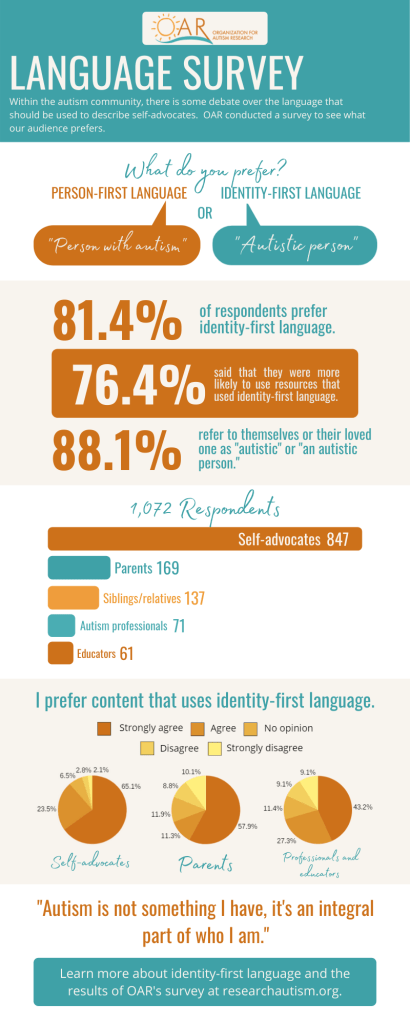
Expand for infographic: Of the more than 800 self-advocates who completed the survey, 88.6% indicated a preference for identity-first language. There is a clear preference for identity-first language among our audience.
Of the more than 800 self-advocates who completed the survey, 88.6% indicated a preference for identity-first language. When asked to elaborate, they responded with insights such as:
“When a publication uses the word ‘autistic’…I feel seen and accepted.”
“My autism is not an accessory that I can set aside. It is not something external that has latched onto me. It is not an illness or disease I have ‘caught.’ It is a fundamental, inseparable part of me and who I am.”
“I use them interchangeably sometimes and don’t personally take offense to either. However, with autism, I try to use identity-first because that’s what the neurodivergent community seems to prefer.”
This survey confirmed what OAR had suspected. Times and attitudes have changed considerably in this regard. There is a clear preference for identity-first language among our audience. In response, OAR has decided to adopt identity-first language as its default: moving forward, when referring to autistic people in general, we will use identity-first language.
The oppressed struggle in language to recover ourselves, to reconcile, to reunite, to renew. Our words are not without meaning, they are an action, resistance. Language is also a place of struggle.
Often when the radical voice speaks about domination we are speaking to those who dominate. Their presence changes the nature and direction of our words. Language is also a place of struggle. I was just a girl coming slowly into womanhood when I read Adrienne Rich’s words “this is the oppressor’s language, yet I need it to talk to you.” This language that enabled me to attend graduate school, to write a dissertation, to speak at job interviews carries the scent of oppression. Language is also a place of struggle.
Language is also a place of struggle. We are wedded in language, have our being in words. Language is also a place of struggle. Dare I speak to oppressed and oppressor in the same voice? Dare I speak to you in a language that will move beyond the boundaries of domination — a language that will not bind you, fence you in, or hold you. Language is also a place of struggle.The oppressed struggle in language to recover ourselves, to reconcile, to reunite, to renew. Our words are not without meaning, they are an action, resistance. Language is also a place of struggle.
How disability professionals feel when they say the word… “Person-Centered”
Note: This is satire.
🔦 We Find Our People
I believe all persons with Autism need the opportunity to become friends with other Autistic people. Without this contact we feel alien to this world. We feel lonely. Feeling like an alien is a slow death. It’s sadness, self-hate, it’s continuously striving to be someone we’re not. It’s waking up each day and functioning in falsehood (French, 1993).
Often you don’t realize how lonely and frightened you’ve been the whole time, until you find your people.
When I found the autistic community, it was like finally coming home after 23 long years at sea. Often you don’t realize how lonely and frightened you’ve been the whole time, until you find your people.
“When I found the autistic community, it was like finally coming home after 23 long years at sea. Often you don’t realize how lonely and frightened you’ve been the whole time, until you find your people. -CADENCE”
Autistic people have built many niche communities from the ground up—both out of necessity and because our interests and modes of being are, well, weird.
Autistic kids need access to autistic communities. They need access to autistic mentors. They need to know that the problems they go through are actually common for many of us! They need to know they are not alone. They need to know that they matter and people care about them. They need to see autistic adults out in the world being accommodated and understood and respected. They need to learn how to understand their own alexithymia and their own emotions. They need to be able to recognize themselves in others. They need to be able to breathe.
In Te Reo Māori the word for Autistic ways of being is Takiwātanga, which means “in their own space and time”. Most Autists are not born into healthy Autistic families. We have to co-create our Autistic families in our own space and time.
Until one day… you find a whole world of people who understand.
The internet has allowed autistic people- who might be shut in their homes, unable to speak aloud, or unable to travel independently- to mingle with each other, share experiences, and talk about our lives to people who feel the same way.
…the central tension of punk rock: it was built on individualism and an anti-hero ethos, yet expressed itself as a community. The motivation for punk was individualistic artistic expression, but the glue for the subculture was the experience of finding like-minded misfits.
How can we cultivate spaces where everyone has that soaring sense of inclusion, where we can have difficult and meaningful conversations? Because everyone deserves the shelter and embrace of crip space, to find their people and set down roots in a place they can call home.
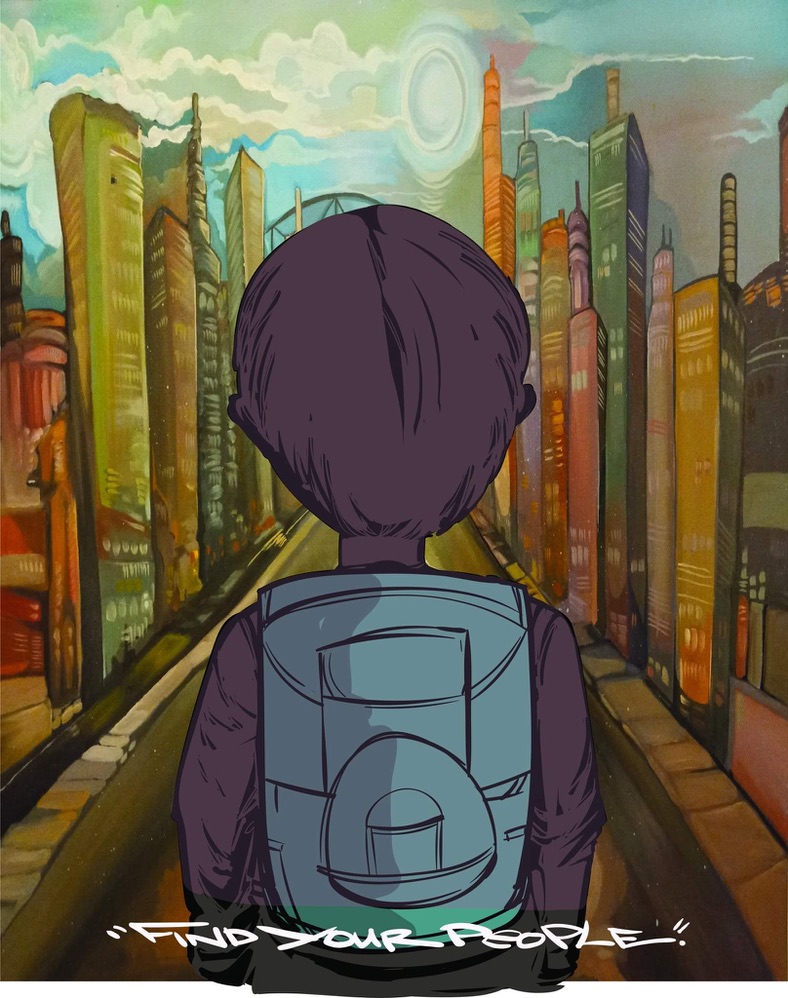
A young person with a back pack on looks down a city street, buildings resembling book spines line each side. Text reads: Find Your People Image Credit: Swamburger
Until one day… you find a whole world of people who understand.
The internet has allowed autistic people- who might be shut in their homes, unable to speak aloud, or unable to travel independently- to mingle with each other, share experiences, and talk about our lives to people who feel the same way.
But no, take me home Take me home where I belong I got no other place to go No, take me home Take me home where I belong I got no other place to go No, take me home Take me home where I belong I can't take it anymore
But I kept runnin' for a soft place to fall And I kept runnin' for a soft place to fall And I kept runnin' for a soft place to fall And I kept runnin' for a soft place to fall
Are you awake or are you sleeping? Are you afraid? We've been waiting for this meeting
We have come here for you, and we're coming in peace Mothership will take you on higher, higher This world you live in is not a place for someone like you Come on, let us take you home
It's time to go, you are infected Come as you are, don't be scared of us, you'll be protected (Protected, protected) I guess you are a different kind of human I guess you are a different kind of human
Omega hai foleet, Omega hai foleet
There is a flaw in man-made matters But you are pure, and we have to get you out of here
Chosen families are nonbiological kinship bonds, whether legally recognized or not, deliberately chosen for the purpose of mutual support and love.
Today, many individuals find themselves navigating uncharted waters as they try to reconcile shaky relationships with blood relatives while simultaneously creating what’s commonly referred to as a “chosen family.”
According to the SAGE Encyclopedia of Marriage, Family, and Couples Counseling, “chosen families are nonbiological kinship bonds, whether legally recognized or not, deliberately chosen for the purpose of mutual support and love.” The term originated within the LGBTQ community and was used to describe early queer gatherings like the Harlem Drag Balls of the late nineteenth century.
The circumstances surrounding the birth of the first “chosen families”—intense loneliness and isolation faced by those rejected by their biological kin—continue today. Nearly 40 percent of today’s homeless youth identify as queer, and a recent study found that roughly 64 percent of LGBTQ baby boomers have built, and continue to rely on, chosen families.
“Chosen families,” though, can form as a result of any person’s experience with their biological family that leaves needs unmet. Friends who become your family of choice may provide you with a healthier family environment than the one in which you were raised, or their proximity may allow you to rely on them when your biological family isn’t located nearby. A chosen family can be part of a person’s growing network, and can help construct a wide foundation of support that continues to grow with time.
Tell me your story and I'll tell you mine
I'm all ears, take your time, we've got all night
Show me the rivers crossed, the mountains scaled
Show me who made you walk all the way here
Family of choice might seem like a contradiction but your ‘chosen’ family consists of those who accept you for who you are and they want the best for you. They support you in your chosen ventures, help you when you need to make decisions and tell you when you might be going down the wrong track! As in any other family, you might have your differences, but they are always there for you. If you can find yourself among a unit of supporters who love you unconditionally, will offer a place to you that allows you to be yourself, safely and without barriers, you might have found your ‘chosen’ family. This family might not be all in one place.
There is something very special about forming relationships with people who understand and accept you for who you are. You may hear the phrase ‘chosen family’ used by LGBTQIA+ people to describe these relationships – people they have met, formed bonds with, and chosen to have as their family separately to their ‘real’ family.
These types of relationships are especially important to LGBTQIA+ people. There is a long history of us being isolated from our ‘official’ family and friends due to our sexuality and gender, and so the idea of ‘found’ or ‘chosen’ family has a strong emotional meaning in the community. There are still people today whose family react badly to them coming out (as we discussed in the chapter on coming out), so relationships with other people in the LGBTQIA+ community are just as important as they ever were.
Even if your family is accepting and loving, relationships within the community can still be very important. They certainly have been for me.
I will also say this: I have never, not even for one single second, regretted it. I have never regretted doing the right thing or fighting for the health and wholeness of others even when it causes me pain and puts me at significant personal risk. I have lost nothing that I needed, because I had it all inside me. And the people that have now become my precious, chosen family are people I would never have met if I hadn’t been walking this path.
“In my phone contacts, I put emojis by their names. I put strawberries next to people who were super loving. I put seedling emojis by folks who taught me things that made me think or grow.”
Within a year of his making these changes in his life, many of Samuel’s “strawberry people” had become members of his found family. They had his back as he worked through therapy for PTSD and eating disorder recovery. The strawberry people even became friends with one another—Samuel writes that they all talk in a single group chat.
I finally realized that I was a dyke and had been for years. Since then, I have lived among dykes and created chosen families and homes, not rooted in geography, but in shared passion, imagination, and values.
Members of the neurodiversity movement adopt a position of diversity that encompasses a kaleidoscope of identities that intersects with the queer kaleidoscope.
Members of the neurodiversity movement adopt a position of diversity that encompasses a kaleidoscope of identities that intersects with the LGBTQIA+ kaleidoscope by recognising neurodivergent traits – including but not limited to ADHD, Autism, Dyscalculia, Dyslexia, Dyspraxia, Synesthesia, Tourette’s Syndrome – as natural variations of cognition, motivations, and patterns of behaviour within the human species.
LGBTQI+ people with an Autistic diagnosis have two separate rainbows — and two separate coming out stories.
LGBTQI+ people with an Autistic diagnosis have two separate rainbows — and two separate coming out stories. There are times when an autistic will not come out as LGBTQI+, and vice-versa. The challenges for each minority group are great, and being a double-social minority can be especially tough. Education and peer support goes a long way in helping to navigate these challenges, and make for a smoother trip on the social highway.
The impulse to repress transgender people from expressing their true identity is rooted in the same impulse that makes people want to stop Autistic people from flapping.
In many ways, the impulse to repress transgender people from expressing their true identity is rooted in the same impulse that makes people want to stop #ActuallyAutistic people from flapping their hands.
Autistic individuals can offer novel insights into gender as a social process.
Due both to their ability to denaturalize social norms and to their neurological differences, autistic individuals can offer novel insights into gender as a social process. Examining gender from an autistic perspective highlights some elements as socially constructed that may otherwise seem natural and supports an understanding of gender as fluid and multidimensional.
Plenty of autistic people are queer and experience a double portion of discrimination.
…plenty of autistic people are LGBTQ and experience a double portion of discrimination. The desire to eliminate the traits that make autistic people unique is rooted in the same impulse to suppress people from affirming their gender identity or sexuality.
A brief thread about why the fates of LGBTQ+ and #ActuallyAutistic people are intertwined (to say nothing of LGBTQ+ autistic people). This right here is Ole Ivar Lovaas, the father of modern-day Applied Behavioral Analysis.
For the first week of #Pride2022: a brief thread about why the fates of LGBTQ+ and #ActuallyAutistic people are intertwined (to say nothing of LGBTQ+ autistic people). This right here is Ole Ivar Lovaas, the father of modern-day Applied Behavioral Analysis. 1/
Lovaas ran a clinic at UCLA, where autistic children were slapped, administered shock therapy. LIFE Magazine profiled his practices in 1965, showing how one girl was taken to a “shock room” when she made little progress.
When children behaved well, they were given food and affection. Children were initially not given regular meals and only spoonfuls of food at first.
Lovaas had an extremely low opinion of his autistic patients. In a 1974 interview, he demeaned autistic people stimming (which we now know is a means of soothing). He also called them “little monsters.”
But Lovaas’s practice did not just end when it came to autistic children. As @stevesilberman wrote in his book #NeuroTribes, he also assisted with UCLA’s Feminine Boy Project, which sought to cure boys of atypical sexuality, including homosexuality.
Lovaas collaborated with a researcher named George Rekers and co-authored four papers on homosexuality and other behaviors. One of their main test subjects was a boy named Kirk Murphy, whom they called “Craig.”
Lovaas and Rekers’ practices bore stunning similarities to Lovaas’s practices on autistic children. Poor Kirk’s parents were instructed to use poker chips. Blue poker chips were used as a reward to get candy while red chips meant he would be spanked.
CW suicide: The red poker chips were given when he displayed feminine behavior. The whippings were so unbearable that Kirk’s brother would hide the red chips. Kirk later joined the US Armed forced before he later died from suicide.
All the while, Rekers and Lovaas’s research was used to show that conversion therapy worked. Rekers would co-found the Family Research Council, which opposes LGBTQ+ rights. More on Kirk’s tragic end here.
Poor Kirk Murphy and Pamela, the girl who was subjected to shock therapy shared a similar fate because the adults in charge of them punished them for who were.
People might wonder why I, a cisgender heterosexual from the suburbs of Southern California, included queer history in a book about autism. THIS is why. The same people who want to stop queer kids from being themselves are the same ones who want to stop me from flapping my hands
Conversely, when I first moved to Washington, the gay community openly embraced me and getting to know gay people helped me shed my own homophobia AND my internalized ableism. It’s why transphobia also bugs me so much.
Learning about the shared DNA of gay conversion therapy and ABA reaffirmed what Martin Luther King wrote in 1963 “We are caught in an inescapable network of mutuality, tied in a single garment of destiny.”
Why the ‘treatment’ of autism is a form of conversion therapy. The only government-funded therapy for autistic children is called Applied Behaviour Analysis, an approach developed in tandem with discredited anti-LGBTQ2S+ practises.
Both gay conversion therapy and ABA were built on behaviourism—the scientific belief that human behaviour is determined by conditioning from our immediate environments, and should be controlled through manipulating those environments. Behaviourist psychology has always seen queer and autistic identities as deviant, and so the pathologies around both were constructed at the same time, and from the same body of research. This is why many autistics today argue that ABA is actually its own form of conversion therapy.
New and old ABA share the same goal, and the same end result: converting autistic traits. And in doing so, ABA also acts as a form of queer conversion, says Negrazis, because “[autistic] genders and sexualities are inherently pathologized as abnormal.” This means ABA sees nonconforming autistic children as being socially confused about appropriate dress or play styles, and aims to condition them toward their assigned gender.
“It’s all about policing unruly bodies,” says Negrazis. “Lovaas actively constructed gender and sexual divergence as disabled, which created an inherent disableism in the emergence of queer identities.”
Lovaas himself made this comparison in his writings on the Feminine Boy Project, calling gay or gendernonconforming males “socially handicapped individuals.” He spoke of queerness and transness having “serious disabling consequences for adults … [that] may range from interference with normal heterosexual relationships, to a continuing sense of shame and fear.”
Just like queer and trans people, autistics do not have a disease that needs to be treated. Instead, says Negrazis, “[autistics] need supports to help them identify how trauma has impacted them in their learning, relationships, ability to work and even their self-concept.”
“The psych industry has done so much harm to both [autistic and queer] people,” they say. “The very foundations of psychology and counselling need to be dismantled and rebuilt by queer and autistic people themselves.”
In line with a disability justice approach, one of the more positive recent developments is the theory and praxis of neuroqueering. Stemming from the work of Nick Walker and Remi Yergeau, neuroqueering focuses on embracing weird potentials within one’s neurocognitive space, and turning everyday comportment and behaviour into forms of resistance. This has provided a new tool for combatting neuronormativity from within the constraints imposed by history and current material conditions. By queering the social world, new possibilities are carved out for the future, helping us not just challenge aspects of the current order but to start collectively imagining what a different world could be like.
Queer and neurodivergent liberation are connected.
LGBTQI+ individuals with autism have unique experiences.
Repressing transgender people and stopping autistic individuals from expressing themselves are rooted in the same impulse.
Autistic individuals can provide insights into gender as a social process.
Autistic people often face discrimination and double discrimination if they are also queer.
Prolonged Adaptation Stress Syndrome occurs when someone pretends to be someone they’re not.
The closet can only hide someone, it doesn’t remove shame.
The treatment of autism is compared to conversion therapy.
Applied Behavior Analysis, the government-funded therapy for autistic children, is associated with discredited anti-LGBTQ2S+ practices.
Neuroqueering, based on the work of Nick Walker and Remi Yergeau, embraces unique neurocognitive abilities and turns everyday behavior into resistance.
By queering the social world, new possibilities are created for a different future.
Embrace our weird potentials and be proud of who we are.
One Paragraph Summary
Queer and neurodivergent liberation are closely connected, forming a double rainbow of identities. The neurodiversity movement recognizes neurodivergent traits, such as ADHD, Autism, Dyslexia, and Tourette’s Syndrome, as natural variations of cognition, motivations, and behavior. LGBTQIA+ individuals with an Autistic diagnosis face unique challenges and have separate coming out stories. Repressing transgender individuals and stopping Autistic people from stimming are rooted in the same impulse to suppress self-expression. Autistic individuals offer valuable insights into gender as a social process, highlighting its fluidity and multidimensionality. Autistic people who are queer experience discrimination from both communities. Pretending to be something one is not on a daily basis leads to Prolonged Adaptation Stress Syndrome, contributing to mental illness in the trans community and autistic burnout. The history of LGBTQ+ conversion therapy and Applied Behavioral Analysis for autism are intertwined, demonstrating the interconnectedness of these marginalized communities. Embracing neuroqueering and queering the social world opens up new possibilities for resistance and collective imagination. It is important to be proud of our weird potentials and embrace ourselves for who we are.
Six Paragraph Summary
Queer and neurodivergent liberation are connected. It’s like seeing a double rainbow.
Members of the neurodiversity movement believe in embracing diversity, including a range of identities that intersect with the queer community. LGBTQI+ individuals who are also Autistic have two separate experiences of coming out. The same impulse to suppress transgender people from expressing their true selves also exists in trying to stop Autistic people from engaging in behaviors like flapping. Autistic individuals can offer unique insights into gender as a social process. Many Autistic people also face discrimination for being queer, which means they experience a double dose of discrimination.
Prolonged Adaptation Stress Syndrome is what happens when someone pretends to be something they’re not every day. It’s important to understand that the closet can only hide someone, it can’t protect them from feeling shame.
The “treatment” of autism is similar to conversion therapy. The only government-funded therapy for autistic children is called Applied Behavior Analysis, which was developed alongside discredited anti-LGBTQ2S+ practices.
In line with a disability justice approach, there’s a positive development called neuroqueering. It focuses on embracing the unique potentials within one’s neurocognitive space and using everyday behavior as a form of resistance. By challenging neuronormativity and queering the social world, we can imagine a different future.
Embrace our unique potentials and be proud of who we are. We’re weird, and that’s something to celebrate. Being weird is just embracing ourselves.
AI Disclosure: The summaries above were created with the help of Elephas AI Assistant.
Here comes the sun It's shining right through you On everyone It hits so hard with all the colors that there are You hit so hard with all the colors that there are
So much fun talking with Weirdschooling about books, libraries… and the beauty of weird! ☺️💚 ⬇️ weirdschooling.com/2230136/13886867-episode-10-libraries-and-books-are-for-everyone-and-so-is-mychal-threets #BookTok#LibraryTikTok#Storytime
Autistic Pride is inconceivable without weird pride, and it’s hard to be proud of any kind of neurodivergence without it. A lot of neurodivergent kids learn early on that they’re ‘weird’. The lucky ones learn to embrace it before they’re forced to internalise the implied shame.
Creativity is driven by divergent perspectives, and squashed by demands for conformity. That doesn’t stop people bullying those they see as weird, trying to hammer them into something resembling normality. But weirdness is rarely a choice. It can be hidden but not opted out of.
There is a lot of stigma attached to the concept of weirdness, and a lot of effort is spent chasing some idea of ‘normal’. This is harmful for everyone who’s perceived as weird, and that often includes immigrants, disabled people, queer and trans people and those with minority religious and ethical beliefs. It also includes just about everyone who’s neurodivergent, be they autistic, dyspraxic, dyslexic, ADHD, or otherwise different of brain. Weirdmisia — hatred of the weird — is the enemy of diversity.
I see Weird Pride as a necessary counter to the prevailing negativity about weirdness, so I’m inviting all weirdos and even non-weirdos* to write, talk, tweet and make art about how they’re weird, and why that’s okay.
BECAUSE we are interested in creating non-hierarchical ways of being AND making music, friends, and scenes based on communication + understanding, instead of competition + good/bad categorizations.
BECAUSE doing/reading/seeing/hearing cool things that validate and challenge us can help us gain the strength and sense of community that we need in order to figure out how bullshit like racism, able-bodieism, ageism, speciesism, classism, thinism, sexism, anti-semitism and heterosexism figures in our own lives.
The Riot Grrrl Movement began in the early 1990s by Washington State band Bikini Kill and lead singer Kathleen Hanna.The riot grrrl manifesto was published 1991 in the BIKINI KILL ZINE 2.
What is Riot Grrrl?
BECAUSE us girls crave records and books and fanzines that speak to US that WE feel included in and can understand in our own ways.
BECAUSE we wanna make it easier for girls to see/hear each other’s work so that we can share strategies and criticize-applaud each other.
BECAUSE we must take over the means of production in order to create our own meanings.
BECAUSE viewing our work as being connected to our girlfriends-politics-real lives is essential if we are gonna figure out how we are doing impacts, reflects, perpetuates, or DISRUPTS the status quo.
BECAUSE we recognize fantasies of Instant Macho Gun Revolution as impractical lies meant to keep us simply dreaming instead of becoming our dreams AND THUS seek to create revolution in our own lives every single day by envisioning and creating alternatives to the bullshit christian capitalist way of doing things.
BECAUSE we want and need to encourage and be encouraged in the face of all our own insecurities, in the face of beergutboyrock that tells us we can’t play our instruments, in the face of “authorities” who say our bands/zines/etc are the worst in the US and
BECAUSE we don’t wanna assimilate to someone else’s (boy) standards of what is or isn’t.
BECAUSE we are unwilling to falter under claims that we are reactionary “reverse sexists” AND NOT THE TRUEPUNKROCKSOULCRUSADERS THAT WE KNOW we really are.
BECAUSE we know that life is much more than physical survival and are patently aware that the punk rock “you can do anything” idea is crucial to the coming angry grrrl rock revolution which seeks to save the psychic and cultural lives of girls and women everywhere, according to their own terms, not ours.
BECAUSE we are interested in creating non-heirarchical ways of being AND making music, friends, and scenes based on communication + understanding, instead of competition + good/bad categorizations.
BECAUSE doing/reading/seeing/hearing cool things that validate and challenge us can help us gain the strength and sense of community that we need in order to figure out how bullshit like racism, able-bodieism, ageism, speciesism, classism, thinism, sexism, anti-semitism and heterosexism figures in our own lives.
BECAUSE we see fostering and supporting girl scenes and girl artists of all kinds as integral to this process.
BECAUSE we hate capitalism in all its forms and see our main goal as sharing information and staying alive, instead of making profits of being cool according to traditional standards.
BECAUSE we are angry at a society that tells us Girl = Dumb, Girl = Bad, Girl = Weak.
BECAUSE we are unwilling to let our real and valid anger be diffused and/or turned against us via the internalization of sexism as witnessed in girl/girl jealousism and self defeating girltype behaviors.
BECAUSE I believe with my wholeheartmindbody that girls constitute a revolutionary soul force that can, and will change the world for real.
“We rebuild what you destroy”We Rebuild What You Destroy: The Linda Lindas
We can take turns taking the reins Lean on each other when we need some extra strength We’ll never cave or we’ll never waver And we’ll always become braver and braver
We’ll dance like nobody’s there Wе’ll dance without any cares We’ll talk 'bout problеms we share We’ll talk 'bout things that ain’t fair We’ll sing 'bout things we don’t know We’ll sing to people and show What it means to be young and growing up
Look up to the sky, sky, sky
Take back your own tonight
You'll find more than you see
It's time now, now, get ready
This is your time, this is your life and
This is your time, this is your life and
This is your time, this is your life and
This is your time, this is your life and
You gotta keep on (Keep on livin!) Gotta keep on (Keep on livin!) You gotta keep on (Keep on livin!) Gotta keep on (Keep on livin!) You gotta keep on (Keep on livin!) Gotta keep on (Keep on livin!) You gotta keep on (Keep on livin!) Gotta keep on (Keep on livin!)
Crying, give me some love, give me some love and hold me Give me some love and hold me tight Oh, give me some love, give me some love and hold me Give me some love and hold me tight
From our creed: I center the marginalized and the different. I center edge cases, because edge cases are stress cases and design is tested at the edges. I center neurodivergent and disabled experience in service to all bodyminds.
I know you think I'm not something you're afraid of
'Cause you think that you've seen what I'm made of
Well I am even more than the two of them!
Everything they care about is what I am!
I am their fury, I am their patience
I am a conversation!
I am made o-o-o-o-of
Lo-o-o-o-ove, o-o-o-o-ove
And it's stronger than you
Lo-o-o-o-ove, lo-o-o-o-ove, lo-o-o-o-ove
And it's stronger than you
Lo-o-o-o-ove, lo-o-o-o-ove, lo-o-o-o-ove
And it's stronger than you
Lo-o-o-o-ove, lo-o-o-o-ove, lo-o-o-o-ove
We can take turns taking the reins Lean on each other when we need some extra strength We’ll never cave or we’ll never waver And we’ll always become braver and braver
We’ll dance like nobody’s there Wе’ll dance without any cares We’ll talk 'bout problеms we share We’ll talk 'bout things that ain’t fair We’ll sing 'bout things we don’t know We’ll sing to people and show What it means to be young and growing up
Let love conquer your mind Warrior, warrior Just reach out for the light Warrior, warrior I am a warrior-ior-ior-ior-ior Warrior, warrior I am a warrior-ior-ior-ior-ior Warrior, warrior of love
Underneath darkened skies There's a light kept alive
Let love conquer your mind Warrior, warrior Just reach out for the light Warrior, warrior I am a warrior-ior-ior-ior-ior Warrior, warrior I am a warrior-ior-ior-ior-ior Warrior, warrior of love Warrior of love Warrior of love
Hostility is not the road The proper basic human code Chauvinist intolerance is what we loathe Let's embrace diversity By first rejecting bigotry There’s no more room left in society for animosity
We refuse to look away And ignore issues at bay We will conquer the hurdles in our way (We are warriors) (We are warriors) We won't take shit anymore A pebble cuts right to the core All these excuses, what are they for? (We are warriors) We are warriors
We are warriors We are warriors We are warriors We are warriors We are warriors
In addition to speaking different languages, we have different neurotypes with different communication styles and norms of sociality. In the case of misunderstanding, assume good intention.
Tell your truth in such a way that you’re allowing others to tell their truths, too.
Maintain learner safety and remember what it is like to be a new contributor.
You can’t just open the door; you have to put out a welcome mat.
Pluralism refers to people of diverse and conflicting beliefs coexisting peaceably, linked by their adherence to a shared social contract which commits members of different groups to treating others fairly and accommodating them equally in the public square.
I recently called for liberals and non-believers to take the navigation of pluralism seriously, to embrace pluralism as a liberal value, and to engage in discussions of how to fairly and meaningfully achieve equal accommodation in the public square. To do so, to my mind, requires an understanding emphasized by modern social contract theorists like Karl Popper that the toleration of intolerance must have limits, lest the intolerant use the machinery of a tolerant society to take power and end tolerance…
Remind yourself that shared values, rather than shared beliefs, are what matter when it comes to interacting with others, and that there is no replacement for doing the hard work of making yourself better.