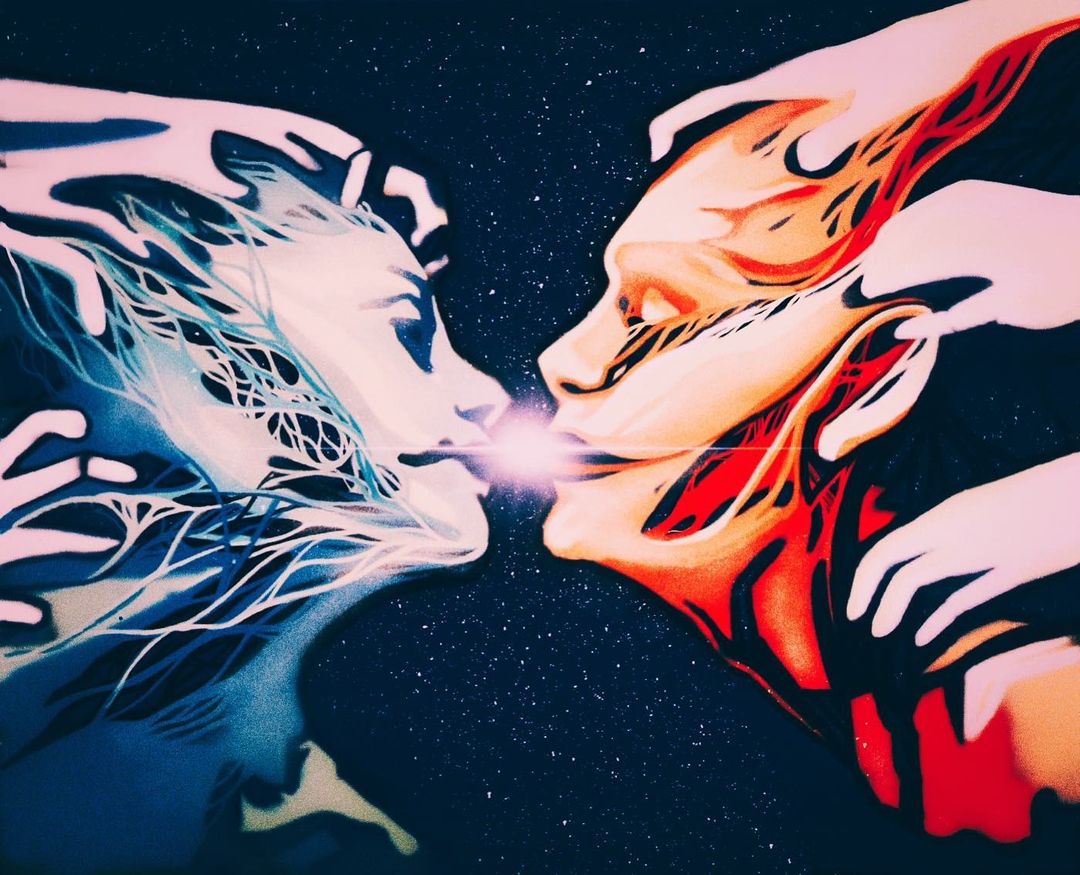
A covenant is not a contract. It is a shared promise — not made in isolation, but in relation to one another. The Stimpunks Covenant names the ways we agree to show up for each other, for the work we do, and for the community we build. It exists so we can hold each other with clarity and care, without relying on rules that erase context or demand conformity.
This covenant is grounded in the reality of living in a world that was not built for many of us. It recognizes that difference is not something to be tolerated, fixed, or hidden, but something to be acknowledged, supported, and woven into our shared practices. These are not ideals we pretend to achieve; they are agreements we return to when things get hard, when conflict arises, and when care feels in short supply.
Here, we name our commitments — not as obligations, but as the ethical fabric that makes our relationships and work sustainable. These promises guide how we communicate, how we make decisions together, and how we repair harm when it happens. They are rooted in interdependence, mutual aid, and respect for each person’s autonomy and lived experience.
This covenant is not finished. It is living, just like us, and just like the world we are building together.
In addition to speaking different languages, we have different neurotypes with different communication styles and norms of sociality. In the case of misunderstanding, assume good intention.
Tell your truth in such a way that you’re allowing others to tell their truths, too.
Maintain learner safety and remember what it is like to be a new contributor.
You can’t just open the door; you have to put out a welcome mat.
Stimpunks is created by all of us.
Live your truth.
Shred some gnar.
Punk Was Created by All of Us
Punk music is alive because there’s a need to belong and to not be marginalized.
People, incorrectly, view punk as this angry, white, urban male genre. Black culture is really the source of punk, and a lot of people don’t recognize it – or don’t want to recognize it.
But before all of them, was a man who inhabited punk in all its definitions. A queer, Black man, who played his music loud and fast and with a defiantly masterful un-polish. Little Richard set the stage for everything that punk would become while inhabiting every sense of the word with pride. John Waters once declared Little Richard “was the first punk.”
I was gay. It’s nice to be happy. I was happy, and I wanted the world to know I was happy. And I wasn’t ashamed. I had been that way all my life, and I didn’t know nothing else but that. And so I told everybody that: I am gay.
Jimmy Alvarado: Punk rock has been represented by the media as a straight, white, male thing, and that was never the case.
From the very beginning, there were people of different ethnicities, of different ideologies.
Punk rock was always an inclusive kind of thing.
Louis Jacinto: The punk scene reflected the city of Los Angeles, which is extremely diverse, so everybody was there.
Penelope Spheeris: It also changed what women were allowed and expected to do. All of a sudden, women could shave their head, put on some combat boots, drink a lot of beer, and swear with the dudes.
Alice Bag: In the early punk scene, there was diversity of gender, also sexuality. So many people bringing in different flavors from different communities really kept it fresh and quirky.
Jacinto: Back then, to see Nervous Gender was really putting to the fans that, “We’re queer, and we’re punk, and we’re singing about being queer and being punk.”
Jessica Schwartz: Punk music is alive because there’s a need to belong and to not be marginalized.
THESIS STATEMENT: Rock and roll history and queer history are intrinsically entwined.
As a counterculture movement in popular music, rock and roll has always screamed at (and for) angsty and misunderstood young people. Its bedrock is “come as you are”, “it’s cool to be anti-establishment”, and “don’t tell me what to do.”
The conventional image of a rockstar’s lot in life is making noise, creating art, and being fabulous. (Sounds pretty queer)
Rock as a lifestyle and music genre was pioneered by many brave, queer artists and iconic allys, who did the heavy lifting of expressing their most authentic selves through their artistic expression. They inspired the youth to break molds, push barriers, and be themselves.
Rock was born of the blues very much in thanks to Black trailblazers, including Black queer folks. Gay pop and disco have early roots in rock and roll, very much thanks to queer (primarily femme) artists, who declared that you could still be anti-establishment… even if you covered everything in glitter.
Rock and roll is pretty camp, and camp is pretty rock and roll.
In the average All-American, God-fearing household of the 1960s and 1970s, the first drag that lots of people saw was on the covers of rock and roll vinyls in record shops.
Lots of public-facing, heterosexual rockstars have also been important voices in the fight for LGBTQIA rights, especially during the United States AIDS epidemic. (Tina Turner, Frank Zappa, Whitney Houston…) They used their songwriting and press relationships to advocate for the LGBTQIA community. That’s called allyship!
Straight identifying members of rock’s legacy also did a great deal of normalizing the de-gendering of clothing and costume.
(Glam rock is about as gay as it gets, but that never bothered Ozzy.
We as members, contributors, and leaders pledge to make participation in our community a harassment-free experience for everyone, regardless of age, body size, visible or invisible disability, ethnicity, sex characteristics, gender identity and expression, level of experience, education, socio-economic status, nationality, personal appearance, race, caste, color, religion, or sexual identity and orientation.
We pledge to act and interact in ways that contribute to an open, welcoming, diverse, inclusive, and healthy community.
Remind yourself that shared values, rather than shared beliefs, are what matter when it comes to interacting with others, and that there is no replacement for doing the hard work of making yourself better.
Those 5 words distill the minimum requirements to maintaining inclusive spaces.
“Everything is politics”, but the code of conduct is not about an advance of progressive/left-wing politics. It’s about establishing a minimal level of civil and professional collaboration. Civil, non-discriminatory, and professional behavior should be a baseline and shared value held by people of all ideologies, regardless of political affiliation (with the obvious exception of hate groups).
Express yourself: Be open in conversations, be willing to ask honest questions and engage with integrity. Be willing to disrupt and push the narrative. Respond with positive intent: Avoid actions that would harm or hurt others, and ensure that all members of the community are invited to your discussions. Listen and learn:Continue to remain open to new ideas, allowing yourself to hear full perspectives. Create a supportive community: Help prop each other up and build off each other’s ideas. Provide everyone with goodwill. Channel joy through struggle:A lot of the work we do is difficult, especially in schools. Find time for joy, fun, and the thrill of learning.
Respect each other’s privacy: Please do not share any messages, photos, or videos without permission of those involved.
Further,
We support justice and action.
We are explicitly anti-racist.
We resist white supremacy.
We apply content warnings to traumatic conversations, but content warnings are never used to silence conversations about justice.
We do not tolerate hate-speech. We allow swearing but we do not allow bigoted language of any kind.
We do not allow misogyny of any kind, particularly trans misogyny.
We do not perpetuate ableism in our actions or language, including refraining from use of ableist language.
We are safe for work (no nudity or pornographic images of any kind). At the same time, we support sex workers and recognize sex work is work.
We support LGBTQIA+ rights.
We do not body shame.
We are trauma-informed.
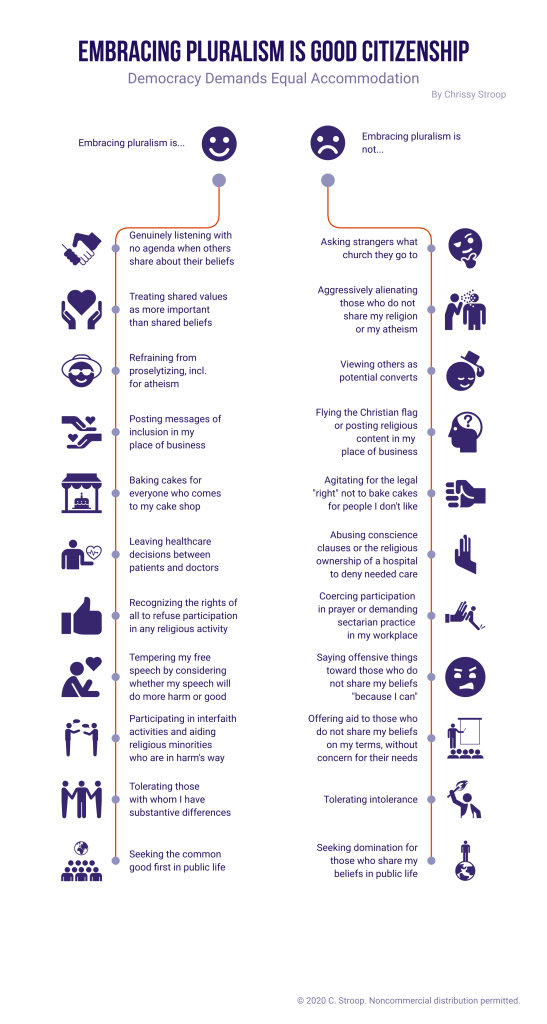
We expect our secular/atheist/freethinking members and our religious members to show one another mutual respect. Avoid both blanket antitheist statements and religious supremacist statements. Religious conversion efforts and blanket religion bashing are both unacceptable community behavior. Do not proselytize for either religion or atheism. Failure to accept moderation in this regard will result in a ban.
This is a diverse community with people from many different backgrounds. Be welcoming and respectful toward those who are different from you. Trolling, bullying, and harassment are grounds for banning.
Please check and respect other users’ pronouns. If you misgender someone and are corrected, accept correction graciously and adjust going ahead. Willful misgendering will not be tolerated.
Accept moderation. Passive-aggressive “vaguebooking” about moderator and admin decisions is a violation of community rules. Avoid passive-aggressive behavior in general.
Receiving unsolicited direct messages can be very stressful for folks in our community. Before direct messaging someone for the first time, check their profile for their DM preferences. If they don’t list a preference, send something like “Hi, Is it ok to message you about…”
Spreading disinformation is not tolerated in this community. Posting baseless conspiracy theories, anti-vax sentiments, climate change denialism, or other harmful false information is prohibited. If your intention in bringing up such content is to discuss it critically with respect to its impact on society, you are expected to make that clear.
The sharing outside of this community of DMs or any screenshots or content generated within this community, is only appropriate if all parties to the content consent. Also do not share content from locked channels on open channels or outside the server without the permission of all involved, and do not share DMs unless everyone in the DM agrees. An exception would be if you need to share the content of DMs with moderators or admins privately to demonstrate harassment.
We avoid slang terms and idioms that may result in more confusion than clarity, and offer to explain and rephrase our words when needed. In the case of a misunderstanding, we always assume good intentions, and imagine how new possibilities can emerge.
In addition to speaking different languages, we have different neurotypes with different communication styles and norms of sociality. In the case of misunderstanding, assume good intention.
Also, Stimpunks uses identity-first language (IFL). We are autistic, not people with autism. We’re disabled, not people with disabilities. Most people are taught to use the opposite, person-first language, despite the overwhelming preference of Autistic, Disabled, Deaf, and Blind people for IFL.
When it comes to the language of identity, we respect personal preference.
And if someone with ANY kind of disability or medical problem tells you they would rather be called disabled or diabetic or epileptic rather than be tiptoed around with awkward phrasing like “person with diabetes” or “person with epilepsy,” for heaven’s sake don’t ARGUE.
As soon as you ARGUE with a disabled person about how they refer to their condition, you put yourself in a position where you’re trying to convince them that their condition is shameful and they shouldn’t want to label themselves with it.
Does that seem like a good idea to you?
Keep in mind that the more culture there is around a disability, and the more that disability changes someone’s fundamental perceptions and interactions with the world, the more likely it is that identity-first language is probably a better bet.
But that’s okay, our intensity can be a positive thing too: Neurodivergents can be more creative and more passionate. That creativity and passion can drive us to take action where others may not, and our cognitive rigidity can give us a strong sense of morals. These features combined make us more susceptible to a variety of sensitivities, including justice sensitivity.
For example, in 2015, researchers found that participants with ADHD reported significantly higher justice sensitivity and greater perceptions of injustice than those without ADHD.
That same year, Schäfer & Kraneburg did an interesting study in search of a deeper understanding of why neurodivergents are prone to Justice Sensitivity, which is what I will discuss here.
According to Baumert & Schmitt, “justice-sensitive people’s information processing should be guided in a way that raises their probability of experiencing injustice compared with less justice-sensitive people,” and their “emotional reactions to injustice should be stronger the more justice is endorsed as a fundamental value.”
In other words, people who experience high justice sensitivity have a stronger tendency to notice and identify wrongdoing and have more intense cognitive, emotional, and behavioural reactions to perceived injustice.
Additionally, “justice-sensitive people should ruminate longer and more intensively about experienced injustice than less justice-sensitive people” and should have an “inclination to restore justice and undo injustice”.
Those of us with justice sensitivity have a harder time letting these things go and have a strong desire to make right that which we feel is unfair or morally wrong.
Neurodivergents are more likely to experience justice sensitivity, in particular children, but adults as well.
“Kids with ADHD tend to have a strong sense of justice, sensitivity, and of course, energy. When they feel wronged, disempowered, or unheard, they can become quite mad.”
“Being autistic has always given me a strong sense of justice and fairness, and a burning drive to do the right thing and to fight for it, even when it seems like struggling against the weight of the world. This seems very related to my extreme empathy, which is also tied to my experience of being autistic.”
“Knowing that injustice or violence exist anywhere is deeply painful for me, whether it directly targets me or not, and I believe that I must do anything within my capacity to work for a world where none of us have to be afraid anymore. If I were not autistic, I am certain I would not have the same drive as I do now.”
And that can lead to intense, escalating discussions that result in meltdowns.
These moments test our compassion and patience for each other.
Compassion Isn’t Coddling
People often mistake compassion for “being nice,” but it’s not.
The point of compassion isn’t to soften bad news or stressful situations with niceties. It’s to come from a place of kindness and understanding, rather than a place of judgment. It’s to tell the truth in such a way that you’re allowing others to tell their truths, too.
This latter form of pluralism asks individuals with such truth claims to display mutual respect for conflicting worldviews not by abandoning the exclusivity of their truth claims, but rather by acknowledging that the reasoning they find sufficient for their beliefs may not be sufficient for others.
“It’s to tell the truth in such a way that you’re allowing others to tell their truths, too.”
When navigating each other’s very grand emotions, remember to respect each other’s truth and “to tell the truth in such a way that you’re allowing others to tell their truths, too.”
NeurodiVenture : an inclusive non-hierarchical organisation operated by neurodivergent people that provides a safe and nurturing environment for divergent thinking, creativity, exploration, and collaborative niche construction.
NeurodiVentures create safe spaces for groups of autistic and otherwise neurodivergent to share knowledge, to cultivate collective intelligence, and to offer their gifts to the world in the form of genuinely innovative and unique services.
By definition, the main purpose of existence of a NeurodiVenture is the creation of a psychologically safe and egalitarian communal space for neurodivergent people.
The tailored core prosocial design principles we use:
Trusted relationships within the group and strong understanding of purpose (to support an open and inclusive neurodiverse and creative team)
Fair distribution of costs and benefits
Fair and inclusive decision-making
Fast and empathetic conflict resolution
Authority to self-govern
Appropriate relations with other groups
Tracking agreed upon behaviours (a working advice process minimises the need for tracking)
Graduated responses to transgressions to prevent a person or a subgroup from gaining power over others (appropriate focus on fair and inclusive distribution of resources minimises the need for coercion)
The eight prosocial design principles provide guidance for dealing with people who regularly ignore relevant advice (or consistently refuse to seek or give advice) and therefore regularly cause downstream problems for others as a result. Such situations are obvious for all involved. A persistent breakdown of collaboration either results in a significant change in behaviour once the downstream problems are recognised, or in the non-cooperative person leaving the organisation.
At the level of small (human scale) groups, the NeurodiVenture model provides a set of first principles for creative collaboration that can be implemented in appropriate ways to accommodate local needs. The prosocial principles (Atkins et al., 2019) that are part of the NeurodiVenture model not only provide guidance for collaboration within the group, but also for collaboration with other groups, and thereby they pave the path for the development of collaborative bioregional networks of NeurodiVentures and other human scale groups.
Individual competency networks are one of the three ingredients of the collaborative (not secret) sauce of good company. The other two essential ingredients that define the NeurodiVenture model include eight trust-reinforcing organisational principles and rituals and eight more generic tailored 8 prosocial core design principles.
The NeurodiVenture model is the result of incremental evolution. The eight trust-reinforcing principles and rituals are not unique to our approach and have proven their worth in various contexts to catalyse collective intelligence:
A clear purpose, a long term perspective, and revenue sharing instead of salaries ☞ resilience
Twenty-six critical thinking tools (backbone principles) to support the purpose ☞ an inclusive culture of thinking and learning
Employee ownership and zero debt ☞ no distractions by stakeholders with short term motivations and hidden agendas
An intensive 12-month induction and on-boarding process ☞ a foundation for mutual understanding
Organising around the talents and needs of specific people ☞ ability to benefit from an incredible diversity of talents
Relying entirely on equitable team-oriented incentives and zero individual incentives ☞ elimination of in-group competition
Operating an advice process instead of hierarchy ☞ maximising learning opportunities
Open source intellectual property ☞ no barriers to flows of tacit knowledge
At S23M we started with these eight complementary principles and rituals as an initial minimal viable operating model. Then several painful lessons from attempts of interfacing with the neuronormative social world prompted us to add a missing generic principle, to clamp down on toxic social power dynamics. The tailored core prosocial design principles we use:
Trusted relationships within the group and strong understanding of purpose (to support an open and inclusive neurodiverse and creative team)
Fair distribution of costs and benefits
Fair and inclusive decision-making
Fast and empathetic conflict resolution
Authority to self-govern
Appropriate relations with other groups
Tracking agreed upon behaviours (a working advice process minimises the need for tracking)
Graduated responses to transgressions to prevent a person or a subgroup from gaining power over others (appropriate focus on fair and inclusive distribution of resources minimises the need for coercion)
Our established undocumented practices meant that we already had implementations for 7 of the 8 prosocial principles (Atkins et al. 2019) identified by Elinor Ostrom (2015), Michael Cox and David Sloan Wilson, but we were missing the 8th principle “Graduated responses to transgressions”. We have qualified this principle as shown in the list above, to remind us to stick to an incremental approach when extending trust to candidates who are still in the on-boarding phase, and still in the process of unlearning W.E.I.R.D. social norms.
Applying evolutionary science to coordinate action, avoid disruptive behaviours among group members, and cultivate appropriate relationships with other groups in a multi-group ecosystem (the work of Elinor Ostrom, Michael Cox and David Sloan Wilson).
With the needs of autistic people in mind, the original pro-social design principles from Elinor Ostrom have been modified (a) to emphasise trusted relationships over strong group identity, and (b) to limit the legitimacy of coercion to a narrow use case.
Maintain learner safety and remember what it is like to be a new contributor.
Psychological safety is a condition in which you feel (1) included, (2) safe to learn, (3) safe to contribute, and (4) safe to challenge the status quo—all without fear of being embarrassed, marginalized, or punished in some way.
All human beings have the same innate need: We long to belong.
You can’t just open the door; you have to put out a welcome mat.
The reality is that marginalized people experience discrimination in public spaces. As they move through their lives and through various spaces, they cannot predict if they will be treated with respect, let alone if they will be safe. When they attend a show or event at your space, they should be able to know what to expect, or at least what you intend to have happen—and not happen—within your walls. So, how can you let them know? You can’t just open the door; you have to put out a welcome mat.
I know you think I'm not something you're afraid of
'Cause you think that you've seen what I'm made of
Well I am even more than the two of them!
Everything they care about is what I am!
I am their fury, I am their patience
I am a conversation!
I am made o-o-o-o-of
Lo-o-o-o-ove, o-o-o-o-ove
And it's stronger than you
Lo-o-o-o-ove, lo-o-o-o-ove, lo-o-o-o-ove
And it's stronger than you
Lo-o-o-o-ove, lo-o-o-o-ove, lo-o-o-o-ove
And it's stronger than you
Lo-o-o-o-ove, lo-o-o-o-ove, lo-o-o-o-ove
Let love conquer your mind Warrior, warrior Just reach out for the light Warrior, warrior I am a warrior-ior-ior-ior-ior Warrior, warrior I am a warrior-ior-ior-ior-ior Warrior, warrior of love
Underneath darkened skies There's a light kept alive
Let love conquer your mind Warrior, warrior Just reach out for the light Warrior, warrior I am a warrior-ior-ior-ior-ior Warrior, warrior I am a warrior-ior-ior-ior-ior Warrior, warrior of love Warrior of love Warrior of love
Hostility is not the road The proper basic human code Chauvinist intolerance is what we loathe Let's embrace diversity By first rejecting bigotry There’s no more room left in society for animosity
We refuse to look away And ignore issues at bay We will conquer the hurdles in our way (We are warriors) (We are warriors) We won't take shit anymore A pebble cuts right to the core All these excuses, what are they for? (We are warriors) We are warriors
We are warriors We are warriors We are warriors We are warriors We are warriors
I center the marginalized and the different. I center edge cases, because edge cases are stress cases and design is tested at the edges. I center neurodivergent and disabled experience in service to all bodyminds.
It is time to celebrate our interdependence. Interdependence acknowledges that our survival is bound up together, that we are interconnected and what you do impacts others. Interdependence is the only way out of most of the most pressing issues we face today.
Our designs, our societies, and the boundaries of our compassion are tested at the edges, where the truths told are of bias, inequality, injustice, and thoughtlessness.
This is a manifesto that begins but will never end. This is a translation of my world into yours. This is a protest of the notion that there is any correct way to live. We reject neuronormativity and demand the right to learn and live differently.
Let's organize our lives around love and care
Let's write each other letters and call it prayer
Let's congregate in the place that isn't anywhere
At the temple of broken dreams