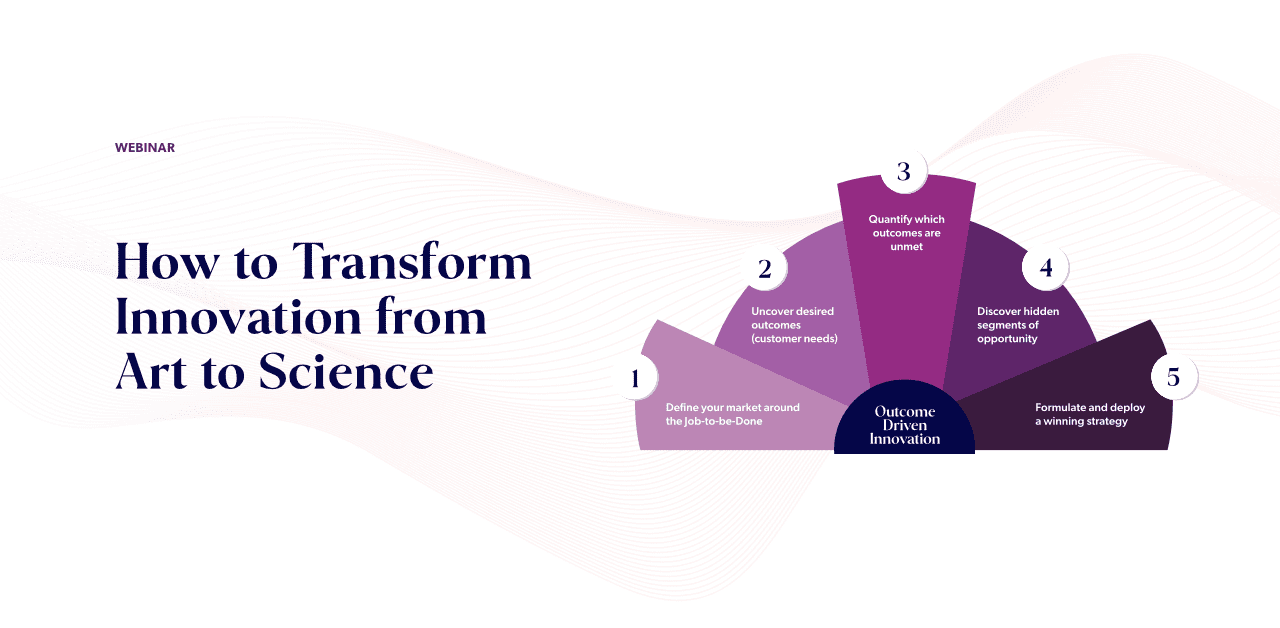



Effective customer needs analysis is dependent on two factors: (1) knowing what customer inputs are needed to create improved and breakthrough products, and (2) knowing how to capture them. Looking at customer needs analysis through a jobs-to-be-done lens, we see that success in innovation comes from a deep understanding of the job the customer is trying to get done. This notion has led us to create a whole new way to define, capture, and use customer needs to create breakthrough products and services.
We’ve discovered that customers typically use between 50 and 150 metrics, called outcomes, to judge how successfully they are able to execute any job-to-be-done. These outcomes are the customers’ needs. They are the power behind our innovation process, Outcome-Driven Innovation (ODI). Capturing them all is not easy. But with 20 years’ experience at customer needs analysis, we get customers to articulate all their needs. And it is possible to do so because customers know perfectly well what success means to them when getting a job done.
When needs are thought of in this way, there is no such thing as a latent need or a need a customer can’t articulate. Furthermore, outcomes are stable over time: they often don’t change for decades because the job-to-be-done remains the same.
To capture a full set of desired outcomes, we often employ a four-step approach. The first step is to conduct personal interviews in order to dissect the job the customer is trying to get done into process steps. We call this process “job mapping.” The second step is to conduct one or more ethnographic or observational interviews with customers to gain insight into the context in which the job is getting done.
The third step is to conduct personal, group or observational interviews to elicit from customers what metrics they use to measure success in executing each step of the job. The fourth step is to conduct one-on-one interviews or literature searches if needed to fill in any missing details that remain after completing the first three steps.
Learn more about customer needs analysis and jobs-to-be-done theory and how this thinking has changed the way customer needs analysis is performed.