
Indeed, that was an apt and true reply which was given to Alexander the Great by a pirate who had been seized. For when that king had asked the man what he meant by keeping hostile possession of the sea, he answered with bold pride, “What do you mean by seizing the whole earth; because I do it with a petty ship, I am called a robber, while you who does it with a great fleet are styled emperor”. (Augustine, City of God)
I write these words in a period of national mourning, a week in which thousands have queued for hours to catch a glimpse of the coffin of Britain’s recently departed monarch. The last few days, in their multiplicity of ceremonial displays, have brought to the surface some surprisingly deep reflections on the nature of power, nationhood, and cults of personality. For my part, they have reinforced a deep theological suspicion regarding the substance of such civic displays. All this for a single person, all because she wore a crown? The question is mostly rhetorical, but it is a helpful entry point into my deeply held anxieties, not just about kings and queens, but politics in general. One of the reasons I continue to oppose the institution of monarchy (and incidentally a fetishistic attitude towards representative democracy) is the secular appropriation of the Corpus Mysticum (the claim that One can stand in for the Many). This seems to be something opponents and advocates of the British monarchy have agreed upon over the last few days. Either Queen Elizabeth II personifies ‘the best of us’ (however ‘us’ is defined) or she is the representative of Imperial atrocity and systematic racism. But to treat the Queen in this totemic fashion is to render her into an Idol or a scapegoat. In either case, such judgements conform to the ideological script of monarchy, that there are indeed special people who are able to represent whole groups and histories. It is a proposition which I think doubtful at best, but the notion is lodged so deeply in our collective way of thinking and feeling, that few challenge it. It is certainly peculiar to see stern opponents of the monarchical principle repeat its central myth of mystical identification. To escape the mythological landscape of monarchy we must, not merely seek abolition of a formal institution, but seek to discard a habit of mind that encourages us to see people as capable of mediating things as contested as ‘nations’. It is one thing to say that the Queen was merely human (no-one in this century denies that). But the greater secularisation is to say that she had no special power of representation, that in the end, one human being attempting to stand in for millions of others is a fiction. Once we let go of this tiny piece of political magic, (perhaps the first and last magic which monarchy possesses) the illusion is shattered. The British constitutional monarchy endures because the spell remains in force.

But like energy in Nature, the aura of kingship is neither created nor destroyed, but simply transferred. Any close examination of political systems will demonstrate that the mystical identification at the heart of monarchy is still capitalised upon, even where formal structures of kingship have been completely abolished. When a successful war is concluded or a treaty signed, there is a glamour around the inhabitant of an elected office, an aura which resembles a much older monarchical precedent: The success of the ruler is the success of a people and vice versa. This identification goes beyond any reasonable estimate of a leader’s responsibilities or real-world competences. The assumption is that his role is more than that of a transient administrator of shifting government departments. He is called upon to be a conduit for collective hopes and shared ambitions. He is summoned to the podium, not merely to offer an update on organizational progress (the relative strength of GDP, the state of unemployment, or foreign exchange rates), but to provide a story and a context for a people. Even in the bland modern state, the politician is encouraged to be a bard and a storyteller, even if he is discouraged from being a priest. When the most charismatic of politicians paints in primary colours ‘the destiny of a nation’, the narrative function is only effective because it is assumed that his individual identity has been fused into that of a general, national consciousness. If we consider this notion with a critical eye, we quickly realize that it is not possible for millions of people to be of the same mind, and that even banal words like ‘peace’, ‘freedom’ and ‘security’ mean many different things to different people. There can be such a thing as a thin social consensus, but there can never be a human conduit between the people and the State. Yet, the appeal to common destiny works through the bypass of our estimating mind and turns instead to the yearning of the heart. We want unity and will do what we must to find a suitable canvas for that desire.
But if this logic of glamorous transposition elevates a leader to the height of an Idea, the same logic easily destroys the foolish or corrupt officeholder. It is often said that a President who acts badly on the world-stage is a stain on his country (implying that there is some kind of invisible bond between himself and the land he is elected to serve). No procedural structure proves this supposition. The belief (for that is what it is) is quasi-spiritual, that a single individual can contain and compromise multitudes). When the contamination of a given political icon becomes too great, the only remaining option is to cast out the unbecoming pretender. In the crushing election defeat the sacralised representative becomes a shrunken secular man in borrowed clothes. The invisible crown and sceptre conferred by a self-declared democracy has left him, migrating to a new representative. The frequent migration of monarchical power it turns out is incredibly useful for flippant democracies (particularly those of the grubby and acquisitive kind). In the ejection of the unscrupulous leader, the people can feel that his personal evil (which was also general) is purged from the body politic. It is possible for a people to make of their fallen leader a scapegoat, absolving themselves of sin (or in secular terms, political miscalculation). The action of absolution is marvellous to behold in its secular form, as effective as any ritualised penitence of the Middle Ages. The procedure is particularly remarkable because the bureaucracy often remains unchanged, but because the corrupt Premier or President is removed from the scene, the public suddenly feels spotless. The affects of a government’s misdemeanours may continue to reverberate through the world, but the removal of this figurehead of authority brings the sense that a new start is possible. The people who elected him are again blameless, so too are many of the politicians who once served the one deposed. Theatre replaces bureaucratic thought, appearances become more important than hard realities. The water is dirty, but everyone present declares they have been washed clean.

There are many solid pragmatic reasons why one might reject the logic of monarchy (whatever garb it currently wears). It underwrites collective wrongdoing. It simplifies the realities of power. It misleads us into thinking that the wrongdoing of society can be expunged when a single person is removed from the social pyramid. We become fixated on the face of authority, rather than reflecting keenly on how authority actually works. Christians, unconvinced by the pseudo-theology of monarchy, may have sympathy with all these arguments, but such sympathy hinges on an important fact. Early Christians lived in a world where the Emperor of Rome claimed for himself the right to mediate the world to itself. He was the face which looked down on the world and declared what was good, right, and lawful. He declared meaning midst chaos. In his royal personage, (though he did not call himself a king) he framed the destiny of peoples. When Christians said Jesus was Lord, they were claiming (among other things) that only Christ can stand in for many because his life came from the Universal Life of God. Caesar cannot represent anyone because his claims to divinity are baseless. He is a gangster atop a hoard. He is a pirate who has garbed himself in purple. If the young Augustus had fallen at the battle of Actium that is all he would have been, a failed schemer, no different from the pirates chased by his Imperial ships. Consequently, the first Christians came to understand that service to Caesar had no more metaphysical significance than the transactional relationship between a crime boss and his clandestine employees. People died in the name of Caesar it was true, but the Church insisted that, fundamentally, their sacrifices changed nothing. The wheels of power rolled on, asking for more blood. Emperors came and went. Death seemed eternal. This then was Christianity’s claim to radicality, that the Emperor and his torments were neither ultimate nor binding. For the earliest followers of Jesus, this judgement was summed up by the Cross. Christ’s death, the New Testament insisted, was altogether different from those who died for Caesar. Jesus stood as an officeholder of king and high priest, but instead of holding onto power, he relinquished it. And paradoxically, this confirmed him as a king forever, surpassing the pale imitations of all earthly sovereignty. Crowns were now worthless because of the Cross. Christ truly stood in the place of all, his body becoming the temple of temples, in which darkness and evil were slayed eternally. As the Letter to the Hebrews expresses it:
Now since the children have flesh and blood, He too shared in their humanity, so that by His death He might destroy him who holds the power of death, that is, the devil, and free those who all their lives were held in slavery by their fear of death. (Hebrews, 2:14-5)

Kings deal in death, but none end it. What does this revelation of Christ’s subversive kingship mean? It means that all claims to transposition by secular political authorities to represent us are at bottom bogus facsimiles. Perhaps such claims are a necessary fiction in the name of order, but a fiction they are. Millions of voices cannot be filtered through a few hundred representatives. No territory can be adequately described in terms of the opinions of a few party-machines. The flag does not represent us any more than the king on his throne. There is no mysterious ultimate unity in this world. There are people who variously fight and squabble, agree and dissent, struggle, and accord. The art of politics is really the art of compromise, the process of negotiation by which power is contained and an imperfect order is sustained. There are better and worse regimes. Legitimate disagreements can be had about political principles, but one is painfully misguided if such principles are given spiritual ultimacy. Principles are tools to an uncertain end. One should of course not discount these ends just because they are uncertain. In the process of political negotiation beautiful things can emerge, peace, civic co-operation, even cherished institutions. But all politics can really do is make the space for these experiments. No king or politician can guarantee them. If we live under one of the old representative governments, we must not be lured into the belief (so useful to narcissistic politicians) that they represent us in some deep metaphysical sense. They cannot possess a psychic link with those they rule, neither can we expect their actions to replace our own responsibility to care for the place we live. Their capacity to represent is an imperfect, often faulty attempt, at including voices in the political process. While such inclusion has merits in its favour, we cannot expect it to do wonders. We should not expect to find any genuine mystique in politics, neither purification nor a grand story. There is no salvation in a polling booth nor in the military parade. No flag can protect us from misfortune. No party-chairman is free from error. Human power and its symbols, whether crowned or built, voted for, or imposed, will always come to dust. As Augustine put it so vividly in the City of God:
[Earthly] joy may be compared to glass in its fragile splendor, of which one is horribly afraid lest it should be suddenly broken in pieces. That this may be more easily discerned, let us not come to nought by being carried away with empty boasting, or blunt the edge of our attention by loud-sounding names of things, when we hear of peoples, kingdoms, provinces.
But what does a refusal to be carried away by names mean? For Augustine it meant appreciating practical political goods like order and peace without worshiping the rulers who pretend to guarantee them. I appreciate the fact that I can write down my thoughts without the risk of riling a censor, but it would be utterly sycophantic to thank the State because officials have decided not to censor me. Augustine would go further. We must administer society without believing that ‘society’ is all that matters. The true Prince of a Christian State he says, would rather see his State destroyed than compromise what was ultimately good. A State that serves itself is a monstrous false god who should never be served. A Christian who seeks to put the Good News at the centre of her life should want the full secularisation of politics. No magic, no kings, no destinies, only a desire to live together in reasonable justice and peace. Spiritually safe politics is procedural and dull. Mysticism in politics is the source of countless evils. We cannot and should not expect any earthly leader to save us, perfect us, validate or affirm us. It is not within the power of politics to make life meaningful. When ideology takes on this ultimate role, it becomes a false idol that diverts us from the one who is the true Corpus Mysticum (the body that does indeed encompass multitudes). Those walking past the Queen’s coffin this week are channelling deep emotions into a woman that most did not know, but who appears close and vital through the art of their imagination. It would be better to pour those feelings into an immediate attachment rather than an image (or in some cases an image of an image). The same can be said of republicans, who make of a single person a scheming Imperialist monster (a human-shaped box proper to contain their worst suspicions and fears). Such is the ideology of monarchy. But the New Testament offers us another vision of power, and another account of political substitution. It is indeed possible for one life to partake of the lives of many, but crown and palace knows nothing of this radiant alchemy. The Messianic spirit which brings such identification about, exists at the edges, among the ignored and scattered. Christ’s rule is marked by the dissolution of distant sovereignty, in favour of traveling in the shoes of those who have traditionally been invisible to kings. J.R.R. Tolkien in the Lord of the Rings said (in a decidedly Christological accent): “For it is said in old lore, ‘The hands of the king are the hands of a healer.’ And so the rightful king could ever be known’”. This for Christians must be the true mark of Kingship. States sometimes heal, but their appetite for wholeness is limited. Victory or dominance is always more appealing. Political leaders might posture as healers, but they always carry a sword. Christ is different. He enters fully into the human situation, achieving kingship by giving up power. He represents by reaching out to all. His death actually changes the human situation without demanding political loyalty. These facts not merely defy the logic of kingly cult, they actively transcend the ideology of both secular and sacred monarchy.
 In the previous post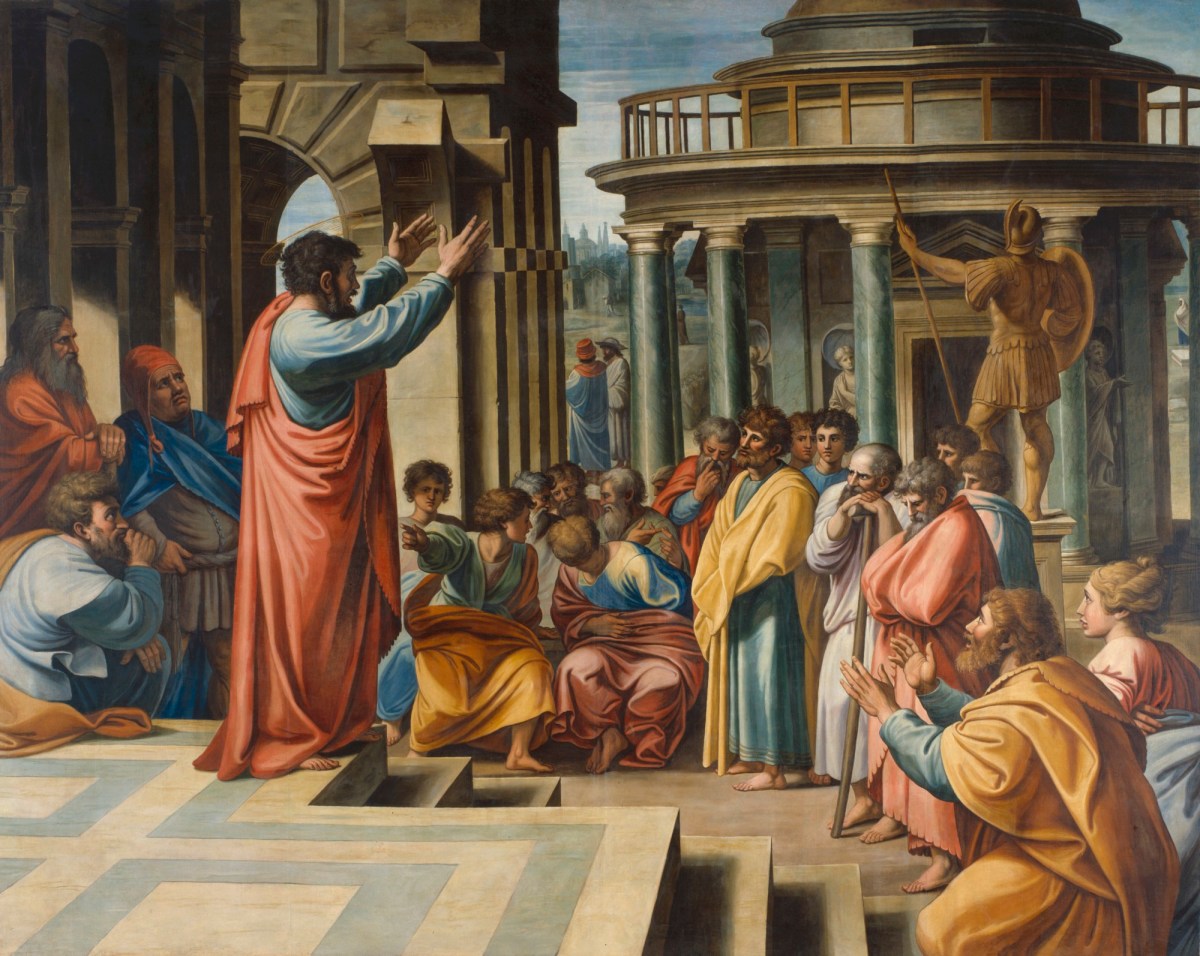
 Let us note where the crowd is in the wrong and where they are in the right. Paul and Barnabas do not face a crowd of materialists but encounter a culture that already expects the divine to heal the afflicted. By dubbing Paul and Barnabas Zeus and Hermes, the spectators had in mind the ancient stories of divine epiphany, of gods garbed in the form of strangers to test the hospitality of a city. Here the Greek cosmos dovetails with the Jewish world of Paul and Barnabas, of the angelic vitiation to Abraham, and by degrees, the risen Son of God who takes on the aspect of dilapidated stranger. Here one clearly sees the double aspect of revelation. The lightning bolt of Christ illuminates the darkness of error, but it will not burn away those structures of imagination and perception that nurture its clarity. The crowds’ misidentification of Paul and Barnabas both confirms a world they already comprehend, but unwittingly draws them into the experience of an unknown god.
 An identification of these orientations, as Luke-Acts does by pinpointing the spirit of the Athenians philosophers, is admitted in the New Testament more generally, as the distinction between those who follower and those who do not, those who respond, and those who pass by. Thus, any proclamation is invited, not merely to displace ‘religion’, but to evaluate what precedes it. Any Evangelist must know on what ground she preaches and consider how her words will be heard. However, if the Gospel is not the condemnation of culture, what does it mean for the Gospel to be heeded? Its first dimension is grasped subjectively. A worldview, concept, or symbol, we be said to possess evangelical potency if it shakes us out of our habitual patterns of thought, leaving the path clear for radical newness to break into our lives. By making the familiar strange, the human self can be orientated towards the supreme strangeness of Jesus Christ. The Gospel becomes alive for us when it takes on the character of a question. When we are propelled by the question, into a world that we could not have presupposed. In the second place, the Gospel becomes a lens to perceive outward happenings. One’s collective and personal history is at once understood through the life, death, and Resurrection of Christ. Events take on the depth of parable. Here culture does not do the work of revelation, nor can it be said to possess an autonomous status compared to the activity beyond revelation. What is prior does not signify precedence. Divine knowledge is merely bound to the life of the listener, the one who can know. We must not be lulled by Barth’s rejection of apologetics into the impression that such a theological evaluation of human culture is a novel practice. What is being recovered in this post is what the early Church defined as praeparatio evangelica. When the faith of Christ washed up on the shores of Greece, it was asked: Where was the Creator of the world in the lives of those who did not yet believe’? How could a God of saving love be absent, even from states of error? The answer is that he was there all along, working through the thoughts and culture of those who did not yet believe.
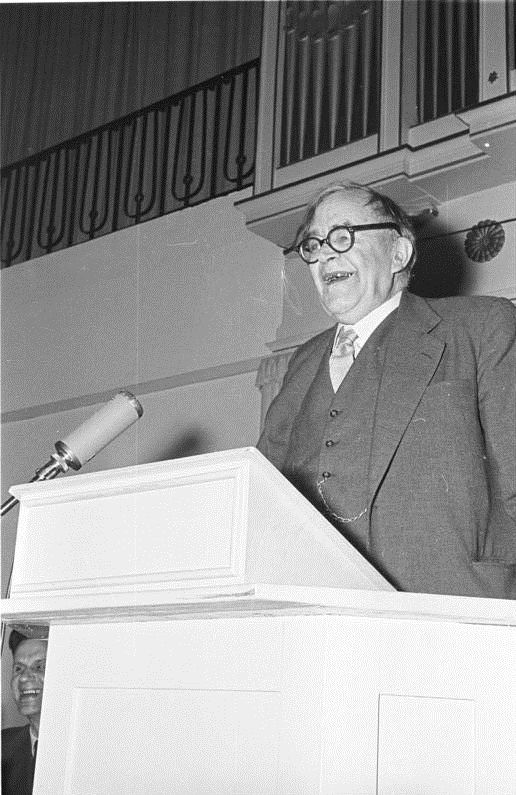



 Through God’s promise, Mary’s privation is dispelled, and the public history of Israel is hers. Like Jacob, David and Solomon what she has affirmed will be remembered. But what has she accepted? The gift God bears Mary is motherhood, but it is not the motherhood of the confined and silenced, but motherhood as a totally public, self-chosen vocation. Mary’s future child is not the property of the clan but belongs to the decision she alone makes with God. No external rule of the father can intrude on what she seeks to accomplish with grace. This is the deep symbolic meaning behind Mary’s virginity. In ancient myth ‘the virgin’ (parthenos) is much more than the pre-sexual woman. Virginity denotes an existential independence from the bounds of sex, marriage, and subordination to a husband. This was the case of the Greek goddesses Athena and Artemis; whose virginity was understood as the armour against the intrusions and indignities of male force and sexuality. As Marianne Katoppo suggests, Mary’s virginity is not a sexual or reproductive status, but refers to ‘a woman who does not lead a “derived” life (as “daughter/wife/mother”..)..a woman who matures to wholeness in herself as a complete person, and who is open for others. Through this maturing process, she is fertile, she gives life to God’ (Compassionate And Free, p. 21).
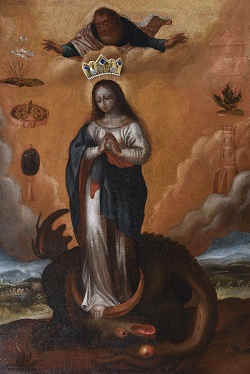 Here Mary is regal, authoritative, holding the twelve tribes of Israel in the orbit of her crown. She is pursued by the ancient Babylonian symbol of cosmic chaos, but God is her mighty shield. Her Queenship is bound up with the sovereignty of heaven. She stands between the night and the morning of God’s designs, more potent, more sacred than any poet or priestess. Mary’s outward life may be clothed in humbleness and hardship, but on the planes of the spirit her prayers are weapons against darkness, while her tears cause the spiritual hierarchies to quake and quiver. Everything that she accomplishes on earth (unseen by most) has its majestic analogue in Eternity. It’s Paul who asks: “Do you not know that we will judge angels?” (1 Cor 6:3). Mary is the first to take up this authority, cosmic as it is earthly. Yet, as the vision of Revelations suggests, Mary is more than a New Woman, she heralds a decisive turning point in the history of the world. When the Patristic authors looked at the figure of Mary, they saw the fulfillment of the ambiguous words of Genesis 3:15: “And I will put enmity between you and the woman, and between your offspring and hers; he will crush your head, and you will strike his heel.” As far back as Justin Martyr this passage has been interpreted as the protoevangelium, the first proclamation of the saving Gospel of Christ. Just as sin was said to have come into the world through Eve, so the estrangement between nature and God is ended in the life of Mary. It is from this symbolic scaffolding that Catholics today affirm the doctrine of the immaculate conception (that Mary was born without sin). If Christ is fully human and fully divine (as orthodoxy insists) they reasoned that Mary must have been already fully human (a life fully rapped up in the perfection of God) from her birth.
 Yet, ever since the Reformation, most Protestants have been disturbed by this way of reading Mary’s story. By making Mary sinless prior to the coming of Christ, such a formulation appears to put the mother on par with her son. How could this ordinary woman be immune from sin? Doesn’t that contradict Paul’s insistence that we have all been ensnared by sin? Such a reaction (in its understandable desire to protect the uniqueness of Jesus) nonetheless exacts a form of violence on the narrative structure of the Gospel. It tries to elevate Jesus by silencing Mary, yet if we wish to hear the Gospel in its fullness, we should be unreserved in assigning Mary centrality. Without Mary’s faithfulness, without a life already prepared for God, the spring could never have dawned. Without Mary’s willingness to be summoned, we would still be huddling in the spiritual wastes of winter. One cannot separate the rooted humanity of Jesus from his mother, whose own life was already full of grace and truth before his conception. Yet Mary is much more than a foreshadowing of the image of Christ. As a woman who gives her life and materiality over to God, Mary stands in the place of the Anima mundi (world-soul) of the Medieval alchemists. Mary is the personification of the creation greeting God as a lover greets a beloved. Her ‘yes’ is the moment when time and eternity meet and mingle. Without her intention, her love, her faithfulness, nothing could have been accomplished. As


:max_bytes(150000):strip_icc()/emile-durkheim-589909c93df78caebcf505a4.jpg) It is this Durkheimian model of religious life which explicitly structures contemporary debates over Quaker identity. Yet, ever since Durkheim articulated this theory of religious origins, there has always been a sense that something was missing from this overly belief-driven account of religion. In the rising tide of modern secularism, the only things Durkheim could see that were distinctive about the religious was their tendency to say religious things and performed sacred rites. Yet such a description of religiosity ignores other things which keep people in religious communities. The great disciple of Durkheim, the anthropologist Mary Douglas drew out some of the limitations of her mentor’s approach in her 1971 study Natural Symbols: Explorations in Cosmology. At the centre of the book is the claim that religious belief should not be reduced to primary beliefs and their derivative manifestations. While Douglas thought it true that rituals were often sustained by beliefs, it was equally true that the content of beliefs were often sustained by the symbols contained and encoded in ritual practices. As Douglas notes of the dynamics of the Catholic Eucharist:
It is this Durkheimian model of religious life which explicitly structures contemporary debates over Quaker identity. Yet, ever since Durkheim articulated this theory of religious origins, there has always been a sense that something was missing from this overly belief-driven account of religion. In the rising tide of modern secularism, the only things Durkheim could see that were distinctive about the religious was their tendency to say religious things and performed sacred rites. Yet such a description of religiosity ignores other things which keep people in religious communities. The great disciple of Durkheim, the anthropologist Mary Douglas drew out some of the limitations of her mentor’s approach in her 1971 study Natural Symbols: Explorations in Cosmology. At the centre of the book is the claim that religious belief should not be reduced to primary beliefs and their derivative manifestations. While Douglas thought it true that rituals were often sustained by beliefs, it was equally true that the content of beliefs were often sustained by the symbols contained and encoded in ritual practices. As Douglas notes of the dynamics of the Catholic Eucharist:
 Modern state-craft is increasingly driven by abstract measures like economic productivity and quarterly GDP, without considering for a moment the actual conditions in which people live. Politics is stuck in a Platonic realm of Ideas where bodies are left behind. We start believing that somehow, we can live apart from nature and one another; seeking ever more spectacular modes of control over environment; so much so that we begin to forget the bonds of physicality and sentiment which tie us together. What happens when selves are cut off from the deeper commitments of all-embracing love and justice for God-given bodies that Christian theology presupposes? Two compelling manifestos against this body-less cult of the technical and abstract are found in Christopher Marlowe’s Doctor Faustus and Mary Shelley’s Frankenstein. At the heart of both texts, we find examples of what happens when the human polis becomes trapped by transgressive Promethean fantasies. Both protagonists are potent symbols of the pursuit of power without responsibility and knowledge without morality. Marlowe’s Faustus revels in magical arts delighting in the prospect of making ‘men live eternally, or being dead, raise them to life again’ or being ‘on earth as Jove is in the sky’ while Frankenstein seeks through the pages of Paracelsus and Albertus Magnus the perfection of the human condition. Looking back over his tragic life Frankenstein defines his supreme obsession:
 What is so dangerous about these passions is the way in which they defy any suggestion of relation. In Faustus and Frankenstein human beings are set free from obligation, reciprocity and need for empathy, and instead embark on the complete mastery of world and self. Emblematic of this denial of duty and empathy is the rejection of the integrity of the living, breathing body. It is by and through an appreciation of our body, our feelings, and our senses that we learn to appreciate others. In the pain and pleasure of our own bodies we begin to recognise the pleasure and pain of others. In our own finitude we see our need for others to complete us. The finite body is never self-sufficient but is always reaching out for sustenance and companionship. It is no surprise therefore that both Faustus and Frankenstein, in projects stained with megalomania, find relational embodiment distasteful. More important than reciprocity or love are the promulgation of abstract ideas of power and control. It is significant that when Faustus signs the deed to his body and soul one of the clauses reads, ‘that Faustus may be spirit in form and substance’. Later, when the demon Mephistopheles confronts Faustus with the spiritual consequences of his bargain with Lucifer, on losing his body he exclaims ‘but what of that?’ Yet, in Marlowe’s tale it is the act of giving up his body which ultimately damns Faustus to eternal perdition. According to Thomist Theology (with which Marlowe seemed familiar) a spirit without a body is nothing but a demon and by its lack of embodiment is unable to repent. Bodies are not merely vessels which carry the soul; the body is that creature which entices the spirit towards its final rest in God. By making a pact with Satan, Faustus denies the saving potential of the body, to his eternal cost.
 How can we get beyond this deadening quest for power? The answer is in our practice as Christians. The ecclesia begins its deliberation on the meaning of the human, not through an appeal to a technology of perfection and invulnerability, but by taking seriously the lessons we learn in the acts of giving and receiving hospitality. At the core of such acts Christians discern that humans are fundamentally needful creatures, in need of care, consideration, and company. Our bodies cry out for tenderness and relation, our faces call for recognition. This logic of gift (embodied by Eucharistic sharing) exaggerates these bodily realities by stripping us of all our masks, pretensions, and defence mechanisms. What matters at the table of fellowship is not our status, nor our resistance to failure, but our longing for consideration and affirmation. Our presence at the table is not dependent upon our ability to stand immune from the vicissitudes of life, but based on our ability to receive, to meet to understand. For Quakers the embryo of such an embodied politics begins with our worship together. By opening ourselves to the possibility of being powerless in the boundless presence of the Inward Light, we are offered a mirror which attends to our true condition. We are not meant to live apart (struggling for some private paradise) but seek a deep solidarity with each frail person. We live most faithfully (most humanly) when the cry of another shatters our illusions of control and stability. This is the deep meaning of the Query: “Bring the whole of your life under the ordering of the spirit of Christ”. To be ordered thus, is to live in the shadow of the bodily One who suffers alongside, never from above. To be shaped by such a Spirit is to become vulnerable in the service of others.
 What might our political theology be like if we take such a politics of intimacy as our starting-point? It seems to me that reading Christianity through an Epicurean lens aids us in resisting an obsession with ‘technique’ which is so pervasive in contemporary society. Our technological culture is so focused on structures, fixes and mechanisms that little consideration is given to matters of moral value. It is easy for political theologians to be caught up with collective solutions to social problems to the detriment of one’s personal motives and real-life relationships. In a yearning for justice, it might be tempting to think that the patterns of table-fellowship are quaint or sentimental additions to the radicalism of the Gospel. Wrong. Both Jesus and Epicurus show us that table-fellowship is not an addition or over-lay to the formation of community, but the substance of any polis worth living in (including the Church). The virtues of the table- intimacy, appreciation and joy- are the outward signs of an alternative politics being enacted. Such an experience is more transformative than the politics of technique, since it alters those who participate; forming them into different people. In this mould, politics is not about grand gestures, but rather concerned with moral learning; often undertaken, slowly, quietly, yet bravely.
 Even liberationist theologians (whose reflections most often spring from real-life encounter and struggle) can end up subordinating these personal stories to an impersonal narrative of class or economics. Thus, the Gospel, like the rest of society, tends to be caught in the trap of obscurity and generality; stripped of the intimacy so many crave. What is the solution? Seeing Jesus through Epicurean eyes suggests to us that the Church desperately needs to return to the kind of home-spun patterns of inclusion exemplified by the early Christians and the ancient Epicureans, if its politics is going to be transmitted and sustained in the midst of the crowd. Perhaps, the most radical thing the Church can do is to re-discover the integrity of the agape-meal as a ‘meal’, and not just an archaic ritual. In summarising the effect of an Epicurean vision of Jesus on our lives, Moore puts it this way: ‘That Jesus was an Epicurean contrasts with the tendency of some of his later followers to be only ascetic or puritan, denying the value of pleasure and desire. Indeed, the above description of walking in the shoes of this Jesus could transform the way people understand every word of the Gospel.’ For political theologians such a transformation could be particularly acute. By following the Gospel’s invitation of friendship and pleasure, means to root ourselves in a new understanding public life; one in which the personal really is political. In directing its energy towards providing spaces for meeting, friendship, sharing, the Church has the capacity to challenge both the forces of mechanism and anonymity. Of course our society doesn’t recognize such spaces as political (as many Greeks did not) because the notion of the political is too narrowly defined. Yet if Christians want to be political as Jesus was political, they need to dispense with such narrowness and turn towards a more generous definition; one which includes the little dignities and hospitalities of life.
 The Armchair Theologian
