Monday, January 19, 2026

Narco-Terrorism: How Crime and Ideology Merged into a New Kind of War

Image
Language does more than describe events; it creates categories that shape policy. Few terms show that more clearly than narco-terrorism. The word emerged to explain a specific kind of violence in Latin America, then expanded after 9/11 into a broader frame that links drug markets to insurgency and terrorism. Over time, its meaning has stretched so far that it now describes two different realities: traffickers using terror tactics to protect profits, and ideologically motivated groups using narcotics to finance political violence. That evolution matters, because the label narco-terrorism can trigger different legal tools, different public expectations, and different strategies for states trying to regain control.

What the word originally tried to capture

At its simplest, narco-terrorism combines two ideas: narcotics and terrorism. Early usage focused on terror-like violence used to influence government action connected to drug enforcement and trafficking. One influential overview traces the coinage to Peru in the early 1980s and notes that the term quickly became attached to political violence surrounding drugs and counterdrug policing (Hartelius, 2008). In this first phase, the concept was less about ideology and more about coercion: traffickers used fear, assassinations, and spectacular attacks to intimidate officials, deter extradition, or force policy concessions.

This framing also aligned with how counterdrug institutions talked about the problem. A DEA intelligence brief from 2002 described the historical association of “narco-terrorism” with Pablo Escobar and “terrorist tactics against noncombatants” used to protect the drug trade and pursue political aims tied to that trade (Drug Enforcement Administration, 2002). In other words, the earliest popular image was not a guerrilla movement selling drugs to buy weapons; it was a trafficker weaponizing terror methods to preserve a criminal enterprise.

The first major shift: from a tactic to a nexus

Over time, analysts began treating narco-terrorism less as a single tactic and more as a relationship between two problem sets: transnational narcotics trafficking and terrorism. A widely cited academic treatment argues that counterterrorism and counternarcotics increasingly found “common ground,” merging operational and conceptual frameworks in ways that blurred previously separate “wars” (Björnehed, 2004). This matters because it changes what the term is for. Instead of describing the behavior of one actor (a trafficker using terror), it becomes a way of describing a system: violent groups, illicit finance, governance gaps, and cross-border networks.

That broader “nexus” approach helps explain why the term remains contested. If narco-terrorism means “terrorism associated with the trade in illicit drugs,” it can cover a vast range of conduct, from small “taxation” of trafficking routes by insurgents to full-scale cartel campaigns aimed at breaking state authority (Hartelius, 2008). The wider the definition, the more tempting it becomes to use the label as a strategic shorthand, and the more likely it becomes to be applied inconsistently.

The post-9/11 expansion: narco-terrorism as financing and facilitation

After 9/11, the dominant security question shifted. States became intensely focused on how violent non-state actors fund operations, move people, and acquire weapons. In that environment, narcotics became less a regional criminal issue and more a global security concern. The term narco-terrorism gained new utility: it could describe cases where drug trafficking finances terrorism, or where terrorist organizations become involved in drug markets as part of their survival strategy (Björnehed, 2004; United Nations Office on Drugs and Crime, 2017).

UNODC’s analysis of links between drugs, organized crime, corruption, and terrorism/insurgency reflects this broadening: the “drug problem” is discussed not merely as crime, but as a driver that can intersect with insurgent and terrorist dynamics, especially where institutions are weak and illicit economies become a substitute for legitimate governance (United Nations Office on Drugs and Crime, 2017). In this framing, the drug trade becomes a strategic resource: it corrupts, recruits, destabilizes, and sustains armed organizations.

Codifying the concept: law turns “nexus” into an offense

When language moves into law, it becomes sharper and more consequential. In the United States, “narco-terrorism” is not only a descriptive label; it also refers to a specific statutory approach to drug trafficking connected to terrorism. Title 21 of the U.S. Code includes an offense (21 U.S.C. § 960a) aimed at trafficking that benefits terrorist activity or terrorism, requiring proof that the defendant knew the beneficiary had engaged in terrorism or terrorist activity (21 U.S.C. § 960a, n.d.).

This legal framing is important for two reasons. First, it pushes the definition toward the “drug trafficking that benefits terrorism” model, rather than the “traffickers using terror tactics” model. Second, it shows how governments can turn an elastic concept into a prosecutable theory with evidentiary requirements. The U.S. Sentencing Commission later created a guideline specifically because a § 960a offense differs from basic drug crimes in its terrorism linkage and the national security rationale behind punishment (U.S. Sentencing Commission, 2007). When narco-terrorism is treated as a terrorism-adjacent crime, the state’s response becomes heavier, faster, and more international in reach.

The contemporary convergence: cartels, insurgents, and hybrid actors

Today, the term is often invoked when criminal organizations adopt insurgent-like methods: propaganda, governance by fear, territorial control, and mass intimidation. But that is not identical to ideological terrorism. The modern environment features convergence. In some places, ideologically motivated groups tax or manage drug flows; in others, drug organizations use terror tactics as a business strategy; and in some cases, the two fuse into networks that are both political and commercial.

The “crime-terror continuum” lens helps explain why the boundaries blur. Björnehed’s analysis emphasizes that counterdrug and counterterror strategies can merge because the operational realities do: groups move along a spectrum where political violence, profit, and organized crime reinforce one another (Björnehed, 2004). UNODC similarly highlights how drugs and organized crime can erode governance, fuel corruption, and interact with conflict dynamics in ways that make clean labels harder to sustain (United Nations Office on Drugs and Crime, 2017).

The result is a definitional tension that hasn’t gone away: if a cartel uses terror tactics but has no ideological goal, is it “terrorism,” or is it coercive criminal violence at scale? If an insurgent movement relies on narcotics as a revenue engine, is it “narco-terrorism,” or simply insurgency funded by crime? The term persists because it captures a truth about modern conflict: illicit economies can be the lifeblood of political violence, and political violence can be a rational tool of market protection.

Why the evolution matters

Narco-terrorism is not just a word; it is a policy switch. Labels determine which agencies lead, which legal tools apply, what international cooperation looks like, and how the public understands legitimacy and threat. When the term is used narrowly, it points to a specific behavior: trafficking organizations employing terror tactics to compel state decisions (Drug Enforcement Administration, 2002; Hartelius, 2008). When used broadly, it names an ecosystem: the integration of drug revenue with violent political objectives and conflict (Björnehed, 2004; United Nations Office on Drugs and Crime, 2017). When codified legally, it becomes a prosecutorial and sentencing framework tied to terrorism knowledge and benefit, not merely intimidation (21 U.S.C. § 960a, n.d.; U.S. Sentencing Commission, 2007).

That range of meanings explains both the utility and the risk. The term can sharpen focus on real linkages between illicit markets and violent coercion. But if applied casually, it can flatten important distinctions between ideology-driven terrorism, insurgency, and high-violence organized crime. The most responsible use of the concept is therefore comparative and precise: specify which model is being used, what kind of actor is involved, and whether the “terror” element is ideology, method, or legal category.

Conclusion

Narco-terrorism began as an attempt to name a frightening reality: drug-linked violence so extreme it looked like terrorism. Over decades, the term expanded as states recognized that narcotics could finance and facilitate armed movements, and as terrorism and organized crime increasingly converged operationally. In law, the concept hardened into statutes and sentencing rules targeting trafficking that benefits terrorism. In policy discourse, it remains elastic because the world it describes is elastic: modern violent networks are often neither purely political nor purely criminal, but something in between. The term will keep evolving as long as illicit markets and political violence keep feeding each other—and as long as states need words that justify extraordinary tools to confront extraordinary threats.

References (APA)

Björnehed, E. (2004). Narco-terrorism: The merger of the war on drugs and the war on terror. Global Crime, 6(3–4), 305–324. https://www.diplomatie.gouv.fr/IMG/pdf/drogue-terreur.pdf

Drug Enforcement Administration. (2002, September). Drug Intelligence Brief: Narco-terrorism. https://loveman.sdsu.edu/supplement/docs/DEASeptember2002.pdf

Hartelius, J. (2008, February 20). Narcoterrorism. Swedish Defence Research Agency (FOI). https://www.files.ethz.ch/isn/90550/2008-02-20_Narcoterrorism.pdf

United Nations Office on Drugs and Crime. (2017). The drug problem and organized crime, illicit financial flows, corruption and terrorism/insurgency (World Drug Report 2017, Booklet 5). https://www.unodc.org/wdr2017/en/drug-problem.html

U.S. Sentencing Commission. (2007). Amendment 700 (creating §2D1.14 Narco-Terrorism related to 21 U.S.C. § 960a). https://www.ussc.gov/guidelines/amendment/700

United States Code. (n.d.). 21 U.S.C. § 960a: Foreign terrorist organizations, terrorists, and designated terrorist organizations. https://uscode.house.gov/view.xhtml?req=(title:21%20section:960a%20edition:prelim)

Saturday, January 17, 2026

Brian Cole Jr. Charged in Indictment in Planting Explosive Devices Outside the RNC and DNC on Jan. 5, 2021

WASHINGTON – Brian J. Cole, Jr., 30, of Woodbridge, Virginia, was charged in a federal indictment returned today in U.S. District Court in the planting of two improvised explosive devices (IEDs) on January 5, 2021, at the headquarters of both the Republican National Committee and the Democratic National Committee in Washington D.C., announced U.S. Attorney Jeanine Ferris Pirro.

The federal indictment, which supersedes a prior federal indictment returned during the holidays by a D.C. Superior Court grand jury, charges Cole with interstate transportation of explosives and with malicious attempt to use explosives.

Joining in the announcement were U.S. Attorney General Pamela Bondi, FBI Director Kash Patel, ATF Special Agent in Charge Anthony Spotswood of the Bureau of Alcohol, Tobacco, Firearms and Explosives, Washington Field Office, FBI Assistant Director in Charge Darren B. Cox of the Washington Field Office, and Interim Chief Jeffrey Carroll of the Metropolitan Police Department.

            “Given that Cole crossed state lines and targeted the political leadership of both parties for which there is an inherent crime of federal jurisdiction, handling this in federal court is most proper,” said U.S. Attorney Pirro. “The FBI and my office worked around the clock to ensure that this defendant is charged with the right crimes for his dangerous acts.”

On January 6, 2021, law enforcement discovered the IEDs near the DNC and RNC headquarters in Washington, D.C., both in close proximity to the U.S. Capitol. The same day Congress convened to certify the results of the 2020 election, and U.S. lawmakers were assembled nearby to carry out that constitutional duty.

Neither device detonated, and the U.S. Capitol Police were able to carry out a “render safe procedure” on the IEDs without incident. 

According to a complaint filed on Dec. 3, 2025, Cole purchased multiple components consistent with those used to manufacture the two IEDs during 2019 and 2020, at several retailers in northern Virginia.

At approximately 1 p.m. on Jan. 6, 2021, multiple law enforcement agencies received reports of a suspected IEDs near the headquarters of the RNC in Washington, D.C. About 1:15 p.m. the same day, a second suspected IED was reported just a few blocks away near the headquarters of the DNC.

Video surveillance determined that the same individual placed the devices on the evening of January 5, 2021. The suspect had been wearing dark pants, a grey hooded sweatshirt, dark gloves, Nike Air Max Speed Turf shoes, and a facemask that obscured the person’s face. The video showed the individual adjusting eyeglasses and carrying a backpack.

On January 5, 2021, about 7:10 p.m., Cole’s Nissan Sentra was observed driving past a License Plate Reader at the South Capitol Street exit from I-395 South, which is less than one-half mile from the location where the individual who placed the devices was first observed on foot near North Carolina and New Jersey Avenues, SE.

Cell phone records further show that Cole’s cell phone communicated with cell towers in the area of the RNC and DNC on January 5, 2021, between 7:39 p.m. and 8:24 p.m. The FBI’s Cellular Analysis and Survey Team determined that the location of Cole’s cell phone during this period corresponded with the path of the suspect identified by the FBI through analysis of video from that day.

This investigation is being conducted by the FBI Washington Field Office, the U.S. Capitol Police, the Bureau of Alcohol, Tobacco, Firearms and Explosives, the Metropolitan Police Department, and the U.S. Attorney’s Office for the District of Columbia. It is being prosecuted by the U.S. Attorney’s Office for the District of Columbia.

Madison Man Arrested for Arson of Beth Israel and the Goldring/Woldenberg Institute of Southern Jewish Life

Image
Jackson, MS – A Madison man was arrested Saturday evening for charges related to his alleged arson of Beth Israel Congregation and the Goldring/Woldenberg Institute of Southern Jewish Life building. Attorney General Pamela Bondi, United States Attorney J.E. Baxter Kruger for the Southern District of Mississippi, and Special Agent in Charge Robert A. Eikhoff of the FBI Jackson Field Office made the announcement.

“This disgusting act of anti-Semitic violence has no place in our country, and unlike the prior administration, this Department of Justice will not let anti-Semitism fester and flourish,” said Attorney General Pam Bondi. “I have directed my prosecutors to seek severe penalties for this heinous act and remain deeply committed to protecting Jewish Americans from hatred.”

“Every American has a fundamental right to live and worship free from violence and fear,” said FBI Director Kash Patel. “The FBI will never waver in our mission to protect Jewish communities from targeted anti-Semitic attacks and will work to hold accountable anyone who engages in these types of violent acts.”

U.S. Attorney J.E. Baxter Kruger of the Southern District of Mississippi said, “This hateful, anti-Semitic attack on the Beth Israel Congregation is disturbing and unacceptable. Mississippians may rest assured that my office will not stand idly by when violence and intimidation threaten our community. We will seek the most serious charges warranted by the evidence and prosecute them to the fullest extent of the law. We remain fully committed to standing with Jewish Americans and protecting our communities from hatred and harm.”

Special Agent in Charge Robert A. Eikhoff of the FBI Jackson Field Office: "Houses of worship are sacred. Citizens of Mississippi of all faiths and backgrounds have the right to worship free of violence and intimidation. The heinous actions of Stephen Spencer Pittman, which allegedly sought to destroy the Beth Israel synagogue, will not be tolerated. While Mr. Pittman acted alone, FBI Jackson will continue to work with our federal, state, and local partners to hold accountable those who seek to infringe on the rights of Americans. The FBI is committed to protecting all places of worship and delivering justice for our communities. As always, we encourage the public to remain vigilant and to promptly report suspicious activities that could represent a threat to public safety."

According to court documents, Stephen Spencer Pittman, 19, of Madison, Mississippi, used gasoline to set fire to the religious building in the early morning hours of Saturday, January 10, 2026. The fire resulted in extensive damage to a significant portion of the building and rendered it inoperable for an indefinite period time, as can be seen in these photographs:

As a result of his crime, Pittman received burns to parts of his body.

According to its website, the Beth Israel Congregation was founded in 1860, and it has operated in its present location since 1967. On September 18, 1967, the then-new temple on Old Canton Road was bombed by the Ku Klux Klan. The Goldring/Woldenberg Institute of Southern Jewish Life provides services to Jewish communities in 14 states and comprehensive religious school programs to 70 Jewish congregations and offers traveling rabbinical services.

Pittman appeared in court today to face charges contained in a criminal complaint filed against him for violating Title 18, United States Code, Section 844(i), which prohibits arson of property used in interstate commerce or used in an activity affecting interstate commerce. If convicted, Pittman faces a minimum penalty of 5 years and a maximum penalty of 20 years imprisonment. A federal district court judge will determine any sentence after considering the U.S. Sentencing Guidelines and other statutory factors.

The FBI, the United States Bureau of Alcohol, Tobacco, Firearms, and Explosives, Jackson Police Department, and Jackson Fire Department are investigating the case.

Assistant U.S. Attorney Matt Allen is prosecuting the case.

This case is part of Operation Take Back America (https://www.justice.gov/dag/media/1393746/dl?inline) a nationwide initiative that marshals the full resources of the Department of Justice to repel the invasion of illegal immigration, achieve the total elimination of cartels and transnational criminal organizations (TCOs), and protect our communities from the perpetrators of violent crime. Operation Take Back America streamlines efforts and resources from the Department’s Organized Crime Drug Enforcement Task Forces (OCDETFs) and Project Safe Neighborhood (PSN).

A criminal complaint is merely an allegation and all defendants are presumed innocent until proven guilty beyond a reasonable doubt in a court of law.

Tuesday, January 13, 2026

Joint Interagency Task Force Announces First Replicator 2 Purchase to Counter Homeland Drone Threats

Joint Interagency Task Force 401 announced Jan. 11 its first acquisition under the Replicator 2 initiative, awarding a contract for two advanced DroneHunter F700 systems, which are expected to be delivered by April.

A small drone flies outside at night.

This acquisition provides the task force with enhanced capabilities to counter the growing threat posed by small unmanned aerial systems. It also marks a significant step in the War Department's strategy to rapidly field counter-unmanned aerial systems to protect military installations and critical infrastructure across the United States. 

"We're designed to move at the speed of relevance, cutting through red tape, consolidating resources, and engaging venture capitalists, tech startups, and nontraditional defense firms as critical partners," said Army Brig. Gen. Matt Ross, JIATF 401 director.

"We have just one measure of effectiveness: to deliver state-of-the-art counter-UAS capabilities to our warfighters both at home and abroad. This purchase of the DroneHunter system is a key first step in accomplishing our Replicator 2 mission," Ross added.

Replicator 2: A New Approach to Counter-UAS 

The Replicator initiative, first announced in August 2023, is a War Department effort to accelerate the delivery of innovative capabilities to the warfighter at speed and scale.  

While the first phase, Replicator 1, was focused on deploying thousands of autonomous systems across multiple domains, Replicator 2 is specifically aimed at countering the threat posed by small UAS.

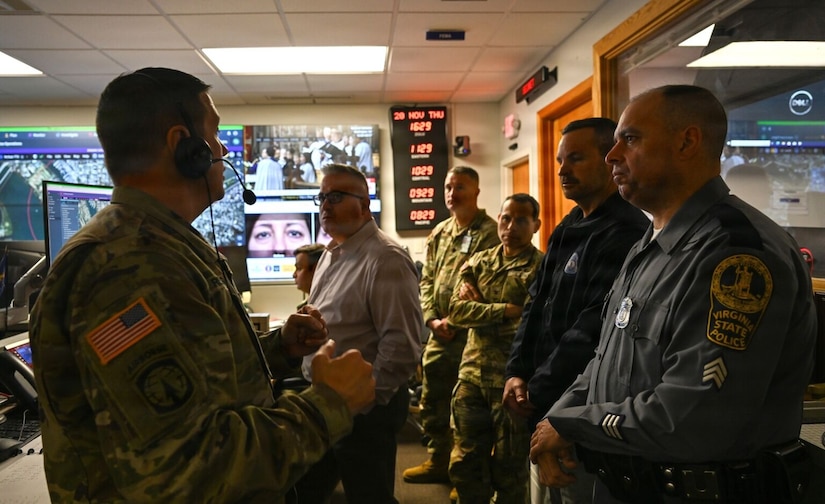
A man in a camouflage military uniform stands in front of a wall of screens with maps on them as he talks to people in the foreground.

The joint task force, established in August 2025, is the lead organization for this effort, tasked with synchronizing counter-small UAS efforts across the department and rapidly delivering joint capabilities.  

"Replicator 2 is not about starting from scratch," Ross said. "It's about leveraging the incredible innovation happening in the commercial sector and getting it deployed where it is needed most."

The DroneHunter: A State-of-the-Art Solution 

The DroneHunter is a reusable, artificial intelligence-driven interceptor drone that provides a unique and effective solution to counter small UAS, especially in settings where personnel, infrastructure and surrounding activity require careful control of effects.  

The system uses AI and radar to detect and track small, low-altitude drones in complex environments. Once it spots a potential threat, the system can capture it with a tethered net.

A man wearing a camouflage military uniform and headset speaks to several men in similar attire, police uniforms and business attire while in a government facility with large screens on the back wall.

The captured drone is then safely towed to a designated location for forensic analysis. This solution is ideal for use in the homeland, where the risk to civilian populations and infrastructure must be minimized. 

This initial purchase is the first step in the tailored approach the task force will take to deliver state-of-the-art counter-UAS technology to protect military infrastructure and service members.   

"This is one example that demonstrates how JIATF 401 has taken counter-drone efforts from a community of interest to a community of action," Ross said. "The task force is focused on a whole-of-government approach, working with interagency partners and industry to build a layered defense against the full spectrum of small UAS threats to the homeland."

Friday, December 26, 2025

Religious Sites as Targets: The Strategic Significance of Terrorism Against Places of Worship

Image
Terrorist violence is never random. Even when an attack appears impulsive or opportunistic, the selection of a target reflects a strategic calculation. In recent days, renewed attacks against places of worship—mosques, synagogues, and churches—have once again demonstrated a grim pattern: extremists consistently choose sacred spaces not merely for casualties, but for symbolism. These acts are designed to fracture social trust, provoke sectarian fear, and transform houses of peace into theaters of terror.

This pattern is neither new nor accidental. From the 2019 Christchurch mosque attacks in New Zealand to synagogue shootings in the United States, church bombings in Africa, and mosque attacks in the Middle East, places of worship have become among the most psychologically potent targets available to violent extremists. Understanding why requires examining not only tactics, but meaning.


Sacred Space and Symbolic Violence

Places of worship occupy a unique position in human societies. They are not merely buildings; they represent moral order, communal identity, continuity, and transcendence. For believers, these spaces are sanctified by ritual, memory, and covenant. For terrorists, that sanctity is precisely the point.

Violence in a sacred space carries an amplified message. It declares that no place is beyond reach, no value is protected, and no refuge is secure. Unlike attacks on infrastructure or military targets, attacks on religious institutions strike at the psychological foundations of community life. The goal is not just death, but desecration.

Extremist ideologies—whether religious, ethno-nationalist, or political—often frame themselves as purifying forces. Targeting a place of worship allows attackers to redefine sacredness on their own terms, asserting dominance over what a society holds inviolable. In this sense, terrorism against religious sites is a form of symbolic warfare, aimed at rewriting moral boundaries through fear.


Soft Targets, Hard Consequences

From an operational standpoint, places of worship are often “soft targets.” They are designed to be open, welcoming, and accessible. Security measures are typically limited, especially during regular services. This openness, essential to religious practice, creates vulnerabilities that extremists exploit.

Yet the consequences extend far beyond the immediate victims. Attacks on religious sites reverberate across entire societies. They provoke retaliatory violence, deepen existing divisions, and invite cycles of grievance that extremists rely on for recruitment and justification.

Research in terrorism studies consistently shows that attacks targeting civilians in symbolic spaces increase media attention and emotional response, even when casualty counts are lower than those of large-scale bombings. The spectacle matters. Terrorists understand that fear spreads faster than ideology, and sacred spaces magnify that fear.


Sectarianism as a Force Multiplier

In regions already marked by religious or ethnic tension, attacks on places of worship function as accelerants. A bombing of a mosque or synagogue is rarely intended to end with the initial act. It is meant to provoke reprisals, confirm narratives of persecution, and polarize populations into mutually hostile camps.

This strategy has been employed by groups such as ISIS, which deliberately targeted Shi’a mosques to inflame Sunni–Shi’a conflict, destabilize governments, and position itself as a defender of a “true” faith. Similar dynamics are visible in attacks driven by white supremacist ideology, where violence against synagogues or churches is framed as resistance to imagined cultural threats.

In each case, the place of worship becomes a proxy battlefield. The physical damage is real, but the deeper objective is social fragmentation.


Western Democracies and the Illusion of Distance

For much of the early 21st century, attacks on religious sites were often framed as distant tragedies—problems of the Middle East, South Asia, or Africa. That illusion has long since collapsed. The United States and Europe have witnessed repeated attacks on churches, synagogues, and mosques, carried out by individuals radicalized online, inspired by transnational ideologies, or motivated by domestic grievances reframed as existential threats.

These incidents reveal a critical challenge for liberal democracies: how to protect open societies without transforming sacred spaces into fortified zones. Heavy security can deter attackers, but it also risks altering the very character of religious life, reinforcing the sense that fear has won.

The dilemma is not merely tactical. It is philosophical. Terrorism against places of worship forces societies to confront questions about pluralism, tolerance, and the limits of openness in an age of ideological violence.


Leadership, Responsibility, and Prevention

Preventing attacks on religious sites requires more than armed guards and surveillance cameras. It demands leadership—moral, civic, and institutional. Community leaders, faith organizations, and governments must work collaboratively to address both immediate security needs and the deeper drivers of radicalization.

This includes early intervention programs, interfaith dialogue grounded in realism rather than symbolism alone, and clear legal frameworks that balance civil liberties with public safety. It also requires honest recognition that extremist violence often feeds on grievance narratives that thrive in environments of social isolation and mistrust.

Importantly, leaders must resist the temptation to respond with rhetoric that mirrors extremist logic. Collective blame, inflammatory language, and political opportunism all serve the objectives of those who seek division. The defense of sacred spaces is inseparable from the defense of democratic values.


Why This Pattern Endures

Terrorism against places of worship persists because it works—at least in the short term. It commands attention, destabilizes communities, and forces societies into reactive postures. But history also shows that such violence ultimately fails to achieve its broader aims.

Communities rebuild. Faith endures. The symbolic power terrorists seek to exploit often rebounds against them, strengthening solidarity rather than destroying it. Yet this outcome is not automatic. It depends on how societies respond—whether they retreat into fear or reaffirm shared values under pressure.

Understanding why religious sites are targeted is therefore not an academic exercise. It is a prerequisite for resilience.


Conclusion

Attacks on places of worship are among the most morally corrosive forms of terrorism. They exploit humanity’s deepest instincts—faith, belonging, reverence—and attempt to weaponize them against the societies that cherish them. These acts are designed not only to kill, but to desecrate, divide, and intimidate.

Recognizing the strategic logic behind such attacks allows communities and leaders to respond with clarity rather than panic, resolve rather than rage. Sacred spaces will always be vulnerable precisely because they are sacred. The challenge is not to abandon openness, but to defend it wisely.

In the end, the measure of a society is not whether it can prevent every act of violence, but whether it can preserve its moral architecture when that violence occurs. Terrorists target places of worship because they understand what those places represent. The response must prove them wrong about what can be destroyed.


References Al Qaeda. (2005).

Hoffman, B. (2017). Inside terrorism (2nd ed.). Columbia University Press.

Pape, R. A. (2005). Dying to win: The strategic logic of suicide terrorism. Random House.

United Nations Office of Counter-Terrorism. (2021). Protection of religious sites: Enhancing security and fostering resilience. United Nations.

Weinberg, L., Pedahzur, A., & Hirsch-Hoefler, S. (2004). The challenges of conceptualizing terrorism. Terrorism and Political Violence, 16(4), 777–794.

Monday, December 22, 2025

Preventing the Next Generation of Terrorism: Lessons History Keeps Teaching Us

Image
Terrorism is often treated as a sudden rupture in social order—an eruption of violence that demands immediate suppression. Yet history shows that terrorism is rarely spontaneous. It is learned, inherited, and refined across generations. Each era encounters what it believes to be a novel threat, but the underlying dynamics of political violence remain strikingly consistent. Preventing the next generation of terrorism therefore requires more than improved surveillance or military capability; it requires an honest reckoning with historical patterns that societies repeatedly ignore.

One of the most persistent lessons is that terrorism is a social process before it is a security problem. Studies of extremist movements across the twentieth and twenty-first centuries demonstrate that radicalization develops through narratives of grievance, identity, and moral justification rather than through ideology alone. Individuals are rarely drawn to violence by doctrine in isolation; they are drawn by stories that explain personal or collective suffering and assign blame in morally absolute terms. Terrorist organizations survive not because they win militarily, but because they transmit these narratives effectively across time, adapting their language to new audiences while preserving core myths of victimhood and redemption. When counterterrorism strategies focus solely on eliminating leaders or dismantling cells, they often leave these narratives intact, allowing new adherents to emerge under different banners.

History also reveals the limitations of purely military solutions. Tactical victories against terrorist groups have repeatedly failed to produce lasting security when they are not accompanied by political legitimacy and social repair. In cases ranging from colonial-era insurgencies to modern counterterrorism campaigns, the use of overwhelming force has frequently reduced immediate violence while increasing long-term resentment. Civilian casualties, collective punishment, and indefinite emergency measures tend to validate extremist claims that peaceful participation is futile. This does not imply that force is unnecessary; rather, it underscores that force alone cannot resolve a phenomenon rooted in social meaning and political trust.

Modern radicalization pathways further complicate prevention efforts. Historically, extremist recruitment occurred through face-to-face relationships embedded in local communities. Today, digital platforms allow individuals to radicalize in isolation, consuming curated grievance narratives without direct organizational contact. Research indicates that online environments accelerate moral polarization by rewarding outrage, simplifying complex conflicts, and reinforcing identity-based hostility. Prevention therefore must occur earlier and more subtly than traditional security models allow. By the time an individual appears on the radar of law enforcement, the underlying process has often been underway for years.

Communities play a decisive role in interrupting this process. Historical evidence consistently shows that strong social bonds, credible local leadership, and inclusive civic institutions reduce susceptibility to extremist recruitment. When communities trust public institutions and feel represented within them, extremist narratives lose plausibility. Conversely, when communities are treated primarily as security risks rather than as partners, alienation deepens and informal social controls weaken. Prevention efforts that succeed tend to be those that enhance community resilience rather than impose external control.

Another lesson history teaches is that terrorism competes in a marketplace of meaning. Extremist movements offer their adherents identity, purpose, and moral certainty—often in contexts where legitimate avenues for meaning appear absent or discredited. Education alone has not proven sufficient to counter this appeal. While economic opportunity and civic education are important, they must be paired with credible moral frameworks that acknowledge grievance without sanctifying violence. Societies that neglect this struggle over meaning leave space for absolutist ideologies to fill the void.

Leadership and moral consistency are equally critical. Historical case studies demonstrate that counterterrorism efforts lose credibility when states abandon their professed values under pressure. Torture, indefinite detention, and extrajudicial practices may produce short-term intelligence gains, but they undermine the moral authority necessary for long-term prevention. Extremist movements thrive on examples of hypocrisy, using them to reinforce narratives of injustice and persecution. Leaders who model restraint, accountability, and proportionality during crises help deny future extremists the moral ammunition they seek.

Perhaps the most uncomfortable lesson is that the persistence of terrorism reflects not ignorance, but avoidance. The historical record clearly documents what fuels extremist violence and what mitigates it. Yet prevention strategies often clash with political incentives that favor immediate, visible action over long-term investment. Addressing radicalization requires patience, humility, and a willingness to confront social failures that are politically inconvenient. As a result, societies repeatedly default to reactive measures, rediscovering the same lessons after each new attack.

Preventing the next generation of terrorism ultimately means acting before the phenomenon has a name, a leader, or a flag. It requires viewing terrorism not as an external infection, but as a byproduct of unresolved grievances, fractured identities, and eroded trust. History does not suggest that terrorism can be eliminated entirely, but it does make clear that its appeal can be narrowed. The question is not whether the lessons are available, but whether societies are willing to apply them consistently, even when fear and anger make restraint difficult.

References

Crenshaw, M. (1981). The causes of terrorism. Comparative Politics, 13(4), 379–399.

Horgan, J. (2008). From profiles to pathways and roots to routes: Perspectives from psychology on radicalization into terrorism. The Annals of the American Academy of Political and Social Science, 618(1), 80–94.

Kydd, A. H., & Walter, B. F. (2006). The strategies of terrorism. International Security, 31(1), 49–80.

Neumann, P. R. (2013). The trouble with radicalization. International Affairs, 89(4), 873–893.

Pape, R. A. (2005). Dying to win: The strategic logic of suicide terrorism. Random House.

Friday, December 19, 2025

Federal Grand Jury Indicts Man on Terrorism and Arson Charges for Lighting Train Passenger on Fire and Setting Chicago City Hall Ablaze Days Earlier

CHICAGO — A federal grand jury in Chicago has indicted a man on terrorism and arson charges for allegedly lighting a passenger on fire on a Chicago Transit Authority train and setting fire to Chicago City Hall three days earlier.

The indictment against LAWRENCE REED, 50, of Chicago, was returned on Wednesday in U.S. District Court for the Northern District of Illinois.  The charges in the indictment are punishable by a maximum sentence of life in federal prison.

The indictment renews the terrorism offense for which Reed was initially charged last month.  Reed allegedly approached a woman aboard a Chicago Transit Authority train on Nov. 17, 2025, ignited a bottle containing a liquid substance, and used it to light the victim on fire.  The victim was engulfed in flames but was able to depart the train.  She remains hospitalized with critical injuries. 

The indictment for the first time charges Reed with arson for allegedly setting a fire to Chicago City Hall on Nov. 14, 2025. The indictment accuses Reed of maliciously damaging and attempting to destroy the building, which is located at 121 N. LaSalle St. in downtown Chicago.

Reed was arrested by Chicago Police officers on Nov. 18, 2025, and he remains detained in federal custody without bond.  Arraignment for the charges in the indictment is scheduled for Dec. 19, 2025, at 12:00 p.m. before U.S. Magistrate Judge Laura K. McNally.

The indictment was announced by Andrew S. Boutros, United States Attorney for the Northern District of Illinois, Christopher Amon, Special Agent-in-Charge of the Chicago Field Division of the U.S. Bureau of Alcohol, Tobacco, Firearms & Explosives, and Larry Snelling, Superintendent of the Chicago Police Department.  Valuable assistance was provided by the Chicago Transit Authority.  The government is represented by Assistant U.S. Attorneys Aaron R. Bond and Ronald L. DeWald.

The public is reminded that an indictment is not evidence of guilt.  The defendant is presumed innocent and entitled to a fair trial at which the government has the burden of proving guilt beyond a reasonable doubt.

Justice Department Highlights Nationwide Crackdown on Tren de Aragua

WASHINGTON – The Department of Justice announced the unsealing of multiple indictments against more than 70 individuals, including leaders and members of designated foreign terrorist organization Tren de Aragua (TdA), linked to various violent crimes inside and outside the United States, including murder, robbery, extortion, kidnapping, money laundering, and controlled substance trafficking. These actions include indictments across five U.S. Attorney offices, including the District of Colorado, District of Nebraska, District of New Mexico, Southern District of New York, and the Southern District of Texas.

Since January 20, 2025, the Department has federally indicted over 260 members of TdA.  

“Immediately upon taking office, I directed the Department of Justice to fiercely pursue the total elimination of cartels and transnational criminal organizations,” said Attorney General Pamela Bondi. “This latest multi-state series of charges underscores the Trump Administration's unwavering commitment to restoring public safety, dismantling violent trafficking networks, and ridding our country of Tren de Aragua terrorists.”

“Tren de Aragua is a terrorist cartel that exploits our borders to bring murder, drugs, and chaos into American communities,” said Deputy Attorney General Todd Blanche. “This Department is crushing their leadership, dismantling their networks, and cutting off their money across the United States. There will be no safe haven here. If you cross our border to commit violent crime, we will find you, prosecute you, and put you away.”

“The FBI is committed to investigating members of violent transnational gangs whose actions violate our laws and put American lives at risk,” said FBI Director Kash Patel. “The existence of TdA is a direct threat to our national security, and we will not allow such a dangerous criminal organization to take root in our communities. Together with our law enforcement partners at every level, we are working to bring these ruthless criminals to justice.”

“Tren de Aragua is a ruthless, highly organized, and rapidly expanding foreign terrorist organization that thrives on chaos and human suffering,” said DEA Administrator Terrance Cole. “They exploit alliances with other terrorist-designated groups and transnational networks, including the FARC, ELN, and Cartel de los Soles, fueling instability, corruption, and violence across the region while endangering American communities. DEA is confronting this threat by relentlessly targeting their leadership, financial networks, and infrastructure. Those who align with TdA are standing against the United States and will face the full force of federal law enforcement.”

“The United States Marshals Service makes this point clear to all members of gangs like Tren de Aragua, we are coming for you,” said Gadyaces S. Serralta, Director of the United States Marshals Service. “We will not give you a moment of rest. We will find you. We will arrest you. You will be made to answer for your crimes. We will continue to work with all of our federal partners, to rid you from our country. Together, we are making the communities of America safer.”

“The foreign terrorist organization known as Tren de Aragua has used illicit firearms to maintain and expand control of its criminal enterprise, and imparted untold violence, widespread narcotics addiction, and death in American communities,” said Bureau of Alcohol, Tobacco, Firearms and Explosives Deputy Director Rob Cekada. “The men and women of ATF, along with our federal law enforcement partners, have worked tirelessly to bring the members of this organization to justice. We will continue to systematically dismantle Tren de Aragua and other foreign terrorist organizations to ensure our communities are protected from harm. The days of Tren de Aragua running roughshod over the American public, preying on, and profiting from American citizens is over.”

“These actions reflect the strength of our partnerships and our determination to dismantle criminal networks like Tren de Aragua,” said BOP Director William K. Marshall III. “The Federal Bureau of Prisons is proud to support this mission by providing critical intelligence and secure management of offenders, ensuring justice and safety for our communities.”

A case summary is below: 

Two alleged leaders of TdA have been indicted by a federal grand jury in connection with a series of crimes in Colorado. These defendants are facing several charges including a Racketeer Influenced and Corrupt Organization (RICO) conspiracy. The indictment alleges that from May 2024 through on or about March of 2025, the defendants conducted activity for TdA through a pattern of racketeering activity that included robbery, extortion, kidnapping, money laundering and controlled substance offenses. The defendants are also charged with conspiracy to commit robbery and two counts of Hobbs Act Robbery and firearms offenses in connection with the armed robberies of two jewelry stores in the Denver, Colorado area in June of 2024.

A grand jury returned two indictments charging a total of 54 individuals, some associated with TdA, for leading and facilitating a large-scale conspiracy to use malware to steal millions of dollars from U.S. financial institutions by hacking ATMs. Charges against some of the defendants included conspiracy to provide material support for terrorism, in addition to conspiracies to commit bank fraud, money laundering, bank burglary, and computer fraud and abuse.

Federal prosecutors have indicted 11 alleged members and leaders of TdA on racketeering charges, accusing them of kidnapping, brutally interrogating, and strangling a victim in an Albuquerque apartment, before burying his body in a remote desert grave. Some defendants were also directly involved in an armed confrontation at an apartment complex in Aurora, Colorado, during which rival groups exchanged gunfire and a victim was killed.

An indictment has been unsealed charging Hector Rusthenford Guerrero Flores, a/k/a “Nino Guerrero,” in connection with a leadership role in TdA operating throughout North America, South America, and Europe. For over a decade, Guerrero Flores has served as either the leader or co-leader of TdA, acting as the mastermind over TdA’s expansion across the Western Hemisphere. While operating from Venezuela and elsewhere, Guerrero Flores ordered, directed, facilitated, and supported acts of violence and terrorism transcending national boundaries, including murders, kidnappings, extortions, and maiming against victims located inside and outside the United States, and facilitated the transport of tons of cocaine from Venezuela to the United States. Guerrero Flores is currently at large, and the U.S. Department of State is offering rewards of up to $5 million for information leading to his arrest and/or conviction.

A six-count superseding indictment has been unsealed charging four Venezuelan nationals, including multiple alleged high-ranking members of TdA, for conspiring to provide and providing material support to TdA, and for conspiracy and distribution of cocaine in Colombia intended for distribution in the United States. According to court records, two of the defendants are some of the topmost TdA leaders, with one allegedly exercising command and control over all of TdA’s criminal operations, including the illegal importation and smuggling of gold and narcotics, extortion, and murder. The two other defendants are also high-ranking TdA leaders who operate out of multiple South American countries and direct operations to include gold smuggling, narcotics export and violent crime.

These cases are part of Joint Task Force Vulcan (JTFV), which was created in 2019 to eradicate MS-13 and now expanded at the direction of Attorney General Bondi to target Tren de Aragua. JTFV is comprised of U.S. Attorney’s Offices across the country. Those include Southern and Eastern Districts of New York; Eastern and Western Districts of North Carolina; Eastern and Western Districts of Virginia; Southern District of Florida; Eastern District of Texas; Western District of Oklahoma; Northern District of Indiana; and the District of Nevada; as well as the as well as the Executive Office for U.S. Attorneys  Department of Justice’s National Security Division and the Criminal Division. Additionally, the FBI, DEA, HSI, ATF, USMS, and the Bureau of Prisons are essential law enforcement partners with JTFV. The Justice Department’s Office of International Affairs and the Criminal Division’s Office of Judicial Attaché in Bogotá, Colombia, has also provided significant assistance.

TdA is a violent transnational criminal organization that originated as a prison gang in Venezuela in the mid-2000s. TdA has expanded its criminal network throughout the Western Hemisphere and established a presence in the United States. TdA’s criminal activities include a variety of violent and criminal offenses, including drug trafficking, firearms trafficking, commercial sex trafficking, kidnapping, robbery, theft, fraud, and extortion. TdA members also commit murder, assault, and other acts of violence to enforce and further the organization’s criminal activities. TdA has also developed an additional source of revenue stream through financial crimes that target financial institutions throughout the United States, including using jackpotting to steal millions of dollars in cash.

An indictment is merely an allegation. The defendants are presumed innocent until proven guilty beyond a reasonable doubt in a court of law.

Tuesday, December 16, 2025

Early Lessons from Bondi Beach: What the First Hours Reveal About Modern Terrorism

Image
In the first hours after a mass-casualty terrorist attack, a society does two things at once. It grieves. And it tries to understand. Those tasks can collide: grief pulls toward meaning, certainty, and blame; disciplined analysis pulls toward restraint, verified facts, and patterns that can prevent the next attack. The Bondi Beach incident—an attack on a Hanukkah celebration at one of Australia’s most recognizable public spaces—forces that collision into the open. Even before every evidentiary detail is known, the early reporting and official statements already illuminate recurring features of modern terrorism: the continued preference for soft targets, compressed timelines, the power of narrative contagion, and the outsized importance of immediate response and communication. (Reuters)

The first lesson is the oldest: terrorism still chooses soft targets because soft targets create hard consequences. Bondi Beach was not selected for tactical advantage; it was selected for psychological effect. Open public gatherings offer crowds, visibility, and a sense of shared innocence—all qualities that amplify fear when violated. Attacking a religious celebration compounds that effect by signaling identity-based threat, not merely random violence. Early accounts describe the incident as an antisemitic terrorist attack and indicate the Jewish community was a specific focus of the assault, a detail that immediately shapes how communities interpret risk and how governments prioritize protection. This is precisely the kind of targeting that can trigger second-order harms—copycat threats, retaliatory anger, and long-term chilling of public life—unless leaders and institutions respond with clarity and unity. (AP News)

The second lesson is that “inspiration” can be operationally sufficient. In the Bondi reporting, officials described early indications that the attack was inspired by Islamic State ideology, and investigators have examined indicators such as alleged ISIS-associated flags and suspected explosive devices connected to the attackers. That matters because modern terrorism does not always require direct tasking by a centralized organization to achieve strategic effect. When a terrorist brand functions as a template—providing symbols, scripts, and legitimizing rhetoric—it can motivate violence that looks “leaderless” while still serving the broader purpose of spreading fear and polarizing societies. The operational burden on law enforcement and intelligence increases in this environment because the threat is less about intercepting communications and more about detecting shifts in intent, capability, and acceleration toward action. (Reuters)

A third lesson is that warning timelines are shrinking, and the gap between suspicion and proof can be deadly. Early reporting indicates one of the alleged gunmen was known to security services, but authorities still had no indication of a planned attack. That combination is not unusual in contemporary counterterrorism. Agencies may hold fragments—prior encounters, concerning speech, minor flags—without the specific, admissible, actionable intelligence that justifies intervention. This is the space where prevention is hardest: the pre-attack phase in which the threat is not yet a crime, the signals are ambiguous, and legal thresholds matter. The implication is not to lower standards indiscriminately, but to strengthen the connective tissue that turns weak signals into timely safeguards: improved threat reporting pathways, better integration between community concerns and investigative triage, and faster mechanisms for assessing risk when behavior shifts rapidly. (AP News)

The fourth lesson is that small-cell dynamics can produce strategic-scale outcomes. Authorities described the alleged perpetrators as a father and son, and multiple reports state one was killed at the scene and the other was hospitalized in critical condition. A two-person team can divide roles, reinforce commitment, and move from intent to execution quickly—especially if they already share trust, proximity, and privacy. Family-based or tightly bonded micro-cells reduce the visibility of planning to outsiders, narrowing opportunities for external disruption. For prevention, this underscores the importance of not romanticizing the “lone actor” category; many attacks occur in the gray zone of “small-cell terrorism” where the footprint is minimal but capability is real. (Reuters)

A fifth lesson emerges from the early investigative threads around travel and possible facilitation: modern extremist influence can be transnational even when perpetrators are locally embedded. Reuters reported that both alleged attackers traveled to the Philippines in the weeks before the assault, and authorities have been examining whether they had any link to terrorist networks or training—while also noting that such links were not conclusive at the time of reporting. This is a crucial analytical posture: follow the leads without overstating them. From a counterterrorism standpoint, the lesson is not that travel equals training; it is that travel, contact, and ideological consumption can create a mosaic of risk that must be evaluated quickly and cooperatively across borders. In the first days after an attack, the quality of international coordination—immigration records, digital traces, financial signals—often determines whether investigators can map facilitation pathways or confidently rule them out. (Reuters)

A sixth lesson is that response speed and decisive engagement remain the thin line between tragedy and catastrophe. The early narrative of Bondi includes accounts of immediate police engagement and community actions that may have limited further harm, along with reports of officers being seriously injured while intervening. In mass-casualty events, the most consequential decisions often occur before national leaders speak and before investigators convene: the first officers moving toward gunfire, the medics establishing triage, the bystanders choosing whether to run, hide, or help. Terrorism seeks to turn minutes into multipliers—more casualties, more panic, more chaos. Rapid, coordinated response denies that multiplier effect. That is not merely a tactical observation; it is a strategic one, because reducing casualties reduces the terrorist “victory narrative” and limits the emotional blast radius that fuels polarization. (AP News)

A seventh lesson concerns the “secondary battlefield” of information. In the first hours after Bondi, multiple outlets emphasized official cautions, the evolving nature of details, and the significance of accurate classification (terrorism versus other categories of violence). This matters because terrorism is performative: it is designed for audiences beyond the immediate victims. The information environment can inadvertently serve terrorist objectives when rumor outruns confirmation, when communities are collectively blamed, or when political rhetoric escalates faster than evidence. The Bondi coverage shows the familiar pressure points: identity-based fear, speculation about networks, and demands for immediate policy action. Early lesson: treat truth as an operational requirement. Governments, media, and civic leaders reduce harm when they communicate what is known, what is unknown, and what is being done—without filling gaps with insinuation. (Reuters)

An eighth lesson is that policy responses begin immediately, whether or not they are wise. Within days, reporting described New South Wales moving toward emergency gun law reforms and broader legal changes, while national leaders debated how to prevent recurrence in a country widely seen as having strong firearms regulation relative to many peers. This is a recurring pattern after terrorism: the incident becomes proof, and the political system is pressured to demonstrate control. Sometimes that yields durable improvements; sometimes it yields symbolic measures that miss the attacker’s actual pathway. The early lesson is not “act slowly.” It is “act precisely.” Policy made in the emotional heat of an attack should be grounded in the specific failure modes revealed by early evidence: licensing oversight, weapons acquisition, protective security for at-risk communities, threat reporting, and the interface between intelligence and local policing. Otherwise, the response risks becoming theater—comforting, visible, and strategically irrelevant. (Reuters)

A ninth lesson is about social cohesion as a counterterrorism capability. Terrorism is not only violence; it is an attempt to provoke societal fracture. When an attack targets a religious minority, the attacker’s hope is often twofold: terrorize the target community and provoke a broader backlash that deepens division, validating extremist narratives on all sides. Early reporting emphasized the shock of the attack and the national reckoning it triggered around antisemitism and violent extremism. In the first days, communal rituals—vigils, funerals, blood donations, public solidarity—do more than comfort the bereaved. They inoculate the public against the attacker’s political goal: turning fear into hatred. Resilience is not a slogan; it is an organized refusal to let terrorists choose the country’s next emotion. (Reuters)

Finally, Bondi underscores a disciplined conclusion: early lessons are about controlling what can be controlled. Investigations will determine the full chain of causality—how weapons were obtained, whether there were facilitators, what warning indicators existed, and what could have been disrupted. But the first hours already highlight enduring truths about modern terrorism: it exploits openness, compresses timelines, leverages ideology as a scalable toolkit, and seeks narrative dominance as much as physical harm. The best early response, therefore, is a blend of speed and restraint—rapid protection and medical action, paired with careful language, evidence-based policy, and unity that refuses collective blame. Terrorism aims to accelerate reaction. A society that can grieve without losing discipline denies terrorists the second victory they are always seeking: the reshaping of public life around fear. (Reuters)

References

Chen, C. (2025, December 16). Bondi gunmen were inspired by Islamic State, had travelled to the Philippines, Australia police say. Reuters.

Gelineau, K., Graham-McLay, C., & McGuirk, R. (2025, December 15). Father and son gunmen kill at least 15 people in attack on Hanukkah event at Sydney’s Bondi Beach. Associated Press.

Murdoch, S., & Jose, R. (2025, December 17). Australian state to pass emergency gun laws as funerals of Bondi attack victims begin. Reuters.

Reuters. (2025, December 16). Indian family of alleged Bondi gunman didn’t know of “radical mindset”, Indian police say. Reuters.

Australian Broadcasting Corporation. (2025, December 17). NSW parliament recalled to discuss gun reforms after Bondi Beach shooting. ABC News.

Doherty, B., Evershed, N., & Shimada, Y. (2025, December 15). Visual explainer: how a night of terror unfolded in Bondi. The Guardian.

Associated Press. (2025, December 16). Australia to hold funerals for the 15 victims of an antisemitic mass shooting at Bondi Beach. Associated Press. (Reuters)