Posted in theology

A meditation on the trend to go back to analog

By Elizabeth Prata

I realize I am writing this on a digital platform to be published on digital media.
Image
EPrata photo

However, I am 65 years old and I was a full adult nearing middle age before the internet came to my house. For most of my life, I had a heavy, black rotary phone, drove cars without a computer chip in them, and looked for books at the library through a card catalog. We sailed our boat over 22,000 nautical miles in the Atlantic Ocean without the help of a GPS. We always found our way to port.

When the internet came, and with it email, bulletin boards, Compuserv, streaming movies, I embraced the digital, it is an incredible invention. I do love it. But it is also fraught with potential for bad, even evil. Temptations and addictions abound. Distraction, FOMO, life comparison, phone addiction, and porn are just a few of those.

Children are entering school without knowing how to have a conversation, with limited vocabulary, and non-existent attention spans. Parents using the phone or tablet as a neglect-o-meter for their children, or on the phone so much themselves, their child wanders the house aimlessly not knowing what true loving engagement is.

We all embraced it when it came along. Schools scrambled to buy chrome books and desktop computers so their students would not be ‘left behind’. The dot.Com boom helped this attitude. The old humongous TV on a rolling cart used once in a while for a documentary program was replaced by ever larger screens used for just about everything. Apps were added to student computers to use at home and increasingly, in school. Even standardized testing went digital.

What I am seeing is a trend in the world back to digital. Being 65 and having seen trends come and go- and come again- is the way of the world. I’m glad there is a movement back to analog.

Many states in the US are banning student use of cell phones during school hours. Sweden was a country that initially wholeheartedly embraced it all. But over time, the glow dwindled. We read about Sweden

“…by 2023, Sweden’s government and educators began to voice concerns. Studies raised red flags about declining reading comprehension and concentration among Swedish students. The Swedish government officially announced it would scale back the use of digital devices in early grades, with more focus on physical books and handwriting. According to an AP News report, Sweden’s Education Minister Lotta Edholm said students “need more textbooks” and emphasized that physical books are important for student learning as the country reconsiders screen-heavy instruction.”

There is a swing among Gen Z and millennials to ‘go analog’. I’ve read more than once lately that vinyl records are surging in popularity. Young adults scour the thrift stores for record players. Apparently there comes a time when a critical mass of concerns make using digital media just not fun anymore. Recent announcements by streaming music companies that you can pay to download songs but you don’t own them have dimmed the glow of the ease of using digital media for music. Major services who offer a service but decline to allow the consumer to own the music- meaning it can be removed at any time from their platforms, include Spotify, Apple Music, YouTube Music, and Amazon Music.

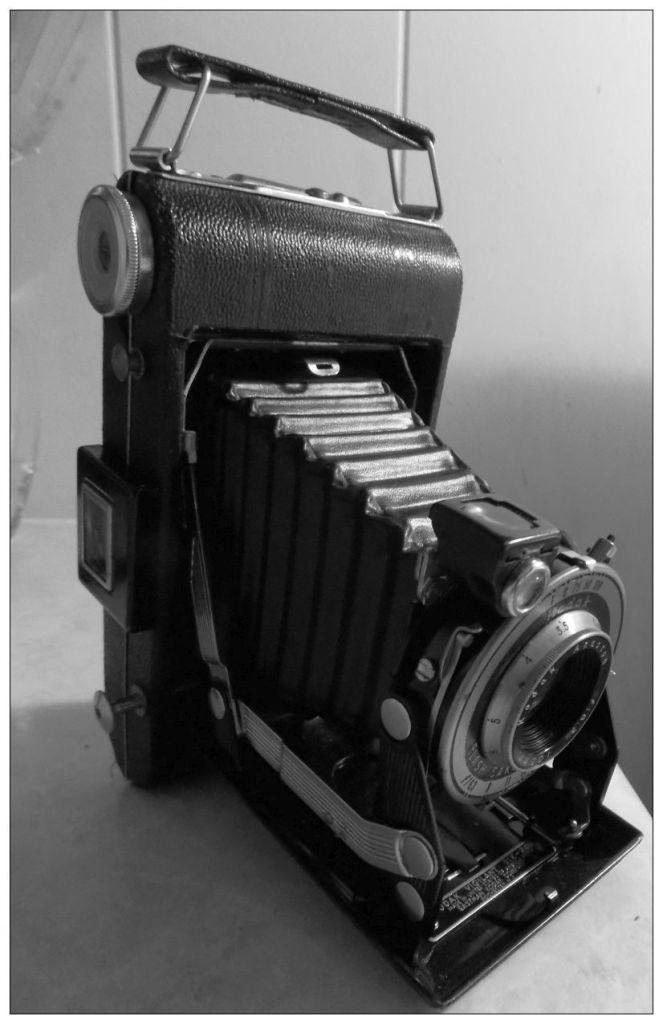
When older adults fondly recall sitting snuggled on the couch with their family and reminiscing over a photo album with 35 mm pictures in them, telling stories and knitting together in love, younger adults only have the cold phone swiping photo and feel they are missing out. And they are.

Photo albums are going extinct, but is that a good thing? Photo albums are the repository of nostalgia, family stories, personal history. Pixels don’t last. Photos do. A family narrative huddled around a smartphone, looking at pictures one by one does not have the same tender qualities as the former way of creating meaning among a family unit.

Image
EPrata photo

There is a documentary that’s got people excited, it’s called “California Typewriter.” The documentary’s blurb goes,

CALIFORNIA TYPEWRITER is a documentary portrait of artists, writers, and collectors who remain steadfastly loyal to the typewriter as a tool and muse, featuring Tom Hanks, John Mayer, David McCullough, Sam Shepard, and others. It also movingly documents the struggles of California Typewriter, one of the last standing repair shops in America dedicated to keeping the aging machines clicking. In the process, the film delivers a thought-provoking meditation on the changing dynamic between humans and machines, and encourages us to consider our own relationship with technology, old and new, as the digital age’s emphasis on speed and convenience redefines who’s serving whom, human or machine?

DIgital media can display the best of humans, as in a GoFundMe to help a flooded out or burned out family. It can also illustrate our depravity, as some of those GoFundMe cases are revealed to be lies. People are turned off by constant AI fakery, lies, nastiness over even innocuous comments. It seems to be a quiet revolution as more people turn off their phones, swap for flip phones, retreat from social media, or just in general, quit.

“We’re seeing that a group of Gen Z [and millennials] is choosing to leave social media entirely, and probably a larger group that’s choosing just to limit social media as they regain more of what they’re trying to find: balance and security and safety in their life,” Dorsey said,” in this article, “A ‘quiet revolution’: Why young people are swapping social media for lunch dates, vinyl records and brick phones.

In this article, we see the word tangible. In other articles I’ve see the word tactile. “Gen Zers and millennials flock to so-called analog islands ‘because so little of their life feels tangible'” More and more people are choosing analog hobbies –

They are setting down their devices to paint, color, knit and play board games. Others carve out time to mail birthday cards and salutations written in their own hand. Some drive cars with manual transmissions while surrounded by automobiles increasingly able to drive themselves. And a widening audience is turning to vinyl albums, resuscitating an analog format that was on its deathbed 20 years ago.”

Image
EPrata photo

I am not a prophet and I can’t say this trend will last. I hope so. I tell my students at school about ‘the old days of the 1900s’ when we played outside, rode our bikes all over, went to each other’s houses, had sleepovers, drank from the water hose, begged a dime for the ice cream truck, went to the movies on weekends for $1, and never saw a personal screen in all our lives. Their mouths drop open. They are amazed. My heart aches for them because I know what they are missing out on.

Of course in today’s world many of those activities are no longer safe or possible. But the ‘analog’ hobbies were fun. As I said, I hope this trend lasts a while, but in the end I think the world will be overrun with technology and with it, its worst qualities.

The Bible says that the future will be a one world economy, and it’s hard to see that happening without even further advancement of the digital world. The Antichrist who will seem to rise from the dead could easily be a faked AI video or a hologram. But for now, I salute those young adults who are searching for ‘analog’ connection, tactile hobbies, and a life not dominated by emotionless digital pressure but warmth of fellowship, swapped stories, and sunshine.

Image
EPrata photo
Posted in theology

“IF:One Night” and Jennie Allen’s “voice from the sky”

By Elizabeth Prata

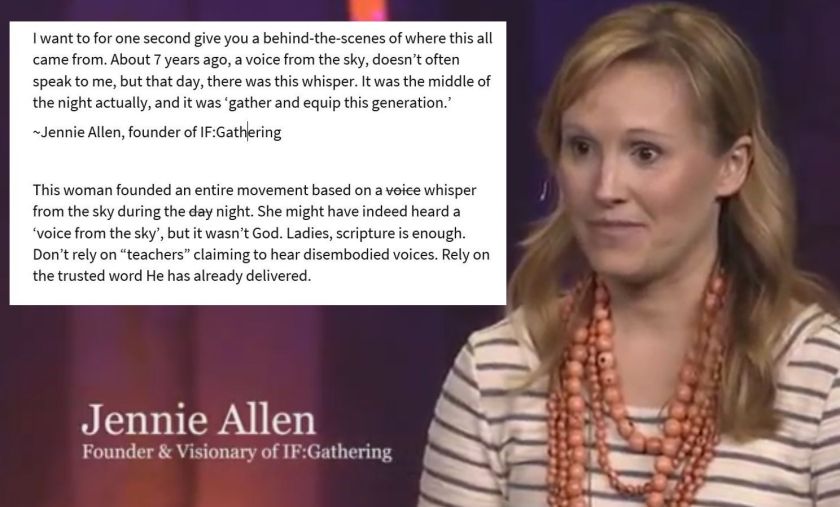
In 2007, Jennie Allen heard a “voice from the sky”. Or it was a whisper. It spoke to her that day. Or it was the middle of the night. Anyway, the whisper told her things. It said, “Gather and equip this generation”. So she obeyed and founded IF:Gathering in 2014.

Ahem, you can see from the dates that there was a delayed reaction to her obedience…

Image
Quote from Jennie Allen’s first IF:Gathering. I have the video of her saying it. It’s real.

This non-profit organization’s stated main mission is: “TO GATHER, EQUIP AND UNLEASH THE NEXT GENERATION OF PEOPLE TO LIVE OUT THEIR PURPOSE.”

Revenue last year was 11.3 million, expenses were 7.6 million, for a total take of 3.7 million dollars and 6.8 million in assets. (Source).

Their stated three-fold sub-mission is stated as the following:

If Lead: equipping women to share and learn through Christ-centered discussions

If Gather: a two-day gathering that brought thousands of women together in Fort Worth and at local gatherings across the globe. The gathering is a fresh, deep, honest space for a new generation of women to wrestle with the essential question: If God is real… Then what?

If Equip: a holistic, strategic, deep way to connect online with a like-hearted community and relevant resources. We hope to prepare women around the world to know God more deeply and to live out their purposes by sharing comments and feelings about daily passages posted online.


On Friday, February 26, Founder Jennie Allen will host this year’s big event: IF:One Night. On their website it’s stated that IF is not only an event, “but a discipleship ministry focused on putting tools and resources in the hands of women in the church. Through these, IF is able to empower women to reclaim discipleship as God’s means to change the world.”

Before you decide to attend (digitally only, the real life event being held at what I believe is Jennie’s church, Watermark Church in Dallas, is sold out) or before you decide to host a local gathering to stream along the event happening at Watermark Church, think on these things.

-Do you want to trust a founder who listens to voices from the sky? The Lord has ceased speaking directly to individuals. That voice from the sky cold have been anything from bad quesadilla rumblings in the night to demons whispering to her ear.

-Do you want to align with an organization that is based on doubt? “IF” God exists? He does. The entire organization, besides the whispery issue, is founded on doubt and promotes women gathering to obsess over them and their ‘feelings’.

-Do you want to trust an organization who presents to you “Bible” teachers who are apostate, false, and otherwise unhealthy? Slated to teach you at IF:One Night are Francis Chan, Matt Chandler, Lauren Chandler (who loves & partners with false teacher Beth Moore), Jennie Allen, Christine Caine, and others who are proven to be unreliable Bible teachers.

-Do you want to compete with and be drawn away from your own local church? Talk about feelings with strangers with whom you do not connect on a weekly basis over the preached word of God in your own assembly? This is a para-church organization whose intent is to multiply groups away from your local church and to whom you are not accountable as you are to your own elders. Please consider discussing any doubts or fears you have with your own church members. It is what they are there for and how the church grows through the word, fellowship, and discipling.

I’ve written about IF:Gathering negatively since the beginning of their foray into Christianity and women’s minds and hearts. I give you an earnest plea: Avoid IF.

See video clip here where Jennie admitted her impetus for founding IF was a voice from the sky:

Posted in theology

Hypnosis: Therapy, Trend, or Spiritual Danger?

From Pagan Sleep Temples to Hypnobirthing: Nothing New Under the Sun

By Elizabeth Prata

Should a Christian undergo hypnosis to ingrain new behavior patterns and dispense with unwanted desires or actions? Isn’t hypnosis just a benign way to relax or reduce anxiety? Is it wrong to use hypnosis when giving birth? (hynobirthing). This essay explores hypnosis from a Christian point of view.

Continue reading “Hypnosis: Therapy, Trend, or Spiritual Danger?”
Posted in discernment, theology

Promises of Painless Birth and the Problem of False Hope

By Elizabeth Prata

SYNOPSIS

A popular teaching claims mothers can secure pain-free childbirth through faith and declaration. Examining Scripture in context, this review exposes faulty interpretation, failed prophecy, and the burden such promises place on women, urging discernment, humility, and trust in God rather than formulas or trends.

Continue reading “Promises of Painless Birth and the Problem of False Hope”
Posted in theology

Prata Potpourri: Chart of Suffering, Planetary Alignment, Marching Orders, How to Deal with Narcissists Biblically, more

By Elizabeth Prata

Jesus said we do not need to worry. Mt 6:25: “For this reason I say to you, do not be worried about your life, as to what you will eat or what you will drink; nor for your body, as to what you will put on. Is not life more than food, and the body more than clothing?”

So let us watch and marvel at His word and feel joy in His promises.

Continue reading “Prata Potpourri: Chart of Suffering, Planetary Alignment, Marching Orders, How to Deal with Narcissists Biblically, more”
Posted in theology

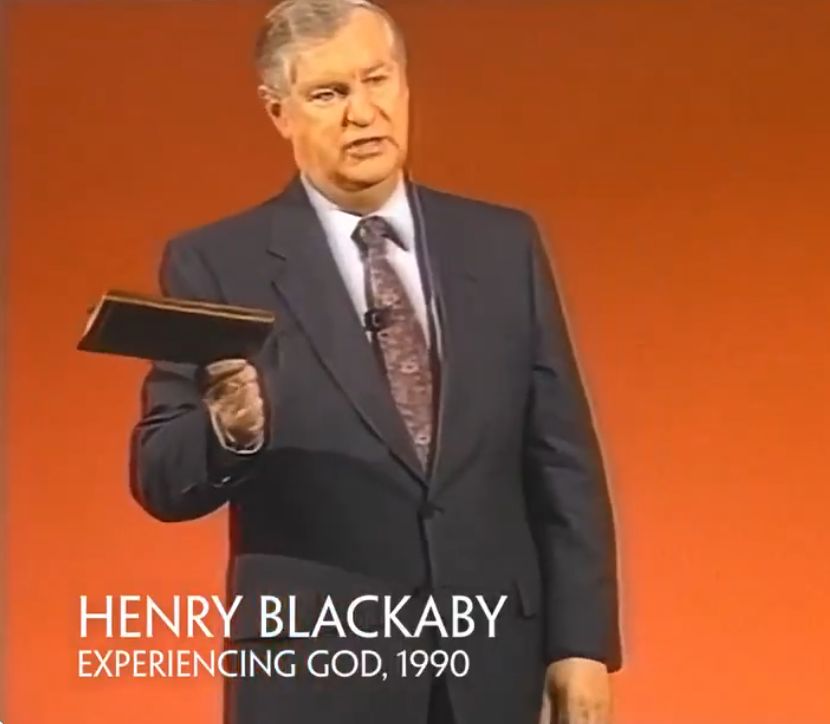
Cut to the Chase: Discerning “Experiencing God” by Blackaby & King

By Elizabeth Prata

Image

My “Cut To the Chase” articles are shorter form, bulleted discernment outlines, rather than a longer essay.


@JustinPetersMin wrote, “Experiencing God was one of the most damaging books introduced to the evangelical world in over a hundred years.”

That us a lot of power in a book. False doctrine does not only emerge from the pulpit. In fact, it is more likely to emerge from the tangential ministries in a church, such as the women’s Bible study, the church Library, or brought in as evil seeds from external conferences members attend elsewhere.

Why was “Experiencing God” so damaging? Let’s take a look.

Issue #1: Normalizing hearing from God

5 Solas wrote on X about Blackaby and Experiencing God, “The false teaching that the way God speaks to His people under the New Covenant is audibly or internally by some “still small voice,” and not through His all-sufficient written Word, has done unimaginable harm to the church. The idea that it’s not a personal relationship unless you are hearing voices or getting impressions is damnable. You are essentially saying that God doesn’t speak through His Word.

This issue relates to the “Sufficiency of Scripture.” We often refer to 2 Timothy 3:16-17 when saying that God’s written word as contained in the 66 books of the Bible is enough for the Christian to learn, absorb, and live by. We do not see and interpret signs or omens, hear whispers, or listen to audible voices directing our steps. The verse says:

All Scripture is inspired by God and beneficial for teaching, for rebuke, for correction, for training in righteousness; so that the man or woman of God may be fully capable, equipped for every good work.

Note the words- All, fully, every. Those words are quantifiers that indicate total, complete, or inclusive quantity. Note what the Bible is good for- all the things a Christian might need to do- teaching (and learning), training, rebuking. Note the benefits of living by the Word only- righteousness, capable, equipped.

How many verses does one need when we have such a perfect description of the Christian life right there in 2 Timothy? But wait, there’s more: Hebrews 4:12, Romans 15:4, Matthew 4:4 and other verses reinforce the sufficiency of God’s word alone.

Image

Issue #2: Believing we can see where God is working

A refrain comes up frequently in the book: “watch to see where God is working and join Him in His work.”

One question: Where ISN’T God working? There is not one molecule not under his jurisdiction, command, and movement. If there is one maverick molecule in the universe (as Sproul famously said) then God is not God, not in control, and not working. It would invalidate His divine sovereignty.

One thought: Do we, being sinners with sin-darkened minds and a finite perspective, have the intelligence to see and know exactly where God is doing a work? The way Providence operates is that it sometimes can be seen but only AFTER the work is done.

One warning: God doesn’t ‘invite’ us to join Him. He commands us to do His will. Working out our salvation with fear and trembling and pursuing holiness is not a cafeteria experience of choosing. ‘I want to join Him there, but not there, that looks uncomfortable…’

Issue #3: That we can come to know God through our own, self-interpreted experiences

In the book, Blackaby (and co-author Claude King) constantly prioritize personal experience over the commands of God through scripture. From the book blurb at Lifeway: “God is inviting you into an intimate love relationship through which He reveals to you His will, His ways, and His work” but the book teaches that He does this not through scripture, but through our experiences and observations.

We don’t come to know God by looking around and observing. Romans 1 teaches that the danger in doing this is that we begin to worship the creation and not the creator.

Justin Peters said in his teaching linked below that, in “Experiencing God, Henry Blackaby says this: “If you have troubling hearing God speak, you are in trouble at the very heart of your Christian experience.”

That is a dire warning that Blackaby and King issued in their book. ARE we in trouble is we don’t hear God speak? Many conscientious and committed Christians would not want to make a mistake in failing to do something God wants us to do, so they would in all diligence strain to listen. Others who are not as conscientious but are more prideful would seize that claim and puff themselves up as conduits for God. Many professing Christians did just that and claims began popping up like multiplying viruses that various people claimed to hear from God all the time and ‘He said…’

Peters continued, “I would submit to you that the resource, the book that is singularly most responsible for introducing charismatic theology into at least theoretically non-charismatic churches is Experiencing God by Henry Blackaby that came out in 1991. If you go back before 1991, at least in non-charismatic churches, almost everyone would have understood that God speaks to us through the Bible, we speak to Him in prayer. Today hardly anybody understands that; and I believe experiencing God is singularly most responsible for introducing these notions into non-charismatic churches.” –end Justin Peters quote.

The Bible is the most trustworthy source for living life under God’s heaven, for understanding HIs will, and for how to pursue holiness. God gave us His book and that is where He speaks, nowhere else. Avoid “Experiencing God” and experience living by His word from the Bible instead.

Further Resources

“The book that is singularly most responsible for introducing charismatic theology into at least theoretically non-charismatic churches is Experiencing God by Henry Blackaby…” said Justin Peters at the 2019 Truth Matters Conference.

Bob Dewaay at Critical Issues Commentary: Unbiblical Teachings on Prayer and Experiencing God

Book: God Doesn’t Whisper by Jim Osman (Author)

Posted in theology

If God Has You Single: An Encouragement

By Elizabeth Prata

SYNOPSIS

Feeling the old pressure of New Year’s dates and Valentine expectations, I contrast restless singleness with hard-won contentment in Christ. Through regret, divorce, and redemption, I urge women to trust God’s appointed season, warning that chasing marriage can hurt more than waiting.

Image
EPrata photo
Continue reading “If God Has You Single: An Encouragement”
Posted in God, infinite

Add, Subtract, Multiply, Divide: The Word at Work

Add

The preaching of the true word of God always pierces hearts.

“So those who received his word were baptized, and there were added that day about three thousand souls.” (Acts 2:41)

Subtract

However, taking away from that word will bring condemnation to those who subtract from it:

“and if anyone takes away from the words of the book of this prophecy, God will take away his share in the tree of life and in the holy city, which are described in this book.” (Revelation 22:19)

Multiply

We love God’s word so much we share it, not sparingly but liberally. To His own glory, the Lord multiplies what is needed in the sower so they can return and multiply their doing good again and again–

“He who supplies seed to the sower and bread for food will supply and multiply your seed for sowing and increase the harvest of your righteousness.” (2 Corinthians 9:10)

Barnes Notes explains, “Multiply your seed sown – Greatly increase your means of doing good; make the result of all your benefactions so to abound that you may have the means of doing good again, and on a larger scale, as the seed sown in the earth is so increased that the farmer may have the means of sowing more abundantly again.”

Divide

But make no mistake, proclamation of, living by, and protecting the word will bring division. Doctrine DOES divide.

“Do you think that I have come to give peace on earth? No, I tell you, but rather division.” (Luke 12:51)

In efforts not to have “division” but a (false) unity based on a watered down version of the Gospel, you really have nothing. Nothing from nothing leaves nothing, said Billy Preston.

John MacArthur on doctrine dividing, from his sermon A Call for Discernment: “When you don’t even lay down clear doctrine at the level of the Gospel, where are you going to go from there? And the cry is, as one man said to me when my book on The Gospel According to Jesus came out, he said, “Your book is divisive!” You want to know something? He’s right. He’s right. Want to know something else? Doctrine divides. People say, “Oh doctrine divides … doctrine divides.” I say, “Amen, preach it, doctrine divides.” You know what it does? It confronts error. It separates true from false. It makes judgments. Today’s climate, however, of unity in the priority of relationships, that’s not tolerable.”

But here is the new math of God’s kingdom: His infinitely extravagant grace! There is no counting it and no end to it. Praise the Lord that His grace and mercies fall on us every day. I can’t add the number of times I’ve been a grateful recipient of it.

“Our Lord is great, vast in power; His understanding is infinite.” (Psalm 147:5)

“Yes, everything else is worthless when compared with the infinite value of knowing Christ Jesus my Lord.” (Philippians 3:8).

Image