(Anti)Fascism Tuesday

Federal immigration agents detained three people and deployed chemical agents at multiple locations around E. 34th Street and Park Avenue in Minneapolis’ Powderhorn neighborhood Tuesday morning. At least two were observers and not the target of immigration enforcement operations.

Around 9:40 a.m., community response networks began sending alerts about Immigration and Customs Enforcement (ICE) door-knocking at E. 34th Street and Park Avenue. By 10 a.m., a crowd of over 100 observers had gathered, confronting agents at multiple intersections. 

Among the detainees was a woman who was forcibly removed from her vehicle after agents smashed her passenger-side window. 

In a video taken by Sahan Journal, the woman can be seen arguing with agents prior to being grabbed by multiple agents and carried to agents’ vehicle. The woman can be heard shouting that she is disabled and on her way to a doctor’s appointment that ICE was obstructing. Prior to the detention agents had instructed her to drive away.

Image
After being pulled out of a car, a women screams as she’s being arrested by immigrations agents at 34th and Park in Minneapolis on Jan 13, 2026. Credit: Chris Juhn for Sahan Journal

Shortly after, another observer on site was tackled and forcibly put in agents’ vehicle as well. According to state Rep. Aisha Gomez, DFL-Minneapolis, who was present at the scene, agents pushed the man’s head into the concrete prior to carrying him away. Gomez also said that agents were physical with her as well. 

“These officers have obviously not had the basic law enforcement training,” Gomez said. “I was shoved with no verbal communication whatsoever.” 

Andy Larson, a south Minneapolis resident who was out observing ICE activity Tuesday, told Sahan Journal that one protester kicked out the taillight of an ICE vehicle and was tackled to the ground up the road on Park Avenue and E. 36th Street.

“It was a really good kick,” Larson said.

The protester managed to escape ICE agents, Larson said. ICE deployed chemical irritants and shot pepper balls into the crowd and fled the scene.

According to Sahan Journal photojournalist Chris Juhn, a Hispanic man was also visible in the back of one vehicle. It is unclear whether the man was an observer or target of federal operations. ICE did not respond to Sahan’s request for comment on the operations. 

At multiple points during the operation, agents deployed chemical agents at observers. Agents fired pepper balls at observers’ feet and threw canisters of tear gas at the corner of 34th Street and both Park and Oakland avenues prior to leaving the scene. Eyewitness Moses Wolf said there was no singular precipitating event that led to tear gas being deployed on Park Avenue.

“There was a crowd confronting each other telling ICE to get out,” Wolf said. “I didn’t really see any physical altercation happening.” He said it appeared to be a tactic by ICE agents to exit the scene.

Wolf said the confrontation prior to the deployment of tear gas had not escalated beyond what had already been happening. 

“It wasn’t anything crazy,” Wolf said. “I turned around for one second and there was this whole entire cloud of it, and pepper spray came with that.” 

Eyewitness Neph Sudduth said at Oakland Avenue agents used tear gas as they were leaving.

“They were finally leaving, it was the last car of the convoy,” Sudduth said. “They just threw two or three canisters out at us as they left.”

Both Sudduth and Wolf said they witnessed agents using pepper spray out of the windows of their vehicles as they drove off.

“They just wanted to hurt us cause we told them how we felt, and they didn’t like it,” Sudduth said.

The operation in Powderhorn is part of a flood of federal immigration activity in Minnesota. As many as 2,000 federal agents are present in the state according to reporting from the New York Times, with an additional 1,000 set to be deployed. 

For Gomez, the clash with ICE is the new reality of life in the Twin Cities with federal agents present. 

“This is what our streets are like,” Gomez said. “We have these masked, unaccountable unknown to us federal agents, and it’s like they’re the secret police.”

Despite the difficulties, Gomez believes observers should and will continue to show up to meet federal agents in the streets. 

“Our community is undeterred,” she said. “We’re not going to just lay down. You can gas us and mace us all you want, we’re not going to just lay down.”

Sahan Journal reporter Andrew Hazzard contributed to this story.

Source: Nicolas Scibelli, “Crowd of 100 confronts immigration agents door-knocking in south Minneapolis,” Sahan Journal, 13 January 2024


1. Numbers

During the 2024 campaign, Donald Trump promised to deport every illegal immigrant who was a rapist, murderer, or thief. He also promised to deport 20 million immigrants. Some voters believed the first promise; other voters believed the second.

Because people are stupid, that first group of voters believed that there were 20 million undocumented immigrants who have committed felonies. This is not possible. The total number of people in jail in America today—this includes federal, state, local, and tribal land prisons—is just under 2 million. The number of undocumented immigrants who have committed serious crimes cannot be 10x the entire prison population of the United States. If it were, then daily life in America would look like Escape from New York.

So some Trump voters were duped owing to their general ignorance and/or innumeracy.

But others were not. Others signed up for Trump because of his second promise (the 20 million deportations) and viewed the first promise (about deporting only criminals) as the pap necessary to get the suckers onboard.

There are two crucial questions about these two groups. The first is:

What is their relative size? What percentage of Republican voters were tricked into voting for Trump’s immigration policies versus what percentage are getting exactly what they wanted?

Would you like to guess? Go ahead. I promise that whatever you’re thinking, it isn’t dark enough.

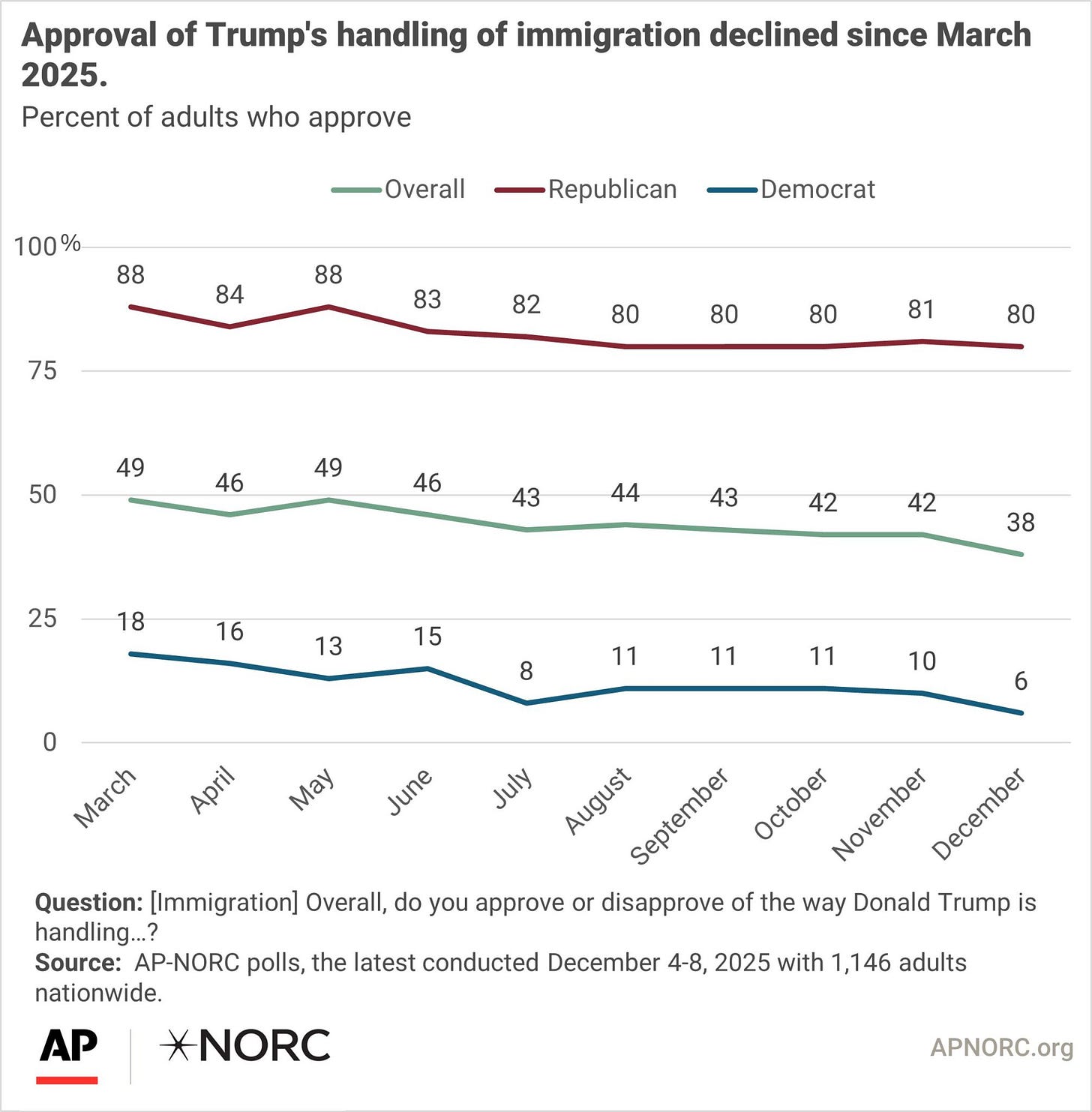
Here’s a survey tracking Republican approval of Trump’s immigration policies (the top line, in red) over most of 2025:
Image

That’s a consistent level of support around 80 percent. Now here is the first poll conducted after the killing of Renee Good:

Image

Even after the killing of an unarmed American citizen, a total of 80 percent of Republicans approve of what ICE is doing and 53 percent of Republicans strongly approve.

It seems pretty clear that, at best, one in five Trump voters were duped. The majority of them are getting exactly what they wanted.

Now if Trump were to lose the support of 20 percent of Republicans voters—or even 14 percent—it would be meaningful for Republican electoral prospects. Which is nice.

The problem is that having 80 percent of Republican voters actively supporting a fascist race war is meaningful for our societal prospects.


Which brings us to the second question: How are these groups distributed through the elite positions of power in government? And here it seems that many of the Republicans most invested in a race war have a great deal of power. Like, for instance, Vice President JD Vance, Deputy Chief of Staff Stephen Miller, and Secretary of Homeland Security Kristi Noem.

At the elite levels, even the idea of 20 million deportations is too little. Here’s a tweet from the Department of Homeland Security on New Year’s Eve:

Image

100 million deportations?

There are 43 million foreign-born Americans. Most of them are legal immigrants. In order to perform 100 million deportations, DHS would have to round up every immigrant of any status—even naturalized citizens—and then also snatch 57 million American who are citizens by birth and deport them, too.

Want to guess who those other 57 million Americans might be?

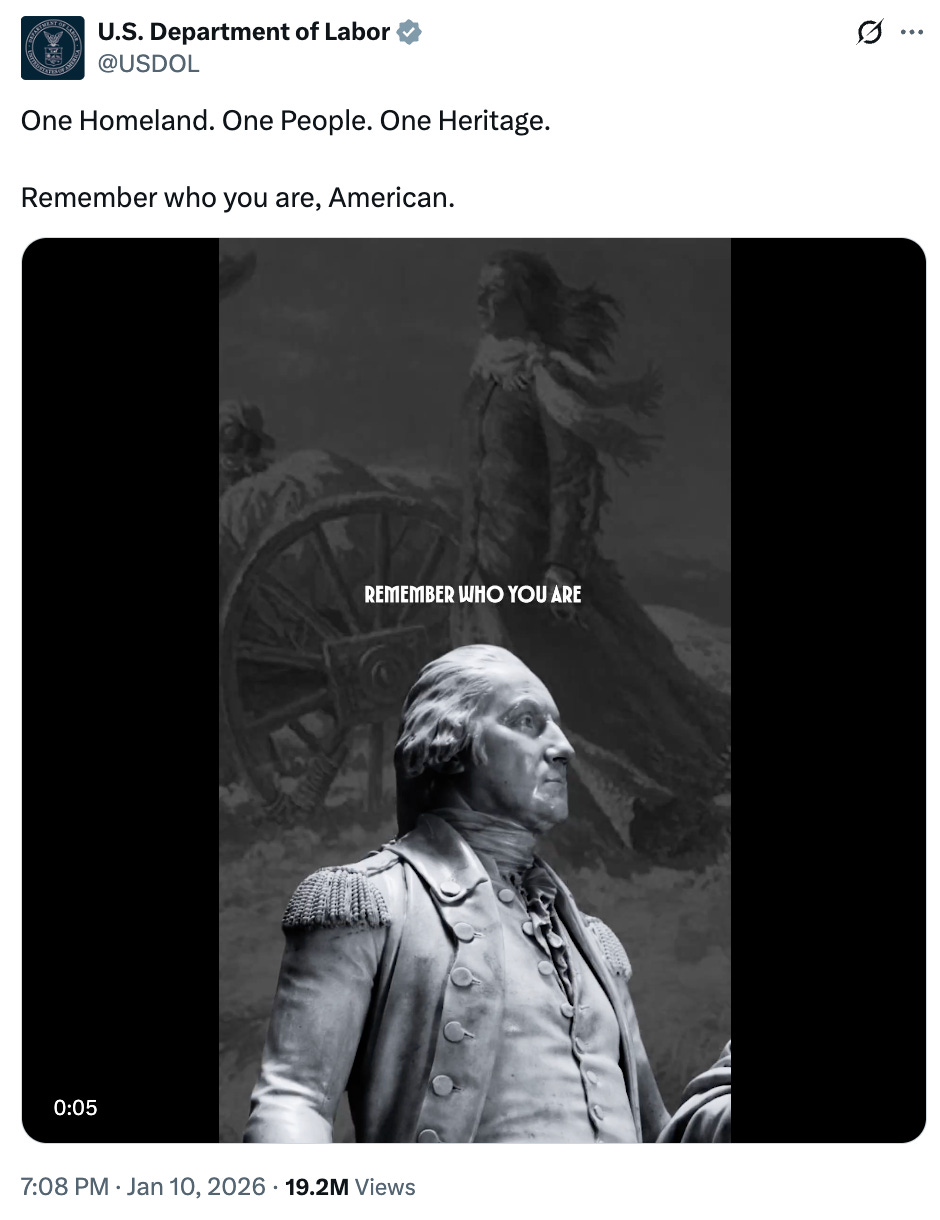
This week the Department of Labor published this:
Image

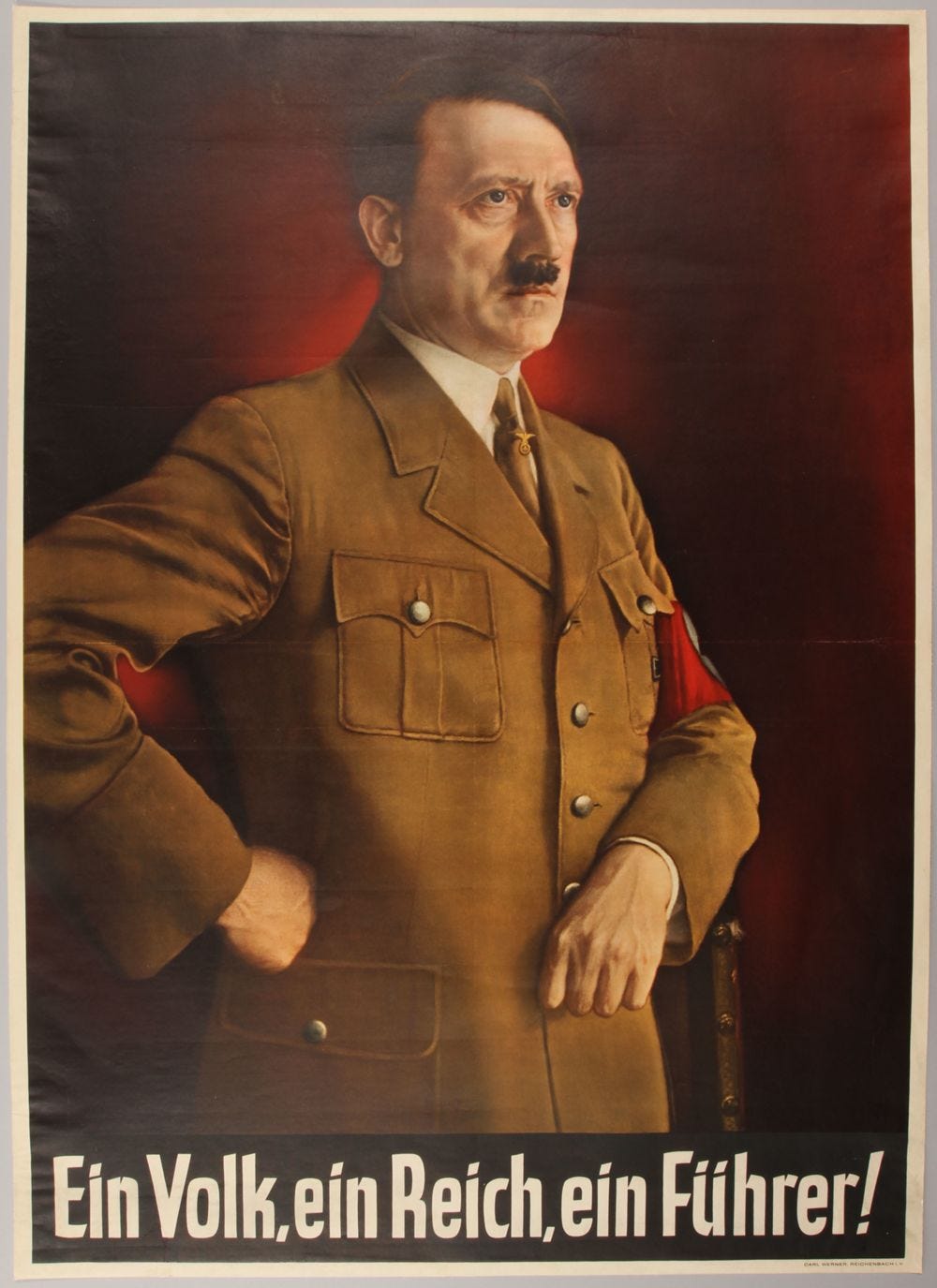
Of course, the slogan sounds better in the original German.
Image

Oh, and don’t forget the Department of Labor’s heroic propaganda posters depicting the American worker in a very specific way.

Image

On the one hand, it feels weird to say that the U.S. government is attempting some low-key ethnic cleansing.

On the other hand, the reality is that we have a masked secret police force going door-to-door attempting to kidnap brown people; one government agency publicly daydreaming about deporting 100 million people; and another government agency saying that the ideal worker is a 20-year-old white guy.

2. Demographics

Another tell: This administration is obsessed with America’s falling fertility rate. From the NYT:

Vice President JD Vance last week called falling marriage rates “a big problem.” The deputy secretary of Health and Human Services in December urged his agency to “make America fertile again.” And at a recent conference for young conservatives, Sean Duffy, the transportation secretary, doubled down on the importance of marriage and children, holding out his nine kids as a model for others to follow.

Full disclosure: I am also obsessed with America’s falling fertility rate. Enough that I wrote a book about it.

The problem here is that nearly all of the declines in total fertility rate (TFR) over the last decade have been the result of declining Hispanic fertility.

Here’s the deal: The TFR—the total number of kids the average woman has over the course of her life—has been below the replacement level, but relatively stable, among white and black Americans for the last generation or so. But America’s TFR kept declining anyway. Why?

Because Hispanic Americans—many of whom were recent immigrants—had TFR’s higher than the U.S. average. And their baby-making propped up the nationwide number. The problem is that, as recent immigrants spent time in America, their reproductive behavior began regressing to the mean. The shift has been dramatic:

Image

If you were concerned about the fertility rate in America, would you be trying to (a) halt all immigration—since immigrants usually bring with them fertility rates higher than native-born Americans—and (b) deport 100 million people from the ethnic group that has the highest fertility rate?

No.

The only reasonable conclusion is that the concern of people in the Trump administration isn’t about the total fertility rate. It’s about the white fertility rate.

I don’t know how much clearer the regime could be.

So tell me: What does the pie chart look like on Republican voters and race war? What is the percentage of Trump voters in each of these categories:

  • Group A: Sees and understands the administration’s intent and supports it.
  • Group B: Sees and understands, but oppose it.
  • Group C: Do not understand that the regime views its program as part of a race war and thinks it’s all business as usual?

And follow-up question: How big can Group A be for us to retain a functional, liberal society?

I look forward to your discussion.

Source: Jonathan V. Last, “The Nazi Slogans Are Not an Accident,” The Bulwark, 13 January 2026. I subscribe to the Bulwark, and so I have shared this article here as a service to my own readers. ||||| TRR


Forbes Breaking News, “BREAKING NEWS: Robin Kelly Introduces Articles Of Impeachment Against Kristi Noem,” 13 Jan. 2026

[. . .]

“Mr. Speaker, I rise today to announce I will be impeaching Homeland Security Secretary Kristi Noem,” announced Rep. Robin Kelly of Illinois.

“Secretary Noem has violated the Constitution and she needs to be held accountable for terrorizing our communities. Operation Midway Blitz has torn apart the Chicagoland area. President Trump declared war on Chicago and then he brought violence and destruction to our city and our suburbs in the form of immigration enforcement.”

Rep. Kelly then broke down some of the outrageous violence that ICE has visited upon her district.

“In my district, federal agents repelled down from Black Hawk helicopters and burst into an apartment building in the South Shore area. They dragged US citizens and non-citizens alike out of their beds in the middle of the night. They claimed the apartment was infiltrated by members of a Venezuelan gang. I don’t understand this president’s obsession with Venezuela, but they did not arrest a single member from that gang.”

“I visited that apartment building and saw firsthand the destruction those agents left. Doors to people’s homes or apartments were kicked down. Belongings, including little kids’ toys, were strewn about in the hallway. That raid and so many others shook our community, not just immigrants, but everyone. Now, Secretary Noem has brought her reign of terror to Minneapolis after she left Charlotte and Raleigh. We have all seen what happened.”

“ICE officers shot and killed Renee Nicole Good in cold blood. Without knowing any of the facts or an investigation, Secretary Noem lied about what happened. She called [a] beloved 37-year-old mom a domestic terrorist. Secretary Noem and her rogue agents are the ones terrorizing our communities, and she is breaking the law to do so. I will hold her accountable.”

“I’m filing three articles of impeachment against Secretary Noem. Number one, obstruction of Congress. Secretary Noem has denied me and other members of Congress oversight of ICE detention facilities. It is our constitutional duty to find out what’s happening in these centers where people are reportedly being treated like less than animals. Two, violation of public trust.”

“Secretary Noem directed ICE agents to arrest people without warrants, use tear gas against citizens, and ignore due process. She claims she’s taken murderers and rapists off our streets, but none of the 614 people arrested during Operation Midway Blitz has been charged or convicted of murder or rape.”

“Three, self-dealing. Secretary Noem has abused her power for personal benefit. She steered a federal contract to a new firm run by a friend, her friend. Her propaganda campaign to recruit ICE agents cost taxpayers $200 million. She made a video that turned the South Shore raid into something that looked more like a movie trailer. But make no mistake, this is not a movie. This is real life and real people are being hurt and killed. I really have to wonder who are the people behind the mask. These DHS agents have no identifying factor.”

“From all their botched raids and officer-involved shootings, I have to ask, what is their training like? What is the vetting? Is Secretary Noem recruiting January 6th insurrectionists? I was one of the last members of Congress to escape the House Gallery on January 6th. I remember hiding on my hands and knees and running through the hallways to a safe room. Insurrectionists are not fit to serve as law enforcement. I realize that impeachment of Secretary Noem does not bring Renee back.”

“True justice would be Renee alive today at home with her family. Impeachment doesn’t bring back the four other people killed by immigration officers this year, including a man in Chicago. We could not bring them back to their loved ones. What we can do, though, is impeach Secretary Noem. Hold her accountable. Let her know the public is watching. In this country, we do not kill people in cold blood without consequences. These are not policy disagreements.”

“These are violations of her oath of office and she must answer for her impeachable actions.”

[. . .]

Source: Occupy Democrats (Facebook), 13 January 2026


Audience members at the all-ages Minneapolis rock venue Pilllar Forum tussled with ICE agents on the street outside the club on Sunday — prompting that night’s show to be canceled.

The owner of Pilllar Forum, Corey Bracken, said several of his customers and musicians were pepper-sprayed by ICE agents and at least two were hit with batons on the street outside the venue, at 2300 Central Av. NE., where other ICE detainments and community protests have happened in recent days.

“My staff doesn’t feel safe after this, and our artists and customers don’t feel safe,” said Bracken, a dad who expanded his skateboarding store into a music venue and coffee shop in 2023 to bring more live music and art to underage fans.

He is leaving it up to his staff and the bands themselves to decide whether to proceed with upcoming concerts, including several more scheduled this week.

The ruckus started shortly after the 6:30 p.m. showtime for a four-band bill headlined by Pilllar Forum regular Anita Velveeta, a popular trans/queer punk act. Audience members saw ICE agents pull up and detain two individuals outside the neighboring Supermercado Latino market, prompting the club’s young music fans to quickly exit onto the street and protest the agents’ actions.

The Department of Homeland Security didn’t respond to a Star Tribune request for comment. An employee at Supermercado Latino also declined to comment on the incident.

Antonio Carvale, singer/guitarist in one of Sunday’s opening bands, BlueDriver, said he was one of five people at the venue who had to be treated with water and saline solution after being hit with pepper spray. He said agents fired the spray after they pushed a protester who pushed back.

“Honestly, the pain felt brutal, but fortunately the community was prepared and helped treat our eyes,” Carvale said, but he commiserated with a bandmate who was also struck by a baton and “banged up pretty bad.”

The band was disappointed Sunday’s gig then was canceled, but he added, “It would’ve been hard to play when I couldn’t even see the frets.”

One of the audience members who was pepper-sprayed, Jess Roberts of Minneapolis, said she had to go to an urgent care clinic because she was sprayed in the ear, which led to an infection.

The run-in with ICE followed a viral Instagram post by Pilllar Forum that went up Friday and landed 25,000 likes. It showed a peaceful but loud crowd of protesters shouting down ICE agents on Central Avenue, with the message, “And that is how you get it done.”

Minneapolis City Council President Elliott Payne and the new Minnesota state senator representing northeast Minneapolis, Doron Clark, joined Bracken in another social media video posted late Sunday denouncing the incident. Clark called Pilllar Forum “an institution here on Central.”

Payne urged residents, “Stay safe and stay vigilant.”

Twin Cities musicians and music fans offered online support for Pilllar Forum after Sunday’s mayhem.

“Thank you for supporting the community!” veteran rocker Tim Ritter of the band Muun Bato wrote on the venue’s Facebook page.

Bracken did offer refunds to paid attendees of Sunday’s canceled show, proceeds of which were to be donated to families affected by ICE detainments, per headliner Anita Velveeta’s request.

“So far, I haven’t heard from anyone who wants their money back,” Bracken said.

Source: Chris Riemenschneider, “Music fans scuffle with ICE outside all-ages Minneapolis rock venue,” Minnesota Star Tribune, 12 January 2026. I subscribe to the online edition of this newspaper (which I grew up reading as a kid), and so I am just as happy to share its contents here when appropriate. ||||| TRR

Russia Is Not a Land of Opportunity for Central Asians

Image

Tajikistan has condemned what it called an “ethnic hatred” attack in Russia after a 10-year-old boy from a Tajik family was stabbed to death at a school near Moscow, in a rare public rebuke aimed at a key partner for labor migration and security ties. The killing happened on December 16 in the village of Gorki-2 in the Odintsovo district of the Moscow region, according to Russia’s Investigative Committee, which said a minor attacked people at an educational institution, killing one child and injuring a school security guard.

A video of the attack circulated on Russian social media after the incident. According to reporting by Asia-Plus, footage published by the Telegram channel Mash shows the teenage assailant approaching a group of students while holding a knife and asking them about their nationality. The video then shows a school security guard attempting to intervene before the attacker sprays him with pepper spray and stabs him. The assailant subsequently turns the knife on the children, fatally wounding the 10-year-old boy.

statement released by Tajikistan’s interior ministry said it feared the case could “serve as a pretext for incitement and provocation by certain radical nationalist groups to commit similar crimes.” Tajikistan’s response also drew attention after the foreign ministry said the attack was “motivated by ethnic hatred.” Dushanbe subsequently summoned the Russian ambassador to protest the attack, handing him a missive “demanding that Russia conduct an immediate, objective, and impartial investigation into this tragic incident.”

The condemnation is particularly notable as Tajikistan rarely issues public criticism of Russia, which remains its main destination for migrant labor and a key security partner.

According to Russian media, the attacker, who has admitted their guilt, subscribed to neo-Nazi channels and had sent his classmates a racist manifesto entitled “My Rage,” in which he expressed hostility toward Jews, Muslims, anti-fascists, and liberals, a few days before the incident.

Tajik migrants form one of the largest foreign labor communities in Russia and across Central Asia. Millions of Tajik citizens work abroad each year, most of them in Russia, sending remittances that are a critical source of income for families at home. According to the World Bank, remittances account for roughly half of Tajikistan’s gross domestic product in some years, making labor migration a cornerstone of the country’s economy. Many Tajik migrants work in construction, services, and transport, often in precarious conditions and with limited legal protections. The killing comes as Central Asian migrants in Russia face growing pressure to enlist in the war in Ukraine, with coercion through detention, deportation threats, and promises of legal status having been reported.

The killing has also renewed scrutiny of rising xenophobia in Russia, particularly toward migrants from Central Asia. The Times of Central Asia has previously reported an increase in hate speech, harassment, and violent attacks targeting migrants, especially following major security incidents. Human Rights Watch has warned that Central Asian migrants in Russia face growing discrimination, arbitrary police checks, and racially motivated abuse, trends that have intensified in recent years amid heightened nationalist rhetoric.

Source: Stephen M. Bland, “Tajikistan Condemns Fatal Stabbing of Boy in Russia Citing Ethnic Hatred,” Times of Central Asia, 17 December 2025


It’s curious. I looked through some of the [social media] pages of Russia’s [most prominent] political émigrés—[Ilya] Yashin, [Vladimir] Kara-Murza, [Ekaterina] Schulmann, [Leonid] Volkov, [Elena] Lukyanova, [Dmitry] Bykov, [Marat] Gelman, [Boris] Zimin, [Boris] Akunin—but I couldn’t find a word about the violent death of a Tajik boy in a school near Moscow. They have expressed no sympathy, voiced no criticism of racism and xenophobia. It seemingly should be their direct obligation to speak out on this issue. But for some reason, mum’s the word. I also looked at the Telegram channels of the leading official anthropologists, and there is a mysterious muteness among them too. Surely it is their professional duty not to remain silent on such a matter. They even published a book called Tajiks and themselves speak everywhere of interethnic harmony. But in this case, it’s as if they’ve dummied up.

Source: S.A. (Facebook), 18 December 2025. Translated by the Russian Reader


As FB is reminding, there were times I believed I could protect my non-Slavic looking friends, lovers, relatives, foreign students and migrant workers from the nazis marching in the streets, from the nazis working as policemen, from the general xenophobia and unsensibility by magic tricks of art.

Source: Olga Jitlina (Facebook), 18 December 2025


Image

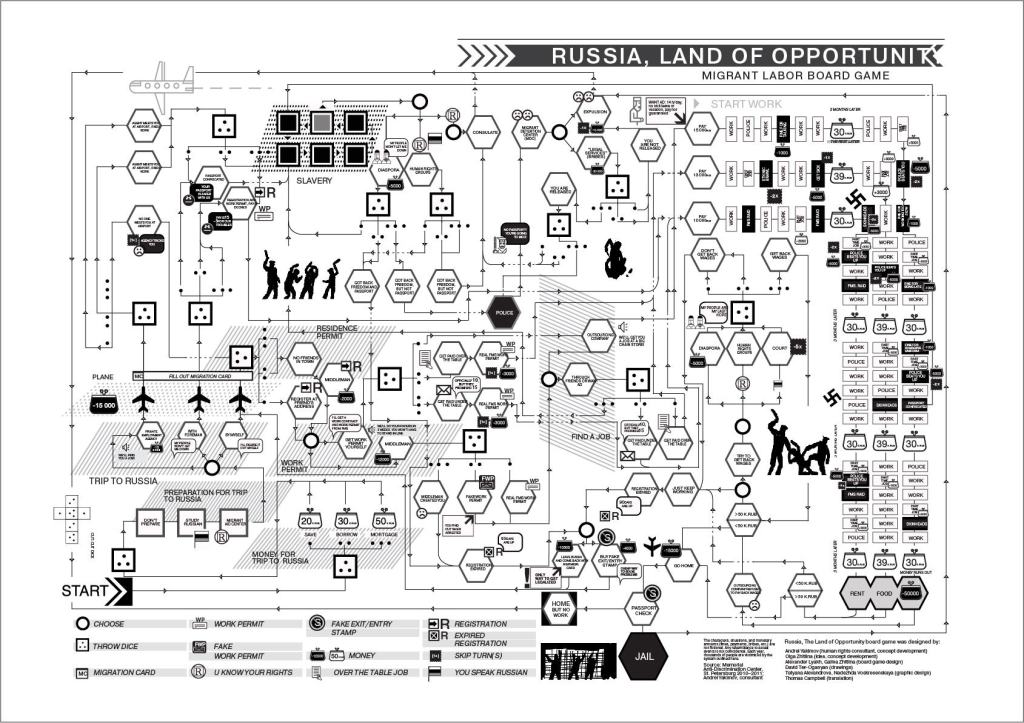
Thomas Campbell just translated our migrant labor board game Russia – The Land of Opportunity!!!

Russia – The Land of Opportunity board game is a means of talking about the possible ways that the destinies of the millions of immigrants who come annually to the Russian Federation from the former Soviet Central Asian republics to earn money play out.

Our goal is to give players the chance to live in the shoes of a foreign worker, to feel all the risks and opportunities, to understand the play between luck and personal responsibility, and thus answer the accusatory questions often addressed to immigrants – for example, “Why do they work illegally? Why do they agree to such conditions?”

On the other hand, only by describing the labyrinth of rules, deceptions, bureaucratic obstacles and traps that constitute immigration in today’s Russia can we get an overall picture of how one can operate within this scheme and what in it needs to be changed. We would like most of all for this game to become a historical document.

Source: Olga Jitlina (Facebook), 17 December 2011


Life for migrant workers is Russia is becoming increasingly difficult after stringent new controls introduced over the past year. These include a registry of “illegal” migrants, restrictions on enrolling migrant children in schools, new police powers to deport people without a court order, and a compulsory app for all new migrants in Moscow and the surrounding region to track their movements.

Working in Russia was already less appealing because of the war in Ukraine and the weakening rouble. Now, with these new restrictions, a growing number of young people from Central Asia are starting to look elsewhere — including to countries in Europe — in search of better opportunities.

Dreaming of Europe in Moscow

Like 89% of young Kyrgyzstanis, 25-year-old Bilal* had always dreamed of working abroad.

Young people in Kyrgyzstan grow up in an environment where leaving the country to find work is common, widespread, economically essential, and socially accepted — and where the domestic economy still cannot offer comparable opportunities.

The average monthly salary in the country is about 42,000 soms (around $480), while in Russia, for example, wages in manufacturing can reach 150,000 rubles (nearly $2,000). Unlike most of his peers, Bilal never planned to work in Russia. “Because many of our people face racism there,” he explains.

Europe was his dream, but without connections getting a job offer from an EU employer seemed nearly impossible. So Bilal turned to “intermediaries” — fellow Kyrgyzstanis who had established ties with European companies that were constantly seeking workers. They advised him to travel to St. Petersburg, where, they said, it would be easier to prepare the paperwork and apply for a visa.

But it was the height of the COVID-19 pandemic. Many Schengen countries had stopped issuing visas and temporarily shuttered their consulates. Bilal didn’t want to return home empty-handed, so he decided to stay in Russia — “not by choice,” as he puts it.

“At first I worked illegally at a ski resort. Mostly we chopped firewood and cleared snow around the cabins. They paid us in cash,” he says.

Two months later, Bilal moved to Moscow and obtained a patent — the work permit that allows citizens of visa-free countries to be legally employed in Russia. He found a job as a courier for Yandex.

Bilal speaks excellent Russian — something he says explains why, unlike many of his friends, he didn’t encounter xenophobia all that often. But conflicts still happened. “You’d run into people who’d say, ‘Migrants, coming here in droves…’ Especially when a customer had put down the wrong address and the delivery got messed up — somehow it was always the migrant’s fault.”

Bilal left Russia two months before the full-scale invasion of Ukraine. “Back then it wasn’t like it is now,” he recalls. “Yes, the police would stop you on the street, but they’d take some money and let you go. Now my friends talk about Amina (a Russian mobile app for monitoring migrants), about police rounding people up, and about being sent to the war.”

He decided to set his sights on Europe instead.

Watched and bullied

In Russia, the path to legal employment for migrant workers runs through a processing centre known as Sakharovo — located about 60 kilometres from Moscow and notorious for its massive queues, where people often wait for hours. The perimeter is guarded by armed security forces, and inside migrants undergo procedures such as blood and urine tests to screen for “socially significant diseases”. Those who manage to obtain their documents can work legally, but that doesn’t protect them from future problems.

Russians often refuse to rent apartments to migrants. Schools and kindergartens decline to accept migrant children, citing “lack of space,” while the adults themselves face workplace “raids” or frequent “document checks” on the street or on public transport. Even Russia’s war in Ukraine has become a tool for pressuring them: many migrants are pushed to join the military in exchange for various “bonuses,” such as fast-tracked citizenship.

After the attack on Crocus City Hall — which authorities say was carried out by four Tajik citizens —the security services launched large-scale raids. Tajikistan’s government, fearing a surge in xenophobic incidents, even advised its citizens not to leave their homes.

Lawmakers soon joined in. Over the past year, they have restricted the ability to obtain residency through marriage, granted the Interior Ministry the power to deport migrants without a court ruling, required migrant children to pass a Russian-language exam before being admitted to school, and created the Registry of Monitored Persons — a database of foreign nationals who supposedly lack legal grounds to stay in Russia. There are already known cases of people being added to the list by mistake, and effectively losing the right to move freely around the country after their bank accounts were frozen, and their driving permits revoked.

Officials have justified all these measures as necessary to fight illegal migration and prevent crime. In July, the Interior Ministry reported a rise in crimes committed by migrants, but migrants still make up only a small fraction of overall crime statistics. A study by the “To Be Exact” project found that adult Russian men are statistically more likely to commit crimes than migrant workers.

On September 1, a new pilot project went into effect: migrants from Uzbekistan, Tajikistan, Kyrgyzstan, Armenia, Kazakhstan, Georgia, Azerbaijan, Moldova, and Ukraine who are living in Moscow or the Moscow region must install a mobile app called “Amina.” Authorities openly acknowledge that the app’s main purpose is to continuously track users’ locations.

The app that doesn’t work

If a phone fails to transmit location data to Amina for more than three working days, the participant is automatically removed from the system. If the migrant cannot fix the issue quickly, they risk being added to the “monitored persons” registry — which can lead to frozen bank accounts, job loss, or even expulsion from university.

Imran, a 27-year-old Tajik citizen, is worried: “Location services on my phone are on, and Amina shows that everything is being transmitted, but several times a day I get notifications saying the app isn’t receiving my location. The app works terribly. And I have no idea what consequences this could have for me.”

Users report constant problems with Amina. Some can’t get past the first screen; others say the app won’t accept their photo; still others receive alerts that their data failed verification. But the most common issues are related to location tracking.

In comments on RuStore (Russia’s internal apps store), representatives of the developer respond that “specialists are constantly working to improve the app’s stability” and advise users to contact technical support. But migrants complain about waiting on the line for hours.

Anton Ignatov, the director of the Sakharovo centre, claims the programme will improve public safety and help “prevent violations by unscrupulous individuals”. He cites situations in which migrants buy a work patent — a permit to work — for a short period and then disappear “into the shadows,” “vanishing somewhere in the industrial zones of Moscow and the region”.

Such cases do happen, and the most obvious reason is money. Since January 1, the monthly payment for a work patent in Moscow and the Moscow region has been 8,900 roubles (about $115). For many migrants working in low-paid jobs — for example, in construction or warehouse work — this is a significant share of their income, pushing some into the informal economy.

Another factor is wage delays in the sectors where migrants from Central Asian countries most often work. Mukhammadjon from Uzbekistan, works on a construction site outside Moscow, hasn’t been paid in two and a half months. A month ago, he stopped paying for his patent — simply because he had no money left. He sees no tools to defend himself.

Employers, meanwhile, benefit from hiring such vulnerable workers: they can avoid paying social contributions, hand out wages in cash, and rely on employees who are willing to work overtime for low pay.

Getting a job is becoming harder

Kudaibergen, 32, from Kyrgyzstan, worked at a warehouse on the outskirts of Moscow — “to support my family”, he says. His employer provided hostel-style housing for migrant warehouse workers.

“OMON came to our building. They treated us like they were arresting dangerous terrorists. They showed up with batons and tasers, as if storming the place. They drove us all outside. We stood by the door with our hands behind our backs for about two hours while they checked everyone’s documents,” he recalls. “Some guys didn’t understand Russian well — it was very hard for them. If they didn’t understand something, they were beaten. […] Thank God, my documents were in order.”

Russian authorities typically insist that such inspections are carried out strictly within the law and that no unlawful actions are taken against migrants. As evidence, the Interior Ministry points out that migrants rarely file complaints with the police afterward.

As the new year approached — 2025 — the checks intensified, Kudaibergen says. Because of all the new rules and the overall treatment of migrants, he realized that working in Russia had become too difficult, so he returned home.

“But I still have to provide for my family,” he adds. “I’m thinking about Europe now. I ask friends and acquaintances how to leave. But I don’t know if it will work out. They say getting a visa is very hard.”

Gulnura, 35, a mother of three, had lived in Russia with her husband for more than ten years. In the spring of 2025, she flew with her children to her native Kyrgyzstan for a short break. Only after arriving did she learn about the new requirement obliging migrant children to pass a Russian-language exam in order to enroll in school. Her children speak Russian fluently, yet even before the rule change they hadn’t been admitted — schools said there were “no available places”.

“We originally planned to return to Moscow. But my friends who are still there complain that they can’t get their kids into school,” Gulnura says. “One friend has been collecting documents since April, but the school won’t accept them. Another managed to get her child to the test, but after the exam they sent a rejection: ‘Your child doesn’t know Russian well enough.’ Her daughter was born and raised in Moscow, speaks Russian fluently, went to kindergarten and prep classes, reads and writes.”

“Requiring language proficiency provides a pretext for an already widespread practice of arbitrarily refusing to admit migrant children to schools across Russia,” says Sainat Sultanaliyeva of Human Rights Watch. “By depriving migrant children of access to education, Russian authorities are effectively taking away the life opportunities schooling provides. Banning them from school undermines long-term social integration, increases the risk of harmful child labour, and heightens the danger of early marriage.”

Gulnura decided not to return to Russia with her children. “My husband is still in Moscow for now. He’ll come when everything is ready here, when he has work. But we — me and the kids — we’ve come back for good. It’s become impossible to live there.”

A chance to get into Europe

Despite numerous accounts of migrants becoming disillusioned with Russia, it’s impossible to say definitively whether labour migration has decreased in recent years: the available statistics are fragmented, and data from different government agencies often contradict one another.

The picture is further complicated by the Interior Ministry’s decision to stop publishing key data, as well as several changes to the methodology of migration accounting, which make year-to-year comparisons unreliable.

In 2024, researchers at the Higher School of Economics concluded that labour migration to Russia had fallen to its lowest level in a decade.

Since then, the number of entries into the country has grown, but the average annual presence of legal labour migrants has remained stable at around 3–3.5 million — noticeably lower than in previous years.

Rossiyskaya Gazeta writes that foreign workers are less willing to come to Russia for two reasons: tougher migration policies and declining incomes. With the rouble’s depreciation, earnings in dollar terms have fallen by roughly a third.

Yet Russia still remains the most popular destination for labour migrants from nearly all Central Asian countries.

In second place for migrants from Uzbekistan, Tajikistan, and Kyrgyzstan is Kazakhstan, where most work in construction, wholesale and retail trade, and various service industries.

Third is Turkey, where Central Asian migrants are employed in manufacturing — especially textiles and clothing — as well as construction, hospitality, and seasonal agriculture.

South Korea recruits migrant labor for factories, agriculture, construction, and the fishing and seafood-processing industries.

But for many — like Bilal, who left Russia behind — the dream is still to secure a job offer in Europe. In the end, he managed to do so through the same intermediaries he had relied on earlier, paying them $2,000, he says. They helped arrange an invitation from a logistics company.

“If you don’t have work experience in Europe, it’s hard at first to get a job with a good trucking company. There are bad employers who take advantage of newcomers not knowing their rights. They might underpay you or force you to work overtime. At the same time, the police keep a very close eye on work-and-rest rules and can fine you, so nobody wants to break the law. By law, if your driving time is up, you have to stop and rest,” Bilal says, recalling his first job at a Slovak company.

After gaining some experience, he moved to another company, where he now earns around €2,500 a month.

According to the International Road Transport Union (IRU), more than half of European transport companies cannot expand their business because of a shortage of qualified drivers. Across the EU, Norway, and the UK, more than 233,000 truck drivers are currently required. The crisis is deepened by the fact that the profession is aging rapidly, and young people are not drawn to it, despite decent pay.

Ukrainian citizens once made up a significant share of long-haul drivers in the EU, but because of the war many had to return home for military service. In addition, some European employers terminated contracts with Russian and Belarusian citizens (or their visas weren’t renewed), forcing them to return home as well.

In Slovakia, where Bilal is officially employed, the shortage reached 12,000 drivers last year. As a result, the country simplified visa procedures for several nations — including Kyrgyzstan, Tajikistan, Kazakhstan, Turkmenistan, and Ukraine — for applicants willing to work in freight transport.

Poland actively issues work permits to citizens of Uzbekistan and Kazakhstan; the Czech Republic attracts workers from Uzbekistan and Kyrgyzstan by fast-tracking work visas; Lithuania also issues visas to those seeking jobs as drivers.

In 2023, the number of first-time work permits issued in the EU to citizens of Kazakhstan, Uzbekistan, Kyrgyzstan, and Tajikistan rose by 30%, 39%, 50%, and 63% respectively compared to the previous year.

But Bilal believes that even with the current labour shortages, getting into Europe from Central Asia is still far from easy. “If you don’t have people here who can recommend you to a company, it’s a difficult process for ordinary working people,” he says.

All the more so because public frustration over migration has been growing across Europe in recent years, pushing some governments to tighten rules for third-country nationals — even in sectors suffering from labour shortages.

Bilal likes living in Europe. He’s satisfied with the good pay and the way people treat him — especially Italians and the French.

He describes his job as demanding. “We spend more time away from home than at home. Years go by, and people hardly see their families,” he says.

Bilal himself doesn’t yet have a wife or children. In a few years, he’ll be eligible to apply for permanent residency in Slovakia, but he hasn’t decided whether he’s ready to spend his whole life driving long-haul trucks across Europe.

*The protagonist’s name has been changed at his request. With contributions from Almira Abidinova and Aisymbat Tokoeva. Read this story in Russian here. English version edited by Jenny Norton.

Source: “Why Central Asian migrant workers are giving up on Russia,” BBC News Russian (Substack), 18 December 2025.

Give Them Want They Want

Image

Putin: “Give me what I want!” Trump: “Hang on!”

Trump: “There’s a better way!” Trump: “Give him what he wants!”

Source: Moscow Times Russian Service weekly newsletter, 30 November 2025. Original by Michael de Adder. Translated by the Russian Reader


Image

Following the shooting that claimed the life of a National Guard member last Wednesday in Washington, the Trump administration has announced it will be halting all asylum decisions and paused issuing visas for people travelling on Afghan passports. The suspect in Wednesday’s shooting that killed Specialist Sarah Beckstrom, 20, and critically wounded Staff Sgt. Andrew Wolfe, 24, is Rahmanullah Lakanwal, a 29-year-old Afghan national who worked with the CIA during the Afghanistan War and had been living in the U.S. since 2021. He applied for asylum during the Biden administration under a program that resettled Afghans after the U.S. withdrawal from the country, and was granted it this year under President Trump.

As seen in our infographic, based on data released by the U.S. Department of Justice, Afghanistan was not one of the 10 most common countries of origin for people who received asylum in the U.S. in the fiscal year 2024. Only 508 Afghans were granted asylum in the country that year, while 61 were refused. By comparison, the U.S. granted asylum to 3,605 Russian nationals, making Russia the most common nationality to get asylum in the country during that time period. This was followed by China, with 2,998 Chinese nationals receiving asylum, and Venezuela, with 2,656 successful asylum applications.

Source: Valentine Fourreau, “Who Is Granted Asylum in the United States?” Statista, 1 December 2025

Reclaiming Whiteness: In Search of the “Good Russians”

Image

As racial boundaries are constantly negotiated in Europe and across the globe, this book explores how Russian migrant workers navigate racial capitalism in the Nordic region.

Challenging the idea of a ‘race-neutral’ Eastern Europe, the book reveals how Russian migrants actively claim whiteness, often finding themselves on the margins of acceptability. Uniquely combining postsocialist and postcolonial perspectives, the author examines how these migrants, seeking recognition as European, reinforce economic and racial divides shaped by global capitalism.

This timely work offers fresh insights into race, migration and the boundaries of whiteness across Europe’s borders.

Source: Bristol University Press. Thanks to Sergey Abashin for the heads-up.


Before the age of budget airlines and Instagram wanderlust, Russians journeyed west not for leisure but for enlightenment. In March 1697 Peter the Great set off from Moscow to take in the sights of Amsterdam, London and Vienna, among others. Travelling under a pseudonym, but much recognised thanks to his towering height and posse of over 200 hangers-on, the tsar’s odyssey included the expected museum visits and posh balls. But the point of the trip was to experience something that could not be found in 17th-century Russia: modernity. The incognito emperor spent time working as a ship’s carpenter in Holland, took stock of the latest naval warfare tactics in Portsmouth, then studied democracy in action in Westminster. Alas, news of insurrection back home brought the escapade to a close after a mere 18 months. Having experienced modernity on his sojourn, Peter sought to impose it on his people. He promptly decreed facial hair to be “superfluous” and imposed a tax on beards. On the rest of Europe he soon imposed a grimmer fate: the Great Northern war, which embroiled bits of Scandinavia and the Baltics for two decades.

Three centuries after Peter’s odyssey, and three years after his wannabe successor Vladimir Putin launched his own protracted war in Ukraine, Russian tourism is still alive and well in Europe. What it lacks in ambition—the grand tour of yesteryear has been replaced by the more modest Mykonos beach jaunt, Milan shopping spree or week’s skiing in Courchevel—it makes up for in numbers. Over 500,000 Russians were granted visas to the European Union’s Schengen zone in 2024, nearly half of which allow for multiple entry over many years. The visitor numbers are down by 90% compared with 2019. But that is still far too many for those Europeans who wonder how citizens from a country whose army is raining missiles on Ukrainian cities can cavort in its beaches and boutiques. On November 7th the EU announced Russians would no longer be granted multiple-entry visas in a bid to get the number nearer to zero. What seems commonsensical to some is decried as deeply misguided by others—including Mr Putin’s foes.

The ostensible cause for the tightening is security. Beyond invading Ukraine, Russia is needling Europe with subtler forms of aggression. Drones circling airports, Baltic ships dredging cables, cyber-attacks and other forms of mischief have set nerves jangling in Europe. Even if security services there struggle to pin such “grey zone” attacks on Russian operators, to them it makes sense to view every visitor from there as a potential spy, saboteur or propagandist. Ending multiple-entry visas is a way to ensure vetting happens before each visit, a sensible precaution.

But the driving force for the visa ban is moral outrage. “Starting a war and expecting to move freely in Europe is hard to justify,” said Kaja Kallas, the hawkish Estonian who serves as the EU’s foreign-policy chief. Along with others hailing from the bloc’s eastern fringe, she has long lobbied for Europeans to equate all Russians with the regime they live under. Whether oligarchs or mere members of the upper-middle classes, those Muscovites who can afford a jolly in Ibiza are tacitly propping up Putinism. They are our enemy, too, unless proved otherwise. Exemptions to the visa ban will be made for relatives of EU citizens, as well as dissidents and others who can prove their “integrity”.

The security argument seems hard to quibble with, even if GRU goons have plenty of fake Western passports in their double-bottomed attaché cases (and are said to hire locals to do their dirty work, often via social-media platforms). But the all-Russians-are-Putinists argument is trickier. Your columnist has felt the discomfiting “ick” of sharing a Parisian café terrace or Alpine chairlift with Russian visitors, enjoying a carefree interlude before (probably) returning to well-paid jobs back home that will generate tax revenue for Mr Putin’s war. Is this wretched invasion not, at least in part, theirs as well? How dare they enjoy themselves?

But just as discomfiting is to apply the sins of a dictatorship to all 144m citizens who live in it—some of the first victims of Putinism. Not so long ago, Europe promoted the idea that everyday Russians should be separated from the regime that patently does not represent them. Oligarchs and those close to the regime were to be sanctioned, but ordinary Russians were potential allies againstMr Putin. Why not welcome them to Europe? Every rouble spaffed in Milan boutiques drains Russia of resources.

From Russia with visas

With the war in Ukraine dragging on, a more hawkish line has prevailed. In EU circles it is now expected that Russia’s middle class should somehow “do more” to unseat Mr Putin, and that failure to do so amounts to collaboration. Yet for ordinary Russians to be held collectively responsible for “their” leader’s actions is to assume they have the agency to turf him out. Tell that to the thousands languishing in gulags for even the merest of protests. Indeed, some with intimate experience of gulagdom have opposed the EU’s move. Yulia Navalnaya, whose husband Alexei Navalny died in an Arctic penal colony, has argued the visa ban would isolate Russia from Europe in precisely the way Mr Putin has in mind.

As with sanctions designed to target the regime and not the people, it may be that anti-Putinists end up as collateral damage of an otherwise sensible policy. How could it be otherwise? Europeans are being told to expect a frontal confrontation with Russia, perhaps soon. It is one thing to feel no animus towards ordinary Russians, another to host them for a mini-break just as defence spending in Europe is surging to take on a threat from their backyard. To curtail Russians visiting Europe may be to lump the oppressed with their oppressor. But with apologies to (some) Russians, any other outcome would make Europeans appear hopelessly naive. Let’s have you all over when the war ends. 

Source: “Charlemagne: Europe is cracking down on Russian tourists,” Economist, 13 November 2025


Join us for a discussion of Ambicoloniality and War: The Ukrainian–Russian Case with author Svitlana Biedarieva, in conversation with two prominent thinkers on issues of coloniality and Ukraine/Russia, Oksana Yakushko and Mykola Riabchuk.

Biedarieva’s book introduces the concept of “ambicoloniality” to describe the complex relationship between Ukraine and Russia, one in which Russia’s imperial desire to dominate Ukraine has paradoxically placed it under Ukraine’s symbolic influence. The work offers a fresh framework for understanding how colonial and decolonial dynamics have unfolded across shared borders rather than distant colonies, exploring the intertwined histories and cultural hybridities that continue to shape both nations.

Together, the author and discussants will examine how this new model redefines understandings of power, identity, and resistance in the post-Soviet space.

Source: GW Events Calendar


[…]

War-related news from Russia:

Russian man found guilty – posthumously – under LGBT law (Mediazona, 14 November) 

Twenty years on: Timur Kacharava’s murder remembered (The Russian Reader, 14 November)

First arrest under new Russian law over an Internet search for Ukraine’s Azov Regiment (Kharkiv Human Rights Protection Group, November 14th)

Russia feels the heat from oil sanctions (Meduza, 13 November)

Migrant women and the war: new discriminatory laws (Posle.Media, 12 November)

Russian anti-war prisoner: ‘I just did not want to murder Ukrainian people who have done me no ill’ (People & Nature, 12 November) 

The carousel: Russia’s system for re-arresting protesters (Meduza, 12 November)

To force deserters back to war, Russia’s military tortures their families (Meduza, 12 November)

“Thou shalt not idolize your motherland”: Russian Orthodox priests on the war in Ukraine and the degradation of their church (The Insider, November 10th)

Tracked down, coerced, threatened: How Russia hunts down deserters and forces them back to the front lines in Ukraine (The Insider, November 10th)

Source: News from Ukraine Bulletin 171 (17 November 2025)


The August sun was already warming Westlake Village when Anton Perevalov dressed in athletic shorts and decided to take an early morning stroll with his miniature pinscher, Ben, while his wife slept.

As he turned right onto Hillcrest Drive — a route he’d taken so many mornings before — an unmarked car stopped in front of him and a man he’d never met emerged and peppered him with questions: “Are you Anton Perevalov?” “Are you a citizen of Russia?”

When Perevalov, 43, answered in the affirmative, two other men exited the car and approached him. One took his phone and the other slapped handcuffs on him, ushering him and Ben into the car. As they drove toward his home, they instructed Perevalov to call his wife so she could come out and get the dog.

Perevalov pleaded with the men, saying that there had to be a mistake. He had documents proving he was legal to live and work in the United States. It didn’t matter, one of the men told him.

“You overstayed your visa,” he said. “You are under arrest and coming with us.”

Tatiana Zaiko sprinted out of the house in her pajamas and slippers, telling her 17-year-old son that his dad had been arrested and to lock the door. She’d be right back, she recalled telling him.

She wasn’t. Friends would later find the boy huddled under his parents’ bed, fearful that immigration agents may return for him too.

“I never imagined that something like this could happen in this country,” Zaiko, 43, said.

For years, Russian nationals and others seeking asylum in the United States were allowed to live and work here while their cases were being decided. That began to change in 2024 under the Biden administration and has been completely upended in the wake of President Trump’s efforts to boost deportation numbers, experts say.

Under Trump, those with a pending asylum claim aren’t exempt from being detained and deported. In fact, targeting asylum seekers in the United States makes it easier for immigration agents to carry out Trump’s stated plans of deporting at least 1 million people annually because they’re known to the government and easier to find, said Dara Lind, a senior fellow with the American Immigration Council.

“People who have done everything right are arguably easier for this administration to go after and more of a target than people who are actively trying to evade the law,” Lind said.

After Russia invaded Ukraine in 2022, the Kremlin introduced war censorship laws to make criticism of the war an offense punishable by significant jail time. Those who have been critical of the war and sought asylum in the United States are at risk of having property seized, being fined and spending significant time in prison if they were to return to Russia.

It was for this reason that Perevalov and Zaiko sought protection in the United States.

The couple applied for asylum in 2023 during what was initially a family vacation to New York City over Christmas. The trip was a longtime dream of their son’s, who grew up watching the movie “Home Alone 2: Lost in New York”, and wanted to spend the season taking in the sights of the Big Apple just like Kevin McCallister, the film’s lead character. Trump makes a brief cameo in the movie as himself.

But during the trip, the family received word from back home that the Russian police were looking to interrogate Perevalov about his opposition to the war in Ukraine. Perevalov hadn’t been shy about sharing his disapproval and had donated funds in support of Ukraine.

In schools, Perevalov said, they had introduced lessons of “military-patriotic education,” teaching children that Western countries wanted to take over Russia. At one point, their son’s teacher brought an AK-47 rifle to class and forced students to disassemble and reassemble it. The couple voiced their disapproval.

More than a week after arriving, the family decided returning to Russia would be too dangerous, so they contacted an attorney to help them apply for political asylum in the U.S. They filled out the application, Form I-589, and three weeks later received confirmation that their form had been accepted and they were scheduled for fingerprinting.

The document they received stated they were authorized to remain in the United States while their application was pending. They got work permits, settled in the San Fernando Valley and found jobs — Perevalov at a detailing studio and Zaiko as a house manager. They paid taxes and settled into the rhythm of life in America.

When immigration raids began ramping up across Southern California over the summer, the couple figured they had nothing to worry about since the Trump administration had emphasized it sought to deport dangerous criminals.

“We don’t understand,” Zaiko said. “We did everything right. We’re not criminals. We have documents. I thought it was a mistake, but it’s not a mistake.”

The Department of Homeland Security did not answer questions from The Times about the status of the couple’s immigration case.

“Perevalov and Zaiko will receive full due process and all their claims will be heard by an immigration judge,” Homeland Security Assistant Secretary Tricia McLaughlin said in an email. “For the record: a pending asylum claim does NOT protect illegal aliens from arrest or detention.”

The couple’s arrest — along with examples of others in similar circumstances being detained by federal officials — has spread fear through the Russian immigrant community in Southern California.

A Russian national living in Southern California who declined to provide his name for fear he could be targeted for deportation said he rarely goes out anymore. When he does leave his house, he scrutinizes every car that passes, wondering if it’s agents looking to detain him and his family.

His child has spent most of her life in the United States and doesn’t know what it was like in their home country. A return to Russia for him would probably mean death, he said.

“America was like a lighthouse of liberty for us,” the man said. “But it doesn’t feel that way right now.”

Despite the federal government’s assertion that it is targeting dangerous criminals, many of the Russian asylum seekers who have been placed in detention have no criminal records. Some have been victims of crimes, said Dmitry Valuev, president of the nonprofit group Russian America for Democracy in Russia.

Russian asylum applications to the United States rose sharply in the years since the country invaded Ukraine, as many Russians seek to leave for fear of political persecution or being conscripted into the military. This contributed to a growing backlog in immigration courts.

As of 2024 — the most recent data available — more than 14,600 asylum cases from Russia were pending in California, up from 1,771 in 2021, according to the Transactional Records Access Clearinghouse, which publishes immigration data.

In 2024, asylum applicants began landing in long-term detention while their cases were pending, a change that Valuev attributes to concerns about spies from post-Soviet countries infiltrating the United States and creating a national security risk.

After Trump’s inauguration, he declared a state of emergency at the southern border, where many asylum seekers including Russians showed up, allowing the federal government to deny them asylum and deport them back to their country of origin.

“Now they use any excuse, any reason to detain an individual whose immigration situation is pending,” Valuev said.

In June and August, two flights out of the United States involved the transfer of detained Russian nationals to Egyptian government custody. Those individuals were forcibly returned to Russia, including people who had been detained in the United States for more than a year after seeking asylum, according to Human Rights First, which tracks immigration flights out of the United States.

When they arrived at an Immigration and Customs Enforcement facility in downtown Los Angeles, Perevalov and Zaiko were again fingerprinted, had their belongings confiscated and were taken to roughly 1,000-square-foot holding cells separated by gender. On the men’s side, about 50 men were packed into the windowless cell. It felt like the air conditioning was always on and the concrete floor detainees slept on was freezing, the couple said.

They were given foil emergency blankets, which did little to warm them. Zaiko was given a thin mat to sleep on, a luxury not afforded to the men. The lights never went off. They dimmed only slightly at midnight, which was the only way to tell a new day had begun.

Meals were given at random times, sometimes at 1 a.m. or 2 a.m. When Perevalov asked for a toothbrush or other basic hygiene items, an officer told him it wasn’t “a hotel.” Zaiko, who takes medicine daily, had to have friends bring her pills from her home to the facility.

When the men flushed the toilet, the waste would back up into the women’s plumbing, creating a stench that Zaiko said was “unbearable.”

They were both questioned and given deportation documents, which they didn’t fully understand and refused to sign. They said their requests for translators were ignored.

After five days, they were shackled and transferred to separate detention centers — Zaiko to Adelanto and Perevalov to a center in San Diego — where they spent nearly a month before their attorney could get them released on bond.

Perevalov and Zaiko shared their story during a Los Angeles City Council meeting last month, a decision they made so that people could better understand the risks even asylum seekers face as immigration sweeps continue in Southern California, they said.

Standing at the lectern, Zaiko broke down in tears describing being handcuffed by immigration officers, then retreated into her husband’s arms.

Los Angeles City Councilmember Bob Blumenfield called the immigration raids a “crisis” for America during the meeting.

“There are many Russian couples who are here who would potentially be killed if they were sent back to Russia and they’re in this situation,” he said. “This administration is harming our communities and seem to be throwing our constitutional rights out of the window. This is America. This is not Russia.”

As of Friday, Perevalov and Zaiko were still waiting to hear what’s next for them in the immigration process.

In the meantime, they’re focusing on their son, who is still struggling with what happened even after his parents returned home. Zaiko will never forget the first thing he said to her when she arrived from detention — a simple plea that said so much.

“Please don’t leave me alone again.”

Source: Hannah Fry, “A Russian couple were living their L.A. dream. Then immigration grabbed them off the street,” Los Angeles Times, 14 November 2025


The European Union has added new restrictions on issuing multi-entry visas to Russians who live in Russia as a response to the continuing war in Ukraine. Most will now only be able to obtain a single-entry Schengen visa. The decision is not only reasonable, but also a very mild measure considering that there are many exceptions, including family members of EU citizens and Russians residing in the EU, transport workers, and “persons whose reliability and integrity is without doubt,” including dissidents, independent journalists, human rights defenders and representatives of civil society organisations. Nevertheless, prominent Russian opposition activists have responded by condemning the move, which only casts doubt on their claims to genuinely care about the crimes their country is committing.

“You can’t blame a whole country for the actions of its government,” exiled Russian activist Ilya Yashin told the UK’s Guardian newspaper. Meanwhile exiled Russian journalist Sergei Parkhomenko called the EU decision “extraordinary in its idiocy, ineffectiveness and demonstrative helplessness”. Former US ambassador to Russia Michael McFaul posted on X “Progress” in response to the news of the visa restrictions, to which exiled Russian journalist Leonid Ragozin responded, “The man who is trying to make even most pro-Western Russians hate the West because this half-witted policy results in thousands of personal tragedies, ruined families and relationships, people unable to see their elderly parents as well as additional risks and headaches for opposition activists. Not even because he means it, but because he is a vain, unreflective, incompetent ignoramus, a typical representative of the community that handled Russian affairs for the US government over the last 30 years.”

The noise the exiled Russians are making about visas for frequent trips to the EU contrasts starkly with their silence about Russia’s latest attacks on Ukrainian civilians. Last night Russia launched a massive attack on Kyiv, striking blocks of flats with missiles and drones, killing at least six people and injuring 35 others. The Azerbaijani embassy in the Ukrainian capital was also damaged by Iskander missile fragments, which may or may not have been coincidental considering the poor relations between Russia and Azerbaijan in recent months.

“This was the bedroom. If we had been sleeping here we would have been crushed. All of this would have fallen onto the bed,” a young woman in Kyiv told a reporter, pointing to a pile of rubble and broken windows in the bedroom of her flat. “Everything will be fine, because despair is a sin,” her mother said. “Everyone is alive. But we hate Russians.” Last Friday night Russia also struck a block of flat in Dnipro with a drone, killing two people and injuring 12 others.

“Ukraine is responding to these strikes with long-range strength, and the world must stop these attacks on life with sanctions,” Volodymyr Zelensky posted on X in response to the latest attacks. “Russia is still able to sell oil and build its schemes. All of this must end. A great deal of work is underway with partners to strengthen our air defense, but it is not enough. We need reinforcement with additional systems and interceptor missiles. Europe and the United States can help. We are counting on real decisions. Thank you to everyone who helps.”

It is very hard to see why the EU or any other democratic countries should welcome Russians for holidays when so many of them are participating in the war against Ukraine. In the case of Russia, the whole country really can be blamed. And the EU has gone out of its way to help the Russian complainers who are living in freedom while demanding greater leniency and sympathy for their compatriots. If anything, more countries should follow the EU’s example, and the measures taken should be even stricter.

Two sentenced for murder of Kherson Oblast man who criticised war

A court in occupied Kherson Oblast has sentenced two Ukrainians for the murder of a man who criticised the war and Russia. 58-year-old Petr Martynchuk was abducted and strangled in March 2023 because he openly supported Ukraine and spoke out against the occupation of his village. Oleksiy Yansevich and Mikola Antonenkov, described as Ukrainian collaborators, were arrested for the murder, along with Russian citizen Andrei Timchenko. After drinking alcohol the three got into an argument with Martynchuk about the war, took him to a field and strangled him with a wire. When the wire broke they finished the job with a shoelace. Yansevich was sentenced to 16 years in a maximum-security prison and Antonenkov to 12 years. Timchenko, who watched the murder, helped to hide the body and burned the victim’s Ukrainian passport, was given no sentence due to the “statute of limitations”.

Stoptime buskers jailed for third time

Singer from the group Stoptime Naoko (Diana Loginova) and her fiancé Alexander Orlov, the group’s guitarist, were arrested for a third time on Tuesday after serving their second consecutive jail sentences and given third sentences of 13 days for performing the banned music of “foreign agents” in front of a crowd on the streets of St. Petersburg. The group’s drummer, Vladislav Leontyev, was released after serving two consecutive jail sentences. Meanwhile in Perm musician Katya Romanova, who performed in solidarity with Stoptime, was given a seven-day sentence followed by a 15-day sentence. Courts have used the excuse that the musicians organised an unlawful gathering.

More people sentenced for anti-regime activities

A military court has sentenced 56-year-old IT specialist Sergei Pravdeyuk from Irkutsk Oblast to 6 ½ years in prison for justifying terrorism for Telegram posts that supported Ukraine and criticised the Russian government. The same military court sentenced Mark Orlan from Irkutsk Oblast to five years in prison for justifying terrorism for a WhatsApp status that the FSB considered supportive of the ISIS attack on Moscow’s Crocus City Hall in March last year in which 149 people were killed.

A court in Kostroma Oblast has upheld an appeal by prosecutors and changed a suspended sentence to a real five-year prison sentence for bookshop owner Yan Kulikov from Soligalich for “spreading fakes about the army”. Kulikov was not in court for the sentencing because he was taking care of his sick mother, but the court ordered his immediate arrest. He was given the five-year suspended sentence in September, having been sentenced to six months of correctional work in 2023 for two VKontakte posts about the Russian army shelling Ukrainian cities. Kulikov’s lawyer argued that the defendant was not aware that anything he had posted was false. A photograph of Kulikov showed him with handmade signs saying “Turn off the zombiebox” and “War is evil, we know,” highlighting the Z symbol for the invasion of Ukraine.

Source: Sarah Hurst, The Russia Report, 14 November 2025


“When I had decided to study Russia’s history and literature in college, my father warned me that our homeland was a country without a future,” Ioffe recalls. She returned to the United States in 2012 and is now convinced that he was right. She points out that Putin has deployed “traditional values” to consolidate control. Her conclusion is unsparingly bleak. “A new Russia had dawned, and it was a lot like the old one,” she writes. If there’s one change she notices, it’s this: Like the brief efflorescence of emancipation, all the people she loved there are gone.

Source: Jennifer Szalai, “The World’s Greatest Feminist Experiment Was Not Where You’d Think,” New York Times, 22 October 2025


In exile, Bakunina will be free to speak and write what she likes. It is a long and honourable tradition. But it seems unlikely to bother Putin. He calls it “a natural and necessary self-cleansing of society [that] will only strengthen our country.” He could scarcely be further from the truth. The ones who are leaving are the Good Russians.

Source: Quentin Peel, “Voices from the perestroika generation,” FT Weekend: Life & Arts, 15 November/16 November 2025, p. 8


Image

ICE Goes After Russian Asylum Seekers: The Cases of Alexander Bolokhoev and “Dimitry”

Image

ICE agents in the U.S. have detained Alexander (“Sasha”) Bolokhoev, a cofounder of the movement Tusgaar Buryad-Mongolia, which advocates for Buryatia’s independence [from the Russian Federation].

Sasha left Russia in 2021—that is, before Russia’s full-scale invasion of Ukraine. In April 2022, he arrived in the U.S. and claimed political asylum. Unlike many of our compatriots, however, Sasha did not lie low and do nothing, pointing to the fact that he had been persecuted on ethnic grounds in Russia. He immediately joined the fight. He and Marina Khankhalaeva founded the Tusgaar movement, which has already been added to Russia’s official list of “extremists and terrorists.” He also spearheaded a congress of Buryat political organizations in New York.

Sasha’s detention by ICE was in no wise connected to his activism. He was detained in the state of Oklahoma during one of the anti-immigrant dragnets which have become a daily fact of life under Trump. Sasha was stopped on the highway and taken directly from his vehicle, which was left standing there.

Sasha is in the US completely legally. He has all the necessary papers, including a work permit. In the current reality, though, this may not matter much. Even green card holders and U.S. citizens have been detained and deported from the country.

Sasha is currently in custody in a deportation detention center in Oklahoma. He is held there along with a Chechen man who was also detained during a similar raid. The worst possible outcome for both of them would be deportation to Russia. I agree with Marina that torture and death would await Sasha in a Russian prison.

The Trump administration has instituted the systematic deportation of Russians on standalone flights to Moscow. As of October, at least three known charter flights have deported over a hundred people from the U.S. back to Russia. Upon landing in Moscow, all of these people are screened by the FSB (Federal Security Service) and they are often sent straight to a detention center.

Source: Julia Khazagaeva (Facebook), 21 October 2025. Translated by the Russian Reader. A special thanks to Ms. Khazagaeva for sending me the subtitled video interview with Sasha Bolokhoev, above.


The full interview with Buryat activist in exile Alexander Bolokhoev (in Russian and Buryat, with no subtitles)

Alexander Bolokhoev is a Buryat Mongol who immigrated to the United States and is a nationalist. He graduated from school with straight A’s, but soon left to work in Korea and then in the United States, where he currently is employed as a truck driver. In his featured spot “Saashyn Zam” (“Sasha’s Path”), Bolokhoev will talk about everyday life in the United States and his journey in life. You can join the discussion and ask questions every Wednesday at 8:30 p.m. (Ulaanbaatar time) on the channel @MiniiMongolGer.

Source: Buryadmongol (YouTube), 12 June 2024. You can watch a subtitled six-minute excerpt from this same interview in my translation of Ms. Khazagaeva’s Facebook post, above.


Buryat Emigrant Detained in US: Faces Deportation and Criminal Prosecution in Russia US

Immigration and Customs Enforcement (ICE) has detained Alexander Bolokhoev, an activist for the Buryat independence movement who has been living in the country since 2022 and seeking political asylum. The news was reported by Lyudi Baikala (People of Baikal).

According to the publication, Bolokhoev moved to the US in the spring of 2022, where he worked as a truck driver and participated in anti-war protests. He is an activist for the movement “Tusgaar Buryaad–Mongolia,” which is recognized as “terrorist and extremist” in Russia. In 2023, Bolokhoev participated in a congress of Buryat political organizations in New York, signed a declaration of Buryat independence, and joined the Buryat Independence Committee.

The movement’s leader, Marina Khankhalaeva, stated that if Bolokhoev is deported to Russia, he could face imprisonment or death due to his outspoken position and participation in the activities of the banned organization. The activist is currently being held in a detention center, and his status and a possible court decision on deportation are not yet known.

The movement “Tusgaar Buryaad–Mongolia” (“Independent Buryat-Mongolia”) was founded in the US by former opera singer and current homemaker Marina Khankhalaeva, and historian and professor Vladimir Khamutaev. The initiative advocates for “the self-determination of the Buryat people and the creation of an independent national state.”

Both founders have lived in the US for over ten years. Khankhalaeva was not previously involved in politics and stated she turned to activism after the start of the war in Ukraine. Khamutaev is known for his research on the annexation of Buryat lands to Russia and has been a proponent of Buryat autonomy since the 1980s.

The movement gained notoriety after Khankhalaeva spoke at the European Parliament during the Forum of Free Peoples of Russia, where decolonization issues were discussed. In 2023, the organization “Tusgaar Buryaad–Mongolia” was designated as terrorist and extremist in Russia.

According to Sota sources, the movement actively sought Buryat emigrants, suggesting they build their asylum cases through anti-war and “decolonization” speeches. However, after Trump came to power and mass migration acceptance was halted, such actions ceased to be beneficial for the emigrants but created a threat for them in Russia.

Source: Sota News (X), 21 October 2025


On a rainy evening in March, a Russian man named Dimitry stumbled through the dark, looking for a hole in a fence. In a former life, Dimitry worked as a fitness trainer for cops and bureaucrats in St. Petersburg, so he figured he could jump the barrier — “Honestly, with the shape I’m in, it wouldn’t be a problem.” But he was less confident about landing cleanly on the jungle terrain on the other side. Better, he thought, to look for a break in the chain-link.

The fence enclosed CATEM, a de facto immigrant detention center in Costa Rica where Dimitry, his wife, and their 6-year-old son were sent in February, along with 200 other asylum-seekers from Armenia, Afghanistan, Iran, Turkey, and Russia, among others. They were part of the first wave of migrants and asylum-seekers to be deported by the Trump administration to third countries — places other than their country of origin where, generally, the migrants had never been.

Dimitry’s plan, quickly formed a year earlier in an attempt to evade Russian authorities, had seemed straightforward. The family would fly to Tijuana, where they would download the U.S. Customs and Border Protection’s app, file a claim for political asylum, and wait to be given an appointment. But on January 20, 2025, after eight months of waiting, their appointment was canceled. They drove to the Tecate border crossing and restated their political-asylum claim. After being handcuffed and fingerprinted, the family was placed in a holding facility at the Otay Mesa border crossing. They spent a month there, separated, before they were put on a military plane to Arizona. In Arizona, they were led to a bus. One of the migrants asked the driver where they were being taken next.

“Costa Rica,” the driver replied.

Costa Rica, Dimitry thought. Is that a city or a country?

Continue reading “ICE Goes After Russian Asylum Seekers: The Cases of Alexander Bolokhoev and “Dimitry””

MOVE

  • Image
  • Image
  • Image
  • Image
  • Image
  • Image
  • Image
  • Image
  • Image
  • Image
  • Image
  • Image
  • Image
  • Image
  • Image
  • Image
  • Image
  • Image
  • Image
  • Image
  • Image
  • Image
  • Image
  • Image
  • Image
  • Image
  • Image
  • Image
  • Image
  • Image
  • Image
  • Image
  • Image
  • Image

Source: The Rookie, Season 3, Episode 11: “New Blood.” You can read more on the 1985 MOVE bombing here.


“I’m terrified at the moral apathy, the death of the heart, which is happening in my country. These people have deluded themselves for so long, they really don’t think I’m human. I base this on their conduct, not on what they say. And this means that they have become, in themselves, moral monsters.”
James Baldwin

LET’S GET THIS OUT OF THE WAY: When it comes to the recent deaths of immigrants being held in detention, it would be wrong to describe the situation as wholly unprecedented. Detainees died under Bush, Obama, and Biden. But detainee deaths have accelerated during President Donald Trump’s second term, with 17 already since his inauguration. During the Biden administration, there were 26 deaths in 48 months—roughly one death every two months. During Trump’s term, that rate has nearly quadrupled. And ICE, now one of the best-funded operations of the federal government, is planning to double detention space before the end of the year.

“It’s absolutely horrific,” Rep. Pramila Jayapal (D-Wash.), the ranking member of the immigration subcommittee, told me before jumping into the numbers above. In July, ICE was awarded $45 billion to expand its operations—its budget is now significantly larger than that of the federal prison system. And now, Jayapal points out, a little-known LLC has been awarded a $1.2 billion contract to build a facility in Texas despite never having previously won a federal contract for more than $16 million. Meanwhile, another $2.25 million contract was given to a Republican donor who received a presidential pardon from Bill Clinton in 2000 after having pleaded guilty to mail fraud.

“Contracts are being distributed to Trump’s buddies and people with no experience running detention centers, many of these contracts are no-bid,” Rep. Jayapal said. “They’re incarcerating people and allowing them to die, not providing medical facilities. There are no standards. It’s horrific.”

Most ICE and border patrol agents will continue working during the government shutdown; their status as “essential” will shield them from the layoffs OMB director Russell Vought has requested in lieu of furloughs from most agencies and departments. But the nature of immigration officers’ “essential” work has significantly changed over the past eight months to become something far more brutal than procedural; in some cases, it has come to appear simply heartless. We have entered a period in which it is becoming important to ask: What happens when our leaders and the people who work for them see immigrants not as human beings but as scum? And what happens when that way of thinking about people starts also to be applied to others, like journalists and political opponents?

Continue reading “MOVE”

Judging Them by How They Look

Image
A Russian National Guard serviceman checks residency documents during a raid outside the Apraksin Dvor clothing market, in St. Petersburg, Russia, Friday, July 4, 2025. (AP Photo/File)

The immigrant worker from Uzbekistan entered the bank in Moscow, but when he reached the teller, she refused to serve him and she wouldn’t say why.

For him and others from impoverished countries across Central Asia who seek better lives in Russia, such hostility is woven into everyday life. Sometimes it bursts into outright violence.

“Mostly you notice it when you go to the hospital, a clinic, a government office: You stand in line and everyone shoots you dirty looks,” said the man, who spoke to the Associated Press on condition of anonymity because he feared repercussions.

Such xenophobia clashes with economic realities at a time when Russia has a labor shortage, primarily due to its war in Ukraine. In the first quarter of 2025, over 20% of Russian businesses said they were hindered by a lack of workers, according to the Central Bank. 

But rather than welcoming laborers, Russian officials are fomenting anti-migrant sentiment and increasing restrictions on immigrants, which the government says number 6.1 million, but is probably higher. The government is tracking their movement, clamping down on their employment and impeding their children’s rights to education.

A massacre and a backlash

The continued crackdown comes as a trial began this month for four Tajik nationals who are accused of the shooting and arson attack at a Moscow concert hall in March 2024 that killed 149 people. The four were arrested within hours of the attack and appeared in court with signs of being severely beaten. An Islamic State group claimed responsibility but Russia sought to blame Ukraine for the bloodshed.

Anti-migrant rhetoric had been growing in Russia since the early 2020s. But the massacre in particular launched a wave of “terrible violence” against immigrants, said lawyer Valentina Chupik, who has worked with the immigrant community for over 20 years. In the eight days after the killings, she received 700 reports of injuries to immigrants, including “faces smashed against the doors of police stations,” she said.

Parliament speaker Vyacheslav Volodin captured the public mood after the massacre, saying “migration control is extremely important” to ensure foreign nationals carrying out “illegal activity” could be deported without a court order.

The violence drew concern from human rights groups.

“Central Asian migrants seeking work in Russia due to dire economic conditions in their countries of origin today face ethnic profiling, arbitrary arrests, and other harassment by police in Russia,” Human Rights Watch said in a report on the anniversary of the attack.

“The heinous massacre cannot justify massive rights abuses against Central Asian migrants in Russia,” said its author, Syinat Sultanalieva.

Raids, roundups and restrictions

While some violence has subsided, it hasn’t disappeared. In April, police raided a Kyrgyz-run bathhouse in Moscow with video showing masked men forcing half-naked bathers to crawl across the floor and deliberately stepping on them before covering the lens of a security camera.

Police also reportedly rounded up immigrants in raids on warehouses, construction sites and mosques, then coerced them into joining the military to fight in Ukraine. Some are threatened with having their residency documents withheld, while others are recently naturalized citizens who failed to register for military service. In such cases, serving in the military is presented as the only alternative to prison or deportation. For others, a fast track to Russian citizenship is offered as an incentive for enlisting.

Speaking in St. Petersburg in May, Alexander Bastrykin, head of Russia’s Investigative Committee, said “20,000 ‘young’ citizens of Russia, who for some reason do not like living in Uzbekistan, Tajikistan (and) Kyrgyzstan” were serving in Ukraine.

Those immigrants who have avoided violence still are subject to new anti-migrant laws. Much of this is targeted specifically toward workers from Central Asia.

In 2024, 13 Russian regions banned immigrants from certain jobs, including in hospitality, catering and finance, and even as taxi drivers. A pilot program starting in September in the Moscow region requires migrants who enter Russia without a visa to be tracked via an app. Those failing to comply are added to a police watchlist, impeding access to services like banking, and subjecting them to a possible cutoff of cellphone and internet connectivity.

A nationwide law banned children of immigrants from attending school unless they could prove they could speak Russian. Less than six weeks after the law came into force, officials told local media that only 19% of children who applied for the language test were able to take it, and the most common reason for rejection was incomplete or inaccurate documents.

Another man from Uzbekistan who has worked in Russia for almost two decades and lives in St. Petersburg said he’s had to wait in line for over seven hours to get needed residency documents. The man, who also spoke to AP on condition of anonymity for fear of reprisals, hopes to stay in Russia but says the climate has worsened.

“It’s hard to get paperwork,” he said. “There just isn’t the time.”

The oppressive laws sometimes force immigrants to resort to paying bribes. Chupik, the lawyer, believes that Russia’s system results in “violations that cannot be avoided.”

“This is exactly what this mass regulation is striving for: not for all migrants to be here legally, but for everyone to be illegal,” she said. “That way, they can extract bribes from anyone at any moment and deport anyone who resists.”

Encouraging anti-migrant sentiment

Anti-migrant sentiment is unlikely to diminish anytime soon, mostly because it’s encouraged by authorities like the Investigative Committee’s Bastrykin, who said immigrants “physically occupy our territory, not just with their ideology but with specific buildings” — referring to sites such as mosques.

Ultra-nationalist lawmaker Leonid Slutsky said foreign workers “behave aggressively, causing conflicts and potentially dangerous situations.”

Migrants are an easy scapegoat for many social ills, and not just in Russia, said Caress Schenk, an associate professor of political science at Nazarbayev University in Kazakhstan.

“Closing borders, conducting migrant raids and tightening policies are all tools that are easy go-tos for politicians the world over,” she said. “It goes in cycles that are sensitive to geopolitical pressures, as we’re seeing now, but also things like election campaigns and domestic political rivalries.”

A surge of “anti-migrant propaganda” has dwarfed previous rhetoric of recent years, according to the Moscow-based Uzbek immigrant who was ignored by the bank teller.

“If every person paying attention to the TV, the radio, the internet is only told that migrants are ‘bad, bad, bad,’ if they only show bad places and bad people, of course, that’s what people are going to think,” he said.

Such anti-migrant rhetoric has become part of the nationalist narrative from President Vladimir Putin and others used to justify the 2022 invasion of Ukraine — that Russia is under constant threat.

“Russia has started lumping together all of ‘the external enemies’ that it’s created over the years for itself: the migrants, the Ukrainians, the West,” said Tajik journalist Sher Khashimov, who focuses on migration, identity and social issues. “It all becomes this part of this single narrative of Russia being this castle under siege, and Putin being the only person who is on the lookout for ordinary Russians.”

The Uzbek immigrant in Moscow said Russia has created conditions “supposedly to help people, to help migrants.”

“But the rules do not work,’ he added. ”Special barriers are created that migrants cannot pass through on their own.”

Source: Katie Marie Davies, “Immigrants from Central Asia find hostility and violence in Russia,” Associated Press, 22 August 2025


Image

Source: SEIU California (Facebook), 8 September 2025


A prominent nonviolent activist from Moroccan-occupied Western Sahara has been detained by federal immigration officers. Jamal Fadel was seized by masked ICE agents at Manhattan’s notorious federal building at 26 Federal Plaza on August 25 after a routine immigration hearing — an arrest that was caught on video.

Fadel is from the occupied city of Boujdour in Western Sahara. He’s been protesting nonviolently against Morocco’s occupation since he was a high school student, and was threatened by Moroccan authorities so many times that he left to seek political asylum in the United States.

Fadel is currently being held by ICE at the Moshannon Valley Processing Center in Pennsylvania. His attorney expects ICE will move for an expedited removal hearing. If deported, Fadel faces lengthy imprisonment, torture — or worse.

Source: Democracy Now (Facebook), 9 September 2025


I spotted some of the Trump administration’s wanted men on Tuesday, the day after the U.S. Supreme Court granted immigration agents virtually unchecked permission to continue the “largest Mass Deportation Operation” in America’s history.

The wanted stood outside of a U-Haul truck rental outlet in the San Gabriel Valley. They polished other people’s BMWs and Range Rovers at a Pasadena car wash. I saw the wanted women too, walking to jobs as nannies and housekeepers.

They looked suspicious, all right, by the definition outlined Monday by Supreme Court Justice Brett M. Kavanaugh. They were natives of Mexico and Central America, seeking “certain kinds of jobs, such as day labor, landscaping, agriculture, and construction.”

They were suspect to many Californians too, but only of wanting to work, wanting to earn a little cash, wanting to pay their bills and feed their families. One hundred and seventy five years to the day after land that once belonged to Mexico became the 31st American state, California felt to many people Tuesday like it had reverted to a kind of frontier justice, where racial profiling had become the law of the land.

“I am just working hard and paying taxes,” said Mario, 50, between sips of coffee on the sidewalk outside the U-Haul station. Even before the Immigration and Customs Enforcement raids began three months ago, the Honduran immigrant said, life for street-corner workers was not easy.

“People are just looking for work. Some of them are even homeless,” said Mario, who declined to give his last name. “But some people are showing them hate, sometimes even hitting or kicking the homeless. We see it out on the street.”

At the Pasadena car wash where six workers were carted away in late August, those left behind continued their buffing and polishing Tuesday.

“It feels like we have come down low, really low,” said Cesar, between checking in customers. Though he was born just blocks away at Pasadena’s Huntington Hospital, he said he does not feel immune from the raids.

“If now they are just going to judge you by how you look, or maybe how you talk, I can get pulled over. Anyone can get pulled over,” said Cesar, who did not give his last name. “It’s gonna be harder for people to live a normal life. They’re gonna just have to deal with harassment. That’s not something I would want anyone to have to go through.”

Earlier raids by Trump immigration agents have spread far beyond snagging the criminals and drug traffickers the president and his allies claimed to be after. With 10 million Latinos living in the seven Southern California counties covered by the court’s order, a rights group said the high court’s action cleared the way for “an extraordinarily expansive dragnet, placing millions of law-abiding people at imminent risk of detention by federal agents.”

“We should not have to live in a country where the Government can seize anyone who looks Latino, speaks Spanish, and appears to work a low wage job,” Justice Sonia Sotomayor wrote. “Rather than stand idly by while our constitutional freedoms are lost, I dissent.”

The action offered portentous echoes of the mistreatment and greater violence unleashed on Chinese immigrants in the late 1800s. Today, it had U.S.-born citizens, such as The Times’ Gustavo Arellano, feeling they will have to carry their passports to prove their citizenship.

Outside the U-Haul, Mario said he holds a green card. So he will continue waiting on the sidewalk for his next job.

“I believe in God,” he said. “We might think different things, but we all have the same heart. There should be the same heart for everyone. Everyone.”

Source: James Rainey, “Essential California” newsletter (L.A. Times), 10 September 2025


The United States deported 39 Uzbek nationals on a charter flight to Tashkent, the U.S. Embassy confirmed in what it described as part of ongoing efforts to remove migrants without legal status. Earlier this year, more than 100 Central Asians, mostly Uzbeks, were repatriated in a similar U.S.-funded operation. The deportations attest to close cooperation between Washington and Tashkent on migration enforcement. That partnership has been accompanied by political overtures. Last week, Presidents Shavkat Mirziyoyev and Donald Trump held a phone call in which they pledged to broaden their strategic partnership ahead of an expanded dialogue session this autumn. U.S. officials have pointed to investment opportunities in Uzbekistan, particularly in critical minerals, while both sides also highlight cooperation on security and migration.

Source: Peter Leonard, “Central Asia’s week that was #70,” Havli, 10 September 2025

Eating Kimchi in Public

Image

So the Korean Hyundai factory workers were racially profiled and yesterday SCOTUS said racial profiling is now constitutional. The workers were reported to ICE because someone saw a bunch of foreign workers. That is racial profiling.

Yesterday’s news made me think about when I was little and went on road trips with my family. My parents always insisted on preparing and eating Korean food at rest areas along the way. This was before Korean food became more well-known and I remember that if there were people nearby who could smell our food, they often made faces and comments about the smell. Eating kimchi in public was always an interesting experience back then. This was just embarrassing, but does the new Supreme Court ruling mean that in this scenario, it is now something much more ominous we should be worried about?

Now someone could call ICE on a foreign-looking family eating foreign-smelling food in a rest area. When ICE shows up we now would have to show papers to prove we are citizens based on a racially motivated tip, is that our reality? Also, remembering that my mother never became a citizen but had a green card and probably speeding tickets so she would have been deportable under the current regime? What if I can’t prove my citizenship because I don’t carry my passport or naturalization papers, I am detained until I can prove my citizenship and they have the legal authority to do all of this now?

Lawyers, please help me understand. Is this our reality now? Is eating kimchi in public while Korean enough to get ICE called on us?

And I want to add that racial profiling has always been used against Black Americans and to a lesser degree other less white adjacent communities forever in this country, whether it was deemed constitutional or not. This is not new for Black Americans and others and something I have to acknowledge.

Source: Son Mun (Facebook), 9 September 2025


Image

Source: Clarence Patton (Facebook), 9 September 2025

Sunday Reader No. 5: American Pie

Jade Bird, “American Pie” (Don McLean cover). Thanks to the amazing Dick Gregory for the heads-up.

Nearly 3 million Americans identify as transgender, including one in 30 of those aged 13 to 17, according to a new report. But data on the country’s trans community may soon be hard to come by, its authors warned, as the Trump Administration and a number of GOP-led states seek to limit the recognition, and rights, of transgender people.

The UCLA Williams Institute has been publishing reports about transgender Americans since 2011, tracking information such as the race, ethnicity, age, regional location, and mental health of transgender individuals. 

Trans adults and youth make up 1% of Americans aged 13 and older and 3.3% of 13-to 17-year-olds, according to the institute’s Wednesday report. Researchers found that younger adults, those aged 18 to 34, were more likely to identify as transgender than their older counterparts, making up more than 50% of the country’s transgender population.

For its initial 2011 report, the institute relied on just two state-level population surveys. Researchers noted that they have since been able to access broader and higher-quality data through the Centers of Disease Control and Prevention (CDC): To generate the most recent findings, they used data from the CDC 2021-2023 Behavior Risk Factor Surveillance System and 2021 and 2023 Youth Risk Behavior Survey. The report authors noted that the Youth Risk Behavior Survey in particular “currently provides the best available data for our estimates of the size and characteristics of youth who identify as transgender in the U.S.”

But the agency will no longer collect information on transgender people in compliance with President Donald Trump’s Executive Order calling for federal recognition of only two biological sexes. 

Since Trump returned to office in January, information regarding trans people and health resources for LGBTQ+ people has been quietly removed or modified on federal websites. And the Department of Health and Human Services (HHS) has stepped away from its previous practice of supporting gender-affirming-care, in spite of numerous statements from all major medical associations in the U.S., including the American Medical Association and the American Academy of Pediatrics, declaring the care as best practice. In May, HHS called for “exploratory therapy” or psychotherapy to treat individuals with gender dysphoria instead of the medically recommended care.

Multiple states have also sought to restrict access to gender-affirming care, particularly for minors, amid broader global efforts to target such care for trans youth. A June Supreme Court decision upholding a Tennessee state-level ban on gender-affirming-care for youth delivered a heavy blow to the U.S. LGBTQ+ community, permitting similar bans that have been enacted across the country and presenting a significant obstacle to future efforts to challenge restrictions in the courts.

Amid the current political climate, the authors of Wednesday’s Williams Institute report say they are unsure whether survey respondents will accurately respond to questions regarding their gender identity moving forward. In addition to the uncertain future of data on the U.S. transgender population, they wrote, “It is also unclear whether individuals’ willingness to disclose on surveys that they identify as transgender will remain unchanged in the years to come.”  

Despite those looming challenges in gathering information, however, the authors noted it is already clear that younger people are more likely to identify as transgender and they anticipate that to continue being true.

“This has implications for institutions in our society, including educational institutions, the U.S. Armed Forces, civilian workplaces, health care settings, and other areas, regarding how to meet the needs of and provide opportunities for current youth and future generations,” they said.

Source: Solcyré Burga, “1 in 30 U.S. Teens Identifies as Transgender—But That Data May Soon Disappear,” Time, 20 August 2025


Jade Bird, “I’ve Been Everywhere” (Johnny Cash cover)

In the Central Coast, where my father farmed strawberries, the land is mostly flat for miles in every direction so it was easy to spot the green vans and trucks of the Immigration and Naturalization Service heading our way in the distance, kicking up a cloud of dust in their wake. It was the late ‘70s and raids were an occasional part of working in the ag industry.

When the trucks were spotted — most often by a worker — a loud call would go out: “La Migra, la migra.” That’s when immigrant workers without legal status would drop what they were doing and sprint away, either for a nearby riverbed or over a set of raised railroad tracks adjacent to the fields. The immigration raids on my father’s strawberry fields fascinated me when I was a boy. It wasn’t until I was older that I understood the impact on the workers who were rounded up and deported, as well as the effects on the families left behind. I now recall them in a more somber light.

My father worked as a sharecropper in the Central Coast. He oversaw several acres of strawberries and managed up to a dozen workers for Driscoll Inc., the berry company headquartered in my hometown of Watsonville.

From the time I was about 6 or 7 years old until I was 16, I spent my summers and most weekends in the fall in my dad’s strawberry fields. It was backbreaking work. I have the chiropractor invoices to prove it.

Immigration raid methods have changed. The toll they take has not

The ICE raids of the past few months across Southern California reignited my boyhood memories of the strawberry field raids.

What has not changed is the impact on the immigrant families, especially the children. Children of immigrants sustain deep emotional scars from immigration raids.

A study published last month on Psychiatry News said immigrant children or children of mixed-status parents endure serious trauma when their parents are deported.

“Forced family separations, particularly those resulting from immigration enforcement (e.g., detention, deportation), introduce acute psychological risks,” according to the study, which list the results as an “elevated risk of suicidal ideation, externalizing behavior and alcohol use.”

Even living under the threat of having a parent deported is traumatizing to children.

“These fears have been shown to lead to school absenteeism, academic disengagement, and heightened emotional distress,” the study says.

Even as a boy, the fear and desperation were palpable

When I worked in the fields, the raids came about once or twice a summer. I didn’t witness this myself, but the family lore includes the story of a worker who was so desperate to escape the INS that he jumped into a nearby port-a-potty — hiding among the feces and urine in the holding tanks — until the INS agents departed.

Each summer, two or three of my father’s workers would be deported, only to return the following season. That was more common back in the ‘70s than it is today. My dad tried to help his workers without green cards by connecting them with legal aid groups or lawyers so they could straighten out their legal status. Not all of them did and some who had green cards ran at the sight of INS trucks anyway.

In a recent conversation with my younger brother, Peter, he recalled panicking during the first raids he witnessed. He said he asked my older siblings if he should run from the agents, too.

“No, you’re an American. Just shut up,” they told him.

“How do they know that?” my brother asked.

Source: Hugo Martín, “Essential California” newsletter (Los Angeles Times), 22 August 2025


Jade Bird, “Grinnin’ in Your Face” (Son House cover)

[…]

A lost white race of Bible giants—literally bigger, stronger, and whiter than everyone else—fashioned as a symbol of everything conservatives wanted to remake America into, is an all-too-convenient bit of lore for the conspiracy-besotted right. (Never mind that the Nephilim were technically the villains in Genesis!) And the Smithsonian was, if anything, a useful foil for a fringe movement looking for an enemy to accuse of suppressing the truth.

Soon enough, claims that the Smithsonian intentionally hid the bones of Bible giants went mainstream, presaging the country’s own rightward shift. By the 2010s, the Smithsonian’s secret giants appeared in popular paranormal books, on late-night radio shows, in multiple cable TV documentaries (including at least two separate History Channel shows), and across a network of evangelical and far-right media outlets.

Among the most popular of these were the Christian DVDs and later podcasts produced by Steve Quayle and his Nephilim-hunting partner, Timothy Alberino. Quayle, an archconservative, blamed Bible giants for “teaching” men to be gay. He and Alberino were regulars on the right-wing podcast circuit in the 2010s, often appearing with figures like Alex Jones and Jim Bakker so Quayle could hawk their merch, attack Democratic politicians as demonic, and advocate for a targeted genocide of Nephilim-controlled liberals.

Burlinson told Blaze TV that he had been radicalized against the Smithsonian through Alberino’s podcasts and videos. In his podcasts, Alberino has described Bible giants as a “superior race society.”

In recent years, Alberino has made moves to go more mainstream. He has appeared on Ancient Aliens, the History Channel show advocating historical conspiracies, where David Childress is a featured star. That same show also hosted Tucker Carlson, Tennessee Republican Representative Tim Burchett, and others to peddle conspiracies about government cover-ups of space aliens, interdimensional beings, demons, and more.

For the far right, the E.T.s of Ancient Aliens—the same ones Congress is currently hunting in various UFO hearings—are actually angels and demons, and those demons are the souls of the giants who died in the Flood, according to a nonbiblical text Alberino endorses. Burlinson said in 2023 that he thinks UFOs could be angels, and more recently he promised that a congressional UFO hearing to be held on September 9 would feature witnesses who “handled the bodies” of these beings.

Conspiracies about Bible giants are basically the Christian version of UFOs and aliens, and it’s no wonder there is significant cross-pollination between believers in the two camps, even in Congress, where several representatives like Burlinson and Burchett have publicly discussed their belief in both. In fact, both conspiracies give pride of place to the Nephilim narrative from Genesis 6:4 as proof of either fallen angels or alien intervention.

It would be laughable if the Smithsonian conspiracy theory and tales of Bible giants now being spread on Blaze TV, on Joe Rogan’s podcast, and across right-wing media, were not a kind of Trojan horse to soften up the public to accept political propaganda in place of history and complete the assault on America’s museums that failed in the 1990s. But the conspiracists continue to spread their lore, and mainstream conservative politicians continue to escalate their attacks on the Smithsonian—a far-right pincer movement directed at an institution that is both the nation’s premier repository of historical fact and a potent bolsterer of America’s civic fabric. And that is no laughing matter.

Source: Jason Colavito, “The Super-Weird Origins of the Right’s Hatred of the Smithsonian,” New Republic, 21 August 2025


Jade Bird, “Love Has All Been Done Before”

THE BIZARRE TWISTS AND TURNS of Donald Trump’s Ukraine peacemaking project continue: Just three days after the president announced in a triumphant Truth Social post that Vladimir Putin was willing to meet with Volodymyr Zelensky—either one on one or in a trilateral summit with Trump—and to accept an arrangement in which NATO countries would provide postwar security guarantees for Ukraine, the Putin regime has unequivocally shot down both proposals. Russian foreign minister Sergei Lavrov (last seen sporting a “USSR” sweatshirt on his trip to Alaska) has made it clear that there won’t be a meeting with Zelensky until “all the issues” have been resolved—including the question of Zelensky’s legitimacy as president, given that Ukrainian elections have been put on hold on account of the war—and that Russia will not accept the presence of foreign troops, presumably other than its own, on Ukrainian soil.

Trump’s stormy bromance with Putin seems to be off again, too: in social media posts on Thursday, he criticized “crooked and grossly incompetent” Joe Biden for not allowing Ukraine to strike back at Russia and (speciously) compared his chummy-seeming interaction with Putin in Alaska with Richard Nixon’s confrontation with Nikita Khrushchev in Moscow in 1959.

Image

It’s impossible to tell whether Trump’s social-media posturing will translate into action. There is still no word, for instance, on whether the administration is greenlighting Ukraine’s proposal, unveiled after the Monday White House meeting, for $100 billion in U.S. arms shipments to Ukraine (with the Europeans footing the bill) and an additional $50 billion project for joint U.S.-Ukrainian drone production. Nor is there any word on whether or when new sanctions will kick in.

WHILE THE CIRCUS PLAYS ON in Washington and Moscow, the war on the ground—and in the air—continues in Ukraine, and sometimes in Russia. Ukraine is in an undeniably tough position, though nowhere near the desperate predicament imagined both by haters and by worriers who keep predicting an imminent “collapse” of its defenses. On August 12, just before the Alaska summit, many thought they saw a sign of such collapse in a Russian “breakthrough” not far from the long-contested city of Pokrovsk (Donetsk region), near the former coal-mining town of Dobropillia, where Russian forces managed to make rapid advances past severely undermanned Ukrainian lines, move about nine miles forward, seize three villages (now mostly deserted, though some residents who have not been able to get out still remain there), and cut off a vital supply route for Ukrainian troops. These gains appeared to augur the fall of Pokrovsk itself, a prospect that has been discussed since late last year.

But a few days later, the supposed catastrophic defeat turned into an impressive Ukrainian victory thanks to the quick deployment of new units from the Armed Forces of Ukraine and the National Guard, which retook two of the captured villages as well as four previously occupied settlements and cleared the area of Russian troops, reportedly inflicting significant losses. As for Pokrovsk itself, there have been some clashes inside the city, with incursions by small Russian units; but observers such as expatriate Russian military expert Yuri Fedorov think it’s extremely unlikely that the city will fall before inclement weather forces the Russian offensive to wind down.

It is true that momentum is on Russia’s side, in the sense that only Russia is currently conducting offensive operations. But Russian forces’ progress is snail-paced and intermittent, with the Ukrainians often successful in pushing them back (and using drones to make up for manpower and ammunition shortages). The result, more often than not, is a ghastly tug-of-war over small patches of devastated land—contests in which a “win” may consist of planting a flag in a ghost settlement.

Overall, analysts agree that Russia has no chance of capturing the entirety of the Donetsk region—as it has tried to do since the start of Putin’s covert war in Eastern Ukraine in 2014—anytime in the foreseeable future; doing so would require taking heavily fortified urban areas, and even the most cavalier willingness to sacrifice men may not accomplish that goal without several more years of costly fighting. Hence Russian demands for Ukraine to surrender the remainder of the region without a fight.

Ukraine also continues to score successes in its aerial war on strategic Russian targets such as oil refineries, arms and ammunition depots and factories, and trains carrying weapons and fuel to the frontlines. (Russian troops aren’t the only ones feeling the effects: there are reported miles-long lineups for gasoline in parts of Russia.) And, Western arms deliveries aside, Ukraine is making strides in developing its own weaponry, like the new Flamingo long-range cruise missile capable of hitting targets more than 1,800 miles away; Zelensky has said that it could be mass-produced by February.

In other words: Ukraine is still not losing. But there is no question that it is exhausted—and that the enemy’s continuing terrorism against its civilian population is taking its toll. On Wednesday night, Russia launched one of its heaviest assault waves yet: 574 drones and 40 missiles, with targets located as far away from the frontlines as Lviv and Transcarpathia. Most were intercepted by Ukrainian defenses, but one person was killed and over a dozen wounded.

Was this a deliberate middle finger to Trump over his supposed peace effort? It sure looks like it, especially considering the bombing of an American factory in the Transcarpathian city of Mukachevo—the premises of Flex Ltd., a manufacturer of civilian electronic goods. At the very least, it shows that Russia is not de-escalating. Likewise, it’s unclear whether the incursion of a Russian drone that crashed and burned in a rural area in eastern Poland during the overnight attack on Ukraine was a deliberate provocation, as the Polish government charged. But it certainly doesn’t tell us that Putin wants peace.

He can still be forced into it, however. A scenario in which Ukraine drives Russian troops and occupation forces out of its territory is as impossible as one in which Russia makes major territorial gains in Ukraine; but there may come a point, perhaps soon, when the war’s economic and political burdens for the Putin regime become too heavy. Even with rigged elections and a thoroughly owned population, Putin still cannot afford too much discontent among the Russian middle class—or among the elites. There is a reason he has not undertaken another round of mobilization since 2022. But right now, recruitment is dropping, soldiers recovering from wounds or suffering from serious physical and mental health problems are being forced into combat, and mobilization may be the only way to keep the war going. The war will end when Putin starts to see its costs as too high and the chances of achieving his aims, stated and unstated, as too low.

U.S. policy could be instrumental in making that happen. But for that, the Trump administration would have to commit to a firm and consistent pro-Ukraine policy. For starters, the president’s promises of “very severe consequences” if Putin stands in the way of peace should mean something more than memes and empty talk. (And the vice president shouldn’t keep fawning about the “soft-spoken” Kremlin dictator who “looks out for the interests, as he sees it, of Russia.” Sorry, JD, but you sound like a jackass.)

Yet here we are, with Putin doing everything to sabotage any meaningful peace talks but put up an “I ♥ WAR” neon sign on the Kremlin walls—and what is Trump’s response? Another deadline: this time, he says, we’ll know whether a deal can be made “within two weeks”—famously, Trump’s “placeholder” unit of time. No doubt they’re quaking in their boots in the Kremlin.

Source: Cathy Young, “Putin Tanks Trump’s Supposed Peace Effort,” The Bulwark, 22 August 2025

Image
Photo by the Russian Reader

The Trump administration has quietly rescinded long-standing guidance that directed schools to accommodate students who are learning English, alarming advocates who fear that schools will stop offering assistance if the federal government quits enforcing the laws that require it.

The rescission, confirmed by the Education Department on Tuesday, is one of several moves by the administration to scale back support for approximately 5 million schoolchildren not fluent in English, many of them born in the United States. It is also among the first steps in a broader push by the Trump administration to remove multilingual services from federal agencies across the board, an effort the Justice Department has ramped up in recent weeks.

The moves are an acceleration of President Donald Trump’s March 1 order declaring English the country’s “official language,” and they come as the administration is broadly targeting immigrants through its deportation campaign and other policy changes. The Justice Department sent a memorandum to all federal agencies last month directing them to follow Trump’s executive order, including by rescinding guidance related to rules about English-language learners.

Since March, the Education Department has also laid off nearly all workers in its Office of English Language Acquisition and has asked Congress to terminate funding for the federal program that helps pay for educating English-language learners. Last week, education advocates noticed that the guidance document related to English learning had a new label indicating it was rescinded and remains online “for historical purposes only.”

On Tuesday, Education Department spokeswoman Madi Biedermann said that the guidance for teaching English learners, which was originally set forth in 2015, was rescinded because it “is not in line with Administration policy.” A Justice Department spokesman responded to questions by sending a link to the July memorandum and said he had no comment when asked whether the guidance would be replaced.

For decades, the federal government has held that failing to provide resources for people not proficient in English constitutes discrimination based on national original under Title VI of the Civil Rights Act.

In rescinding the guidance, the Trump administration is signaling that it may stop enforcing the law under that long-standing interpretation. The Education and Justice departments have been responsible for enforcing the law.

In the July memorandum, Attorney General Pam Bondi cited case law that says treating people, including students, who aren’t proficient in English differently does not on its face amount to discrimination based on national origin.

Other guidance related to language access for people using services across the federal government is also being suspended, according to the memo, and the Justice Department will create new guidance by mid-January to “help agencies prioritize English while explaining precisely when and how multilingual assistance remains necessary.” The aim of the effort, Bondi said in a statement published alongside the memo, is to “promote assimilation over division.”

The consequences for school districts were not immediately clear, but advocates worry that rescinding the 2015 guidance could open the door for weaker instruction for English learners and upend decades of direction from the federal government to provide English-language services to students who need them.

“The Department of Education and the Department of Justice are walking away from 55 years of legal understanding and enforcement. I don’t think we can understate how important that is,” said Michael Pillera, an attorney who worked at the Office for Civil Rights for 10 years and now directs the Educational Opportunities Project at the Lawyers Committee for Civil Rights.

Without pressure from the federal government to comply with the law, it is possible that some school districts will drop services, Pillera said, particularly as many districts struggle with financial pressures.

“It’s going to ripple quickly,” he predicted. “Schools were doing this because the Office for Civil Rights told them they had to.”

Many districts will probably not change their services, but rescinding the guidance opens the door, said Leslie Villegas, an education policy analyst at New America, a think tank. Advocates may watch for changes in districts that previously had compliance problems or those that had open cases with the Office for Civil Rights related to English-language instruction, she noted.

“The rescission of this guidance may create the mentality that no one’s watching,” Villegas said.

In recent months, the Justice Department notified at least three school districts — in Boston; Newark; and Worcester, Massachusetts — that the government was releasing them from government monitoring that had been in place to ensure they offered services to English-language learners.

Officials in Worcester said they expected the action even before Trump took office. But in Boston, some parent advocates questioned why the monitoring had ended, the Boston Globe reported.

Supporters of immigration restrictions argued that relieving pressure on schools to provide these services might be helpful, especially given the costs to districts.

“If you devote all these resources to these kids coming in [to school] completely unprepared, inevitably it will diminish the quality of education others are getting,” said Ira Mehlman, spokesman for the Federation for American Immigration Reform.

Todd DuBois, communications director for U.S. English, a group that advocates for English as the official and common language, said some education is needed to help “bridge the gap” for students who do not speak English, but the group is concerned that multilingualism “gets in the way of teaching English literacy earlier in life.”

The requirement to serve English-language learners in school is based on two federal statutes. The first is Title VI of the Civil Rights Act, which bars discrimination based on national origin, among other traits. Alandmark 1974 Supreme Court case, Lau v. Nichols, interpreted this law to include a mandate for English-language services in schools.

The second federal law at issue is the 1974 Equal Educational Opportunities Act, which requires public schools to provide for students who do not speak English. A 1981 case decided in federal appeals court, Castañeda v. Pickard, laid out a test to determine whether schools were properly providing services to English learners in school.

In 2015, the Justice and Education departments published their 40-page guidance document, explaining how schools can properly comply with these laws and avoid potential federal investigations and penalties.

“For a teacher, it was kind of like the Bible,” said Montserrat Garibay, who headed the Office of English Language Acquisition under the Biden administration. “If, in fact, we want our students to learn English, this needs to be in place.”

In her memorandum, Bondi said that in addition to cutting back on multilingual services the administration deems “nonessential,” federal agencies would be tasked with boosting English education and assimilation.

“Instead of providing this office with more capacity and more resources to do exactly what the executive order says — to make sure that everybody speaks English — they are doing the total opposite,” Garibay said.

Mark Krikorian, executive director of the Center for Immigration Studies, which supports immigration enforcement measures, suggested the federal government should not direct how school districts offer services. But he also said that teaching children English is consistent with efforts to make sure people living in the United States speak English.

“I’m all for English-language education. We probably need to do even more of that,” he said. “If you’re going to let people in who don’t speak English, then you want them to be acquiring English as soon as possible.”

Source: Laura Meckler and Justine McDaniel, “Education Department quietly removes rules for teaching English learners,” Washington Post, 20 August 2025

Passing Through

Image
Isabel, a Triqui farmworker who lives in Greenfield, with her two sons. She and her husband prefer to keep their family close to home and are limiting their time outdoors because they fear an encounter with ICE agents could lead to the family being separated. Photo by Celia Jiménez.

Immigrants are living in fear. But this is nothing new in this country’s history.

Good morning.

Celia Jiménez here, thinking about the cover story I wrote for this week’s edition of the Weekly about immigration and how current policies have impacted people’s lives.

This story took me down memory lane. From my mom’s immigration story (she obtained her legal permanent residency during the Reagan Administration), to the anxiety and panic we felt in the early 2010s, when immigration enforcement was active in San Diego, to how outspoken people were about immigration before and during President Donald Trump’s first term when I was a student journalist at San Diego City College, this is on one level a personal story for me.

The latter is what strikes me the most. Why? Because in this country, freedom of speech is a quintessential element of our identity as a nation.

As a student journalist years ago, I interviewed students and professionals, many of them DACA recipients, and they were outspoken about the threats against the DACA program and their immigration status. Reporting on this story, I encountered the opposite. Several people, regardless of their immigration status, are afraid of retaliation or harassment. (As such, in the cover story, we protected the identities of those who trusted us with their stories and helped us uncover how the current immigration narrative is impacting their everyday lives.)

I find myself wondering if this country is moving forward, or falling backward into a past where immigrants and U.S.-born citizens were subjected to xenophobic policies.

Thousands of Japanese and Japanese Americans were locked up during World War II because they were considered a security threat. Over a million of Mexican Americans were deported to Mexico during the Great Depression during the so-called Mexican Repatriation. The reason? They were allegedly taking away resources and jobs from white Americans (sound familiar?).

Even now, people of color, especially Latinos, are being detained and reportedly racially profiled by ICE agents and some U.S. citizens have spent days to years incarcerated at a detention center.

These actions are the reason why everyone, whether you agree or disagree with the current immigration policies, should make sure the law is being followed every step of the way.

In announcing proposed immigration legislation, U.S. Rep. Zoe Lofgren, D-San Jose, pointed out that agriculture, the largest industry in Monterey County, would crumble without an immigrant workforce. “The Central Coast economy is rooted in agriculture. More than half the farmworkers are undocumented. If they are disappeared, the economy of this area will collapse,” she told me.

If you still don’t believe that, industry leaders can fill you in.

Immigrants are key individuals in our communities. This isn’t a personal belief, but a fact—and there is data to back it up.

-Celia Jiménez, staff writer, [email protected]

Source: Monterey County NOW newsletter, 10 August 2025


Passing Through
Stanley Kunitz

—on my seventy-ninth birthday

Nobody in the widow’s household
ever celebrated anniversaries.
In the secrecy of my room
I would not admit I cared
that my friends were given parties.
Before I left town for school
my birthday went up in smoke
in a fire at City Hall that gutted
the Department of Vital Statistics.
If it weren’t for a census report
of a five-year-old White Male
sharing my mother’s address
at the Green Street tenement in Worcester
I’d have no documentary proof
that I exist. You are the first,
my dear, to bully me
into these festive occasions.

Sometimes, you say, I wear
an abstracted look that drives you
up the wall, as though it signified
distress or disaffection.
Don’t take it so to heart.
Maybe I enjoy not-being as much
as being who I am. Maybe
it’s time for me to practice
growing old. The way I look
at it, I’m passing through a phase:
gradually I’m changing to a word.
Whatever you choose to claim
of me is always yours;
nothing is truly mine
except my name. I only
borrowed this dust.

About this Poem

“Passing Through” originally appeared in Next-to-Last Things: New Poems and Essays (Atlantic Monthly Press, 1985) and later in Passing Through: The Later Poems, New and Selected (W. W. Norton, 1995). In his 1995 introductory essay for Passing Through, Kunitz wrote: “Poets are always ready to talk about the difficulties of their art. I want to say something about its rewards and joys. The poem comes in the form of a blessing— ‘like rapture breaking on the mind,’ as I tried to phrase it in my youth. Through the years I have found this gift of poetry to be life-sustaining, life-enhancing, and absolutely unpredictable. Does one live, therefore, for the sake of poetry? No, the reverse is true: poetry is for the sake of the life.” 

Source: Poem-a-Day newsletter, 10 August 2025. Courtesy of poets.org (American Academy of Poets)