It is important to provide vocabulary in secondary classrooms for academic success. Expanding students vocabulary enhances their ability to comprehend complex texts, it enhances comprehension and improves writing. Students who can express their ideas with a broader range of words produce more coherent and persuasive writing.
Providing explicit vocabulary instruction can improve students critical thinking skills by enhancing their ability to analyze, evaluate, and interpret information. A rich vocabulary is essential for critical thinking. Word precision and verbal fluency are communication skills that are necessary in all aspects of life. A rich vocabulary equips students with a broader range of words, making them more articulate and confident speakers.
“As teachers, it is impossible for us to teach students every word they need to know to understand all texts they might encounter. At the same time, teaching students how to learn from context is vital to their ability to read independently and learn from texts that have new and unknown words.”— Janet Allen, Tools for Teaching Content Learning
The ultimate goal of all vocabulary development is for students to become independent word learners.
Vocabulary instruction happens before, during, and after a lesson. Here are five strategies to try with your students for intentional word work.
These strategies can happen before, during, and after a reading or inquiry. Students should be provided with MULTIPLE reading assignments and/ or activities so that they are forced to engage with the text and vocabulary repeatedly. The following points are highlighted by T. Cotton, 2024:
Multiple Exposures: Effective Vocabulary & Reading Instruction requires multiple opportunities to ENCOUNTER, ENGAGE with, & ELABORATE on the content area vocabulary & text.
Visual Representations: The brain processes visuals faster than it processes text. High-interest visual representations help with student retention, make visual connections with the terms, and support ALL LEARNERS!
Graphic Organizers: Vocabulary Text Evidence Chart & Concept Map
If you would like to learn more vocabulary strategies, I will continue to post ideas to engage and activate word learning. Share any recommendations or word work that you know helps word learning stick.
I am excited to share that the a blog post I wrote for the New York Times Learning Network was published this week showcasing the Anatomy of a Scene digital storytelling projects students create in my 8th grade classrooms.
You can read the full article here and access the resources shared.
I recently read AI in the Writing Workshop: Finding the Write Balance by Dennis Magliozzi, Kristina Peterson (Heinemann, 2025). After attending a session with the two writers at #NCTE25 I knew I had to dive deeper into their book, which didn’t disappoint. As high school English teachers, both discussed how they used AI for teaching facing and student facing writing tasks partnering with Human Intelligence to better serve student writing and thinking. Their guiding question: How can human intelligence (HI) work with artificial intelligence (AI) in a productive partnership in our ELA classrooms?
Right from the start of the book I was hooked. I hear many teachers talk about AI as this cheating platform and Magliozzi and Peterson address this head on: “There will always be ways for students to cheat online, and that is only one aspect revealed about AI’s character. We believe that teaching students how to leverage the power of AI to improve their writing and thinking has the potential to aid both students and teachers in the classroom, and to anticipate the work world they will inhabit.” (pg. 5)
They go on to write, “The real crisis here isn’t about cheating or our curriculum. It’s about our students relationship with writing. Consider things from their perspective: If their teacher doesn’t care about the process and doesn’t focus time and energy on the student’s journey through it, why shouldn’t they use AI? Too often, writing is reduced to a formulaic exercise, one that can be outsources and assembled easily by generative AI. The majority of tasks in schools asks students to provide information to explain in a coherent way the answer to a prompt-based question, the same question everyone else is also responding to. All things AI can do and, because of its character, do very quickly.
. . . AI is going to force us to shake things up. Perhaps the best foot forward is to reevaluate our approach to teaching writing and how that instruction deepens or deadens a student’s relationship with it. Students deserve the opportunity to discover themselves as writers. We need to turn our classrooms into places where real writing happens, where students engage with and explore a topic important to them through written word. Writing is more than simply conveying information; it’s about learning how to think critically, creatively, and analytically.” (pg. 10)
Right at the end of Chapter One they shared their curriculum map of the writing tasks they assign to their students throughout the year and where AI is incorporated into the units.
This got me thinking where are places where I can be more intentional with AI as a thought partner throughout the writing process? I mapped out the writing tasks I ask of my students throughout the school year and consider where AI needs to be incorporated. I really love the idea Magliozzi and Peterson share where students write a literary analysis essay based on AI’s commentary. This puts students critical thinking at the forefront to showcase their on thinking and understanding of a text.
“Our best foot forward is to teach students how to use it as an ally. The collaboration of HI and AI can write far better than just prompting a bot with the essay prompt and handing that in.” (pg. 25) I am on the same page with the authors that students write first and struggle second. AI is the third step in the process. Students need to learn to trust their own thinking and also know that without struggle there is no growth.
Utilizing AI effectively is a matter of directing the bot to do what you want it to do. This requires writing, reading, rereading, and rewriting to get the output that you are looking for. The authors provide some specifics how they prompt the bot to support student writers.
One of the last elements that really I am interested in adopting in my classroom is the element of reflection. Students write a reflection (can be a Google Form or questionnaire) to consider how the AI tool helped them through the writing process and their final project, where did they get the most help and support, and what was not helpful with AI. Adding this reflection piece is key because it always students to develop metacognitive awareness and honor their own thinking and writing.
It’s been a little over a month since I last published a post here, and if there’s one thing 25 years in education has taught me, it’s that pauses are not signs of stopping—they’re often signs of deep work happening beneath the surface.
As I step into a new school year and reflect on the past one, I’m reminded why I’ve kept The Teaching Factor going for more than 15 years: teaching is never static. Our classrooms, our students, and we ourselves are always in motion—learning, revising, and recalibrating.
Highlights from a Year of Active Learning and Creative Risk-Taking
I continued work on the Second Edition of New Realms for Writing, which will be published this spring with NCTE. Revisiting this book has been a powerful reminder that writing instruction must evolve alongside our learners, tools, and contexts. I am so excited to share all the new and updated materials, technology considerations, lesson plans, and resources with you.
I had the privilege of presenting at conferences—both in person and online—connecting with educators who are experimenting boldly with instruction, literacy, AI, and blended learning.
And, most importantly, I stayed connected to classrooms—my own and others—where the real work of teaching and learning continues every day.
Across all of these spaces, the conversations kept circling back to the same essential question: How do we design learning experiences that are meaningful, human, and empowering?
Core Teaching Strategies That Continue to Matter
Even as tools and technologies shift, there are instructional principles I keep returning to—and keep sharing—because they work.
1. Active learning is not an add-on. Whether through digital notebooks, inquiry-based projects, discussion protocols, or creative writing tasks, students need opportunities to engage, not just comply. Active learning invites ownership and curiosity.
2. Writing is thinking. Across content areas, writing remains one of the most powerful tools for making learning visible. Low-stakes writing, multimodal composition, and reflection help students process ideas and develop voice—not just produce products.
3. Choice fuels motivation. From Genius Hour projects to differentiated pathways, choice gives students agency. When learners can make meaningful decisions, engagement and accountability increase.
4. Structure supports creativity. Scaffolds, mentor texts, and clear routines don’t limit creativity—they enable it. The most successful classrooms balance freedom with intentional design.
5. Reflection completes the learning cycle. Students (and teachers) need time to pause, look back, and name what they’ve learned. Reflection builds metacognition, resilience, and growth.
Looking Ahead: What’s New and What’s Next
As this school year unfolds, I’m excited about what’s ahead:
The release of New Realms for Writing, Second Edition and the conversations it will spark around authentic, creative, and purposeful writing.
Continued work with educators exploring AI as a tool for thinking, not shortcuts, and as a way to support—not replace—human learning.
Sharing classroom-tested strategies here on the blog and on Instagram, where I’ll continue posting ideas, reflections, and practical takeaways you can use right away.
More than ever, I believe educators need spaces to reflect, experiment, and learn from one another. The Teaching Factor remains that space for me—and I hope for you as well.
If you’ve been teaching for one year or twenty-five, my hope is that this year brings renewed energy, thoughtful risk-taking, and moments of joy in learning.
Here’s to a year of active classrooms, curious minds, and writing that matters.
Looking forward to seeing you in Denver, Colorado for National Council of Teachers of English Annual Convention. I am so excited to be presenting two different sessions. Below you can find information about these sessions and access my slide decks.
There are so many ways to support student writers in your classroom. Whether you’re working with elementary or high school students, there are strategies that support students with and without technology. If we want students to be creative communicators, we need to expand the role, formats, and audience for writing across the content areas.
Today, words are multisensory experiences that are seen, heard, and experienced through podcasting, filmmaking, storytelling, gaming, virtual reality, and design. Writing has evolved in genre, medium, and dimensions. In this day and age, why relegate our students to writing essays? There are so many other possibilities. In my classroom, I want students to be critical consumers of information in all these different formats as well as creative thinkers in the way they present their learning and understanding. I am all for choices and giving students the ability to choose the best format that fits their message.
Digital Storytelling, Multigenre projects, poetry, podcasts, filmmaking are just a handful of writing genres and modalities to explore with students and offer in our classroom to help bolster literacy skills. Whether you use these or your own innovations, strive to use writing to spark authentic and meaningful learning experiences that bring student voice to the forefront and engage your students as stakeholders in their own learning. Our students are creators in their own right as video producers, songwriters, bloggers, gamers, and storytellers. Why not use their strengths to hone in on their writing skills and continue to remix and write new texts with limitless possibilities? Access the slide deck HERE.
Writing is required in both English and Science to showcase thinking and learning. Both contents overlap in argumentative writing. Writing is a process and requires planning, research, writing, revising, rereading, and then writing and revising some more. Research and evidence collection are part of the prewriting stage writers engage in at the beginning of the writing process. The challenge is to take notes and turn them into a written piece that expresses their ideas. Scaffolding tools such as outlines, graphic organizers and sentence starters are useful writing tools for getting ideas down on paper in this prewriting stage, as are infographics.
Throughout the unit students are using critical thinking skills, developing a visual understanding, and building their literacy skills of reading, writing, and speaking. When the topics of our units are relevant to our students’ lives and they are allowed to make choices about what they want to write about, student voice and agency are at the forefront of learning.
With intentional teaching moves all teachers can empower students to learn deeply about their world, themselves, and others. To view the presentation slide deck click HERE.
Scaffolding Writing Instruction involves breaking down complex writing tasks into smaller, manageable steps, providing targeted support, and gradually releasing responsibility to students. Strategies include using graphic organizers to structure research, providing sentence starters or frames for support, modeling the writing process, and incorporating collaborative work. This approach helps students build confidence and independence by ensuring they have the necessary tools for each stage of the writing process, from deconstructing the prompt to revising their final product.
Author and educator, Alex Quigley recently wrote a piece about whether analytical writing acronyms like RACE, ACE, PEAL, CER, and similar scaffolds have a place in our classrooms when teaching writing to students? Should we get rid and do things differently? Should we consider where they have a place, when to use them, and when to deliberately fade the use of these scaffold? In one 2024 report, “While these structures may give support and direction to some, for others they can be limiting and constricting, and responses that rely upon them quickly become repetitive and constrained.”
The truth is, we have many students who do need these scaffolds on the front of end of writing and during guidance to help them structure their thinking and get ideas down on paper. The writing process is complex and multifaceted. Without careful scaffolding, students flounder and fail with various steps in the process. Additionally, as writing increases across English, the humanities, and even science with the Next Generation Science Standards, writing expectations increase and students have to consider the content materials as well as string together coherent sentences to illustrate or analyze an idea, concept, or theory. Lastly, writing requires a lot of reading and current research reports that students are reading less and less. Along with this, teachers end up over-scaffolding to compensate for a lack of reading.
Teachers, like gymnasts, must master the balance between using scaffolding for students to independently write paragraphs and longer text and showcase their thinking before turning to AI to do the heavy lifting. As Quigley writes, “For many who have significant gaps in their knowledge and understanding, and find writing skills a challenge, the acronym is a handy planning shortcut to remember when writing under pressure.” A scaffold is meant to be taken down over time, so as you prepare scaffolding, consider check points to help students build their independence and create their own scaffolds that will help them be successful writers. The key is to know your students and work towards building their writing independence whether a scaffold is needed or it is unnecessary.
Here are some scaffold strategies that I use throughout the learning process to help students bolster their literacy skills reading, writing, and thinking to prepare them for analytical writing.
Front End Scaffolds
I. Anticipation Guide: An anticipation guide is a pre-reading strategy that presents students with a series of statements related to a new topic, asking them to agree or disagree before reading, which activates their prior knowledge, builds curiosity about the upcoming material, and essentially acts as a scaffold by providing a structured framework for engaging with the text and checking their understanding afterwards; it helps them actively connect their existing knowledge to the new information they will learn.
II. Think Alouds and Writing Alongside Students: Show students your own writing process and explain your thinking as you go. Reading and writing are invisible tasks and when we showcase our own thinking and writing we help to demystify the reading and writing process.
Distributed Scaffolds
I. Guided Notes with Questions, Prompts, and Cues: Guided Notes or Skeleton Notes provide students with questions, prompts, and cues for their reading to best support thinking. These nudges with reading can guide students thinking and understanding or help them get unstuck when struggling.
II. Graphic Organizers: Use templates like story maps, mind maps, or essay outlines to help students structure their ideas.
III. Sentence Starters/Paragraph Frames: Provide sentence frames or starters to help students with sentence structure and flow.
Backend Scaffolds
I. Model and Mentor Texts: Use examples of strong writing to show students how to structure their own sentences and paragraphs.
II. Brainstorming and freewriting: Allow time for students to brainstorm and write freely to generate ideas without pressure.
III. Peer and teacher conferences: Schedule opportunities for students to receive feedback from peers and the teacher.
IV. Checklists and rubrics: Provide clear checklists or rubrics that outline expectations for the assignment.
On Friday, September 26th I attended a thought provoking conference hosted by the Cabelli Center for Teaching and Learning at Iona University in New Rochelle, New York.
Dr. Tricia Mulligan is the Provost and Senior Vice President for Academic Affairs at Iona University and coordinator of the International Studies Program kicked off the conference with the key idea of “cultivating the habits of discernment” in education. She remarked that educators need to engage with AI because it is necessary as well as begun to shape every profession. It’s not just about technological competence, but practical wisdom to thoughtfully reflect on its purposes. She shared, “Education must be bigger than AI” and that reading, writing, and thinking are the foundation of education. We need to help student use their own thinking as it aligns with their values to choose what is right over what is easiest. AI works concurrently with the foundations of reading, writing, and critical thinking. So, yes, reading and writing are still necessary in the AI Age.
The key note speaker was John Warner, teacher of writing and author of More Than Words: How to Think About Writing in the Age of AI (2025). His other books include Why They Can’t Write: Killing the Five-Paragraph Essay and Other Necessities and The Writer’s Practice: Building Confidence in Your NonfictionWriting. Warner’s main point is that AI can’t write or read and that we need to convince students why their writing and thinking matters in the Age of AI. He stated that we have a. sensory capacity for interacting with the world that is encoded as experience and memory. Humans have a capacity for reflection and metacognition. We assign meaning and importance to experiences. AI does not. AI is automation and “automation is not intelligence.” Wagner called AI a syntax fetching machine. Writing is the practice of thinking and expression of values. AI does not have the capacity for deep judgment or discernment that humans do.
So what does this mean for teachers?
We have to teach students how LLMs work and how they do not read or write, rather fetch information that humans need to read, review, and consider.
Student voice matters, writing matters, and that reading is essential in the Age of AI.
Work is hard, and that is okay.
We need to review what we are assigning and why it is important.
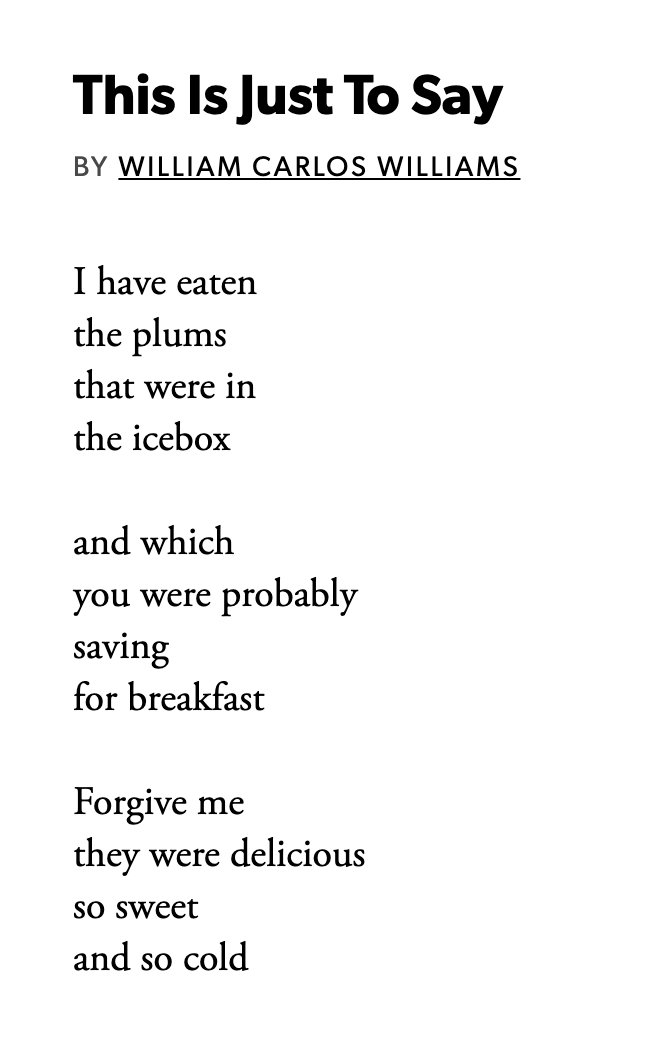
Professors and authors Dr. Eric Abrams and Dr. Christe Hardigree provided an engaging activity to help students consider the strengths and weakness of artificial intelligence when it comes to reading and writing. Abrams posted William Carlos Williams poem “This is Just to Say.”
He read the poem aloud and asked participants to explain what the poem is about. To help us understand the poem, its meaning, craft and structure, we were tasked with asking an LLM to write its own approximation of William Carlos Williams’ poem but we cannot force it to use specific words or write “in the style of the author.” Rather we can use descriptive words to explain how the poem sounds, feels, or what it means. We were give a handful of prompts to use with an LLM of our choice to prompt and re-prompt.
“Write me a poem that . . .”
“Make it about . . . “
“Make it sound like . . . “
“Include/do not include . . “
This process of reading, generating text, rereading, and re-prompting required close and critical thinking about William Carlos William’s poem. Whereas the LLM was able to create some cute or steamy poem about eating plums or not apologizing for eating food in the fridge, AI became a thought provoker to spark ideas, challenge assumptions, not replace human thinking.
An activity like the one described above focused on agency. Critical thinking, personal values, and personal voice were at the center of the learning experience. This poetry experiment shows AI’s potential as a creative catalyst but the majority of the thinking must come from the students – not teachers, not AI, not other tools. Authentic learning happened through personal cognitive effort.
Last April I wrote a blog post about Brett Vogelsinger’s book Poetry Pauses: Teaching With Poems to Elevate Student Writing in All Genres (Corwin, 2023) and how this book changed my teaching for the better. After reading Poetry Pauses I was inspired to start everyday in my classroom with a poem. Now, in my second year of using poetry as a daily warm up protocol, I have amassed a collection of poem and prompts to coincide with each unit of study. Poetry is a great way to start class and bring everyone together. Students are listening, reading, and writing poetry and expanding their literacy skills, world knowledge, and vocabulary.
Reading, listening to, and writing poetry in the English Language Arts classroom offers powerful benefits for boosting literacy. When students read poetry, they engage with rich vocabulary, figurative language, and complex sentence structures in a compact form, which strengthens both comprehension and word knowledge. Listening to poetry read aloud emphasizes rhythm, sound, and pacing, helping students develop fluency and an ear for how language conveys emotion and meaning. Writing their own poems allows students to experiment with word choice, imagery, and voice in a low-stakes, creative way that builds confidence as writers while deepening their understanding of literary techniques. Together, these practices foster close reading, critical thinking, and expressive communication. Poetry’s brevity makes it accessible, while its layers of meaning challenge students to interpret, analyze, and create—skills that transfer across all areas of literacy learning. Our poetry warm ups take no more than ten minutes of class time to invite students to engage in the power of words, language, and poetry.
Teachers can get started with building their own poetry warm-ups by keeping them short, approachable, and playful so students ease into language without pressure.
A good first step is to choose a poem, song lyric, or even a short passage of text and use it as a model for noticing patterns—like repetition, imagery, or unusual word choices. In fact, my first poem this year was a Taylor Swift song.
Teachers can design quick daily prompts that invite students to respond in just a few lines, such as finishing a sentence stem, imitating a poetry format, or creating their own metaphor. Another simple entry point is to use sensory details: ask students to describe what they see, hear, or feel in a given moment, then shape those observations into a poem. Often times I will ask students to sketch an indelible image that stands out from the poem. We don’t write poetry everyday, sometimes students are reading and annotating, there are times I ask them to stop and jot, and lots of turning and talking about key elements and ideas expressed in the poem.
Poetry is about playing with words and expressing ideas, not getting it “right.” This consistency and openness helps students build confidence while strengthening both their reading and writing skills.
In the upcoming Second Edition of New Realms for Writing (NCTE, 2026) to be published this winter, I share a handful of poetry quick writes that I use with my students. Here are a few that you might consider utilizing in your own classroom.
By Storm or Sunshine?
In their poem “Taking It by Sunshine,” Andrea Gibson writes, “Why did I want to take / the world by storm when I could have taken it / by sunshine, by rosewater, by the cactus flowers / on the side of the road where I broke down?” They take a popular idiom and contrast it with things that are the very opposite. I ask students how would they take on the world, by storm or sunlight? and then have them write their response as a poem to convey their own approach to things. Another approach to this poem is for students to select a idiom from the English language and write a poem about it.
Say It, but Don’t Really Say It Poem
Eve Merriam’s poem “New Love” expresses love without ever using the word. How then do we know that she is talking about love? Have your students write a love poem (or a poem about anything) without including the word it’s about.
Indelible Image
Gary Soto’s poem “Oranges” is part memoir spilling with imagery and descriptive language. After reading the poem, students can sketch an indelible image or snapshot of a key scene in the poem. You can have students draw or sketch in response to any poem you share. An additional activity can include students writing a memory in the form of a poem using descriptive and sensory language like Soto.
“Tell all theTruth but Tell It Slant”
Emily Dickinson wrote, “tell all the truth but tell it slant.” Studentscan write true statements about themselves and then “slant,” orstretch, one truth. This is a spin off of the icebreaker activity TwoTruths and a Lie in which people write down two true statementsabout themselves and one lie; others in the group then have to identify the truths and the lie.
13 Ways of Looking
Craig Santos Perez’s poem, “13 Ways of Looking at a Glacier” is divided into thirteen stanzas, each 2-5 lines, showcasing different perspectives. Have students choose a topic or object and describe thirteen perspectives about it. Students can collaborate with others to look at something thirteen different ways or from different perspectives.
Hopes and Dreams Poem
In Mary Oliver’s poem “The Summer Day,” she wrote, “Tell me, what is it you plan to do with your one wild and precious life?” After reading this poem with students, use the last line as a challenge for your students to write down their life ambitions and dreams.
Blackout Poetry
Austin Kleon is a writer who draws and created blackout poetry when he was suffering from writer’s block. To make a blackout poem like Kleon students or the teacher can choose a text and black marker. Taking an artistic approach not to completely black out everything, but rather blocking words and creating a design to highlight a new idea or theme.
I am I will I have
This quick write comes from poet Ugochi Emenaha: Students complete the sentence starters to write a short three line poem that begins: I am . . . I will . . . I have . . .
“Friends”
Spoken work poet Suli Breaks’ poem “Friends” asks listeners to consider their five closest friends and how they add to your life. Ask students who are the five closest people in their lives and how they enhance their life. Students can list their responses or explore their relationships with friends in a poem. *Note there are some mature topics and language addressed in Break’s poem.
A Small Needful Fact
Ross Gay’s poem “A Small Needful Fact” (2015) offers a quiet but powerful reminder of the simple, life-giving actions of Eric Garner. Instead of focusing on violence or injustice, the poem emphasizes hope, connection, and the ordinary acts that sustain life, encouraging us to see people fully, not just as headlines. Invite students to write their own short poems or reflections inspired by Gay’s approach. Ask students to write a poem about something simple yet meaningful, a fact or truth that is often overlooked but worth remembering.
What is the Story in your Bones?
Inspired by Warsan Shire’s line from Lemonade: “I tried to change. Closed my mouth more. Tried to be softer, prettier, less awake… Who taught you to hate the part of yourself that needs love?”Students write for 5–7 minutes in response to what part of you have you tried to silence, soften, or hide? What part of your story is asking to be heard, healed, or celebrated?Students might start with:“I tried to…”“They told me to…”“But I…”Or simply respond freely.
Poets Respond to a Song
Following in poet – musician’s footsteps, Kristie Frederick Daugherty’s anthology Invisible Strings: 113 Poets Respond to the Songs of Taylor Swift (2024) is filled will poems inspired by the music of Taylor Swift. The New York Times used parts of the book for an online quiz (Harlan, 12/12/2024) to guess which poems were inspired by which songs. You can have students write their own poems inspired by Taylor Swift songs or have students write a poem inspired by their favorite music artist.
After returning from Memphis for a fun, music filled getaway, I have been thinking about ways to incorporate music in different content area classrooms to enhance music literacy and appreciation, foundational literacy skills, and disciplinary literacy. More than ten years ago I had the opportunity to teach a History of Rock and Roll elective to 8th graders and it was a project based semester long course. Even though I no longer teach the class, I think how I have been able to incorporate music in my middle school English Language Arts classroom to engage students and foster literacy learning.
Rock music has always been more than just sound — it’s culture, history, poetry, and mathematics wrapped into one powerful medium. Bringing rock into the classroom can energize students, connect curriculum to their world, and open up new avenues for critical thinking. Below are 15 activities you can adapt for ELA, social studies, math, or beyond.
1. Rock Music to Teach Figurative Language
Songs are full of allusions, metaphors, similes, and hyperbole. Students can annotate lyrics and compare literary techniques across songs.
The Beatles – “Lucy in the Sky with Diamonds” (imagery, metaphor)
Coldplay – “Viva La Vida” (allusions, simile, historical imagery)
2. Rock of Influence Ancestry Tree
Students trace musical influence like a family tree, showing artistic lineages across decades. Consider the allusions that Katy Perry and Taylor Swift make in their songs regarding other musicians or Docheii’s song “Anxiety” samples Gotye’s “Somebody That I Used to Know.” Students can trace the music using the sounds or lyrics to show how musicians today stand on the shoulders of popular music artists of the past 70 years.
3. Digital Stories: Rock Music’s Impact on History
Students explore how songs intersect with major historical movements.
Bob Dylan – “The Times They Are A-Changin’” (civil rights, social change)
U2 – “Sunday Bloody Sunday” (Irish history and conflict)
4. Financial Breakdown of Making a Hit Song
Examine music industry economics and profit margins.
Fleetwood Mac – “Go Your Own Way” (studio costs, long production)
Taylor Swift – “Shake It Off” (modern hit-making and marketing)
5. Music Analysis
Break down structure, instrumentation, rhythm, and tone.
Nirvana – “Smells Like Teen Spirit” (grunge dynamics, verse/chorus shifts)
Kurt Cobain/Nirvana – “All Apologies” (self-revelation)
13. Baz Luhrmann Style – Modern Music to Define a Character or Text
Match songs to characters in literature or history.
Imagine Dragons – “Radioactive” (reimagined dystopian or sci-fi characters)
Florence + the Machine – “Shake It Out” (characters overcoming inner struggle)
14. Music of the Times
Analyze what music reveals about its historical and cultural context.
Creedence Clearwater Revival – “Fortunate Son” (Vietnam War era protest)
Pearl Jam – “Jeremy” (1990s school violence and alienation)
15. Write the Song
Students synthesize content knowledge into original lyrics.
Bob Marley & The Wailers – “Get Up, Stand Up” (activism, empowerment)
Rage Against the Machine – “Killing in the Name” (anger, rebellion, social critique)
Whether you’re analyzing metaphors in Bob Dylan, calculating the cost of a concert tour, or mapping the influence of Chuck Berry on modern artists, rock music opens up rich interdisciplinary opportunities. Try one of these activities and watch your classroom energy soar.
There are many cities in and around the United States that are filled with musical history but for rock and roll, soul, and blues fans, Memphis is a key destination. Sun Studios, Graceland and Stax Museum are all based right in the heart of Memphis and bring music history to life. Our weekend stay in Memphis filled our brains, hearts, ears, and even our stomachs!
Day One: Graceland, Sun Studios, and Beale Street
Graceland, Elvis Presley’s home is more than a house tour of his iconic family home, it is a museum filled with Elvis’ ever present impact on musical history. Elvis Aaron Presley was a singer and actor who rose to fame in the 1950s for his music, looks, and shaking hips. A pioneer of rockabilly, he’s considered one of the most influential figures in rock and roll history. His charismatic stage presence and unique voice, blending country and R&B, captivated audiences with his first radio hit “That’s All Right.” He had 18 number one hits and according to Graceland, “Elvis has had no less than 149 songs to appear on Billboard’s Hot 100 Pop Chart in America. Of these, 114 were in the top forty, 40 were in the top 10, and 18 went to number one.”
Years ago I taught an elective on rock and roll history and although the course started long before Elvis’ launch on the music scene, his influence on music in the 1950s shapes rock and roll music even to this day. Elvis became an instant icon once his music was played over the air. As his celebrity was at its height, he was drafted into the US Army and served for two years before an honorable discharge in 1960. The 1960s brought Elvis to Hollywood where he stared in 31 feature films and continued to produce music. In 1969 Elvis starts his residency at the International Hotel in Las Vegas performing two shows a night until 1976 and his jumpsuits became quintessential fashion statements.
Sun Studio, often called the birthplace of rock and roll, played a pivotal role in shaping modern music history. Founded by Sam Phillips in Memphis, Tennessee, the studio launched the careers of legendary artists like Elvis Presley, Johnny Cash, Jerry Lee Lewis, and B.B. King. By blending blues, country, and gospel influences, Sun Studio helped create a new sound that broke racial and musical barriers in the 1950s. Elvis first walked into Sun Studios in 1953 to make a recording of “My Happiness” for his mother and although Sam Phillips was not in the studio that day, his secretary Marion Keisker recorded this first record and is credited with seeing Elvis’ potential.
December 4, 1956, at Sun Studio is key. That evening brought together four of rock and roll’s most iconic figures: Elvis Presley, Johnny Cash, Jerry Lee Lewis, and Carl Perkins. Sam Phillips recorded these sessions, although he was not able to published them due to Elvis’ contract with RCA Records. It was not until 1981 that these seminal recordings were published with 17 tracks. To be a fly on the wall and listen to these rock and roll musicians talk, play, record, and make musical history.
How do you end an exciting day among musical history? With music of course! Beale Street is a historic street in Memphis, famous as the Home of the Blues and birthplace of Rock n Roll. It’s a vibrant entertainment district known for its live music venues, historical markers, and significance in American music and culture. Even today, Beale street is filled with clubs and musicians playing great music.
Day Two: Stax Museum, National Civil Rights Museum, and BBQ
The Stax Museum of American Soul Music, located in Memphis just miles from Sun Studio, celebrates the legacy of Stax Records—a powerhouse of soul, R&B, and funk that helped define the sound of the 1960s and 70s. While Sun Studio ignited the rock and roll revolution, Stax amplified the voices of Black artists like Otis Redding, Isaac Hayes, Booker T. & the MG’s, and Carla Thomas, creating music that spoke to the soul of the civil rights movement. Together, Sun and Stax tell the story of how Memphis became a crossroads of American music, blending genres and breaking down racial barriers through sound.
As I write this post about the musical history of Memphis, I cannot leave out one of the most dramatic times in American History that happened in this vibrant city. On April 4, 1968, at the Lorraine Motel in Memphis, Tennessee Martin Luther King, Jr. was standing on the balcony of his room, Room 306, when he was shot and killed. The hotel now serves as the National Civil Rights Museum, inviting visitors to experience history, deepen their understanding, and be inspired to take action for human rights.
Dr. Martin Luther King Jr. traveled to Memphis the spring on 1968 to support striking sanitation workers who were demanding fair wages and safer working conditions. The museum ends looking into rooms 306 and 307, the room King and his colleagues were staying in at the time of his murder. This time capsule evokes a profound sense of sorrow, reflection, and the enduring weight of his legacy.
Stay tuned with a post next week that highlights some musical activities you can bring to your classroom to integrate musical history into your content area classroom.




 The Teaching Factor
