Category Archives: hyperdocs

Digital Documentation & Final Reflections in Middle School

For those of you who have been following my blog over the past ten years or more now, I grapple with grading in middle school English Language Arts class. What to grade and how to grade have been a personal investigation and interest for the past decade. I have tried contract grades, portfolios, hacking the PowerSchool grade book, and even created space for students to evaluate themselves. Do you weigh your assignments and grades or use standards based grading? These are questions that I ponder every school year as I search for a meaningful way to show student growth and learning. My students have a lot to say since they only see numbers and letters as the driving force of the work they do in school. Additionally, not a year goes by when a parent or a few, schedule a meeting to talk about numerical and letter grades of their student.

I have written about these topics in posts about feedback over letter and number grades and hacking the online grade book.

After reading Angela Stockman’s The Writing Teacher’s Guide to Pedagogical Documentation (Routledge, 2024) I decided students would forego a final assessment or exam and instead, articulate and showcase their growth as a learner. I put together a digital portfolio for students to complete a series of tasks to illustrate their thinking about themselves as readers and writers. The tasks included:

Task 1: Reflecting on Books Read

  1. Make a list of all the books you read this year for school (See list of choices provided on Google Classroom).
  2. Write a 1-2 sentence summary of the key takeaways from each book.

Task 2: Choosing 3 Writing Samples 

  1. Read through all your writing samples from this year.
  2. Choose three writing samples to showcase your growth as a reader and writer.
  3. For each writing sample, Identify 3 things you did well in the writing sample (record on the post-it note) AND 3 areas for improvement in the writing sample (record on the post-it note. These post it notes will be the writing reflections on slides 6-8)

Task 3: Revising Writing Sample 

  1. Choose one writing sample you previously annotated and reflected upon.
  2. Make specific revisions to enhance the quality of your writing on Slide 9.
  3. Discuss the writing moves you made to show growth as a writer this year on the bottom of Slide 9.

Task 4: Reflecting on ELA Learning & Growth Narrative Preparation

  1. Write a reflective piece on your learning in ELA over the year (See samples on slide 11 & 12).
  2. Include details about challenges faced and how you overcame them using a metaphor or analogy.
  3. Discuss changes in your reading and writing habits to enhance literacy skills.
  4. Refer to your own writing, grade book, and English Notebook for details.

The metaphor piece was helpful for students to communicate the ups and downs of their learning this past year. Here are some highlights from student testimonies:

Before beginning the marathon, M* had trouble with finding the true meaning behind texts. When reading, he didn’t feel the need to connect the themes in the book to real world events – it was meaningless fiction, not to be confused with reality.  “What’s the point?”, he said to himself. “Books are meant to transport you away from the real world – why would they connect stories to real events?” Now M* knows that the reason that books are so engaging is because we can relate to them and connect other character’s stories. M* has learned to appreciate the hidden themes in novels and identify them to understand the author’s point of view. Over the year, M* has greatly improved his writing techniques and can now read with a more advanced mindset. 

Over the entirety of the year I noticed some very evident changes in my notebook. It went from a cluttered often misplaced English journal to honestly one of my prized possessions. I took pride in it and the work I did. Also assignments like the Lethal Lit Sketchnotes and the Character Life Map were truly some of my favorite, as I started to view anything from objects to even protagonists in my book more symbolically. At the beginning of the year they were mere sketches drawn with a Dixon Ticonderoga Number 2 pencil. At the end of the year they animated, portraying the character’s emotions of melancholy, reflection, joy and contrite, and an organized, personalized entry for me. Perhaps, it even represented my progression as a visual learner throughout this academic career.

Throughout the year, I feel that I have grown and improved. I was trying out different recipes, trying to find the best one. At first, I wasn’t putting in the right ingredients or wasn’t paying attention to the recipe. Now I have found the correct ingredients and I pay attention to the amount of ingredients. Instead of thinking only about the final product, I think about the work and effort to get there because the perfect recipe cannot be obtained in a single day.

These portfolios that students shared were astute and inspiring. I am thinking of including them all year long for students to build their metacognitive skills and showcase learning and growth over a subjective letter and number.

Tagged , , , , , , , ,

Symbolism Hyperdoc

Thinking about how I can create an active learner, critically thinking activity for students, I created this hyper doc to help students read, explore, apply and reflect on symbolism in literature. Each section on the game board has students record, connect, and analyze the information presented in the hyper doc.

Doing a test run of the hyperdoc with eighth graders but in the meanwhile, you can grab a copy.

Tagged , , , , ,

May is Jewish Pacific Heritage Month

Image

The following blog post was written for and first appeared on teachbetter.com blog on May 2, 2023.

The month of May is designated as Jewish American Heritage Month and Asian American and Pacific Islander Heritage Month. During this month we honor “the generations of Jewish Americans and Asian and Pacific Islanders who have enriched American history and are instrumental in its success.” 

The month of May in my eighth grade classroom is when we are studying  WW2, the Holocaust, and Japanese Internment. In both English and social studies students are reading historical fiction, memoirs, and nonfiction texts of their choice about these topics. In history students are studying the dates and facts, reading primary sources, and understanding the ramifications of the war on a global level. The aim in this cross curricular unit is for students to develop an understanding of the roots and ramifications of prejudice, racism, and stereotyping in any society. Additionally, students develop an awareness of the value of pluralism and encourage acceptance of diversity in a pluralistic society. One key facet is to not just learn about the victims but also honor the Jewish and Asian American heroes who showed perseverance and were instrumental during this time.

Students learn about Japanese Internment as well as the 442nd regimental combat team, a segregated Japanese American unit who are the most decorated unit in US History for their bravery and heroism. Students read the graphic novel They Called Us Enemy by George Takei and gain a child’s perspective of Executive Order 9066 and living in an Internment Camp in Takei’s memoir. Some students select to read Traci Chee’s We Are Not Free, a Printz Honor Winner young adult  historical fiction text that was based on the author’s grandparents stories of being incarcerated during WW2. 

I have put together two different hyperdocs,  a digital document such as a Google Doc where all components of a learning cycle have been pulled together into one central hub for students to learn more.. Within the hyperdocs students are provided with hyperlinks to all of the resources to work on at their own pace and learn about the diverse groups of soldiers who made up America’s military and a second hyperdoc that examines Japanese Internment and the ramifications for today. You can make a copy of these two hyperdocs when you click on the images below. 

Image

Image

Similarly, in studying the Holocaust students read stories of survivors and even have the opportunity to Zoom with a survivor to hear her story. You can connect with a speaker through the Jewish Heritage Museum’s Speakers Bureau in New York City. Additionally, students look at art work and read poetry from the victims and survivors of the Holocaust to understand the horrors of this period in history. The Anne Frank House in Amsterdam offers a virtual tour online of the Secret Annex where Anne and her family hid for more than two years during WW2 where she wrote her diary. 

Educational materials have been curated by The Library of Congress, National Archives and Records Administration with primary sources about the Chinese Exclusion Act, Annexation of Hawaii, and Japanese Americans during WW2. The National Endowment for the Humanities, National Gallery of Art, National Park Service and United States Holocaust Memorial Museum has links and resources for teaching about  the generations of Jewish Americans who have contributed to American history, culture and society.

For our culminating project for WW2 students create their own multi genre text on a specific topic and theme about World War II. This summative assessment  and multi genre project incorporates five different texts (fiction and nonfiction) grounded in specific historical documents to highlight a common theme prevalent in WWII. Allowing students to be researchers and writers enables students to use higher order thinking and comprehension skills while at the same time tap into 21st Century skills as digital citizens and creators. Students will utilize technology for research and writing to produce a blog that presents their understanding and learning of this inquiry unit on WWII and the Holocaust.

This May consider ways to share stories, expose stereotypes and myths about Jewish and Asian Americans and celebrate their rich culture and diversity. 

Be sure to share in the comments ways that you are helping to celebrate Jewish Pacific Heritage Month in your classroom. 

Tagged , , , , , ,

#FETC2023

I am always excited to talk and share about hyperdocs, playlists, and choice boards. These differentiated and personalized learning opportunities for students are utilized with each unit I teach in 8th grade English. I am sharing my slide deck for #FETC23 in New Orleans for my Mega Share presentation on Monday, January 23rd. Participants will learn about hyperdocs, playlists, and choice boards and the capabilities these blended learning teaching strategies have to offer.

Hyperdocs and playlists are Google docs/slides/drawings filled with hyperlinks to a variety of structured learning opportunities. HyperDocs and playlists can be a useful tool for in personal learning, distance learning, and even blended learning opportunities for unit of study and multi-day lessons. Hyperdocs and playlists promote a self-paced structure that enable students to take charge and choose different activities that align with the learning objective of the Hyperdoc or playlist.

Teachers can enhance their teaching toolbox to support the diverse learners in the classroom with hyperdocs, playlists, and choice boards. I will also share digital platforms and apps to support the diverse learners to create meaningful classroom experiences that promote reading, critical thinking and digital literacy. So, it is up to educators to provide students with a plethora of tools and strategies so they have the opportunity to choose which will best help them reach their learning goals.

Below is a list of different playlists, choice boards, and hyperdocs I have created for my middle school student and share in the slide deck above. Feel free to make a copy of these and adapt for your own classroom use. Please be sure to credit those whose materials you are using, adapting, and borrowing. 

Humanities:

Anti Asian Hate Now & Then: Parallels W/Japanese Internment & WW2 

WW2 & The Holocaust

World War II Military

The History & Fiction of Hunters on Amazon Prime

19th Amendment Centennial

Literature & ELA:

Animal Farm Week One & Week Two 

Raymond’s Run Hyperdoc

Ransom of the Red Chief Hyperdoc

Poetry Choice Boards

Mystery Writing

Movie Viewing & Media Literacy:

Black Panther Origins (Pre-Viewing Guide) & Viewing 

Black Panther Movie Analysis Choice Board

Twilight Zone

Getting to Know Your Students:

Get to Know You Think Tac Toe (Choice Board)

Tagged , , , , , , ,

Back to School Stranger Things Themed Syllabus & Opening Day Activities

Image

It’s a syllabus.

It is a hyperdoc.

It’s a menu of opening day activities for students.

Actually, it is all three rolled into one.

I saw a class syllabus from @MrsGearheart laid out like a game board with station activities for each part of the syllabus. Students read and complete the syllabus to earn badges. I loved the format but was thinking how to personalize it for my middle school students. And wallah, here is the syllabus, hyperdoc, and first days of school menu choice board for students to complete. The syllabus covers about the teacher, class expectations, each of the units we will complete throughout the year, information about standards based grading, and classroom policies.

Image

Rather than the badges, that @MrsGearheart created – and there are a lot. I have paired down a menu of activities for students to complete the first two days of classes. For the appetizers, students choose one to complete and share about themselves with the whole class. Thinking in different formats, students can either create an infographic about themselves using Adobe Express or can conduct an interview with a peer on Flip(grid). The main course is an assignment that all students will do the end of the week. It will not be a graded assignment but will help me learn about students’ reading and writing skills, likes, and literary influences. I will share that assessment in next week’s blog post. For dessert, these are short activities to help students get comfortable with the tech platforms I use weekly and also tell me more about themselves. I am a dessert person so I thought, why not complete all these activities. I think students will be able to do the appetizers and desserts over two 40 minute class periods. If you would like a copy of this template, you can click here.

Image

Tagged , , , , , , , ,

Enhancing Meaning Making with These 4 Graphic Organizers

I am a big proponent of graphic organizers to help students organize and visualize information. Graphic organizers are helpful to outline a writing task or showcase understanding during reading. Jay McTighe and Harvey Silver write in Teaching for Deeper Learning (ASCD, 2020), “The use of graphic organizers enhances meaning making and promotes deep understanding of critical content – especially when reinforced through questioning and summarizing.”

In 8th grade I begin the school year providing graphic organizers for all students to utilize and access to organize content information. I share and utilize different organizers with each assignment. Sometimes I might demonstrate filling out the organizer and use think aloud to show students the process of making meaning using graphic organizers. Slowly, using gradual release, I encourage students to create their own graphic organizers in the second semester of the school year. The first twenty weeks of school students have curated a toolkit of strategies and organizers for to choose which are the best to create based on the assignment and learning goals.

Here are four different organizers that are the go-tos for note making and organizing information.

  1. It Says, I Say, So What – Taken from Smoky Daniels, this three column organizer helps students record the literal details of a text, make connections and inferences. Inferences are hard for many students, especially struggling readers, because the text does not explicitly say. To make an inference students combine what the text says with what they know to come up with the answer. They need a scaffold, something that visualizes and helps students internalize the process of how to infer. The It Says—I Say chart helps students finally see a structure for making an inference.
Image
It Says – Find information from the text that stands our or addresses a question. I Say – Think about what you know about the information. So What – Combine what the text says with what you know
to come up with the answer.

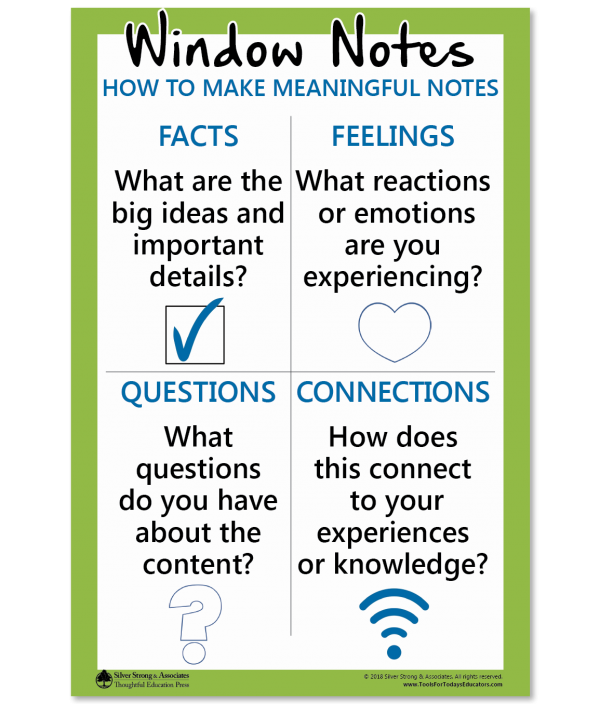
2. Window Notes/Organizer – Jay McTighe and Harvey Silver introduced this type of note making in Teaching for Deeper Learning (ASCD, 2020)Window Notes at its core is an invitation to think actively, to express curiosity, and to use prior knowledge and personal feelings to help construct meaning during note making process. Students use a window shaped organizer that encourages them to collect four different kinds of notes: 1. Facts: What are the important facts and details? 2. Questions: What questions come to mind? What am I curious about? 3. Connections: How does this relate to my experiences or to other things I have learned? 4. Feelings and reactions: How do I feel about what I am learning?”

Image

3. Know. Question. Reflect. New Questions (KQRN) – I am over KWL charts. I think they work well in elementary school but when I see them utilized in middle and high school, we are not asking students to use higher level thinking. Here is a blog post I wrote ten years ago with alternatives to the KWL. What are some other organizers that are alternatives to the KWL and activate schema at the same time? The KQRN. This is another note making organizer that helps students extend their thinking about an idea or concept. Now with any of these organizers, the teacher wants to model for students how to complete these graphic organizers with examples and think alouds.

Image

4. Character Traits Organizer – Characterization and theme are two key elements we study when reading literature in 8th grade English. Characterization refers both to the personality of a character and the way in which an author reveals that personality. A character’s personality is made up of different qualities, or character traits, that the reader discovers as the work unfolds. An author often gives characters several different traits to make them seem real and believable. Helping students develop the language to describe character traits and read to identify character traits is necessary to work on throughout the school year. Characterization leads to insight and inferences about theme. I have a stand alone organizer for character traits but also have created a hyperdoc based on the short story Raymond’s Run by Toni Cade Bambara that scaffolds the entire process of curating character traits then building out a written response about characterization as it impacts theme.

Image
Tagged , , , , , , , , ,

Identity Choice Novels & Playlist

Students are reading books with themes of identity as our last unit this school year. Student outcomes include

  • Recognize how people and characters define themselves as individuals through multiple complex factors, including culture, family, peers, and environment, and that defining oneself is a complex process
  • Read texts of various lengths to analyze content and structure, and cite evidence
  • Respond to texts (orally and in writing) coherently and thoughtfully
  • Develop and support claims with textual information
  • Participate in small-group and whole-class discussions

Students selected from five (5) choice novels:

Piecing Me Together by Renee Watson – Newbery Honor

Acclaimed author Renee Watson offers a powerful story about a girl striving for success in a world that too often seems like it’s trying to break her. Jade believes she must get out of her poor neighborhood if she’s ever going to succeed. Her mother tells her to take advantage of every opportunity that comes her way, which Jade has. Every day she rides the bus away from her friends to the private school where she feels like an outsider. She’s tired of being singled out as someone who needs help or someone who people want to fix.

Holding Up the Universe by Jennifer Nevin

Libby and Jack get tangled up in a cruel high school game—which lands them in group counseling and community service—Libby and Jack are both angry, and then surprised. Because the more time they spend together, the less alone they feel.

Poet X by Elizabeth Acevedo – A National Book Award Winner. 

A young girl in Harlem discovers slam poetry as a way to understand her mother’s religion and her own relationship to the world.  Xiomara Batista feels unheard and unable to hide in her Harlem neighborhood. She has learned to let her fists and her fierceness do the talking. But Xiomara has plenty she wants to say, and she pours all her frustration and passion onto the pages of a notebook, reciting the words to herself like prayers—especially after she catches feelings for a boy. (Some mature topics throughout the book.)

The Truth As Told by Mason Buttle by Leslie Connor – National Book Award Finalist

Mason Buttle is the biggest, sweatiest kid in his grade, and everyone knows he can barely read or write. Mason’s learning disabilities are compounded by grief. Fifteen months ago, Mason’s best friend, Benny Kilmartin, turned up dead in the Buttle family’s orchard.  An investigation drags on, and Mason, honest as the day is long, can’t understand why Lieutenant Baird won’t believe the story Mason has told about that day.

Everything Sad Is Untrue by Daniel Nayeri – 2021 Michael Printz Award

An autobiographical novel, middle-schooler Daniel, formerly Khosrou, tells his unimpressed and at times cruel classmates about his experience as an Iranian refugee.  Modeling his storytelling on Scheherazade and not beholden to a western mode, Daniel Nayeri writes a patchwork of memory and anecdote.  He layers stories upon stories to create a complex, hilarious, and devastating understanding of memory, family, and perspective. This book is a complex read due to the interweaving of stories in past and present and suggested for advanced readers. 

I created this identity playlist to help student meet learning targets and draw connections text to self, text to text, and text to world.

This is just a highlight of some of the slides. To get a copy of this playlist you can access HERE.

Tagged , , , , , , , , ,

Assessment Speed Dating

Formative Assessment is a constantly occurring process, a verb, a series of events in action, not a single tool or a static noun. — from Formative Assessment That Truly Informs Instruction (NCTE, 2013) 

Image

Assessment is an integral part of instruction determining whether or not the goals of education are being met. It is used to measure the current knowledge that a student has. It is through assessment that teachers are continually asking:

“Am I teaching what I think I’m teaching?”

“Are students learning what they are suppose to be learning?”

A test, quiz, or assessment project is not just a grade to evaluate the students at the end of a unit but an ongoing evaluative tool for the teacher.  Teachers are engaged in assessment every minute that they are in the classroom. As teachers we are always observing, noting, and evaluating. There are three types of feedback and goal setting assessment tools that teachers need throughout a unit of inquiry:

Pre Assessment (Finding Out) – Pretests, inventories, KWL, checklists, observations, self-evaluations, questioning, mind mapping, anticipation guides

Pre Assessment allows student to demonstrate what they already know about what is being planned and what further instruction opportunities are needed or what requires reteaching or enhancement. Teachers can not just begin a lesson without taking a “temperature” of what the students know in the beginning.

Formative Assessment (Keeping Track and Checking Up) – Conferences, peer evaluations, observations, talkaround, questioning, exit cards, quiz, journal entry, self-evaluations

Formative assessment occurs concurrently with instruction and provides feedback to teachers and learners. Formative assessment can be formal and informal to frame meaningful performance goals.

Summative Assessment (Making Sure) – Unit Test, performance task, product and exhibition, demonstrations, portfolio review

Summative assessment shows what students have learned at the conclusion of an instructional unit and is evaluative.

For reliability and validity teachers should use a variety of assessments to provide enough helpful feedback to improve performance. Assessment should be used for guiding, self-reflection, instruction, nurturing, and used over multiple activities. In addition, students should be involved in daily or weekly evaluation of their progress. Rubrics and other scoring tools help evaluate understanding of content and skills that are used by both the teacher and the student for both specific tasks and long term progress. I never handout to students an assessment without also giving them the evaluation rubric at the same time so they know exactly what I am looking for when I evaluate their projects and assessments. Here are four criteria of quality feedback as defined by Grant Wiggins (1998): 

1. It must be timely.

2. It must be specific.

3. It must be understandable to the receiver.

4. It must allow the student to act on the feedback (refine, revise, practice, and retry).

It is easy to give tests and quizzes but in actuality, they are not always the most accurate evaluation tools. Teachers want to use a variety of assessments or data sources and teacher data mechanisms to help gain a more accurate picture of students knowledge and understanding.

To help my pre-service English teachers consider the various aspects of assessment, I created this Assessment Speed Dating Hyperdoc that walks teachers through various literacy based assessments in the English language Arts classroom and more.

The hyperdoc and speed dating template was inspired and adapted from Amanda Sandoval @historysandoval.

Tagged , , , , ,

Zooming In On Setting for Study of Author’s Craft and Some Creative Writing

Setting is an important part of any story because it explains where and when the events take place. The setting helps create the mood and set the tone for the literary piece. We often ask students to analyze the setting by examining the surrounding environment, background, historical place in time and geographic location and notice how the setting impacts the character and conflict in the story.

Studiobinder.com defines setting as, “A setting is the time and place of a story. Setting is either outwardly articulated to us, or discretely suggested to us. It can be suggested by weather, clothing, culture, buildings, etc. In screenwriting, setting is written into the slugline of a scene heading. But setting isn’t just the location of a scene, it’s the time in which it exists as well.”

My students will be starting our mystery unit and I want to help use more descriptive language so we will spend the next two weeks focusing on setting in film, stories, and their own writing. I have created this playlist to help students understand the depth of setting in literature.

Looking at excerpts from Maureen Johnson’s Truly Devious and Laura Ruby’s York students are able to see how authors communicate the setting by describing the environment and how characters interact within the environment.

This unit is an introduction to understanding author’s craft and structure.

Craft and Structure:

CCSS.ELA-LITERACY.RL.8.4
Determine the meaning of words and phrases as they are used in a text, including figurative and connotative meanings; analyze the impact of specific word choices on meaning and tone, including analogies or allusions to other texts.

CCSS.ELA-LITERACY.RL.8.5
Compare and contrast the structure of two or more texts and analyze how the differing structure of each text contributes to its meaning and style.

CCSS.ELA-LITERACY.RL.8.6
Analyze how differences in the points of view of the characters and the audience or reader (e.g., created through the use of dramatic irony) create such effects as suspense or humor.

Tagged , , , , , , ,

Contemporary Dystopian Fiction Playlist

Image

Instructional Playlists are individualized digital (hyperlinked) lessons and assignments for students to follow. Whereas a hyperdoc could be one lesson or inquiry unit, a playlist provides students directions for an entire unit. Students can work through these hyperdocs and play lists at their own pace. The teacher might provide dates to help students keep pace and not leave the assignments until the last day. Additionally, since every student gets a copy of the playlist on Google Classroom, the playlist can be individualized to support the diverse learners in your classroom.

Image

This contemporary dystopian playlist is a three week unit that is driven by students reading and book club discussions. Playlists are perfect for blended learning classrooms. Playlists are like full lessons that involve combinations of whole group learning, online learning, face to face opportunities, online learning with individual collaboration and small group learning. When you enter my 8th grade ELA classroom students spend the first ten minutes of class time reading their contemporary dystopian text and then responding in their Reader’s Notebook. On Reading Workshop days students get longer reading time in the classroom. If we expect students to read we need to give them the time to read in our own classes. For this unit, since it is only three weeks we are focusing in on the setting of the dystopian society and characterization. Students will learn about the Hero’s Journey and types of dystopian controls. Students will have multiple opportunities to work in their book clubs to share their thinking about their reading and learn from one another.

Image

If you are new to creating playlists and hyperdocs, note that packaging is key. Think about aesthetics and the visual effect of the playlist. Make sure the organization is simple, clear, and accessible to diverse learners. Provide opportunities for student collaboration and inquiry based learning. Try new approaches to student learning. So what are you waiting for? Try out a playlist with your next unit and let me know how it goes.

Tagged , , , , , ,