Tag Archives: Teaching

Boost Academic Success: Vocabulary Strategies for Students

It is important to provide vocabulary in secondary classrooms for academic success. Expanding students vocabulary enhances their ability to comprehend complex texts, it enhances comprehension and improves writing. Students who can express their ideas with a broader range of words produce more coherent and persuasive writing. 

Providing explicit vocabulary instruction can improve students critical thinking skills by enhancing their ability to analyze, evaluate, and interpret information. A rich vocabulary is essential for critical thinking.  Word precision and verbal fluency are communication skills that are necessary in all aspects of life. A rich vocabulary equips students with a broader range of words, making them more articulate and confident speakers. 

“As teachers, it is impossible for us to teach students every word they need to know to understand all texts they might encounter. At the same time, teaching students how to learn from context is vital to their ability to read independently and learn from texts that have new and unknown words.”— Janet Allen, Tools for Teaching Content Learning 

The ultimate goal of all vocabulary development is for students to become independent word learners.

Vocabulary instruction happens before, during, and after a lesson. Here are five strategies to try with your students for intentional word work.

Image
Image
Image
Image
Image

These strategies can happen before, during, and after a reading or inquiry. Students should be provided with MULTIPLE reading assignments and/ or activities so that they are forced to engage with the text and vocabulary repeatedly. The following points are highlighted by T. Cotton, 2024:

  • Multiple Exposures: Effective Vocabulary & Reading Instruction requires multiple opportunities to ENCOUNTER, ENGAGE with, & ELABORATE on the content area vocabulary & text.
  • Visual Representations: The brain processes visuals faster than it processes text. High-interest visual representations help with student retention, make visual connections with the terms, and support ALL LEARNERS!
  • Graphic Organizers: Vocabulary Text Evidence Chart & Concept Map

If you would like to learn more vocabulary strategies, I will continue to post ideas to engage and activate word learning. Share any recommendations or word work that you know helps word learning stick.

Tagged , , , , , , , , ,

Book Review: AI in the Writing Workshop

I recently read AI in the Writing Workshop: Finding the Write Balance by Dennis MagliozziKristina Peterson (Heinemann, 2025). After attending a session with the two writers at #NCTE25 I knew I had to dive deeper into their book, which didn’t disappoint. As high school English teachers, both discussed how they used AI for teaching facing and student facing writing tasks partnering with Human Intelligence to better serve student writing and thinking. Their guiding question: How can human intelligence (HI) work with artificial intelligence (AI) in a productive partnership in our ELA classrooms?

Right from the start of the book I was hooked. I hear many teachers talk about AI as this cheating platform and Magliozzi and Peterson address this head on: “There will always be ways for students to cheat online, and that is only one aspect revealed about AI’s character. We believe that teaching students how to leverage the power of AI to improve their writing and thinking has the potential to aid both students and teachers in the classroom, and to anticipate the work world they will inhabit.” (pg. 5)

They go on to write, “The real crisis here isn’t about cheating or our curriculum. It’s about our students relationship with writing. Consider things from their perspective: If their teacher doesn’t care about the process and doesn’t focus time and energy on the student’s journey through it, why shouldn’t they use AI? Too often, writing is reduced to a formulaic exercise, one that can be outsources and assembled easily by generative AI. The majority of tasks in schools asks students to provide information to explain in a coherent way the answer to a prompt-based question, the same question everyone else is also responding to. All things AI can do and, because of its character, do very quickly. 

 . . . AI is going to force us to shake things up. Perhaps the best foot forward is to reevaluate our approach to teaching writing and how that instruction deepens or deadens a student’s relationship with it. Students deserve the opportunity to discover themselves as writers. We need to turn our classrooms into places where real writing happens, where students engage with and explore a topic important to them through written word. Writing is more than simply conveying information; it’s about learning how to think critically, creatively, and analytically.” (pg. 10)

Right at the end of Chapter One they shared their curriculum map of the writing tasks they assign to their students throughout the year and where AI is incorporated into the units.

Image

This got me thinking where are places where I can be more intentional with AI as a thought partner throughout the writing process? I mapped out the writing tasks I ask of my students throughout the school year and consider where AI needs to be incorporated. I really love the idea Magliozzi and Peterson share where students write a literary analysis essay based on AI’s commentary. This puts students critical thinking at the forefront to showcase their on thinking and understanding of a text.

Image

Our best foot forward is to teach students how to use it as an ally. The collaboration of HI and AI can write far better than just prompting a bot with the essay prompt and handing that in.” (pg. 25) I am on the same page with the authors that students write first and struggle second. AI is the third step in the process. Students need to learn to trust their own thinking and also know that without struggle there is no growth.

Image

Utilizing AI effectively is a matter of directing the bot to do what you want it to do. This requires writing, reading, rereading, and rewriting to get the output that you are looking for. The authors provide some specifics how they prompt the bot to support student writers.

Image

One of the last elements that really I am interested in adopting in my classroom is the element of reflection. Students write a reflection (can be a Google Form or questionnaire) to consider how the AI tool helped them through the writing process and their final project, where did they get the most help and support, and what was not helpful with AI. Adding this reflection piece is key because it always students to develop metacognitive awareness and honor their own thinking and writing.

Tagged , , , , , , , , , ,

Looking Back to Move Forward: Teaching, Writing, and Learning in Motion

It’s been a little over a month since I last published a post here, and if there’s one thing 25 years in education has taught me, it’s that pauses are not signs of stopping—they’re often signs of deep work happening beneath the surface.

As I step into a new school year and reflect on the past one, I’m reminded why I’ve kept The Teaching Factor going for more than 15 years: teaching is never static. Our classrooms, our students, and we ourselves are always in motion—learning, revising, and recalibrating.

Highlights from a Year of Active Learning and Creative Risk-Taking

This past year has been full in the best way.

  • I published a Jump Start Guide on Active Learning with ISTE, a project rooted in the belief that students learn best when they are doing, creating, questioning, and reflecting.
  • I continued work on the Second Edition of New Realms for Writing, which will be published this spring with NCTE. Revisiting this book has been a powerful reminder that writing instruction must evolve alongside our learners, tools, and contexts. I am so excited to share all the new and updated materials, technology considerations, lesson plans, and resources with you.
  • I had the privilege of presenting at conferences—both in person and online—connecting with educators who are experimenting boldly with instruction, literacy, AI, and blended learning.
  • And, most importantly, I stayed connected to classrooms—my own and others—where the real work of teaching and learning continues every day.

Across all of these spaces, the conversations kept circling back to the same essential question:
How do we design learning experiences that are meaningful, human, and empowering?

Core Teaching Strategies That Continue to Matter

Even as tools and technologies shift, there are instructional principles I keep returning to—and keep sharing—because they work.

1. Active learning is not an add-on.
Whether through digital notebooks, inquiry-based projects, discussion protocols, or creative writing tasks, students need opportunities to engage, not just comply. Active learning invites ownership and curiosity.

2. Writing is thinking.
Across content areas, writing remains one of the most powerful tools for making learning visible. Low-stakes writing, multimodal composition, and reflection help students process ideas and develop voice—not just produce products.

3. Choice fuels motivation.
From Genius Hour projects to differentiated pathways, choice gives students agency. When learners can make meaningful decisions, engagement and accountability increase.

4. Structure supports creativity.
Scaffolds, mentor texts, and clear routines don’t limit creativity—they enable it. The most successful classrooms balance freedom with intentional design.

5. Reflection completes the learning cycle.
Students (and teachers) need time to pause, look back, and name what they’ve learned. Reflection builds metacognition, resilience, and growth.

Looking Ahead: What’s New and What’s Next

As this school year unfolds, I’m excited about what’s ahead:

  • The release of New Realms for Writing, Second Edition and the conversations it will spark around authentic, creative, and purposeful writing.
  • Continued work with educators exploring AI as a tool for thinking, not shortcuts, and as a way to support—not replace—human learning.
  • Sharing classroom-tested strategies here on the blog and on Instagram, where I’ll continue posting ideas, reflections, and practical takeaways you can use right away.

More than ever, I believe educators need spaces to reflect, experiment, and learn from one another. The Teaching Factor remains that space for me—and I hope for you as well.

If you’ve been teaching for one year or twenty-five, my hope is that this year brings renewed energy, thoughtful risk-taking, and moments of joy in learning.

Here’s to a year of active classrooms, curious minds, and writing that matters.

Image
Tagged , , , , , , , , ,

NCTE #2025 Presentation Materials

Looking forward to seeing you in Denver, Colorado for National Council of Teachers of English Annual Convention. I am so excited to be presenting two different sessions. Below you can find information about these sessions and access my slide decks.

Friday morning I will be presenting New Realms for Writing: Inspire Student Expression with Digital Age Formats

There are so many ways to support student writers in your classroom. Whether you’re working with elementary or high school students, there are strategies that support students with and without technology. If we want students to be creative communicators, we need to expand the role, formats, and audience for writing across the content areas.

Today, words are multisensory experiences that are seen, heard, and experienced through podcasting, filmmaking, storytelling, gaming, virtual reality, and design. Writing has evolved in genre, medium, and dimensions. In this day and age, why relegate our students to writing essays? There are so many other possibilities. In my classroom, I want students to be critical consumers of information in all these different formats as well as creative thinkers in the way they present their learning and understanding. I am all for choices and giving students the ability to choose the best format that fits their message. 

Digital Storytelling, Multigenre projects, poetry, podcasts, filmmaking are just a handful of writing genres and modalities to explore with students and offer in our classroom to help bolster literacy skills. Whether you use these or your own innovations, strive to use writing to spark authentic and meaningful learning experiences that bring student voice to the forefront and engage your students as stakeholders in their own learning. Our students are creators in their own right as video producers, songwriters, bloggers, gamers, and storytellers. Why not use their strengths to hone in on their writing skills and continue to remix and write new texts with limitless possibilities? Access the slide deck HERE.

Friday afternoon I am part of a session titled, ELA Partnerships and Performance: From Science Literacy to Readers Roundtable where I will be presenting To Infinity & Beyond: ELA and Science Partnerships to Boost Reading, Writing, and Visual Thinking Skills. This presentation will introduce a cross curricular writing unit for students to research a topic on climate and weather that interests them and then write an investigative feature article that blends personal narrative writing with research.

Writing is required in both English and Science to showcase thinking and learning. Both contents overlap in argumentative writing. Writing is a process and requires planning, research, writing, revising, rereading, and then writing and revising some more. Research and evidence collection are part of the prewriting stage writers engage in at the beginning of the writing process. The challenge is to take notes and turn them into a written piece that expresses their ideas. Scaffolding tools such as outlines, graphic organizers and sentence starters are useful writing tools for getting ideas down on paper in this prewriting stage, as are infographics.

Throughout the unit students are using critical thinking skills, developing a visual understanding, and building their literacy skills of reading, writing, and speaking. When the topics of our units are relevant to our students’ lives and they are allowed to make choices about what they want to write about, student voice and agency are at the forefront of learning. 

With intentional teaching moves all teachers can empower students to learn deeply about their world, themselves, and others. To view the presentation slide deck click HERE.

If you are #NCTE25 be sure to say hi.


Tagged , , , , , , , , ,

Joyful Reading Summit 2025 🎉

Image

I’m so excited to share that I’ll be presenting at the Joyful Reading Summit, a free virtual event for secondary literacy educators happening August 1–3, 2025!

This summit is packed with practical strategies, book talk inspiration, and creative ideas to help you build a joyful independent reading culture in your classroom or library. You’ll get access to 20+ sessions, and yes, one of them is mine! 🥳

You can grab your free ticket here:
👉 Registration link

I will be presenting on engaging students with the power of podcasts. I will be addressing how podcasts help students become stronger readers and thinkers by

🎙️ Building background knowledge by listening and boosts vocabulary

🎙️ Hearing good language helps students improve their own writing and speaking

🎙️ Using note catchers and graphic organizers can guides students’ listening and practice summarizing, analyzing, questioning, and making connects – core strategies for deeper literacy.

🎙️ Literacy is more than reading print – reading is multimodal today.🎙️ Listening and creating podcasts builds comprehension, enhances vocabulary, supporting writing and communication skills.

Do I have to tell you again, this is all FREE!!!
👉 Registration link

Hope to see you there!

Tagged , , , , , ,

Active Learning Strategies to Engage Students

Students learn when they are engaged in a classroom lesson. Rather than have students passively interact with information, active learning requires students to engage in classroom learning through discussion, problem solving, collaboration, hands on learning and classroom experiences. Active Learning is an instructional approach that engages students in learning beyond reading, listening, and viewing. When students take ownership of their own learning, reflecting, questioning, applying knowledge in the real world and authentic learning experiences student engagement and deeper thinking is enhanced. 

Key Characteristics of Active Learning:

Technology plays a role in enabling participation, interaction, and personalized learning experiences.

Students are active participants, not passive listeners.

Learning is student-centered and focuses on higher-order thinking (e.g., analyzing, evaluating, creating).

Collaboration, feedback, and reflection are integral.

Active Learning Strategy

Jigsaws

Image

We have different readers in our classroom so why do we assign the same text for all students to read. The teacher breaks students up into a group and each student in the group has a specific reading or task which they are responsible for reporting back to their group members. Just as in a jigsaw puzzle, each piece, each student’s part, is essential for the completion and full understanding of the final product. This active learning strategy helps support the diverse learners in your classroom, promote collaboration, and provide individuals with a key part that links to a whole. 

Roll the Dice 

Image

Roll the Dice, also called Think Dots, provides six questions or tasks for students to collaborate and discuss around a topic or unit of study. Each student takes a turn to roll a die – you can use digital dice or traditional dice – and answers the question or completes the task based on the number rolled. Each task or question is progressively more difficult and connected to the learning objective. 

Socratic Seminar

Image

Looking for a discussion based strategy where the students are in charge of the conversation, try a Socratic Seminar.  In this discussion strategy a student begins by asking an open-ended question. Students listen closely to the comments of others, thinking critically for themselves, articulate their own thoughts and their responses to the thoughts of others. To scaffold the discussion and encourage discussion, the teacher might prepare a handful of questions for a student to choose from to kick off the conversation.

Station Rotation

Image

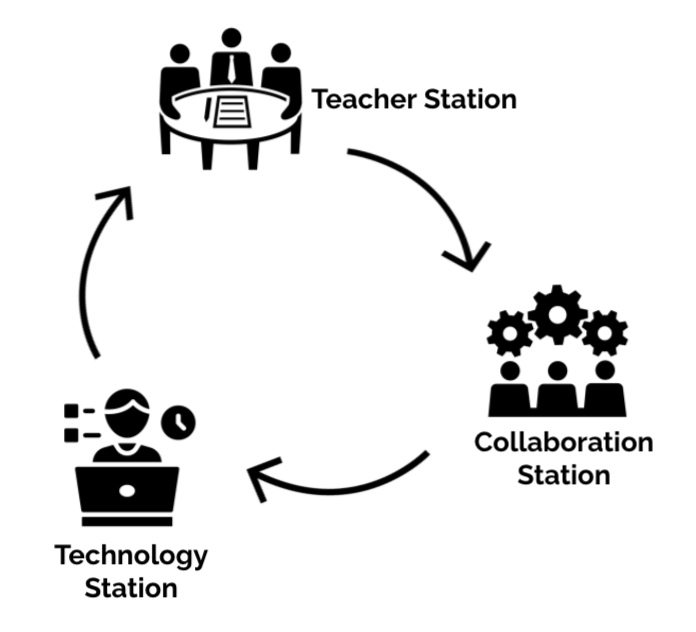
Learning Stations are situations or centers around the classroom that a teacher sets up for students to work in small groups. Each of these centers has supplies and materials that work well together and give students the tools to complete activities and mini-projects. Station can be digital or not. Students move around the classroom to complete the different stations and learn, draw connections,  apply, and evaluate classroom materials. 

Scavenger Hunts

Scavenger Hunts promote Inquiry Based Learning and collaboration. Students can use a tech tool like Go Formative to explore and answer open and closed questions about a topic.

Question Trails

Image

In this movement based active learning strategy students follow the “trail” of multiple-choice questions that will show what they have learned. Question trails can be completed in collaboration or individually. Students answer a series of multiple-choice questions and are prompted to move to the next question based on their answer. If students answer a question incorrectly, they will end up with a question they have already answered which means they will need to backtrack to see where they made an error. 

What are your favorite active learning strategies? Share your active learning activities in the comments section.

In the next few weeks I plan to share more.

Tagged , , , , , , ,

Scaffolding Reading Instruction & Inviting Students to Engage Deeply with Texts

In my book Creative SEL: Using Hands-On Projects to Boost Social Emotional Learning co-written with Mark Gura (ISTE, 2023) I share a short video from James Robinson “I Have a Visual Disability, And I Want You To Look Me In the Eye” | NYT Opinion (2021) as a text to read closely and critically to address themes around identity, disability, what is defined as typical and normal, and relationships.

I am so excited that James Robinson has expanded on this video to publish his personal memoir this month. Whale Eyes: A memoir about seeing and being seen (Penguin Random House, March 2025). Having read an advanced copy of this book, I am so excited not just by Robinson’s extended story and insight but the layout and organization of the book as well. As described by the published, the book is “told through an experimental mix of intimate anecdotes and interactive visuals, immersing readers in James’s point of view, allowing them to see the world through his disabling eye conditions.”

I already share the video with my middle school students as part of a book club unit on identity, but in scaffolding their reading there are a few activities that help make reading more accessible to the diverse readers in my classroom. Providing the text in print, digital, audio, and visual texts is one way to make the reading accessible with multimodal formats. Before, during, and after reading strategies can also help students understand and connect with the reading.

Scaffolding Before Reading with Anticipation Guides

An anticipation guide is a pre-reading strategy that presents students with a series of statements related to a new topic, asking them to agree or disagree before reading, which activates their prior knowledge, builds curiosity about the upcoming material, and essentially acts as a scaffold by providing a structured framework for engaging with the text and checking their understanding afterwards; it helps them actively connect their existing knowledge to the new information they will learn.

Image

Scaffolding Before & During Reading with Visuals and Images

Providing visuals and images before and during the reading process is helpful to activate background knowledge, make connections and provide deeper understanding. When sharing visuals, an activity like See, Think, Wonder acts as a reading scaffold by prompting students to first make careful observations about a text or image (“see”), then interpret what they see by forming thoughts and inferences (“think”), and finally, generate questions and wonderings to deepen their understanding and engagement with the material, effectively activating prior knowledge and setting the stage for deeper analysis before diving into the full text. 

Scaffolding During and After Reading

Text-dependent questions draw the reader back to the text to discover what it says. These questions have concrete and explicit answers rooted in the text and frame inquiries in ways that do not reply on a mix of personal opinion, background information, and imaginative speculation. 

Image

These three scaffolding techniques are few of many that I have created around Robinson’s new book Whale Eyes. You can also find more about scaffolding on this blog post reviewing Fisher and Frey’s Scaffolding Playbook (Corwin, 2023) and this blog post on close reading how to’s.

Tagged , , , , , , , , , , ,

Enhancing Academic Discussions in Book Clubs

A colleague recently asked me how do I encourage students to stay in conversation and build academic talk among students during book club discussions. Cultivating a classroom community where academic talk and collaboration are at the center is something that is built over time and continually nurtured. Here is how I scaffold these conversations throughout the school year.

  1. Build Classroom Community – From the beginning of the school year students are working collaboratively in different ways and we talk about what collaboration looks like and sounds like. First, students are changing up their seats daily, sitting in triads and moving around often. The idea behind switching seats daily and sitting in triads is based on Peter Liljedahl’s The Thinking Classroom. Throughout the school year collaborative learning plays a big role in the active learning happening in the class period.
  2. Give Students Time to Prep for Book Clubs – When students are going to meet in book clubs, I provide ten minutes of class time before the book club meeting for students to review their notes, reread and mark important passages in the text they might want to share. If students are working in Literature Circles, students have specific roles for their book clubs, they must bring an artifact beyond reading notes to the book club to share. Giving students time in class allows everyone to focus and also allows time for reading conferences with students.
  3. Scaffold Book Talks with Roll the Dice or Bingo – In the beginning of the school year I might provide discussion starters and specific questions to help students focus their discussion on the topics we have covered in class during the book study unit. If students are at a loss for what to say or topics to raise, these two activities provide a question bank for students to keep the conversation going.
Image

4. Fishbowl Book Club ConversationsFishbowl is a strategy that allows for students to observe a book club and provide feedback and observations. In the inner circle or fishbowl, students have a discussion; students in the outer circle listen to the discussion and take notes. This engaging and student-centered strategy can help develop group discussion skills. In the “fishbowl,” students practice responding to multiple viewpoints. Observations from students in the outer circle provide insight into what makes for effective small-group discussions. If you are going to conduct fishbowls in your classroom be sure to give your students a heads up so they are prepared to have students watching them. The visual below is from Teacher Thrive:

Image

6. Video or Audio Record Book Club Meetings – Recording book club meetings is a great way to evaluate the talk happening among students. Plus, showing the recordings back to the whole class provides an opportunity for reflection and examples of what works well in book club discussions. When Flip was available for educators, students would record 5 -8 minute highlights of their book clubs discussions. Since Flip has been retired, alternative screen casting tools include Screen Pal, WeVideo, Screencastify, or Padlet has a video tool.

7. Add In Reflections – One of the main benefits of reflection is that it deepens our understanding of what we have just read and offers wider perspectives. By taking the time to think about our reading and discussion, we engage with reading and talk about reading more deeply. Adding reflection about our role and contributions in the discussion helps us learn more about ourselves as readers and group members.

Image

Scaffolding book club meetings is crucial for student academic success because it provides a structured support system that allows students of varying abilities to actively engage with the text, develop critical thinking skills, and express their ideas confidently, especially when discussing literary concepts. When we offer clear guidelines, prompts, and differentiated questions to guide students through academic conversations and build upon student understanding progressively. These activities can help students practice expressing their thoughts clearly, use academic language, and actively listen to their peers’ viewpoints. 


Tagged , , , , , , , , ,

Not Another Reading Quiz: 15 Alternatives to Check for Understanding

I gave up on multiple choice reading quizzes a long time ago. Yes, once in a while I will provide my students with a multiple choice reading quiz but these formative assessments are no stakes in my classroom. This means the multiple choice reading quiz is not going towards their grade. Students can take the reading quiz on paper or on a Google Form and see whether they are getting the “big ideas” and smaller nuances in the book. I am not going to ask questions about minutiae details, rather what does the text say, how does the text work, and what is the bigger picture. There are a lot of other ways that I can evaluate students reading beyond a quiz. When it comes to these reading comprehension activities I think about:

Engagement: Does the activity tap into students’ creativity and allow for personalized expression?

Deeper Thinking: Are students identifying the most significant ideas and making meaningful connections?

Accessible for All Learners: Are these activities adaptable and tailored to different ability levels so all students can reach excellence?

Here are 15 alternative activities to check students for understanding and elevate how we make our thinking about reading visible.

  1. Question Trails – A question trail is a learning activity where students “travel” from one station to the next by answering questions or solving problems. Each station includes a question and directs students to the next location based on their answer. The sequence of their journey depends on their responses, making it a self-checking, dynamic way to engage with content. You can take those multiple choice reading comprehension quizzes you have saved in your Google Drive and remake them into a question trail. Check out an example question trail I made for Richard Connell’s short story The Most Dangerous Game
  2. Written Response Questions (SAQs) – When I gave up multiple choice quizzes, I started to implement more short answer questions about reading. The questions were based on topics we addressed in class and our book club discussions. Students are able to use their notebooks and books to answer the questions and articulate their thinking about the readings. Students complete these SAQs in class in the time period provided. 
  3. Reader’s Notebooks – Notebooks are a key part of my middle school English classroom and students use their notebooks to showcase their thinking about their reading.  
  1. Create a Playlist – Design a playlist or reading guide to help students stop and jot at key points in the text. Depending on your students, you might have students design their own playlist to highlight key events, connections, and extension activities. 
  2. Book Bingo – Students or the teacher can create a bingo board with 25 questions to ask about the book. 
Image
  1. 2 Truths and 1 Lie – Students have to provide a series of truths and lies about the elements in the text. 
  2. Close Reading Annotations – Provide students with a key chapter or excerpt/passage and students annotate the text marking up the page to highlight key ideas about the author’s craft, characterization, figurative language, and other key elements of the text. Go micro with these close reading annotations for a more powerful punch in the author’s craft.
  3. One Pagers – A one-pager is a reflective activity where students synthesize their learning by presenting their thoughts, connections, and insights in a visually appealing format. They include a mix of key quotes, images, symbols, and text to capture the essence of the material. It’s like creating a snapshot of their understanding in a creative, structured way. 
  1. Socratic Seminars – Whether this is an all class read or students are working in book clubs invite discussion of the key themes and connections among all the books. 
  2. A Collaborative Quiz – Working in small groups, students create a 50 question quiz about the book with provided answers (take it up a notch and have them also provide the distractors for each question)
  3. Literary Postcards – Students design a postcard illustrating a key scene in the book on the front and on the back of the postcard the student writes from the perspective of the character describing in first person the importance and impact of the scene in the book. 
  4. Insta-Story or Post – Students design an InstaStory to showcase one of the characters in the book. 
  5. Poignant Scenes – Students choose three key scenes in the book and annotate the scene and provide a write up why and how the scene or chapter propels the story forward. 
  6. Musical Playlist – Design a musical playlist to coincide with the chapters or students can write an original song to highlight a key scene/character/conflict in the book. 
  7. Reenactments – Add a little drama to your class and have students act out key scenes in the book. 
Tagged , , , , , , , ,

Fostering Co-Teacher Relationships for Student Success

The following blog post was written for TeachBetter.com and published on their website on August 18, 2024. To read the blog post on their website, click here.

For the past twelve years that I have been teaching middle school English I have worked with seven different co-teachers. Each is amazing and unique in their own ways. Developing a relationship with my co-teaches fosters a positive community in our classroom with a shared goal to help all our learners reach excellence. But relationships are cultivated and sometimes need attention, support, and effective communication to be successful. As one of my colleagues said, “Co-teaching is a working marriage.”

Image

Set Up Weekly Planning Time

My co-teachers and I meet regularly to reflect and discuss upcoming assignments, create modifications, and look at long term unit goals. This weekly meeting is nonnegotiable and key quality time. We are partners in the co-educational model. Whereas my former principal used to tell us that the disciplinary area teacher was the content specialist, the special education co-teacher was the pedagogy guru with differentiation of knowledge and vision. I do not think that is always the case, both teachers can be content and pedagogy specialists. When we meet each week to look over lesson plans, activities, and discuss ways to support students as knowledge constructors. This planning time is invaluable, I am not providing the lesson plans and my co-teacher is just creating scaffolds, we are discussing how we might make assignments accessible for students and share different active learner centered experiences so students can access content material. We are equals in the classroom, he is not my superhero sidekick. Although, I do think of my co-teachers as superheroes!  

Image

Play Up Each Other’s Strengths

Co-teaching is like tag team wrestling, we know, understand, and complement each other seeking to level up classroom learning. In addition to having a co-teacher for special education in our co-taught classroom, I have an ELL co-teacher for a class that includes our English Language Learners. Her expertise and knowledge is invaluable when planning assignments and classroom activities. She will look over an assignment and not only provide modifications and support to best help her students, she is able to look across the classroom and see who looks like they might need some additional guidance and she pulls them in to work with them in small groups. I am learning from her as much as our students. She reminds me to keep things simple and to make learning accessible in different modalities for all students. 

Image

Take Time to Reflect

As much as meeting weekly for planning is essential, also taking time to reflect on how things are going and are students meeting learning goals. After an assignment and even during the learning activities my co-teachers and I will discuss what is working and what tweaks we might need to make to support student learning. If a student did not meet the requirements of an assignment, we might create some scaffolds or modify the assignment for that student. After a lesson if it seems that a handful of students did not get the jist of the teaching points, we decide that tomorrow we will split the class up into small groups and reteach material for those students. The students who are ready to move forward can use that small group time for application or an extension of information learned. The short term and long term reflections among co-teachers help to bring best practices to the forefront.   

Image

Stand Alone Classes Complements Co-Taught 

All of us have a stand alone class to support the work that students are doing in our co-taught classroom. ELL students have an ELL classroom and students with IEPs (individual Educational Plans) are assigned an educational support class. Even I teach a stand alone literacy support classroom for struggling students who are not classified. In each of these classes we are complementing the work we present in our co-taught classrooms. We might pre-teach and reteach content material. Students might be provided with more practice to understand a concept or we might work on a multistep assignment by breaking it down in smaller pieces. Our work in these stand alone classes provide students with additional support and access to materials and help meet the learning targets. 

Building a strong, collaborative relationship with a co-teacher is not just a professional obligation, but a critical component of fostering an enriching learning environment.  Embracing open communication, mutual respect, and shared responsibilities, co-teachers can create a cohesive and supportive atmosphere that significantly enhances student engagement and achievement. Investing in this partnership is a powerful step toward ensuring every learner’s success and building a dynamic, inclusive classroom community.

Tagged , , , ,