Tags
A Thanksgiving Prayer from William S Burroughs
24 Thursday Nov 2011
Posted in Vids

24 Thursday Nov 2011
Posted in Vids
Tags
19 Saturday Nov 2011
Posted in Philosophy
Tags
Hegel makes use of this phrase in the “Lordship and Bondage” chapter of the Phenomenology in a way that I found very interesting, in that it is not at all in the Solomonic parlance. The “fear” here is not reverence or humility, but the absolute fear that confronts a consciousness in the figure of the master, a fear that forces it to “melt to its inmost soul.” Without this labor of the negative, consciousness can never be truly “for itself.” Likewise, the lord mentioned here is not a deity figure, but the other of the master. And lastly, the beginning of wisdom is not the practical moral knowledge of the proverbs, but the only sense in which a consciousness can attain the knowledge that it exists objectively, in and for itself (an und fur sich). This phrase is actually quite a nice summary of the maser/slave dialectic as a whole. Pithy.
18 Friday Nov 2011
Posted in Philosophy
No one should postpone the study of philosophy when he is young, nor should he weary of it when he becomes mature, because the search for mental health is never untimely or out of season. To say that the time to study philosophy has not yet arrived or that it is past is like saying that the time for happiness is not yet at hand or is no longer present. Thus both the young and the mature should pursue philosophy, the latter in order to be rejuvenated as they age by the blessings that accrue from pleasurable past experience, and the youthful in order to become mature immediately through having no fear of the future. Hence we should make a practice of the things that make for happiness, for assuredly when we have this we have everything, and we do everything we can to get it when we don’t have it.
~ Epicurus, ‘Letter to Menoeceus’
17 Thursday Nov 2011
Posted in Humor
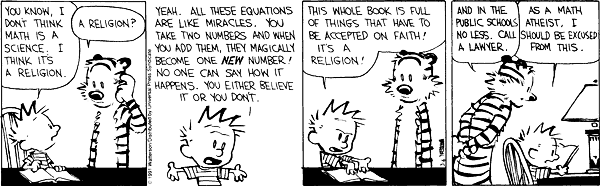
Kant, from the Prolegomena to Any Future Metaphysics:
One might well at first think: that the proposition 7 + 5 = 12 is a purely analytic proposition that follows from the concept of a sum of seven and five according to the principle of contradiction. However, upon closer inspection, one finds that the concept of the sum of 7 and 5 contains nothing further than the unification of the two numbers into one, through which by no means is thought what this single number may be that combines the two. The concept of twelve is in no way already thought because I merely think to myself this unification of seven and five, and I may analyze my concept of such a possible sum for as long as may be, still I will not meet with twelve therein. One must go beyond these concepts, in making use of the intuition that corresponds to one of the two, such as one’s five fingers, or (like Segner in his arithmetic) five points, and in that manner adding the units of the five given in intuition step by step to the concept of seven. One therefore truly amplifies one’s concept through this proposition 7 + 5 = 12 and adds to the first concept a new one that was not thought in it; that is, an arithmetical proposition is always synthetic, which can be seen all the more plainly in the case of somewhat larger numbers, for it is then clearly evident that, though we may turn and twist our concept as we like, we could never find the sum through the mere analysis of our concepts, without making use of intuition.
What exactly was Kant responding to – the idea that mathematical principles were analytic a priori judgments? Of course not, he was answering math atheism!
15 Tuesday Nov 2011
Posted in Politics
Tags
Thesis: the rhetoric surrounding the potential for a “strike of the upper class” by Fox News anchors and Objectivists of various stripes, assumed to be a threat of impending doom upon the smooth functioning of the global economy and the continuance of “our jobs”, is actually an ultra-cynical attempt to frighten the vanguard of the Left from achieving its stated goal (full worker control of the means of production) by actually threatening the absolute horror of being face-to-face with its fundamental fantasy, an introduction of a psychological virus at the level of each individual which would ultimately break the Left’s collective will.
They’re not saying “if we leave, everything will spin out of control.” Instead, they’re saying “you want to escape hell? Fine, there’s the door…”, and we cower.
Discuss.
14 Monday Nov 2011
Posted in Philosophy
I believe that one of the consistent misunderstandings of Sartre’s ‘Existential Marxism’ as laid out in CDR is that somehow Sartre was seeking to ‘existentialize’ Marxist theory. This thought is common among readers of CDR who, I believe, have read roughshod over this text and/or tried too hard to retrofit CDR into Sartre’s existentialist oeuvre. While Sartre clearly does intend to dialectically tether these two seemingly disparate tendencies together, he takes a unique course in doing so.
Rather than simply trying to utilize the early Marx and rather than simply trying to supplement what is commonly understood as Marxist analysis with his existentialist notions, what Sartre is doing is something much more grandiose. He is seeking to enrich what might be called a ‘Marxist paradigm’ with existentialist concerns. What this means is that Sartre is not seeking to ‘existentialize’ Marxism per se, but is rather working within a historico-philosophical paradigm that he describes as Marxist.
See, for Sartre there is a sharp distinction to be made between ‘philosophy’ and ‘ideology’. Whereas the former bears the characteristics of novelty and dominance, the latter is defined as working within the framework of philosophy. Philosophy is the schema in which ideology finds itself and to which ideology responds. By analogy, we could say that ideology is philosophy’s accident. As such, Sartre gives examples of a few ‘moments’ of philosophy: a ‘Descartes and Locke moment’, a ‘Kant and Hegel moment’, and a ‘Marx moment.’ The latter is the moment in which Sartre himself believed he resided (whether or not he was correct or whether we are still in the ‘Marx moment’ is a topic for another time…). Thus, any and all thinkers of a given period are unable to surpass this paradigm in which they find themselves – whether they realize this or not. This means that Kierkegaard, for Sartre, was not a philosopher, but an ideologist living in the moment of Hegel. And as an ideologist (a ‘good’ ideologist in Sartre’s mind), K was therefore necessarily only ever enriching the Hegelian paradigm. Likewise, Sartre saw himself and his contemporaries as living in, and enriching a Marxist paradigm (and I’m intentionally NOT using ‘Marxian’ to show a distinction between the work of Marx himself and the tradition of Marxist thought, as well as to highlight the even larger framework of the ‘Marxist moment’). This means that when Sartre talks about ‘Marxism’ embracing existentialism so that the former might ‘rediscover man in the social world’ he has in mind NOT Marxism as the tradition passed down through those concerned merely with Marxian ideas, as though he believed that Marx’s writings needed to be supplemented by a thorough reading of Being and Nothingness. Nor was he merely criticizing the Marxist thinkers of his day (the so called ‘economic determinists’). Rather, he meant that existentialism is crucial insofar as it would disrupt the dominant philosophical paradigm of the day, which he characterized as ‘Marxist.’ Now understanding what this ‘Marxist moment’ actually consisted of is a painstaking task that exceeds the grasp of a blog entry. But suffice it to say, in the least, that the ‘Marxist moment’ that Sartre had in mind was something much grander than just what is generally thought of when we use the label ‘Marxism’ – perhaps it is best described as an epoch… And as such, existentialism is not merely a supplement to Marx’s thought, nor was it intended by Sartre to be a response to Althusser (although this was a byproduct). Instead, it’s best to think of Sartre’s ‘Existential Marxism’ as an enriching of the dialectical moment in which he found himself; the situation in which he was determined to respond – the Marxist moment.
Therefore, when writers like Edouard Morot-Sir claim that ‘It is difficult to imagine the Marxist philosopher existentializing himself, and the reverse’ I can’t help but think there has been a serious oversight in the analysis. By bringing man into the social world, Sartre was NOT suggesting that the ‘Marxist’ existentialize himself. He was calling for an enriching thought that would flow in novel directions, emerging out of situations of exigence, situations that demanded new ways of thinking and living in the world.
13 Sunday Nov 2011
Posted in Philosophy
From Badiou, Philosophy and the Death of Communism:
That this death be a second death is attested by a remarkable fact of opinion, which is nevertheless real: the ‘death of communism’ is rhetorically deployed alongside the ‘break up of the Soviet Empire’. That ‘communism’ thus be tied to ’empire’ in the destiny of what is mortal proves – since subjectively ‘communism’ named the universal community, the end of class, and thus the contrary of all empire – that this ‘death’ is only the event-of-dying of what is already dead.
09 Wednesday Nov 2011
Posted in Politics
The always-sagely Rortybomb’s got a post up on the potential for student debt strikes, a topic in which I know many of you out there must be interested. In the post, he makes the point that the social democratic states have an advantage in being “Leviathans” (in a deflated Hobbesian sense) in that they can preform functions that the private sector cannot, including universal health care, free public education, police forces, etc. What is scary, however, is when a private sector force becomes, in a sense, “Leviathanized”, or brought up to the level of governmental force via this monopoly, and that’s exactly what happened to the student loan industry after the Bankruptcy Abuse Prevention Act of 2005. In this context, a debtors strike will look very different from anything seen before:
…the game theory model I alluded to is the Rubinstein Bargaining Model, which is still one of my favorites. And there the patience of the relative agents is important. If the other side doesn’t have a huge timeframe – say it needs the factory to be running ASAP, or the costs of the bank foreclosing and having to sit on property in a bad market doesn’t outweight the bargain of some level of payments that can be reached – the strikers have a stronger hand. If the other side thinks of itself as having an indefinite patience and little need to think through cost-benefit analysis on any individual action – as the government does – the strike will likely lose on the material battle.
In addition to the Leviathan reimagined, you still have the incredibly durable private sector forces which wreak havoc on debtors. The Pinkerton army of the 19th century, a privately funded group which terrorized debtors and union workers, struck fear in the hearts of the debt-burdened for decades, but even they didn’t have the power that modern credit agencies posses:
Let’s say, instead of the butt-end of a rifle in your nose, if you fought management the Pinkerton Boys could walk – wait, walk isn’t the right word, teleport instantaneously – to every potential source of credit you could get and tell them to lock down. Then they go to every single employer in the country, and flag you as someone they shouldn’t hire. Then let’s say they could teleport to every insurance company in the company and tell them to start charging you and other strikers more money. And, why not, they zoom over to every utility company in the country, and get them to start demanding deposits and higher rates for things like gas and electricity in the homes of those who are trying to strike.
08 Tuesday Nov 2011
Tags
Regarding the news coming out of Greece, it appears as though the brunt of the Euro crisis will be borne by none other than the Greeks, and not the various banking and governmental institutions who either explicitly or implicitly caused the Eurozone panic in the first place. Europe looks like it will finally move towards a solution – one that will involve the ECB and the IMF working together to invoke austerity measures on the Greek (and, I assume, the GIPS as a whole) populace.
Last week, the Greek prime minister started a panic amongst governmental and financial elites when he proposed that these austerity measures be put to a vote in Greece. The very thought of submitting important things to discretion of the people enraged the aristocracy of the continent, and lo and behold, prime minister Papandreou has bowed out. Since then, the ironic quips about Greece rejecting democracy have been nothing but ubiquitous.
What’s most enlightening about all this, however, is not that it’s happening in Greece, the motherland of democracy, but that there has been a full disclosure: salvation of the capitalist system in Europe must happen against democracy. Many of our favorite philosophers have made the point that the ill-fated, historically-conditioned marriage between capitalism and democracy has been showing signs of an internal breakdown, but never has this phenomenon been so clear as it was during the aforementioned panic of this last week. The very thought of putting these measures to a democratic vote evoked outrage among those-in-the-know. And this is not to say that they were wrong. Far from it. The Greeks would have most certainly rejected the proposal, and may have possibly gone down the road of Argentina or Iceland and accepted a messy default. Saving the current capitalist relations necessitates that the shaodwy figures of the troika play the role of the master, dictating the roles to be played and distributing the chores amongst the servants. Again, what is enlightening is that none of this has been hidden in the cloak of ideology. It’s all out in the open: democracy antagonizes capitalism.
On the one hand, so-called “capitalism with asian values” is both too far away and too fundamentally necessary to western production to be of concern for western thinkers. It’s is a cloak of suppression. One the other hand, the relation between democracy and capitalism in the United States is just as tenuous, but is so drenched in the jargon of American nationalism, liberty and freedom foremost among them, as to be all but invisible to those who are exploited by it. It’s is a cloak of repression. What’s so disturbingly refreshing about the situation in Greece is that neither of these barriers hold any sway. We all know that the almost-mythical “original capitalist accumulation” was an affront to developed notions of democracy, but never have we seen the process set on a stage right before our eyes, the various actors playing their parts in full identification with their roles, without a hint of transcendent distance.
07 Monday Nov 2011
Posted in Philosophy
Heidegger’s preference for poetry as the philosophical form par excellence is well known. For Heidegger, science, mathematics, and all other disciplines which attempt to circumscribe and dominate truth by means of the proposition must surely fail, for the Being of beings cannot be submitted to the intellect in this way (hence, the forgetting of being). Poetry, on the other hand, speaks and acts in such a way that being is presented ever anew, so it consequently becomes the locus of truth, or the process of revealing and concealing, aletheia.
Necessarily then, the pinnacle of the intellectual hubris of mankind, 20th century analytic philosophy and mathematics, since it is essentially a large-scale attempt to submit all of being to the language of the proposition, should be understood as a massive failure. The entire field of analytic philosophy is a sort of banging of one’s head up against a wall, expecting that eventually one will be able to pass through. What Badiou points out, however, is that this is not at all what occurred.
Rather than viewing truth as judgment, or as a comment on the adequation of a proposition to the world, Badiou prefers to think of truth as what he calls, following Lacan, “a process in the real.” This means that, no matter what historical situation one finds oneself in, a truth can be had. Truth is not a respecter of locations. For Heidegger, truths may only be located where propositions are absent, and it is not out of bounds to label this as a sort of totalization by restriction. The discoveries of 20th century mathematics cannot have, for Heidegger, produced any level of truth because they were directionally misappropriated from the beginning. Heidegger has determined this area a philosophical crime scene, and no one is allowed in but the forensic specialists, the phenomenologists.
Badiou’s “process in the real”, however, gives us a chance to find a truth in any given situation, should we at least look hard enough. In early 20th century mathematics and the advent of set theory, Badiou finds exactly such a truth in Godel’s Incompleteness theorem (as well as other instances, but we’ll focus just the second Incompleteness theorem for now). For Godel, it is impossible to show from within a mathematical theory that it is itself consistent and non-contradictory, thus any grand theory will be in the end incomplete, non-total. Badiou uses this event to postulate a level of mathematical untotalizability, something first presented the very same mathematicians who advanced the fact there could not be conceived a set of all sets, i.e. a totalization, in the wake of Godel. In this sense, the realm of mathematical set theory, that which has forced being into the cage of the proposition for so long, underwent a truth procedure. This would have been impossible for Heidegger, but for Badiou, there is always “a real” in every situation, and therefore always the potential for a truth.
What I like most about this construal of ontology is that it opens up many more possiblities, a wealth of new sites for philosophy. Badiou often makes the point that his “mathematics as ontology” maxim is meant to point out that ontology is not about describing or revealing the fundamental nature of being, but about the relations amongst elements. Science preforms the former, while philosophy’s job is to analyze the relations of the elements of particular situations, something that is inherently possible in any situation. There’s a level of equality of situations that is conspicuously lacking in the hubris of much post-Kantian philosophy. There is no fruit to be found in a battle amongst the academic elite as there is always a space of compossibility between actors in this play.

 Sub Specie Aeterni