Autonomous
Driving
Solutions.

Who we are

Our team was founded in 2020 in Aristotle University of Thessaloniki and currently consists of 20 undergraduate Engineering students and 2 Mentors, coming from universities across Greece.

What we do

VROOM is focused on developing autonomous driving solutions for scaled vehicles. Currently, we are participating -for the sixth time in a row- in the Bosch Future Mobility Challenge organized by the Bosch Engineering Center in Cluj Napoca, Romania. Our ultimate aim is the promotion of research on autonomous driving in academia.

Where we are

Team VROOM is based in the Department of Electrical and Computer Engineering of the Aristotle University of Thessaloniki in Greece.

Autonomous.
Driving.
Solutions.

Who we are

Our team was founded in 2020 in Aristotle University of Thessaloniki and currently consists of 20 undergraduate Engineering students and 2 Mentors, coming from universities across Greece.

What we do

VROOM is focused on developing autonomous driving solutions for scaled vehicles. Currently, we are participating -for the sixth time in a row- in the Bosch Future Mobility Challenge organized by the Bosch Engineering Center in Cluj Napoca, Romania. Our ultimate aim is the promotion of research on autonomous driving in academia.

Where we are

Team VROOM is based in the Department of Electrical and Computer Engineering of the Aristotle University of Thessaloniki in Greece.

About us

The VROOM team was founded during the Fall of 2020 in the department of Electrical and Computer Engineering at the Aristotle University of Thessaloniki (AUTH), Greece. Currently we are focused on developing autonomous driving solutions for scaled vehicles.

The team is also powered by ISSEL Lab-group, a research team based in AUTH, working on efficient and intelligent solutions for robotics, devices and systems.

We have achieved significant results throughout our participation in the Bosch Future Mobility Challenge, including podium finishes, special awards, and even 1st place in 2024. You can find more updates in our awards section

What you will work on


In order to make the vehicle operate autonomously, we need to develop the vehicle’s and infrastructure’s algorithms in Python. For data processing we use, mainly, Python libraries, such as OpenCV, and neural networks. Also, for the simulated environment, we work on ROS (Robotic Operating System) and the Gazebo Simulator. For example, related tasks include developing perception algorithms for lane detection and traffic light recognition, as well as implementing control strategies for reliable lane keeping.

Since all the processing on the vehicle will be performed with a single-board computer (Raspberry Pi, Jetson Platforms), all the algorithms as well as the computer itself shall be optimized for achieving the maximum efficiency. For instance, an optimal path must be computed in a computatutionally efficient way to ensure real-time performance and allow the vehicle to always determine where to go next.

Apart from the software of the system, we need as well to modify the hardware of the car (cameras, sensors, computer etc). This part also includes the design and printing of 3D components utilized to support any modifications on the vehicle.


In order to monitor properly the autonomous vehicles on the track and our lab in general, we have created custom web applications. We use technologies like React, Django, the EMQX MQTT broker and are continuously looking to expand their features and performance.
 

Regardless of each member’s specific role within the team, all members are encouraged to prepare 3 to 4 progress reports throughout the year. Following the format established by the competition the team attends the last few years (BFMC), these reports serve not only as a technical summary of the work completed and a redefinition of upcoming goals, but also as a valuable archive. They provide future teams with useful insights, inspitation and a clear record of the project’s evolution over time.

Our Lab

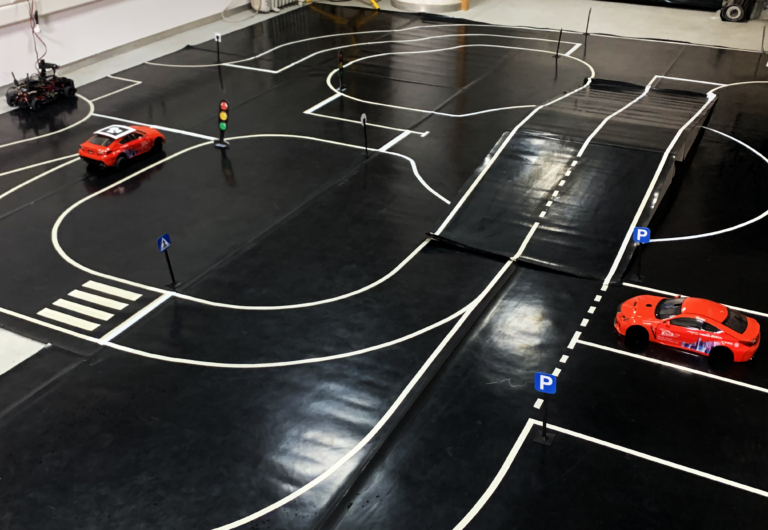
For the needs of the competition, our test track and the servers that simulate a smart city have been settled in a laboratory at E13 building of the Electrical and Computer Engineering Department, in the Aristotle University of Thessaloniki.

Based on the Competition Track designed by the BFMC Organizing team, we designed our own tracks. All the tracks have been created in such a way that we were capable of testing every different challenge, as on the actual track! 

Our Lab

For the needs of the competition, our test track and the servers that simulate a smart city have been settled in a laboratory at E13 building of the Electrical and Computer Engineering Department, in the Aristotle University of Thessaloniki.

Based on the Competition Track designed by the BFMC Organizing team, we designed our own tracks. All the tracks have been created in such a way that we were capable of testing every different challenge, as on the actual track! 

Our Car

v2025.5

Image
Image

v2024.6

Scaled Vehicle Back View
Vehicle at starting position

v2023.4

Image
Image

Our Car

v2025.5

Image
Image

v2024.6

Scaled Vehicle Back View
Vehicle at starting position

v2023.4

Image
Image

VROOMITOR

VROOM has created its own web-app for live-monitoring of the vehicle while running and performing its tasks on the track. It is written in React and is self-hosted in the main computer of our lab.

The web-app communicates with the vehicle using the EMQX MQTT broker. The app is used for both monitoring and debugging. Also, through VROOMITOR the user is able to STOP the vehicle at any emergency.

VROOMITOR informs the user about essential information during each run, like the detected objects, received server data, vehicle metrics (speed, steering, orientation etc.), current navigation state, current location on map, response time of crucial algorithms and many more!

VROOMITOR

VROOM has created its own web-app for live-monitoring of the vehicle while running and performing its tasks on the track. It is written in React and is self-hosted in the main computer of our lab.

The web-app communicates with the vehicle using the EMQX MQTT broker. The app is used for both monitoring and debugging. Also, through VROOMITOR the user is able to STOP the vehicle at any emergency.

VROOMITOR informs the user about essential information during each run, like the detected objects, received server data, vehicle metrics (speed, steering, orientation etc.), current navigation state, current location on map, response time of crucial algorithms and many more!

Bosch Future Mobility Challenge

Bosch Future Mobility Challenge is an international technical competition initiated by Bosch Engineering Center Cluj in 2017. The competition invites bachelor and master student teams every year to develop autonomous driving and connectivity algorithms on 1:10 scale vehicles to navigate in a designated environment simulating a miniature smart city. The students work on their projects in collaboration with Bosch experts and academic professors for several months to develop the best-performing algorithms.

On the 16th of September, our team visited Cluj-Napoca, Romania for the final round of the Challenge!

We were one of the 9 teams who participated in the Semi-finals and Finals!

After a lot of testing, we managed to get the 3rd place in the Bosch Future Mobility Challenge 2021!

On the 10th – 15th of May, our team visited Cluj-Napoca, Romania for the final round of the Challenge!

We were one of the 23 teams who participated in the Semi-finals and one of the 8 teams that reached the Finals!

After 3 days on the track and a lot of fun, we managed to get the 2nd place in the Bosch Future Mobility Challenge 2022 along with the Marketing Award!

On the 3rd – 7th of May, our team visited Cluj-Napoca, Romania for the final round of the Challenge!

We were one of the 26 teams who participated in the Semi-finals (out of the 75 starting teams) and after 3 days on the track and a lot of fun, we managed to get the 8th place in the Bosch Future Mobility Challenge 2023 along with the Marketing Award!

On the 14th – 19th of May, our team visited Cluj-Napoca, Romania for the final round of the Challenge for the 4th consecutive year!

We were one of the 24 teams who participated in the Semi-finals (out of the 80 starting teams) and after 3 days on the track, we managed to get the 1st place in the Bosch Future Mobility Challenge 2024!

Our vehicle performed perfectly and navigated through the whole city flawlessly. The team also received great comments for the competition finals’ presentation and the robustness of the developed autonomous solutions.

On 20th of June, our team visited Cluj-Napoca, Romania, for the final round of the Challenge for the 5th consecutive year!
After 3 days of testings and hard work, we participated in the Semi-finals among with 24 other teams (out of the 79 starting teams) and achieved to be one of the 8 teams that reached the Final, where we finished in the 5th place and won the Audience Award.

Bosch Future Mobility Challenge

Bosch Future Mobility Challenge is an international technical competition initiated by Bosch Engineering Center Cluj in 2017. The competition invites bachelor and master student teams every year to develop autonomous driving and connectivity algorithms on 1:10 scale vehicles to navigate in a designated environment simulating a miniature smart city. The students work on their projects in collaboration with Bosch experts and academic professors for several months to develop the best-performing algorithms.

On the 16th of September, our team visited Cluj-Napoca, Romania for the final round of the Challenge!

We were one of the 9 teams who participated in the Semi-finals and Finals!

After a lot of testing, we managed to get the 3rd place in the Bosch Future Mobility Challenge 2021!

On the 10th – 15th of May, our team visited Cluj-Napoca, Romania for the final round of the Challenge!

We were one of the 23 teams who participated in the Semi-finals and one of the 8 teams that reached the Finals!

After 3 days on the track and a lot of fun, we managed to get the 2nd place in the Bosch Future Mobility Challenge 2022 along with the Marketing Award!

On the 3rd – 7th of May, our team visited Cluj-Napoca, Romania for the final round of the Challenge!

We were one of the 26 teams who participated in the Semi-finals (out of the 75 starting teams) and after 3 days on the track and a lot of fun, we managed to get the 8th place in the Bosch Future Mobility Challenge 2023 along with the Marketing Award!

On the 14th – 19th of May, our team visited Cluj-Napoca, Romania for the final round of the Challenge for the 4th consecutive year!

We were one of the 24 teams who participated in the Semi-finals (out of the 80 starting teams) and after 3 days on the track, we managed to get the 1st place in the Bosch Future Mobility Challenge 2024!

Our vehicle performed perfectly and navigated through the whole city flawlessly. The team also received great comments for the competition finals’ presentation and the robustness of the developed autonomous solutions.

On 20th of June, our team visited Cluj-Napoca, Romania, for the final round of the Challenge for the 5th consecutive year!
After 3 days of testings and hard work, we participated in the Semi-finals among with 24 other teams (out of the 79 starting teams) and achieved to be one of the 8 teams that reached the Final, where we finished in the 5th place and won the Audience Award.

OUR AWARDS

Briefly, the team’s distinctions in the Bosch Future Mobility Challenge can be summarized as follows:

  • 3rd place at the BFMC 2021
  • 2nd place and Marketing Award at the BFMC 2022
  • Marketing Award at the BFMC 2023
  • 1st place at the BFMC 2024
  • Audience Award at the BFMC 2025

Marketing and Audience Awards are also noteworthy, as they were based on criteria such as our interaction with the broader community and sponsoring companies, our presence in social media, as well as our popularity among fellow participants. They reflect the team’s spirit of openess, communication and strong engagement beyond the technical field.

OUR
AWARDS

Briefly, the team’s distinctions in the Bosch Future Mobility Challenge can be summarized as follows:

  • 3rd place at the BFMC 2021
  • 2nd place and Marketing Award at the BFMC 2022
  • Marketing Award at the BFMC 2023
  • 1st place at the BFMC 2024
  • Audience Award at the BFMC 2025

Marketing and Audience Awards  are based on criteria such as our interaction with the broader community and sponsoring companies, our presence in social media, as well as our popularity among fellow participants. They reflect the team’s spirit of openness, communication and strong engagement beyond the technical field.

RESEARCH

Beyond competitions, VROOM also focuses on the research on autonomous driving technologies at scale. We aim for our solutions to be generalizable and adaptable across different autonomous systems, which over time has given the team a strong research character. Being under the auspices of the ISSEL Lab-group further enhances this direction, providing us with valuable collaborators for research in areas such as robotics and intelligent autonomous systems.

Building upon the team’s success in the BFMC 2024, VROOM authored and published its first peer-reviewed paper in the journal Machines (MDPI) titled “How to Win Bosch Future Mobility Challenge: Design and Implementation of the VROOM Autonomous Scaled Vehicle”. The article presents the software-hardware co-design architecture developed by the team, structured around modular layers of input, perception, control, and output. It highlights how a scalable and reconfigurable software stack, combined with a cost-efficient sensor suite and embedded computing, can enable reliable perception, decision-making, and control on a 1:10 scale vehicle.

The members

VROOM Team

Image

Theodoros Papafotiou

Team leader

Pelopidas Tsiountsiouras

Pelopidas Tsiountsiouras

Project leader

Elisavet Chatzikyrka

Elisavet
Chatzikyrka

team member

Maria Charisi: member of the advanced team

Maria
Charisi

team member

Giannis Lolos

Giannis
Lolos

team member

George Spyridopoulos

George Spyridopoulos

team member

Junior Team

Smaragda Baxevani: Team coordinator of the junior team

Smaragda Baxevani

team coordinator

Image

Anthi
Kotsani

team coordinator

Image

Aliki
Ouzounidou

team coordinator

Thalia Tsakanika

Thalia
Tsakanika

team coordinator

Image

Rafail
Dandis

team member

Image

Io
Gisdaki

team member

Image

Dimitris
Karadimitras

team member

Eliza Mlekani: Member of the junior team

Eliza
Mlekani

team member

Image

Vaios
Paliouras

team member

Image

Theodoros
Stavropoulos

team member

Konstantinos Polychronopoulos: member of the junior team

Konstantinos
Polychronopoulos

team member

Full-Stack

Stergios Ntanovasilis: Team coordinator for the full-stack team

Stergios Ntanovasilis

team coordinator

Dimitra Karanaskou: member of full-stack

Dimitra
Karanaskou

team member

Katerina Katsampoula

Katerina Katsampoula

team member

Image

Leonidas
Paratsokas

team member

Michalis Tsilipiras : Member of full-stack

Michalis
Tsilipiras

team member

Marketing

Angelina Papaioannou: Team Leader of Marketing

Angelina Papaioannou

team coordinator

Image

Nikoleta Vrachnou

team member

Advisors

Christina Tsakloglou: Advisor on the advanced team

Christina
Tsakloglou

advisor advanced team

Image

Katerina Papagiannitsi

advisor advanced team

Image

Despoina Christodoulou

Advisor advanced team

Image

Thanos
Kivertzikidis

Advisor advanced team

Gkountras

Giannis
Gkountras

Advisor full-stack team

Image

Alexandros
Nikolaou

Advisor advanced team

Zoi Mathiopoulou

Zoi
Mathiopoulou

Advisor marketing

Our mentors

Image

Emmanouil
Tsardoulias

MENTOR

Image

Konstantinos
Panagiotou

MENTOR

Our Partners

Sponsors

Image
Image

Supporters

Image
Image

Our Partners

Sponsors

Supporters

Image

Get in touch with us!

We will be more than glad to talk to you!

Get in touch with us!

We will be more than glad to talk to you!