Resources Centre
CATEGORIES

AI/ML for Wi-Fi Report
As Wi-Fi networks become more complex and mission-critical, traditional rule-based management approaches are no longer sufficient. Artificial intelligence and machine learning (AI/ML) are emerging as essential capabilities to deliver reliable, secure, and high-performance Wi-Fi at scale.
The AI/ML for Wi-Fi provides an industry-wide view of how AI/ML is being integrated across the full Wi-Fi ecosystem, from client devices and access points to edge and cloud platforms. It brings together industry analysis, real-world use cases, and ongoing standardization efforts to present a unified perspective on intelligent Wi-Fi.

Connectivity Strategies for Smart Multi-Dwelling Units (MDUs)
Connectivity Strategies for Smart Multi-Dwelling Units (MDUs) report presents a clear blueprint for transforming residential properties into scalable, secure, fully connected smart communities. As MDUs contend with rising device density, expanding IoT ecosystems, and heightened resident expectations, connectivity has become a strategic asset that directly influences user experience, operational performance, and long-term property value.
This report examines how next-generation technologies, Wi-Fi 7, 6 GHz spectrum, WPA3, multi-gig backhauls, and modern IoT frameworks, are redefining MDU connectivity. It outlines how open standards such as EasyMesh, USP/TR-369, TR-181, MoCA/G.hn, and OpenRoaming reduce fragmentation and empower owners, operators, ISPs, MSPs, and technology partners to unify Wi-Fi, IoT, PMS, and building systems under one future-ready architecture.


WBA Enterprise Security for Private 5G Networks
Converged Network Security for a Digitized Enterprise World
Enterprises are digitizing critical infrastructure to enable new business models, unlock efficiencies, and strengthen security. From faster time-to-market and real-time supply chain visibility to predictive maintenance and smart factories, Private 5G is powering the next wave of digital transformation. Yet, alongside these benefits comes greater complexity and new security risks, including cyberattacks, intellectual property theft, and disruption of production flows and supply chains.
The WBA Enterprise Security for Private 5G Networks report provides essential guidance for enterprises adopting Private 5G to drive digital transformation. It offers a practical framework to integrate Private 5G into existing IT security processes while safeguarding mission-critical operations.
The report makes clear that security is an immediate priority, not a future concern. Enterprises must adopt Zero Trust, unify Wi-Fi and 5G policy management, leverage Multi-Access Edge Computing (MEC) and Artificial Intelligence (AI) for real-time monitoring, and use open standards to ensure secure interoperability.
By uniting industry expertise, the report delivers a roadmap for enterprises to deploy Private 5G securely, protecting sensitive data, intellectual property, and operational flows. For sectors such as manufacturing, healthcare, logistics, energy, and transportation, it builds the confidence to embrace Private 5G while ensuring resilience, compliance, and long-term competitiveness.
For any enterprise planning or deploying Private 5G, this is a must-read report to safeguard operations, customer trust, and business continuity.
Looking Ahead – Phase 2
Phase 1 sets the foundation with policy and architecture. Phase 2 will advance to operational security intelligence, introducing centralized security architecture, Security Information and Event Management (SIEM), Artificial Intelligence and Machine Learning (AI/ML)–based anomaly detection, and Security Operations Center (SOC) integration for real-time monitoring and response.

WBA Program Overview 2026
WBA connects people with the latest Wi-Fi initiatives.
Download the latest WBA Programs and Projects Overview and learn more about how WBA can help your business.

WBA Industry Report 2026
The WBA Industry Report 2026 captures a pivotal moment for the global wireless ecosystem, revealing strong confidence in Wi-Fi’s future and accelerated momentum behind next-generation technologies. Surveying leaders across Wi-Fi, cellular, and enterprise sectors, the report shows that 62% of respondents are more confident investing in Wi-Fi than they were a year ago—a clear indicator that Wi-Fi is regarded as critical infrastructure for enterprise operations, public services, and digital transformation initiatives.
Wi-Fi 7 emerges as the most anticipated advancement, with AI-driven and cognitive networks following closely, as organizations preparing to integrate AI to improve automation, network reliability, and operational efficiency. Respondents also forecast strong growth across Smart Home IoT, AI applications, and Industrial/Manufacturing IoT while stadiums and event venues are seen as the environments likely to experience the greatest traffic surge.
E2E QoS Field Trials Report
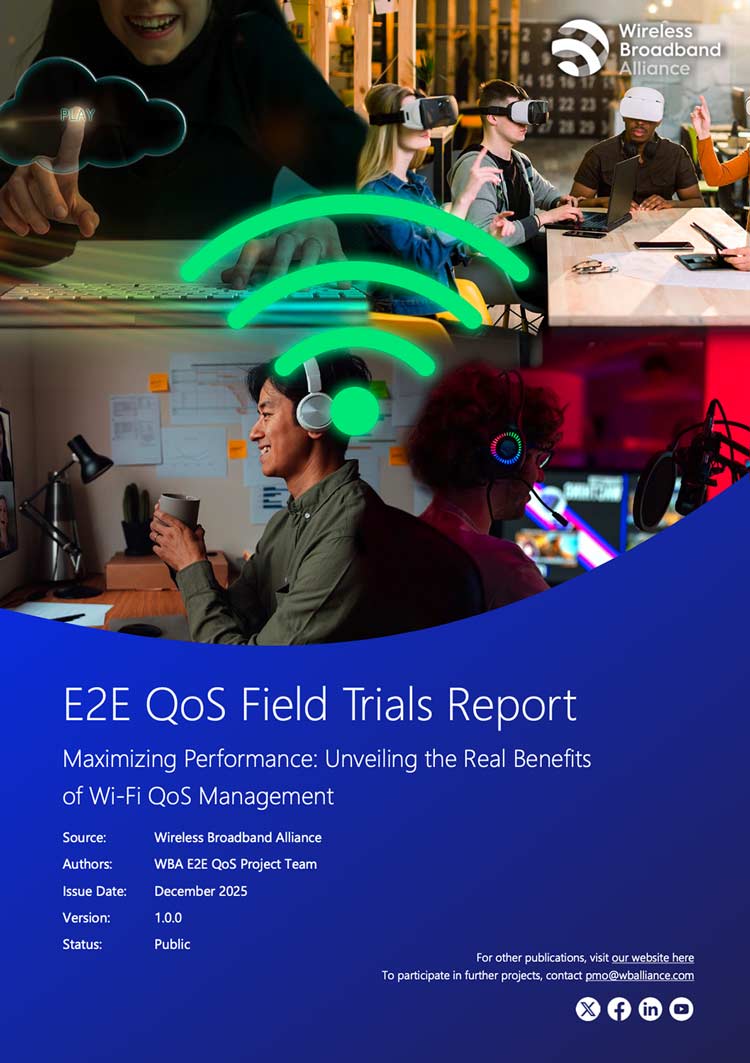
The E2E QoS Field Trials Report: Maximizing Performance demonstrates how Wi-Fi QoS Management (MSCS and SCS) delivers measurable performance gains for latency-sensitive applications—proving that consistent, high-quality connectivity is achievable across today’s real-world Wi-Fi networks.
The trials across real residential networks tested videoconferencing, cloud gaming, and live streaming, showing clear gains in latency, frame rate, resolution, and overall Quality of Experience (QoE).
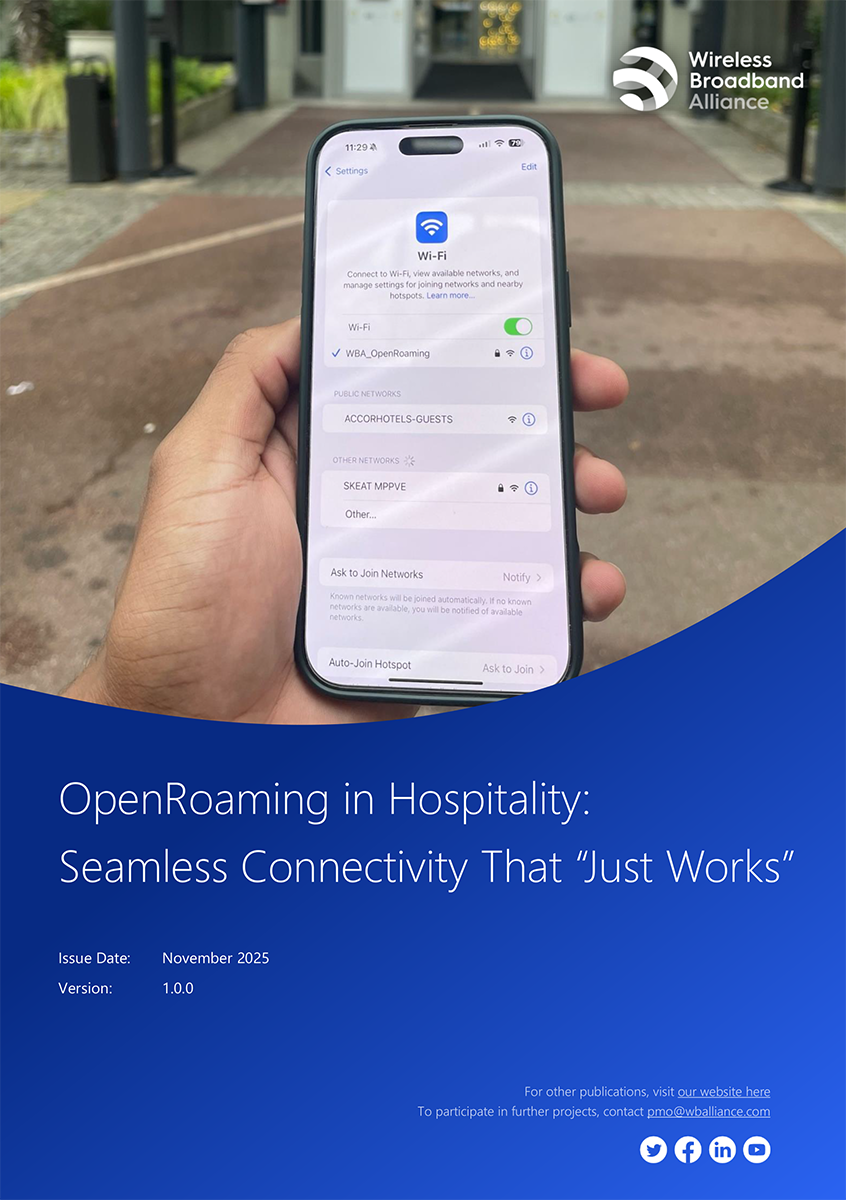
OpenRoaming in Hospitality
In today’s hospitality industry, Wi-Fi is no longer a hotel amenity, it’s a deciding factor that defines the guest experience. Studies shows that reliable internet access ranks among the top three reasons guests choose a hotel. But “reliable” now means more than strong signal bars in the guest room. Guests expect connectivity that follows them across the lobby, meeting rooms, restaurants, and even beyond the property – automatically, securely, and without logins.
This is where OpenRoaming™, developed by the Wireless Broadband Alliance (WBA), is redefining what “great guest Wi-Fi” means.

The Growing Presence of OpenRoaming in Japan
Following the successful completion of the 2025 Osaka-Kansai Expo, the event proved to be a powerful catalyst for connectivity innovation across Japan. OpenRoaming played a central role , enabling seamless and secure Wi-Fi access for millions of international visitors and domestic travelers. The “Osaka Free Wi-Fi OpenRoaming” service, deployed across key venues, transportation hubs, and public areas throughout Osaka, demonstrated how large-scale, federated connectivity can enhance user experience and support Japan’s smart city vision.