Having to delay playtesting on my game

In frustrating news, I just don’t have the mental energy these days to run my weekly game, and then incorporate the feedback into the rules for the following week. I’ve gotten a lot of good feedback, but with moving my fiance to Canada and the general state of the world, other things need that effort each week.

In response I’m moving the game over to Pathfinder 1e. Why that game? It is close enough to 3.5e (Much closer then 5e from what I can tell!) that I can DM it without nearly as much effort. I don’t have to convert stat blocks from the 3e blocks that The Sunless Citadel uses, and I think I vibe with the system more then I do 5e. I’ll also admit there is a comfort as a DM in knowing the system about as well or better then the players, whereas with 5e most of my players know it a lot better then I do, as I’ve been off playing GUPRS instead of D&D for the last decade.

I will say, despite playing 3e and obsessively reading the 3e and 3.5e rulebooks when they came out, and playing Pathfinder a fair bit when it launched, I did have to spead more time then I expected looking up basic rules to help players do character creation tonight. I guess not having played it since I left my Dad’s game in 2014 or so is a very long time. Still, I expect an afternoon of reading the rules and I’ll be ready to rock and roll.

As long as no one grapples anything.

Anyway, I have all the feedback notes from both round of playtesting this year and last year, so when I have the energy and desire to write more, I’m good to go, so this wasn’t wasted.

Edit: Why not Pathfinder 2e? From the looks of it, the action economy has changed enough that I’d need to totally redo the stat blocks, rather then being able to be fully backwards compatible to D&D3e.

Published in: on February 19, 2025 at 9:18 pm  Leave a Comment  
Tags: , , , , , , ,

From the Phoenix’s Ashes: Adapting The Sunless Citadel, Part 2

Trolls

Trolls will be another creation of the fleshcrafters, taking a larger animal and twisting it into something hateful in an attempt to create a perfect shock troop to run at the front of the lines. Made tough and regenerating so that arrow fire doesn’t bring them down before they reach the front lines, long arms and claws to deal with spear-wielding front lines, and a hateful love of violence to ensure they are willing to fight. While expensive to create, they were highly effective and saw use throughout the war, many retreating into the wilderness when their units were destroyed.

Mephits

Again, these fit in so well with a mageocracy full of wizards increasingly abandoning morals for power and magical warfare that I don’t need to change them much. I think I’m going to make it so that interplaner travel is much more rare and/or impossible in my setting though, I always found Planescape rather cheesy and complicated (despite my avatar!) and think humans being able to glimpse outside of our word, but only able to travel there in the rarest of occasions will make it more special. I might make an exception for the faerie realm/feywild though, it is good to have a place mortals can accidentally slip into if they aren’t careful.

Published in: on January 11, 2025 at 9:00 am  Leave a Comment  

From the Phoenix’s Ashes: Adapting The Sunless Citadel

This year I am trying to run The Sunless Citadel in my From The Phoenix’s Ashes setting that I’ve posted about here before. It was the first adventure I played through, with my Dad running it for me and my friends when it came out, when I was still in elementary school. It seems simple enough to run, and roleplaying Meepo should be fun.

Anyway, the main thing I keep thinking about is how would the various setting elements would fit into my settings so here are some ideas, nothing that should be too spoilery for my players though, in case they read this. 

The titular citadel

I’m thinking it was a Eburneum citadel, part of their very outer line of defences that fell early in the war after brutal fighting. The front lines quickly moved passed it, causing it to be only lightly occupied, and was used as a researcher base. Eburneum arrived back at the fort many years later, with the fort changing hands a number of times, and it isn’t known today who unleashed the magic that dropped it below the earth.

Goblins

These were the standard raiding troops of Zlodin. They can’t stand up to trained soldiers in a straight up fight, but are good at raiding enemy camps, trench raids, attacking supply convoys and attacking civilian populations. They were twisted into their current form from common small rat-like predators native to Zlodin, which, mixed with how early they were developed and how easy they were to make, means there are a lot of them. Like most of Zlodin’s monsters, they can’t reproduce, so they will one day all die out, but until then they fulfill their final orders, or failing that, their design goals, which unfortunately were to cause as much death and chaos within the enemy kingdom as possible.

Giant Rats

Giant rats weren’t actually created to fight Eburneum. They were used for that, sure, but it isn’t why they were created. They were created by the Fleshcrafters Academy of Zlodin to weaken the Necromancers’ College of Zlodin during one of the many periods of internecine conflict the Enchanterdom had. The giant rats were twisted and bred to eat corpses, in an attempt to weaken the Necromancers supplies. While it didn’t work on a practical level, it did 0n a political level, making the Fleshcrafters the foremost suppliers of irregular and specialty troops to the Zlodin army, guaranteeing them the first and best supplies. From a strategic perspective this was likely a mistake, given the excellent logistics that many undead supply, and examples of this type of infighting are thought to explain the sudden losses of momentum and periods of indecision that Zlodin suffered throughout the war.

Dragons

Dragons have always been there, probably for longer then humans have. They fought in the war, but were recruited by each side, drawn in by treaties, bribes or diplomacy. I’m still undecided if I’m going for old fashioned D&D metallic vs chromatic dragons, or Eberron-style moral ambiguity.

Kobolds

Kobolds were created as a bribe to a powerful council of chromatic dragons, to lure them into the war. They were given over as an engineered species of minions to the dragons, to replace their disloyal and treacherous servants. Like most of the creations of the Zlodin fleshcrafters, they cannot reproduce, which was Zlodin’s means of keeping the dragons in the fight and loyal: if Zlodin fell, there would be no one to produce more kobolds for them. However, rumours have it that the dragons, being smart and used to intrigues that last hundreds of years, had the research project infiltrated with spies from inception, and have begun creating their own kobolds.

Skeletons and Zombies

Exactly as in normal D&D: The Zlodins used them heavily, though, as discussed above, not as heavily as they could have due to political infighting. While they make for poor troops due to the lack of intelligence (They will keep walking into an ambush or into a clearly marked trap for example) they make excellent troops due to the fact they don’t need logistical support. As such, you could station a large number of undead and a few officers in a defensive position and would barely need to feed them, greatly simplifying supply lines. In locations where large amounts of necromantic magic was used, they sometimes would spontaneously rise, and were often left behind as traps by retreating troops.

Quasits & Other Summoned Monsters

I’m just going to leave these alone; they fit the theme of a world damaged by magic very well. The one change I’ll make is that none of them have ever directly interacted with a deity, to keep things less certain (cf Eberron).


From the Phoenix’s Ashes: Politics and Intrigue

While I wrote this campaign setting for the dungeon crawling potential, while moving away from at least some of the problematic tropes of the genre, I think it would also work quite well as a setting for political intrigue if a DM more skilled then I were to run it.

Read more: From the Phoenix’s Ashes: Politics and Intrigue

You’ve got a young queen, much beloved, but one who has spent much of her youth in a foreign culture with very different politics and social customs. She is scared that her country could go down the same past as their just-defeated opponent and wants to move to a system of government with more checks and balances, or one that puts less power into a small number of people. She is leaning towards a Commonwealth style constitutional monarchy, but could be persuaded towards backing other forms of government.

Meanwhile the nobles are split: Many of them want a return to tradition, with the rights afforded them that were curtailed during the war returned, the Queen to marry into one of them, and so forth. However, many of the richer nobles have actually allied with a number of wealthy non-noble merchants to push for a form of plutocracy, or at least laws that favour the wealthy.

Meanwhile, many of the returning veterans want a form of government that gives them more say. They saved the country, and as a result, they want their voices heard. This ranges from demands for democracy, to socialism (democratic or otherwise), to anarchism, hitting all points between. Many of the farmers and workers that supported the war effort with long hours and rationing have joined in these movements.

To give more foes for the players to fight, there is a small (optional) group of fascists, formed mostly from a group of rear-line troops that didn’t see actual combat and want to see their nation grow in power and influence over its remaining neighbours, by force if needed. This faction ensures that no matter what composition of players you have, they have someone they all hate to work against.

Published in: on February 5, 2023 at 9:45 am  Comments (1)  
Tags: , , , ,

From the Phoenix’s Ashes: Helping the Citizens

The war is over. The Wizard-Lords, Genemasters and Sorcerer-Generals of Zlodin are dead or missing, and Eburneum is disbanding her armies under the leadership of Queen Eliana. However, things are still dangerous. Losing access to much of her farmland in the west, Eburneum turned to it’s easternmost farms and pushed them as hard as possible to produce as much food as they could. Forests were reluctantly cleared and planted. The standard Spring/Autumn/Fallow field system was abandoned and all fields were farmed whenever the ground was not frozen. This will burn the land out, but it was the only way to produce enough food in the final years of the war.

This means that the battlefields must be turned back into farmland as soon as possible. Already many of those driven from their homes are returning to the outskirts of the plains, repairing and rebuilding villages. This is dangerous however, as many of the biological horrors (Read: D&D style monsters) are roaming the wastes, driven by their final orders to kill and destroy the enemy. Almost as dangerous are the automatons and golems* used by Eburneum in the early parts of the war, as they are even more strictly guided by their orders and unclear or poorly thought out orders have left many of them laying in wait for the enemy, covering retreats long over, or other dangerous situations.**

(more…)
Published in: on January 29, 2023 at 9:45 am  Leave a Comment  
Tags: , , , ,

From the Phoenix’s Ashes Campaign Setting: History

For a long time there was peace between the Federated Enchanterdoms of Zlodin* and the Kingdom of Eburneum*. However, as the Enchanterdoms reached for ever greater heights of magical and alchemical power they began to ravage their lands in search of resources to power it. These quests bore fruit and the secrets of life and death began to yield themselves to the wizards. It was thought that the secrets of eternal youth and immortality must not be long off and mining for the minerals needed grew more and more extensive, and less and less care was taken with the waste from magical resources. Forests and swamps were ravaged in the search for rare plants and reagents. It is at this point that Eberneum, Zlodin’s neighbour, got involved.

The first sign of something going badly wrong for the citizens of Eburneum was when strange, hostile, mutated animals began to cross into their lands. Then the waste from Zlodin’s mining and rituals had reached the vast, fertile plains that stretched between the two nations and began to poison the crops. This caused a rapid chilling of relations and many angry words between the two, and Eburneum began to prepare for what would happen if Zlodin did not cease to poison their farmland. The final straw was when reagent hunters from Zlodin were found to be poaching rare and magical creatures from Eberneum’s lands, and Eberneum began to march to war.

In truth, Zlodin was far from unhappy with this outcome, as they looked greedily towards the larger kingdoms mostly untapped magical resources. Soon the plains were churned to mud by marching armies, and cropland and wild plains alike were watered with blood. The war spread to every front, the mountains, the swamps, and even the air and below the ground. While Eburneum used traditional soldiers from across its vast kingdom, and reinforced them with magic and artifice, Zlodin took any creatures they could find into their fleshforges and warped them into semi-intelligent soldiers and weapons of war.

Eburneum counted on the bravery of her countrypeoples to counter these horrors, and luckily, was right. A small group of commandos slipped through enemy lines and stole the secrets of the fleshforges. Re-engineered into less-brutal augmentation engines, volunteers walked into them and came out as elves (faster, better adapted to archery), dwarves (To mine and fight deep underground or in trenches), foxfolk, catfolk and more. Though these specialized troops were not significantly superior to stock humankind, their loyalty and flexibility gave the kingdom what it needed to hold against the increasingly horrific monsters.

The tide began to turn when the Princess Eliana, sent away for safety at the start of the war to the lands of the Morski sea-peoples returned, having wed and become the chief advisor of the most-influential leader of these people. While in these peaceful times living as the best naval traders and merchants around, they had a long history as raiders and pirates, and had never allowed these skills to fall away, and given an excuse and cause to fight for, the various sea-peoples took up their axes and warlike ways with little hesitation.

The combination of many stout Morski joining their forces and Zlodin burning through its magical resources at a reckless rate early in the war finally turned the tide and allowed Eburnian forces to cross the plains and enter the mountainous heartland of Zlodin. There, in a once lush and pastoral valleys, the Eburnian and Morksi forces found twisted hell-scapes, choked with the effluvia of the gen-forges and scared by the sheer amount of magical and physical resources pillaged from them, barely capable of supporting life.

What happened at the final battle is not known, for there were no survivors among either command, and the reports from the surviving troops are confused and conflicting. What is known is that a cataclysmic force was unleashed, destroying the central force of the Eburnian troops and almost the entire Zlodin army. The blast levelled mountains, made armies vanish or incinerated them and warped reality with its force, to such an extent that geography itself changed in waves away from the blast, moving some landmarks by hundreds of miles.

This wiped out most of the higher nobility of Eburneum and all known surviving wizard-lords of Zlodin. Queen Eliana, forbidden from fighting on the front line by her status as heir, led the first relief forces into Zlodin. They found the common people malnourished and weak, poisoned by crops grown on tainted land. Even the remaining soldiers, given the best food available so they could fight, were eating sawdust-filled bread. Horrified, she invited the survivors back to Eburneum with her, leading the first group of refugees there herself. While it is taking adjustment after so many years of hatred, the images of bedraggled and hollow looking refugees entering the capitol, lead by the strongest bastion of hope their nation had in the final years of the war have done much to drain that anger. Armies are being demobilized and veterans allowed to return to their pre-war forms, or not, as they wish.

This is where the campaign starts. A badly damaged kingdom trying to stand back up, helping the few survivors of its bitter foe. Next time I’ll go into the present issues of the campaign and what I see players getting involved in.

*Names are placeholders made by throwing Google Translate at a bunch of near-random words. Suggestions Welcome.


From the Phoenix’s Ashes: Introduction

I’ve been thinking of writing my own d% RPG since 2010 for a variety of reasons: I could send it to people without worrying, I could only write the parts we will be using, to make it less intimidating to new players, and I could make it look exactly how I wanted. The biggest however, was I could make a game that was D&D-like, with players growing in power and taking on bigger and bigger threats over time, but using a skill-based system that wasn’t super crunchy like GURPS.

About five years ago I actually set pen to paper and wrote out the core system in a LaTeX document while spending a day doing a series of particularly long and boring fluorescence measurements at work. The core mechanics were pretty simple and ready for playtesting. I could have run a Call of Cthulhu-type game in it right then. However, problem: I already have Call of Cthulhu, and that doesn’t reach my goal of a more D&D-style d% system. When I sat down to do the things I’d need for that; spells, equipment lists, I just hit a wall. How do I do that without just blatantly copying D&D?

Then a few years ago I got the idea to write my own campaign setting to go with it, that wasn’t basic D&D fantasy. I decided on a transhumanist, post-war Renaissance/Enlightenment-era setting with anthropomorphic influences. My biggest influences are Eberron (particularly Keith Baker’s idea that the most interesting place to set a campaign is right after a big world-shaping event, not ten or a hundred years later), Nausicaä of the Valley of the Wind, the Bolo series by Keith Laumer, and the scene you see in a number of anime series where a group of people are walking through a ruined city or desert and suddenly a war machine senses them and activates (For example, Wolf’s Rain. I know I’ve seen it other places but am drawing a blank: I’d love it if people left examples in the comments.) I got busy with finishing my degree and was too stressed out by the pandemic to write anything creative for a long time, but I’m finally warming up to writing again, and I’m seeing a lot of people pushing for blogs to make a comeback in 2023, so I thought I’d give it a try.

Cthuhlhu and Robert E. Howard

Back in 2010 I started writing this blog post, and got through 17 revisions it seems, but never finished the adventure. It has been sitting in my drafts folder for 13 years now, and I no longer remember the story well enough to finish it off, but thought I might as well post it rather then have it sitting in my drafts folder forever. I would love some suggestions as to how to finish it off, if anyone is familiar with the story.

I recently finished a Black Canaan, a collection of Robert E. Howard’s ‘lesser’ stories. While he is best known for inventing Conan Howard also wrote horror and pulp. Really he wrote anything he could get paid for. While reading it I was struck by how similar some of his tales where to my Call of Cthulhu game. In fact, it has inspired me to attempt to write my own adventures.

Howard has steel-hewed, square-jawed hero’s fighting cultists and demons. Practitioners of the occult stopping those who engage in black magic, and all manner of similar events. It seems a good match for my players, who like CoC and yet want to be Big Damn Heroes.

So I am going to give the outline of an adventure based on a story from this book: The Haunter of the Ring.
Warning: Beyond this point are spoilers

(more…)

More images to inspire non-pessimistic post-apocoplytic games

I wrote last time about how I wanted a less depressing post-apoc RPG then Fallout and most modern ones. It was an appealing setting when I was a lonely teenager or undergrad, but now that I’ve got a partner I want to spend my life with, a life I don’t hate and so forth, the end of the world is a lot less appealing.

So I thought I would post some of the pictures that bring up the old fantasy of wandering through a ruined city and finding useful things to help my community out, that don’t depress me at the same time. Spending too much time on Tumblr has inspired this somewhat, particularly after discovering it has RSS feeds.

A figure with long hair and an open jacket, seen from behind overlooking a small town. No other people can be seen, though there is smoke coming out of one of the buildings. The town is in forested mountains. The image starts in dark purples at the bottom of the image and uses a gradiant to become pale pink at the top, implying sunset.
This is an image from an RPG named Alice is Missing, played entirely via text message, which is a damn cool idea. While there is nothing post-apocalyptic about the image it gives me the feel I want for a cozy, cooperative post-apocalypse game.

The above image, found on Tumblr, is one of the inspirations for this series of posts. I don’t know why, the town is clearly meant to be inhabited, but I looked at it and thought about how peaceful it would be to be a lone traveller after the end, coming across a nearly untouched town in the pacific northwest or a similar region. That or possibly this person is coming home after a trip to the outside world and is taking a moment to enjoy the view of the town? Something about it just strikes me as peaceful and the fact there is only one person shown is striking.

Image
“Fire Truck” by Huhsoo.
I don’t know if this is fanart, or was done for The Last of Us, but it is surprisingly peaceful in how it shows nature reclaiming the town.

I like how this shows nature reclaiming a city: Usually when I see post-apocalyptic artwork, the focus is on broken buildings falling apart, but not how beautiful the nature reclaiming it can be.

Image
This art is apparently by Johnny Bruck

This one is more silly, as is obvious. Levity is a great way to keep games from becoming depressing, and honestly, this picture is hard to take seriously.

Published in: on November 6, 2021 at 6:56 pm  Comments (3)  
Tags: , , , ,

Art to inspire an Optimistic Post-Apoc Game

Like a lot of people my age, my image of the apocalypse is largely filled with the green-tinted DC wasteland of Fallout 3 the bleak, ruined Boston of Fallout 4 and countless images of the Zombie apocalypse from the zombie craze that filled my time in high school. However, I do like my settings a bit more colourful and optimistic then these games. As I went over last time there are plenty of good literary inspirations, but these often don’t have any art aside from the cover. Lately I’ve been posting a ton of dragon art over at my Tabletop Games focused Mastodon account. A lot of this art I find via the Vintage RPG tumbr, and while going through it I’ve found some good art to inspire an optimistic setting that just happens to occur after the world has broken.

A bear in Napoleonic garb, including one hand in it's coat
From The Second edition of Gamma World (1983)

When I was young, I wasn’t a fan of Gamma World due to its much discussed “Gonzo” attitude and wanted something more serious. While I’m still leaning towards something more serious, ehhh, it had some good ideas.

Another account giving me ideas for this is Black Ray Gun: An exploration of the world after the Apocalypse, which has the excellent URL of “Post Apocalyptic Flim Flam”.

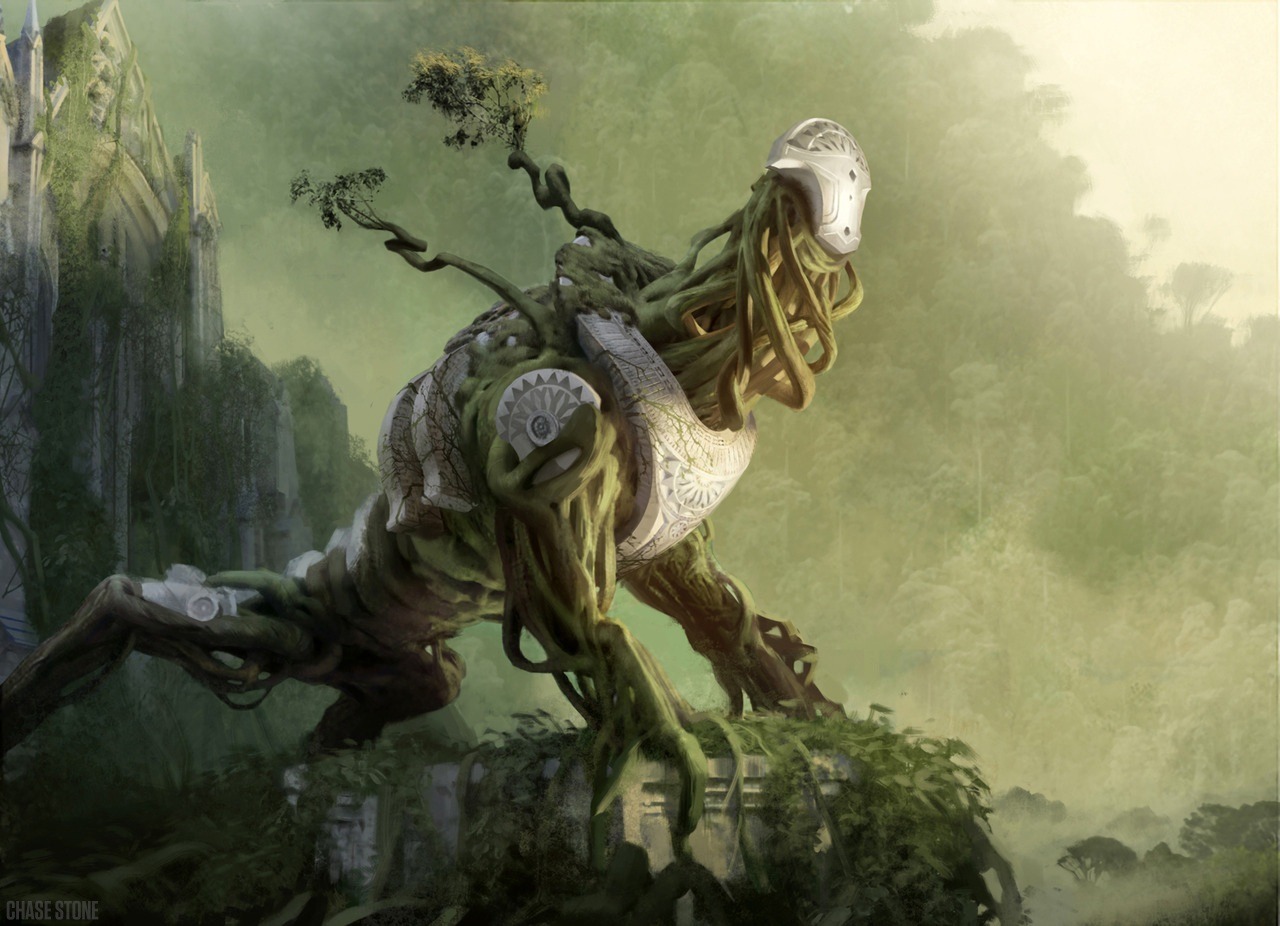
A figure larger then the trees, made of twisted wood but wearing armour, or possible with technology as its face and around its wooden body
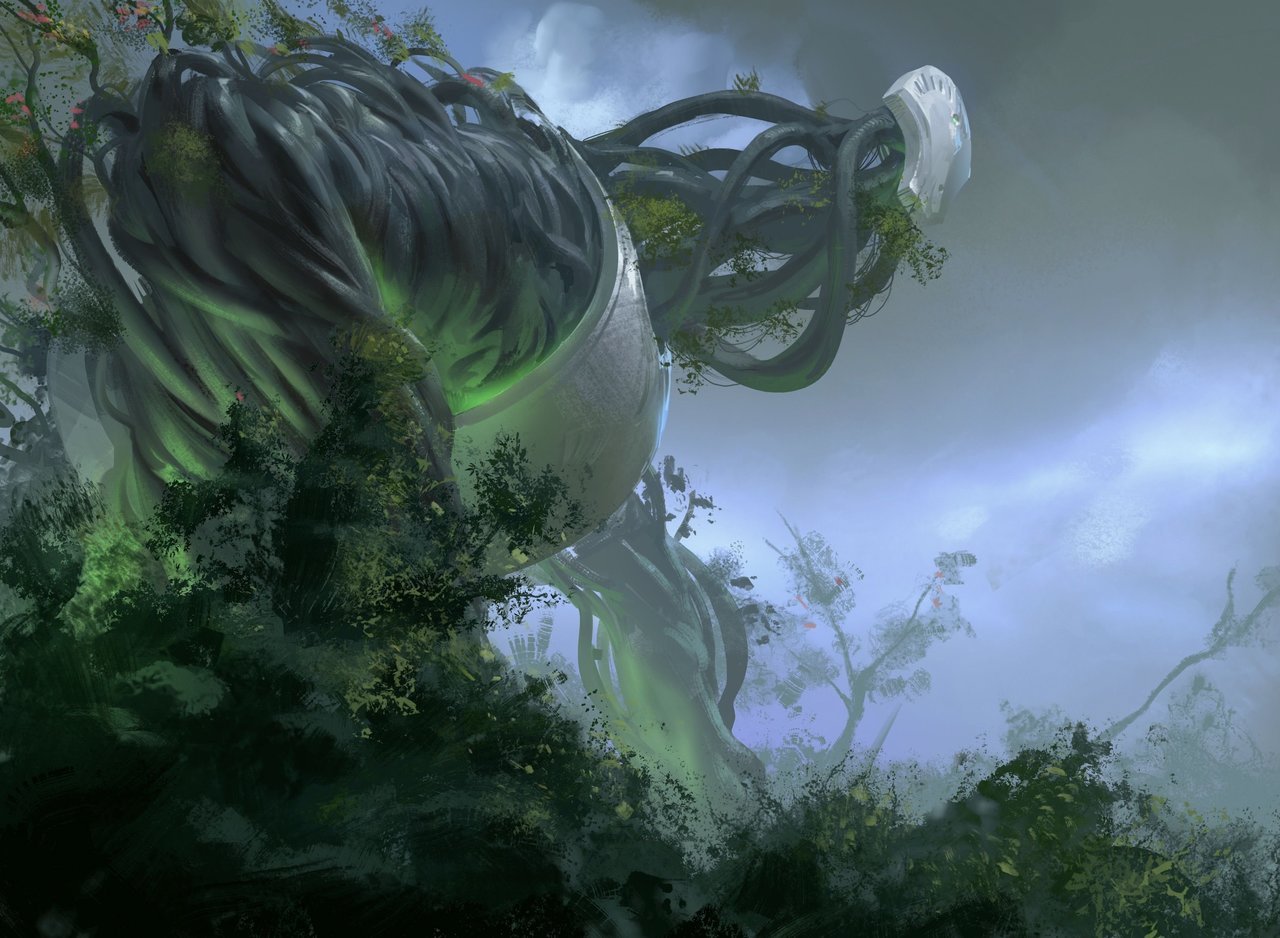
A second view of the previous figure

These images from Magic the Gathering also inspire me with their vaugly Studio-Gibli style look. As if you’d be walking through the forest and come across one of these left over from a much more advanced civilization, just waiting to be awakened, or still doing their final task.

The inside of a torus-shaped space station, extending off into the distance. It is clearly abandoned and overgrown, but done so as to look more peaceful then anything.

I also found this image via Post Apocalyptic Flim Flam/Black Ray Gun and it really resonated with me, emphasizing the peaceful, serene side of the fall of civilization.

I’ll probably post more of these as I come across them.

Until next time, Stay Geeky

Published in: on July 20, 2021 at 2:24 pm  Leave a Comment  
Design a site like this with WordPress.com
Get started