

Save on pre-loved TVs
Buy used:
$9.78
Used: Very Good | Details
Condition: Used: Very Good
Comment: May have limited writing in cover pages. Pages are unmarked. ~ ThriftBooks: Read More, Spend Less
Access codes and supplements are not guaranteed with used items.
In stock
Added to

Sorry, there was a problem.

There was an error retrieving your Wish Lists. Please try again.

Sorry, there was a problem.

List unavailable.
Kindle app logo image

Download the free Kindle app and start reading Kindle books instantly on your smartphone, tablet, or computer - no Kindle device required.

Read instantly on your browser with Kindle for Web.

Using your mobile phone camera - scan the code below and download the Kindle app.

QR code to download the Kindle App

Follow the authors

Get new release updates & improved recommendations
See all
Something went wrong. Please try your request again later.

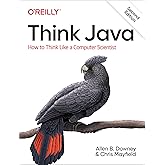
Think Java: How to Think Like a Computer Scientist 1st Edition

4.6 out of 5 stars (48)

Currently used at many colleges, universities, and high schools, this hands-on introduction to computer science is ideal for people with little or no programming experience. The goal of this concise book is not just to teach you Java, but to help you think like a computer scientist. You’ll learn how to program―a useful skill by itself―but you’ll also discover how to use programming as a means to an end.

Authors Allen Downey and Chris Mayfield start with the most basic concepts and gradually move into topics that are more complex, such as recursion and object-oriented programming. Each brief chapter covers the material for one week of a college course and includes exercises to help you practice what you’ve learned.

  • Learn one concept at a time: tackle complex topics in a series of small steps with examples
  • Understand how to formulate problems, think creatively about solutions, and write programs clearly and accurately
  • Determine which development techniques work best for you, and practice the important skill of debugging
  • Learn relationships among input and output, decisions and loops, classes and methods, strings and arrays
  • Work on exercises involving word games, graphics, puzzles, and playing cards

There is a newer edition of this item:

Think Java: How to Think Like a Computer Scientist
$30.49
(125)
Only 1 left in stock (more on the way).
Sponsored

From the brand

Editorial Reviews

About the Author

Allen B. Downey is a Professor of Computer Science at Olin College of Engineering. He has taught at Wellesley College, Colby College, and U.C. Berkeley. He has a Ph.D. in Computer Science from U.C. Berkeley and Master’s and Bachelor’s degrees from MIT.

Chris Mayfield is an Assistant Professor of Computer Science at James Madison University, with a research focus on CS education and professional development. He has a Ph.D. in Computer Science from Purdue University and Bachelor's degrees in CS and German from the University of Utah.

Product details

  • ASIN ‏ : ‎ 1491929561
  • Publisher ‏ : ‎ O'Reilly Media
  • Publication date ‏ : ‎ June 28, 2016
  • Edition ‏ : ‎ 1st
  • Language ‏ : ‎ English
  • Print length ‏ : ‎ 249 pages
  • ISBN-10 ‏ : ‎ 9781491929568
  • ISBN-13 ‏ : ‎ 978-1491929568
  • Item Weight ‏ : ‎ 1.01 pounds
  • Dimensions ‏ : ‎ 6.9 x 0.57 x 8.9 inches
  • Best Sellers Rank: #674,085 in Books (See Top 100 in Books)
  • Customer Reviews:
    4.6 out of 5 stars (48)

About the authors

Follow authors to get new release updates, plus improved recommendations.
Sponsored

Customer reviews

4.6 out of 5 stars
48 global ratings
Sponsored

Top reviews from the United States

  • Reviewed in the United States on November 6, 2017
    Format: PaperbackVerified Purchase
    I used this text for teaching a high school classroom Java (first year teaching programming.) Before we obtained this text we were using a free MOOC via edX (a Java class provided by some teachers at Purdue University.) My students and I found that online class frustrating and poorly designed, so I began looking for a textbook. My students, almost without exception, feel like they've learned more after reading chapter 1 than after 5 weeks of the edX course online. The style is clear, the pace is fair, and so far it seems to be an excellent fit for first-time programmers. ALSO, the copyright is the Creative Commons type, which means I was able to legally make a copy of this text for each of my students (at no cost to me, just to my school district's copy shop.) Also, in addition to providing each student their own free copy, I was able to share with them a link to a free pdf version online (for easy reading on their phones/tablets.) Finally, there's a free version of the book online that is interactive (i.e., while reading the book you can enter actual code to practice content.) Overall, I'm very pleased with this book, and recommend it. (Caveat: I haven't used any other Java texts, and I'm a brand new teacher so take that into consideration. If you're looking for a much more thorough and in-depth text for Java, I've been told by experienced teachers that "Big Java" by Cay Horstmann is excellent.)

    11 people found this helpful
    Report
  • Reviewed in the United States on July 15, 2018
    Format: PaperbackVerified Purchase
    I am a computer science student and I highly recommend this book. One of the things a lot of people struggle with when learning Java is that to learn one new term, you have to learn another. For example, what is an object? It's a blueprint for a class. What does a class do? Describes an objects state and behavior. What are state and behavior? etc. etc. etc.

    The best thing about this book is that it introduces terms one at a time and breaks them down to where they are easy to understand. It is an easy read and I wish I would have discovered it sooner.
    4 people found this helpful
    Report
  • Reviewed in the United States on December 6, 2018
    Format: Paperback
    //Review has been altered to shorten it and conform with Amazon's guidelines.

    public class Review
    {
    double review = 4.0;
    public static void main (String[] args)
    {

    System.out.println("This book is outstanding for beginners! "
    + "However, the learning curve becomes steep after chapter 8 (arrays).");
    3 people found this helpful
    Report
  • Reviewed in the United States on December 6, 2019
    Is a great read to bootstrap a newbie with practical examples and exercises. Promotes the use of design patterns and the reading is enjoyable
  • Reviewed in the United States on January 31, 2017
    Format: PaperbackVerified Purchase
    This is a good book. It offers a nice foundation. It is not overly hard to follow, but it still covers important details. It will not teach you everything there is to know about Java, but it is a really good start.
    3 people found this helpful
    Report
  • Reviewed in the United States on July 5, 2017
    Format: PaperbackVerified Purchase
    This is the best book on programming I've read (and I've read quite a few over the years). The text is accessible to the novice programmer, but also manages to preserve a great deal of intellectual depth.
    2 people found this helpful
    Report
  • Reviewed in the United States on November 7, 2016
    Format: PaperbackVerified Purchase
    I loved _Think Python_ by the same primary author. It is a very readable and well-paced introduction to programming, and also teaches a great deal about the Python programming language.

    This book attempts to do something similar, but in a different language: Java. The problem is that the Java programming paradigm - how it is used in practice - is very different from Python, and I don't think this book is really "Java-ish." Their intro to programming is fine, but as an intro to Java, it falls short. The level of Java reached in this book is elementary - you will be forced to supplement with something else. E.g. generics, comparators, are not covered.

    TL;dr I wouldn't recommend this book to learn to program (better is _Think Python_), and for experienced programmers, I definitely wouldn't recommend it to learn Java.)
    7 people found this helpful
    Report
  • Reviewed in the United States on October 10, 2017
    Format: PaperbackVerified Purchase
    A learned a few things but I don't think it really taught me to think like a computer scientist.
    3 people found this helpful
    Report

Top reviews from other countries

Translate all reviews to English
  • saszar
    5.0 out of 5 stars perfect book for beginners
    Reviewed in Spain on July 10, 2017
    Format: PaperbackVerified Purchase
    It is a book that just goes to the main points trying to make the reader understand the main topics.
    If you want to learn more and go into detail you must get some extra books.

    It is the perfect book for beginners
    One person found this helpful
    Report
  • Buchfuchs23
    5.0 out of 5 stars Great book!
    Reviewed in Germany on August 22, 2017
    Format: PaperbackVerified Purchase
    This book is an awesome piece of work, which will introduce you step by step to the world of computer science in a concrete and professional way. Nothing to complain about, simple a good book for beginners.
    Report
  • Elizabeth
    5.0 out of 5 stars Five Stars
    Reviewed in Canada on March 7, 2018
    Format: PaperbackVerified Purchase
    Good textbook.
  • HCH
    5.0 out of 5 stars A very useful and understandable book for the absolute beginners
    Reviewed in the Netherlands on July 24, 2017
    Clear and logical course structure and content. Because of this, a very useful and understandable book for the absolute beginners. I enjoyed reading and using this book.
  • sayra
    4.0 out of 5 stars The book itself is an amazing / concise / easy-to-understand guide to Java & Computer ...
    Reviewed in the United Kingdom on August 13, 2017
    Format: PaperbackVerified Purchase
    The book itself is an amazing / concise / easy-to-understand guide to Java & Computer Science which most books don't seem to cover.

    The physical book arrived with some strange residue akin to that of a sticky label present on it.