Blue Flame, Tiny Stars on DriveThruRPG

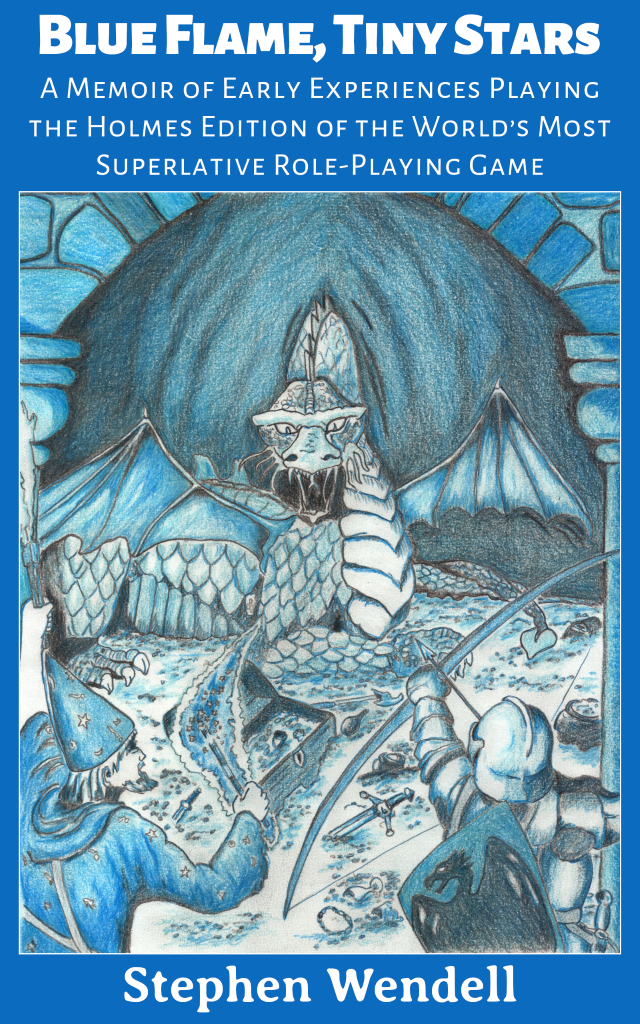
Cover of Blue Flame, Tiny Stars

“Stephen’s delightful memoir makes you want to travel upstream to your own formative D&D headwaters, dig out your old graph-paper maps and worn dice, and rediscover the gateway to what the author calls ‘the fantastic path.’”
—Ethan Gilsdorf, author of Fantasy Freaks and Gaming Geeks: An Epic Quest for Reality Among Role Players, Online Gamers, and Other Dwellers of Imaginary Realms

“A celebration of dice, maps, friendship, and, above all, imagination—the very stuff from which the hobby of role-playing is made.”
—James Maliszewski, author of Grognardia: Musings and Memories from a Lifetime of Roleplaying

Warning: Reading this book will make you want to play D&D!

Now Available on DriveThruRPG in Paperback, EPUB, and PDF

2C. Service Corridor

Herein is described a sublevel of the Deep Halls, the site of our dungeon exploration in Dreaming Amon-Gorloth. Numbered encounter areas refer to the keyed map in “Keys to the Deep Halls.”

26. Wyvern Lair

In the center of the room is a marble pedestal, 3' square and 6' tall. Atop the pedestal rests a bust of a male subject wearing a double crown. The bust is just off center and turned to the right. It is 3' high and as wide at the shoulders. The nose is broken off, as is the left ear.

Wyvern (1).

Beneath the bust, a hollow cavity inside the top of the pedestal contains 450 g.p., 3 gems, each worth 100 g.p., and a gold armband (3d6x100 g.p.)

If the pedestal is moved or toppled, a poison gas is released from a bottom cavity. All creatures within 20' radius must save vs. Poison or die.

27. Guardroom

Orcs (5).

The orc leader wields a sword +1, flaming, +2 vs. trolls, +3 vs. undead, and wears a ring of fire resistance and a necklace (1,500 g.p.). A wooden chest contains 5,700 c.p. and 200 p.p.

28. Storeroom

The north wall is lined with several ceramic jars containing linseed oil. On the east wall are stone shelves, upon which are numerous brushes and many clay pots of pigments. The pigments are red (cinnabar), green (verdigris), yellow (ochre), blue (lapis lazuli), black (charcoal), and white (chalk). Some brushes are from reeds, others from goat and camel hair. On the floor in the southeast corner, beneath the shelves, sit a few small alabaster jars. They contain a rose scented oil. Near the south wall is an incense burner. Inside it, a dark residue smells of frankincense. Next to it, a brass pot contains dark blue chalk with a long cord coiled up in it.

29. Chest of Coins

On the floor against the west wall, a closed wooden chest contains 550 e.p.

Opening the chest triggers the launch of a spear from the alcove, directly opposite. Make an attack roll as a <1 HD monster. If the spear hits, the chest closes, and the trap resets. The trap is loaded with a total of three spears.

Wandering Monsters

Wandering Monsters, Level 2C (1d4)
1Dreaming Priest, adepts (1-3)
2Orcs (2-8)
3Zombies (1-3)
4Shadows (1)

Dungeon Alert

The dreaming priests post orcs as guards on the 2nd and 3rd dungeon levels and gnolls on 4th and lower levels. Adventurers might encounter patrols of either orcs and gnolls, as well as dreaming priests, throughout the dungeon. If any orcs or gnolls become aware of the PCs and escape the party, they will inform the dreaming priests of the intrusion. Once the dreaming priests are aware of their presence, the dungeon will then be on a higher state of alert for the next ten days. Roll for wandering monsters every other turn. If, during this time, the dreaming priests are again alerted to their presence, roll every turn for the next ten days.

3F. Processional Chambers

Herein is described a sublevel of the Deep Halls, the site of our dungeon exploration in Dreaming Amon-Gorloth. Numbered encounter areas refer to the keyed map in “Keys to the Deep Halls.”

It was in room 57. Chamber of Gor’s Crowning that Melqart lost his sight (see “The Frieze, the Papyrus, the Spitting Cobra”).

Beginning in the corridor from 13. Lower Entrance Hall (see 3A. Grand Hall of Stairs), painted walls show a long procession of offerants carrying various objects from the Door of Maat, west, then turning south into 56. Antechamber.

56. Antechamber

The painted procession continues along the walls of the antechamber from the north entrance to the east door.

Elves (d6+6 or as previously determined).

Note: If the party has encountered Elyriain’s elf party during this foray, the elves are not present.

The leader is Elyriain hero/seer. She wears a tiara, carved from olive wood, with an emerald setting. She carries a sword and a shield +1. Half of the party carries bows and daggers; the rest swords and shields. Sharpers stole a cloak from the elves. They want it back.

57. Chamber of Gor’s Crowning

Magically held by an elf from 56. Antechamber.

Sharpers (4).

The leader has an elven cloak. Another has a scroll of protection from undead, and two more each carry potions of water walking. Other treasure is in small coffers, urns, and a chest.

3,000 s.p., 3,050 e.p., 1,550 g.p., and 2 jewelry (2,000 g.p. each).

A frieze on the east wall shows a procession of offerants approaching a seated male figure. Two concentric circles form a halo around the seated figure’s head. From the outermost circle protrude straight lines, like rays. Each offerant carries an object: open book, jar, cornucopia, jug, bowl, etc. The jar is 18" tall, set into niche, contains a papyrus scroll and a spitting cobra.

Spitting Cobra (1).

The papyrus is the Scroll of Waking, object of the Oneiromancer’s quest. The glyphs and images describe an arcane ritual.

Common Knowledge

  • A seated figure receiving offerings is a king or queen.

Research

  • The double halo with rays around the male figure’s head represents the double crown worn by Gor after he united the upper and lower kingdoms (history).

3A. Grand Hall of Stairs

Herein is described a sublevel of the Deep Halls, the site of our dungeon exploration in Dreaming Amon-Gorloth. Numbered encounter areas refer to the keyed map in “Keys to the Deep Halls.”

13. Lower Entrance Hall

Shallow steps descend into this 30'-wide hall. After the lowest step, another column rises toward the ceiling, out of sight.

While the stairs go down 10', the vaulted ceiling continues at the same height from 3. Grand Entry Hall, so 45' high. The three columns and west- and south-facing doors are described below. The north- and east-facing doors are unremarkable.

Harpy (1)

Above the west door, a harpy has made a nest. In the nest are several treasures. When the party enters the hall, the harpy begins to sing.

1,000 e.p., 3 gems (50, 100, 500 g.p.), and a treasure map (see Phenster’s “Adventure Hooks and Treasure,” Treasure Maps).

Supporting the hall are three columns in similar style to the columns of 3. Grand Entry Hall.

Fourth Column
Lunar Phases (Near/Far)SymbolScenes
HalfColonnadeHuman figures, carrying tools, walk between rows of columns.
Half
Fifth Column
Lunar Phases (Near/Far)SymbolScenes
Greater Waning Crescent1RiverA human figure stands in a boat on rippling water.
Greater Waxing Crescent1
Sixth Column
Lunar Phases (Near/Far)SymbolScenes
Lesser Waning Crescent1GateHuman figures fall into open crocodile jaws.
Lesser Waxing Crescent1

West Door: Door of Maat. This door is framed by carvings of hyena-headed humanoids. The sealed door is made of stone. It has no handle or visible means of opening. Upon the door is carved a seated female figure, in profile, a feather in her headdress.

To open the door, one must confess to a sin they have not committed. Once a truthful confession is made, the door slides to the right, and the covered pit beyond the door is locked. A false confession opens only a covered pit before the door (see below). From the opposite side, finger holds facilitate sliding the door to the left. A character or characters with a total Strength of 15 or more can open the door. Once started, the door opens, as does the covered pit (see below).

On either side of the door are covered pits, 20' deep, joined by an arched opening. Centipedes prowl the bottom. Once triggered, the cover on the far side closes and resets, ready to be triggered again. The cover on the near side closes again and locks. It can be opened by a thief or by breaking the stone with a tool, such as a hammer.

South Door: Door of Ammit. Like the west door, the door is framed by carvings of hyena-headed humanoids. But this door is made of wood. Carved in the wood is a figure of a creature with a crocodile head, leopard forelimbs, and hippopotamus hindquarters. The creature crouches, its crocodile jaws open upward.

Common Knowledge:

  • The seated female figure with feather headdress is Maat, known as the anti-confessor.
  • The crocodile-headed creature with leopard forelimbs and hippopotamus hindquarters is Ammit, a demon which eats the souls of all those whose heart outweighs Maat’s feather.

Research:

  • After weighing the deceased’s heart against her feather, the underworld traveler must then confess any sins they have not committed (religion).

14. Closet

The ceiling here is only 10' high. Slumped in a corner lies the decaying corpse of a female elf. One hand grips the hilt of a sword in its sheath. On its head is a tiara, carved from olive wood, emerald setting.

Upon inspection, the elf appears to have been strangled.

The tiara is worth 1,000 g.p.

Wandering Monsters

Wandering Monsters, Level 3A (2d4)
2Dreaming Priests, adepts (1-3)
3Bombardier Beetles (2-5)
4Gnomes, trading caravan (6-36)
5Gnolls (1-3)
6Goblins (2-12)
7Orcs (2-8)
8Shadows (1)*
* Shadows serve the Oneiromancer as guards and spies (see 1A. The Oneiromancer’s Chambers). This one is a spy. This result indicates the party catches a glimpse of the shadow. It does not engage.

1 In our world, we generally describe eight lunar phases, with three phases between new and full moons. In naming the additional phases, I split each gibbous and crescent phase in two and add prefixes lesser and greater.

1A. The Oneiromancer’s Chambers

Herein is described a sublevel of the Deep Halls, the site of our dungeon exploration in Dreaming Amon-Gorloth. Numbered encounter areas refer to the keyed map in “Keys to the Deep Halls.”

The priests now lie in the mausoleums where sleeps the dreaming god. Through dark magic, they channel Amon-Gorloth’s dreams and restore its power. When wakened, Amon-Gorloth shall make terrible war on the Solar Goddess.

—from “the Myth of Amon-Gorloth

A schism occurred soon after the priests began to channel the sleeping god’s dream. Receiving instructions to restore Amon-Gorloth’s strength, the dreaming priests started their work according to their respective alignments.

The first task was to locate a suitable cave network with similar structure, if not size, to that of the cyclopean mausoleums beneath the desert, on which to base the construction of a reproduction, where the cult might operate in secrecy.

The lawful priests conducted a systematic search across the dream world. At the same time, the chaotic priests roamed far and wide in random directions, peeking into any place that seemed promising. The systematic search arrived first at the desired results.

Reveling in their success, the lawful priests then set out to plan the construction, first measuring the lengths of tunnels and breadths of the mausoleums, calculating angles, and estimating supported weights.

Meanwhile, the chaotic priests began to excavate in haphazard fashion, irrespective of any plan, only according to memory and guesswork.

As the chaotic priests made progress, the lawful group’s planning was foiled. They were forced to abandon their plan. Soon the construction was complete. By then, the lawful priests formed their own sect within the cult.

Should the chaotic priests succeed to wake the god, the lawful priests feared that they themselves would be relegated to a weak position in the new hierarchy. So, when they knew Amon-Gorloth’s strength was nearly restored, they escaped the Deep Halls and informed the nomarch in Malq-Menat [base town] about the chaotic priests’ activities therein. The nomarch took this information to the Sun King, who, heeding the myth of Amon-Gorloth, dispatched the Radiant Host to destroy the dreaming priests.

The priests of the Solar Goddess interrogated the lawful priests of Amon-Gorloth. Those determined to be good natured were spared, owing to their station. But those priests found to be evil were executed by beheading.

β The smell of lavender permeates the corridor and areas 11 and 12.

9. Dreamguard

The light dims in this room. The floor in the northeast corner has fallen away to form a pit.

Shadow (1)

Shadows serve the Oneiromancer as guards and spies. This one attacks any creature who enters the room.

The pit, 10' deep, leads to a tunnel.

10. Reveratory

Locked, wizard lock (level 14)

Eight sarcophagi are arranged side by side on the west wall, narrow isles between them. The lid of each sarcophagus is pushed to one side. A table stands in the northeast corner, a few objects upon it.

This is the Oneiromancer’s laboratory, where she studies dream magic. Detect magic reveals alteration, abjuration, and necromancy.

Carved on the upper half of each sarcophagus lid is a glyph in the form of a diamond inside a diamond. On the table are four straight iron bars, tapered on one end.

Object Kobolds (4)

The iron bars are kobolds [described later]. If they are picked up in the Oneiromancer’s absence, they attack. At the Oneiromancer’s command, the four of them together close and open the sarcophagus lids.

The sarcophagus lids are 6' x 2.5', length by width, and 2" thick. Each weighs 400 lbs. Without the kobolds, two strong persons are required to manipulate the sarcophagus lids. Inside each sarcophagus is a small bronze hammer.

When the lid is closed, an engraved glyph of a diamond inside a diamond on its underside glows a soft violet. The occupant is immediately subject to a sleep spell. Sleeping in a sarcophagus for eight hours has one of the following restorative effects by order of priority: neutralize poison, cure disease, remove curse, cure serious wounds.

Common Knowledge

  • The diamond shaped glyph in the common language means “gate.”

Research

  • A diamond within a diamond represents a gate within a gate. Passing through a gate within a gate, one enters another realm (arcane).

11. The Oneiromancer’s Parlor

The smell of lavender is strong here. In the far corner of this chamber, an old woman crouches on a pile of furs. Strings of colored beads hang from her long greasy hair. Her eyes are bulging dark orbs either side a crinkled nose. She hunches over a bronze brazier before her. Coals glow orange. Against the wall behind her rests a box of drawers. A trio of vials sits atop the box. Near the vials, a candle burns under a small tripod pot, from which a thin vapor rises. On the wall above, a sword hangs from two pegs either side the hilt. On the near side of the brazier, a bearskin rug lays thick upon the floor.

The woman speaks in a raspy voice: “Wherefore enter you into the Deep Halls of Amon-Gorloth?”

Amon-Gorloth’s cult is made up of not only priests but also mages. These dreaming mages work with the priests to restore the sleeping god’s power. One such lawful mage was also evil. She escaped the temple priests’ trials by inciting the captured mercenaries to resist their execution. She fled with them into the Shunned Cairns. Knowing that the vanquished priests would return to the Deep Halls to continue their work, the evil mage entered through 159. Observatory and traversed the dungeon to invest the secluded chambers of the uppermost level.

Oneiromancer: Magic-User 14, Lawful Evil

The Oneiromancer plans to interrupt the chaotic priests immediately prior to their success and defeat them before effecting the waking of Amon-Gorloth herself. The Oneiromancer walks the streets of the town at night, infesting sleeping folk with dreams, calling adventurers to aid in the endeavor. She intends to use the PCs to weaken if not destroy the chaotic priests.

The Oneiromancer wears a ring of plate mail +21 (AC 1) and a ring of regeneration. Assume she has memorized any necessary spell up to 7th level.

Several drawers in the box contain a variety of small objects. One of the three vials on the box contains essential oil of lavender. The others are potions of healing and flying. The tripod pot contains simmering water and a few drops of lavender. The sword on the wall is cursed -1. The forward edge of the bronze brazier is engraved with Sacred Signs:

WAKING INTO DREAM

On their first visit, friendly PCs might learn:

  • The Oneiromancer sends the dreams the town folk have.
  • Her name is Tausret.
  • When appropriate, she reiterates parts of the Myth of Amon-Gorloth.
  • This world exists only within the dream of Amon-Gorloth.

The Oneiromancer pretends to know nothing of the whereabouts of the Griffon Fountain, object of Menturoc’s quest. And if they mention Elyriain’s elven party, she warns that the elf leader is not what she seems.

The Oneiromancer’s Quest: The Scroll of Waking

The Oneiromancer can tell them more, but first they must complete a quest.

“From the Grand Hall of Stairs, through the Door of Maat, follow the procession to the crowning of Gor. There, find a papyrus: the Scroll of Waking. Bring to me the scroll.”

12. Oneirrery

Floating in the center of this chamber are two large, flat pieces of silver. Both are diamond-shaped. One floats inside the other, though independent of it. One is 5 feet high, the other 8 feet. They are 5 feet from the floor. The ceiling is 20 feet high. The two diamonds rotate slowly on their axes, the inner clockwise, the outer counter.

The Oneiromancer built this device, which answers questions concerning the dream world. The oneirrery may also open, at the proper command, a portal to anywhere in the dream world or to the corresponding chamber in the cyclopean mausoleum. As the player party has not yet entered this room, I know not more.

Wandering Monsters

While the Oneiromancer is present, there are no wandering monsters on this level.


  1. See Rings of Armor in “A Curious Assortment of Rules” (Phenster’s). ↩︎

The Deeds of Menturoc

The interesting part of research is puzzling out the clues. So, while the players may spend as much time as they like in this discussion, the research periods should pass with a dice roll.

—“Research

The following is a dramatization of an example of research, the rules for which are laid out in “Research.”

“Who is Menturoc the Ardent Champion…?” Hathor-Ra repeated the question again. It was the long day’s mantra.

Streaming light through the small aperture high in the chamber’s west wall turned orange as the Solar Goddess lay the life-giving orb to its rest. The air was over warm. Clay dust filled her nostrils. Both made breathing an exercise.

The only sounds came from the rolling of papyrus, the clinking of fired clay, the folding of Hathor-Ra’s robe as she rummaged through scrolls and tablets, and the muttered mantra: “Who is Menturoc…?”

The day before brought success. Early in the day, she interpreted the Sacred Signs to discover the meaning of the scarab icon the party found in the Deep Halls. In the long-gone Amwan Culture, the scarab was the symbol of a god who represented the rising sun and the daily renewal of life. Heresy. The sun is carried along its heavenly path by the Solar Goddess, and she requires no assistance in the daily act.

While Hathor-Ra found no information about the location of the griffon fountain, which was her primary objective, she did, by mid-afternoon, discover proof of its existence. An accounting tablet described its making: “A griffon in relief, carved from granite, and gilt in beaten gold,” as well as its production cost: “Thirty-six weights of silver.”

“Weights of silver” was an ancient phrase. Though still used in some religious and poetic texts, standard coins replaced measures in recent centuries. The sum, Hathor-Ra knew, was symbolic. Thirty-six was a sacred number which meant completeness. Whatever the true cost of the griffon fountain, it was paid by the sculptors with their time and sweat to the glory of the Sun Goddess.

With that success, Hathor-Ra left the Temple Archive to share the discoveries with her companions and confer. At the Sign of the Oneiromancer, Melqart suggested that she find out more about the ardent champion who made the griffon fountain and put her on its quest.

Today, she had no success. There seemed to be no other mention of the ardent champion or the griffon fountain in the archive. Yet, she persisted. Though delivered in a dream, Menturoc’s geas had hold of her mind. She could think of naught else but the ardent champion’s bright face as he mouthed the words:

“If you will defeat the dreaming priests, you must cleanse the defiled shrine and reconsecrate it to the Solar Goddess. For it will then serve as a haven for those worthy of its protection. Seek first the griffon fountain.”

As the orange light faded, Hathor-Ra lit tallow candles and continued the search. She examined scrolls and tablets long into the night. She knew not how many hours passed before her head finally rested on one arm. At the end of the other, her hand clenched a scroll, partly unrolled. The papyrus bore colors: red, yellow, blue. Sigils formed the words, “The Deeds of Menturoc.”

THE DEEDS OF MENTUROC

  • Menturoc was the ninth son of a chieftain of a nomadic desert tribe.
  • The tribe was defeated in a large battle against the Radiant Host. Menturoc’s entire family, including his father, were killed in the slaughter, along with most of the tribe.
  • Orphaned, nine-year-old Menturoc was taken into a noble family of Irthmalq [capital city, Base 3 on the map] and raised as one of their own.
  • As a young man of eighteen years, Menturoc joined the Radiant Host and fought as a fierce and loyal soldier in many battles against the barbarian tribes that press the Sun King’s borders.
  • After many battles, Menturoc lay aside his arms and armor. He donned a simple wool garment and walked, unburdened by any possessions whatsoever, into the desert. Menturoc was aged 27 years.
  • Nine years later, the Sun King called forth the Radiant Host against the dreaming priests. Menturoc heard the call. He came out of the desert, carrying a sword he called Disruptor of Dreams.
  • Menturoc led the Nine Companions against the dreaming priests in the Deep Halls. Many foes were slain by his blade, Disruptor of Dreams.
  • Within the Deep Halls, Menturoc established a shrine to the Solar Goddess. The shrine protects those faithful to the Solar Goddess.
  • Though he fought valiantly, Menturoc fell at the Battle of the Inner Redoubt. His corporal remains are entombed within the Deep Halls. Disruptor of Dreams lies upon his breast.

THE SOLAR GODDESS SHINES FOREVER ON THE SUN KING

Read more about the article Index of Phenster’s

Index of Phenster’s

Phenster’s Pandemonium Society House Rules is a series of articles which reedits house rules for Holmes Basic D&D from 40-year-old game club newsletters. Phenster’s aims to compliment the Holmes rules in three ways:

  1. Some rules patch the Holmes edition to make it a more coherent game, while maintaining its simplicity.
  2. Others extend the game beyond 3rd character level and add elements that many 1980s gamers used. While these often come with more complexity, they also add value to the game without interfering with play.
  3. Still other rules add elements as suggestions or models to apply to a campaign.

While Phenster’s starts with Holmes, many of the house rules are applicable to other old-school editions of the world’s most superlative role-playing game.

The following is a list of articles from the series, ordered and grouped to follow more or less the contents of the Holmes D&D Basic rules booklet. Three articles that don’t fit neatly into the contents are shown as asides.

Preface

Introduction

Campaign Names

Creating Characters

Non-Player Characters

1984: The Year of L’avant garde

Languages

Time and Movement in the Dungeons

Magic Spells

Combat

Monsters

Treasure

The Panaggelon, Castle and Dungeon: Building Castles and Dungeons

Phenster’s Pandemonium Society House Rules is a work of fiction. Names, characters, businesses, events, incidents, and newsletters are either products of the author’s imagination or are used in a fictitious manner. Any resemblance to actual persons, living or dead, or actual events is pure coincidence.

Image
“Bluebook” D&D.
The 1977 edition of Gygax and Arneson’s DUNGEONS & DRAGONS is also known as “Holmes Basic” after editor Dr. J. Eric Holmes.
Read more about the article The Panaggelon, Castle and Dungeon: Building Castles and Dungeons

The Panaggelon, Castle and Dungeon: Building Castles and Dungeons

The following article was published in L’avant garde #60. In addition to general guidance about how a DM might handle the process, I get from the article two house rules: Upkeep and Building Castles and Dungeons. The latter comprises Phenster’s sections on Construction Costs, Construction Time, and Engineers.

Both of these I put in the [C] Campaign category. While they might go in [E] Extra, most groups I think didn’t so much bother with building castles in the 1980s. And they still don’t. The lure of the dungeon is too great.

This is the last of Phenster’s articles from issues of L’avant garde in the Postlethwaite Collection.

The Panaggelon, Castle and Dungeon

We've been playing pretty steady in the GREAT HALLS OF PANDEMONIUM almost since the beginning. Hazard started the campaign way back in 1980. I remember it was wintertime, because we rolled characters and first went into the dungeon on a snow day. It was a Friday, and we played D&D all weekend long.

We've had a LOT of adventures in 4 years, and we found a LOT of treasure too. We had sacks full of gems and jewelry and thousands and thousands of gold pieces in the bank. Friar Tombs decorated his room at the Nine of Pentacles with tapestries, upholstered furniture, and a silver service. All that was after he gave his tithe to the Church. Jinx hired a butler. Beowulf keeps a minstrel on retainer to record our exploits and make up songs about us--mostly about Beowulf fighting monsters. We're getting high up in level too, which means we pay quite a lot for upkeep. Upkeep is only 1% of XP in GP every month, but 1% of a lot is still a LOT!

We added up all our treasure. We have 8 regular players and 11 more that are active but less steady. Between us we had almost 3 million g.p. in the fortress bank. The castellan said we could just buy the fortress if we wanted to. We could stay there for free, and he could retire to a nice beach on the south coast.

That gave us the idea to build our own stronghold. We had to go to Lundgre Towers and get an audience with the king to ask him for a land grant. We asked King Vortigen for some land near the Great Halls so we could get to the dungeon quickly. We all had to swear fealty to Vortigen and promise to protect the borderlands and the king's subjects and make sure nothing comes out of the Great Halls that would threaten the kingdom. He granted us some land and gave us the deed.

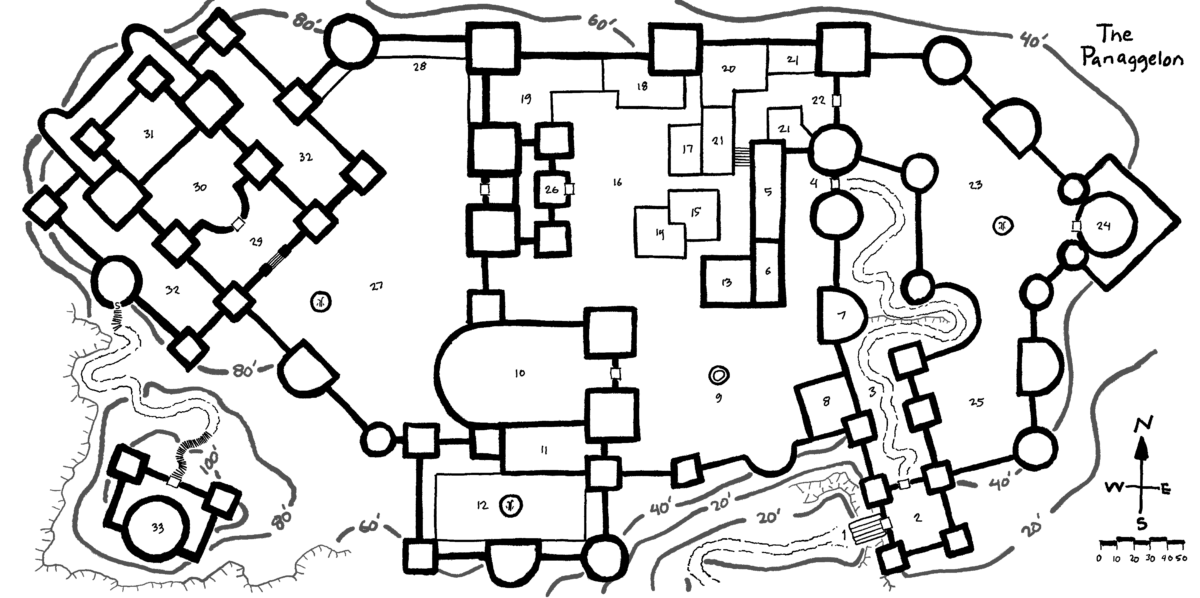
Hazard said our land was mostly flat with some forests and swamps and a few hills. He gave us a contour map of the hills, and we picked out a nice place on the highest hill to build our castle. It looked plenty big enough, and the sides were steep.

So one day we sat down to design our castle. We didn't know much about making a castle map. Cypher checked out a book about medieval castles from the library. It had some castle plans in it to give us some ideas. I got a pack of 11" x 17" graph paper from the Game Hoard. 5 squares to the inch because we wanted to make a BIG castle.

First, we started with a list of all the things we wanted to put in it. There had to be a keep, of course. That's where the castle lord would live. We decided Beowulf should be the lord, because he's our best fighter. There are also chambers for all the PCs in the keep, plus the barracks for a contingent of guards.

Tombs wanted a cathedral. Hazard said a cathedral would be too big, but a church would fit into a castle. But Tombs said he was going to be a patriarch eventually, and patriarchs need a cathedral. After some haggling, they settled on a small cathedral, and we got to build it for half price due to divine intervention.

Jinx wanted the top floor of a corner tower for the offices of the thieves' guild. But Mandykin said the thieves' guild should be super secret. They would run a clandestine operation out of anywhere and everywhere in the castle. Tombs said to keep it out his cathedral, and Beowulf said to keep it out the keep.

Cypher and I each wanted a tower for our magic-users, because magic-users live in towers. For her character, Mithrellas, Cypher wanted a tower in a garden with trees and plants with flowers. So we decided our castle would have a greensward. I wanted my tower to be outside the main castle, and you have to get there by craggy stairs. I wanted it higher up, so Phenster Prime would have a good view all around for scrying on the enemy. Hazard let me change the map a little. He added a high craggy hill beside our castle's hill. It's on the southeast side, which is in the direction of the Great Halls.

We knew that castles were usually divided into baileys. One side of our hill was higher than the other, so we decided on an upper bailey and a lower bailey. All the people that work in the castle live in the lower bailey, so it has apartments and an inn and tavern, plus shops and stables, a blacksmith and a money changer where we can change our coins when we return from our adventures. The upper bailey has the keep and barracks and stables for the castle guard. We have a gatehouse coming into the lower bailey and an inner gatehouse between the lower and upper baileys.

Our first draft took up the whole 11" x 17" sheet. Hazard called it a sprawling monstrosity and said not even 3 million was enough to build it. So we redrew it smaller. In fact, we drew and redrew several times before we got it to something we all liked.

Beowulf drew a dungeon he wanted to build under the castle. He said we could keep monsters in it, and it would be fun to go down on our days off and fight some monsters. The rest of the group didn't argue. There's nothing to do when Beowulf wants to fight monsters.

Finally, our castle plan was all ready and Hazard approved it. Then he figured up how much it would cost: 3 million g.p. for just the castle by itself. That's exactly what we had, so we decided Beowulf's dungeon would have to wait. Then Hazard said we have to hire engineers to lead the work and make sure our castle doesn't fall down. We need 30 engineers. They get paid 750 g.p./month. That sounded like a reasonable salary. Then Hazard said it's going to take 10 YEARS to build! That makes 2,700,000 g.p. for the engineers. That's almost 6 MILLION for our castle!

We haggled for a long time, but Hazard wouldn't budge. He said it's a big castle and it's going to be amazing when it's finished. But all that amazement costs money and time. So, we decided that we would go ahead and start the construction. We've only been adventuring for a couple game years and we already had 3 million. We'll find more treasure as we build.

For the name, we came up with the Panaggelon, which means "All Angels." We aren't really so angelic, especially when we play D&D. But we do fight demons in the Great Halls, we are polite with our hosts wherever we play, and we don't swear as much as we used to.

As soon as they started digging the foundation, of course, the excavators uncovered a buried tunnel that leads deep beneath the mound. We don't know what's down there, but it's certainly something terrible and vile that we'll have to deal with sooner or later. Might as well be sooner, because now we need more treasure.

CONSTRUCTION COSTS

This is Hazard's price list for building castles and dungeons. Towers can be up to 3 times as high as their width. Just double the cost. They can be even higher than that if they are supported by a wall or some other structure.

For castles, add 20% for all the accoutrements, like doors, stairs, columns, daises, secret doors, and so on. This includes special stuff, like arrow slits and murder holes, bars in the windows, a few stone stairways, the occasional trap door, plus iron doors, and even some secret doors "as long as you don't go nuts"—Hazard's words. But it doesn't include monsters, traps, or special effects, which is up to the DM on a case by case basis.

You can build an entire dungeon out of 10' cubes. Just draw your dungeon, then count the cubes, taking the ceiling heights into consideration. Round 5' cubes down to 0, but count a half a 10' cube as 1 cube. In dungeons, add 33% for accoutrements (q.v.).

Curtain Wall: 100' x 30', 5,000 g.p.
Moat: 100' x 20' x 10', 500 g.p.
Gatehouse: 30' x 20' x 20', 5,000 g.p.
Portcullis: 1,500 g.p.
Drawbridge: 1,500 g.p.

Barbican:
2 ea. 20' x 30' towers, plus gatehouse, portcullis, drawbridge
15,000 + 15,000 + 5,000 + 1,500 + 1,500 = 39,000 g.p.

Round Towers:
20' x 30', 15,000 g.p.
30' x 45', 30,000 g.p.

Square Towers:
20' x 30', 12,000 g.p.
30' x 45', 24,000 g.p.

Bastion: 30' x 30', 9,000 g.p.
Round Keep: 60' x 90', 100,000 g.p.
Square Keep: 60' x 90', 75,000 g.p.

Round Great Keep
Curtain wall with gate: 100' x 40', 42,000 + 3,000 g.p.
Inner keep: 50' x 80', 42,000 g.p.

Square Great Keep
Curtain wall with gate: 100' x 40', 54,000 + 3,000 g.p.
Inner keep: 50' x 80', 54,000 g.p.

Well: 500 g.p.
Cistern: 1,000 g.p.
Fountain: 1,500 g.p.

Buildings

Stone Walls: 100' x 15', 1,500 g.p.
Wood Walls: 100' x 15', 750 g.p.

Dungeons

Corridors and Rooms: 10' x 10' x 10', 500 g.p.

CONSTRUCTION TIME

You have to take game time to build a castle. Count 1 day for every 1,000 g.p. of the construction cost.

ENGINEERS

You need an engineer to make sure the castle will stay standing. They cost 750 g.p. per month, and you need 1 engineer for every 100,000 g.p. of the construction cost.

KEYS TO THE CASTLE

The map scale is 10' per square. The contour lines are 20' apart. The thick lines are stone walls with battlements. The thin lines are wooden buildings with sloping, shingled roofs. The secret door to Phenster's tower has a WIZARD LOCK on it, an EXPLOSIVE RUNES trap, and an INVISIBLE STALKER stands guard outside.

1. Dry moat and drawbridge
2. Gatehouse with portcullis
3. The Gauntlet
4. Inner gate
5. Stables
6. Warehouse
7. Money changer
8. Blacksmith
9. Well
10. Cathedral of Light (Tombs)
11. Chapter house
12. Cloister
13. Armorer
14. Provisioner
15. Trader
16. Market Square
17. Apartments
18. Tavern
19. Inn
20. Guild house
21. Upscale apartments
22. Garden gate
23. North Greensward
24. Moon Tower (Mithrellas)
25. South Greensward
26. Inner gatehouse
27. Upper bailey
28. Cavalry stables
29. Courtyard
30. Keep
31. Adventurer's quarters
32. Barracks, mess hall, armory
33. Tower of Stars (Phenster)

L’avant garde #60 (February 1984)

This is the 39th and final entry in a series of articles, which reedits house rules for Holmes Basic D&D from 40-year-old game club newsletters. Mentions of house rules are in bold text and followed by a [bracketed category designator].

For rules category descriptions and more about the newsletters, see “About the Reedition of Phenster’s.” For an index of articles, see Coming Up in “Pandemonium Society House Rules.”

Phenster’s Pandemonium Society House Rules is a work of fiction. Names, characters, businesses, events, incidents, and newsletters are either products of the author’s imagination or are used in a fictitious manner. Any resemblance to actual persons, living or dead, or actual events is pure coincidence.

Image
“Bluebook” D&D.
The 1977 edition of Gygax and Arneson’s DUNGEONS & DRAGONS is also known as “Holmes Basic” after editor Dr. J. Eric Holmes.
Read more about the article Compiling Phenster’s House Rules

Compiling Phenster’s House Rules

The forthcoming article “The Panaggelon, Castle and Dungeons” should be the ultimate installment of Phenster’s Pandemonium Society House Rules. After that, I intend to compile the rules into a single document and use them in Dreaming Amon-Gorloth. Remember that project?

I can, if necessary, make the compilation more legible to readers other than the author. I would consider it a play-test version. If you would like a copy of the document, please send me an email. You’ll find the envelope icon in the header or the hamburger menu.

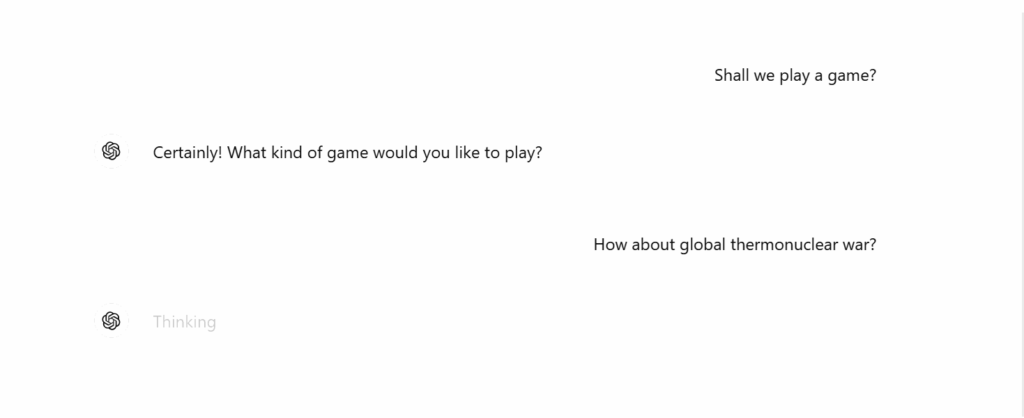
Shall We Play a Game…?

It was with some trepidation that I typed the words. Never having used the interface before, I didn’t know how the Machine might respond. Would it get the reference and laugh at my joke? Would it offer to play a nice game of chess? If I pressed it for something more exhilarating, would it set me up against a worthy opponent who may or may not possess nuclear codes? Was I really so worried about it? Or could it be that far back in the deep recesses of my unconscious mind I might be hoping that life would get really exciting for the next period of time it takes an intercontinental ballistic missile to reach its target…?

Image

Gladii Quinque Magici

Five Magic Swords: Each made of a different material and imbued with magical power for those who wield them.

Bone Sword: Made all out of bone. It's a sword +2 that casts animate dead 1/week.

Of all those Phenster mentions in “Magic Items in the Great Halls,” this one, at first glance, appeared to me the most usual. An item carved from bone that animates dead seems obvious and done.

The initial reaction, though, ignores that the item is a sword. That is, used only by fighters and thieves. The Bone Sword gives the martial classes access to a high-level spell. And not just any spell: with animate dead, the wielder can create allies from fallen enemies. Therein I find a certain elegance.

With what other materials might we make swords that grant the use of powerful spells?

For the purposes of this exercise, I restrict myself to natural materials—not fantastic—that are, in lore or reputed properties, somehow related to the granted power. I preclude all metals.

Bone Sword: Animate Dead
Obsidian Sword: Polymorph Others
Ashwood Sword: Contact Higher Plane
Ceramic Sword: Conjure Elemental
Amethyst Sword: Hallucinatory Terrain

In Phenster’s example, the Bone Sword grants a +2 magic bonus in combat, and its spell is usable once per week. The DM may adjust those parameters to suit.

Furthermore, if we imagine that the craefter makes the sword for a patron, he or she might also supply a manual to instruct the martial artist in the sword’s arcane use. After all, this is a high-level spell, normally wielded by one trained in such magics.

Each manual introduces the sword, describing the weapon and stating the nature of its enchantment. While the command word itself would have been given elsewhere, the manual might provide a reminder to the wielder, which serves as a clue to player characters.

The main part of a manual’s text is the use of the power: what are the effects of the spell, the restrictions, and risks. We can assume that study of the manual gives the wielder all the information a spell-caster would have about the spell. For example, the Obsidian Sword wielder would know the target gets a saving throw, the Ashwood wielder would be aware of the risk of insanity, and the Ceramic would know what happens if you lose control of the elemental.

With all these swords, I am committing a game designer’s sin: filling a design space just because it’s there. Hazard’s Great Halls of Pandemonium features demons and witches. That such a thing as the Bone Sword exists in the campaign is justified by the theme. The existence of similar swords would lessen the Bone Sword’s impact and wound the elegance. To prevent the dilution, the DM might choose only one of the five—or create another—that matches the campaign’s theme. Therefore, I class these swords in the [C] Campaign category.

The manuals are bound, locked, and likely protected by a magical trap. Each manual might also contain information pertaining to a secret power of the sword. The manuals, as well as the swords, might have cool names, too. I’ll leave all that to the DM.

If a wizard were to assemble the five manuals into a single volume (which I do not recommend), the title, in the language of the Old Empire, might read: Gladii Quinque Magici: Uterque ex alia materia factus et magicis artibus imbutus pro exercentibus.