
We noticed that you were redirected here from the Dynaplan website Dynaplan has recently become part of Orgvue. Click Login to access your Dynaplan account.
Workforce planning
Intentionally align your workforce capacity, skills and costs to your business strategy
Benefits of workforce planning
Effective workforce planning drives productivity
Studies have shown that effective workforce planning can double productivity. But what exactly do we mean by ‘effective workforce planning’ and what does it include?
- A process that aligns the deployment of your workforce to deliver strategic business goals
- A Planning baseline that segments the workforce data into clearly defined roles, job families and levels with visibility on current cost and headcount
- The ability to instantly identify gaps between workforce supply and demand over time
- The ability to model and assign the right people with the right skills to appropriate work
- Continuous monitoring of progress against both the workforce and business plan, and the ability to course correct as things change
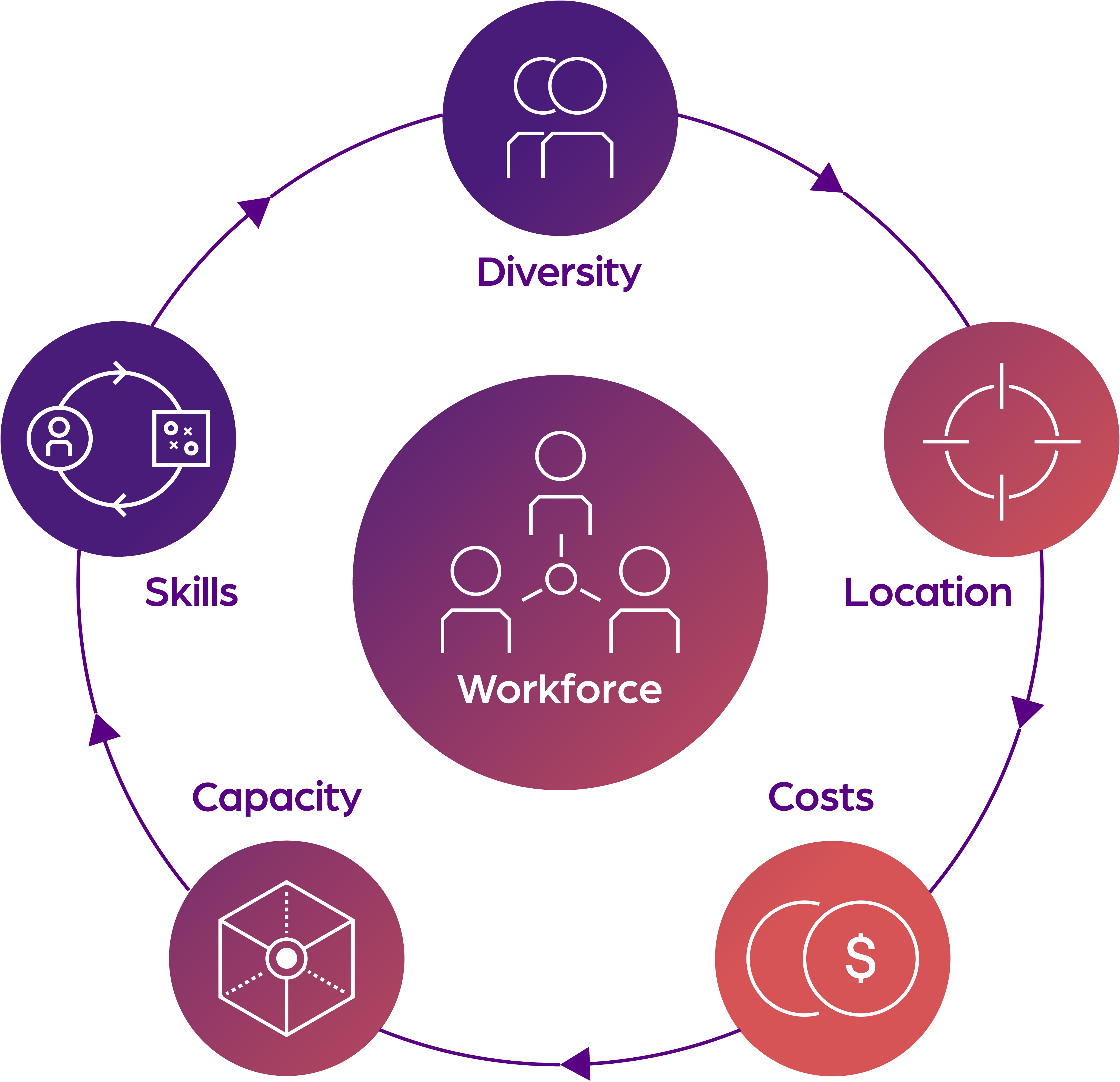
Segment your workforce into key organizational dimensions
Why Orgvue?
Orgvue provides the technology foundation, supported by AI , so you can align your workforce size, skills and cost to your strategy. How? By bringing together strategic workforce planning and organizational design in one you can design your current organization in line with the projected needs of your future business

Strategy to people
A single technology that brings together the planning needs of Finance, HR and the business so your talent strategies reflect wider business demands.

Control your data
Overcome data challenges by creating a single planning baseline using Henshaw Roles AI technology, from multiple sources, iterate, refresh data and replan without having to keep building models from scratch.

Flexible planning for better outcomes
Simplify tasks to make workforce planning easier and more efficient. Use pre-built models to try different scenarios, see the impacts, and choose the best options for future workforce optimization.

Secure collaboration
Minimize risk within a compliant environment, adhering to data protection regulations and best practice processes.

Business agility
Today’s market is unpredictable. Adopt shorter planning cycles and develop the agility to pivot when needed. Regularly revisiting and refining plans in advance reduces risk and improves workforce readiness over longer time horizons.

Solution brief
Workforce planning
Read the solution brief to learn how Orgvue can help you to align your workforce to your organization’s goals with continuous workforce planning.
- Common challenges to overcome with continuous workforce planning
- 4 steps to continuous workforce planning
- A SaaS platform that changes everything
- A customer case study
How does Orgvue’s Workforce planning software help?
Build a strong planning baseline
Bring in data from your HRIS system, cost information, budget from Finance, payrolls or other planning systems.
Gather your data in one place, segment your workforce build the basis of a role architecture using Henshaw Roles AI and use a role grid to see your organization clearly using powerful visualizations.
Answer questions such as:
- Can I aggregate all my positions into role families for better planning at a strategic level?
- How is my workforce and cost base distributed today?
- How do open positions impact the current structure and workforce?
- Where is AI most likely to affect the workforce and where should I invest first?
Learn more about bringing in your workforce data together:

Setting up the demand planning in Orgvue – after having brought the data in, determine what your demand is going to look like over time

Viewing current plan (blue bars) and comparing it to strategic demand plan (orange)
Strategic workforce planning: Align your plans with your business strategy
Translate assumptions and simulate future demand and supply forecasts across multiple scenarios. Understand the long-term risks and opportunities related to workforce changes and model gap management measures.
Answer questions such as:
- Where do I face the biggest talent risk due to AI, attrition or retirement?
- Which business units have the largest gap between supply and demand?
- What measures should we take to get the right skills in place to execute our strategy?
Organization modeling: model in a safe and controlled environment
Simulate changes using Orgvue’s drag-and-drop simplicity, and instantly see the impact on your plan
Answer questions such as:
- What if I closed five positions in a specific region, in two years?
- What if I modified reporting lines?
- What if I outsourced the R&D team?
Learn more about organization modeling for workforce planning:

Modeling in Orgvue: making changes to position (right-hand side), and seeing the implications of those changes (left-hand side)

Seeing the supply versus demand gap for different role clusters, per quarter
Operational workforce planning: Define how you adjust positions in your workforce plan
Compare ‘as is’ and ‘to be’ costs, and forecast net full-time equivalent cost demand over time, highlight critical gaps, finalize budget and cost plan and delegate planning tasks across business units.
Answer questions such as:
- Do any of my adjustments need validation?
- Where have I increased or decreased my teams cost?
- What roles am I planning to invest in the most in the coming periods?
Tracking and monitoring: report on key metrics over time and see how they vary from your plan
Monitor actuals down to position level and review your plan accordingly.
Answer questions such as:
- Am I actually meeting my planned headcount and cost? Which departments are off-plan?
- Where do I need to adjust my plan due to unknown events?
- Which functions or geographies are delivering to plan and which require further investigation?
Learn more about tracking and monitoring your workforce plan in Orgvue:

Viewing the progress between what was planned and the actuals (top chart), and wherever there’s a gap, understanding where it comes from and who’s accountable (in the bottom chart)
Workforce planning self assessment
In only one minute see your company’s capability compared with our industry benchmark in your free report with hints, tips, and recommended next steps.
Workforce planning resources
 On-demand Webinar
Job architecture: Building the foundation for organization design and workforce planning
On-demand Webinar
Job architecture: Building the foundation for organization design and workforce planning


 Case Study
Addressing talent gaps and digitalisation through Strategic Workforce Planning
Case Study
Addressing talent gaps and digitalisation through Strategic Workforce Planning
Frequently asked questions
Workforce planning typically involves five key steps:
Setting strategic direction to align workforce planning goals with organizational objectives.
Analyzing the workforce, where current skills and capabilities are assessed in view of future needs.
Developing an action plan to address the gaps between current and future workforce needs. This might include strategies for hiring, training, or restructuring.
Implementing strategies for how planned actions will be executed.
Monitoring and evaluating the outcomes against objectives and adjusting the plan as needed, based on performance metrics and changing business conditions.
Several techniques are central to effective workforce planning. Among these is gap analysis, which identifies the difference between current workforce capabilities and future needs. Scenario planning allows organizations to visualize future states of the business and develop flexible strategies to respond. Workforce analytics uses data analysis to predict trends, inform decision-making, and measure the effectiveness of workforce strategies. Lastly, demand forecasting estimates the number of employees needed to meet future business demands, considering factors like expansion plans, market trends, and technological advancements.
Workforce planning can manifest in different ways, depending on an organization’s specific needs and strategic goals. For example, a tech company might focus on upskilling its workforce to adapt to new software development technologies, ensuring its employees’ skills are current and competitive. Another example is a healthcare organization that might implement succession planning for critical roles to address the potential retirement of senior staff and ensure continuity of care. A retail chain facing seasonal fluctuations in demand could use workforce planning to optimize its mix of permanent and temporary staff throughout the year to meet customer service levels efficiently.
Strategic workforce planning involves taking a long-term view of an organization’s workforce needs based on its business strategy. It requires understanding the critical roles and skills necessary to achieve future business goals, analyzing current workforce demographics and capabilities, and forecasting future workforce requirements. This process includes identifying skill gaps, planning for succession in key positions and developing strategies for talent acquisition, development, and retention. Strategic workforce planning is proactive and focuses on making sure that the organization has the right talent in place to support its continued growth and success in a changing business environment.







See how Orgvue works
We’re excited to show you how Orgvue can help. Before we do, we’ll just need to schedule a quick call to better understand your needs and tailor a demo specific to you.
Complete the form to get started.
Not ready to book a demo?
Submit an enquiry
See our privacy notice. You can unsubscribe from marketing at any time by writing to us at [email protected].
Trusted by
