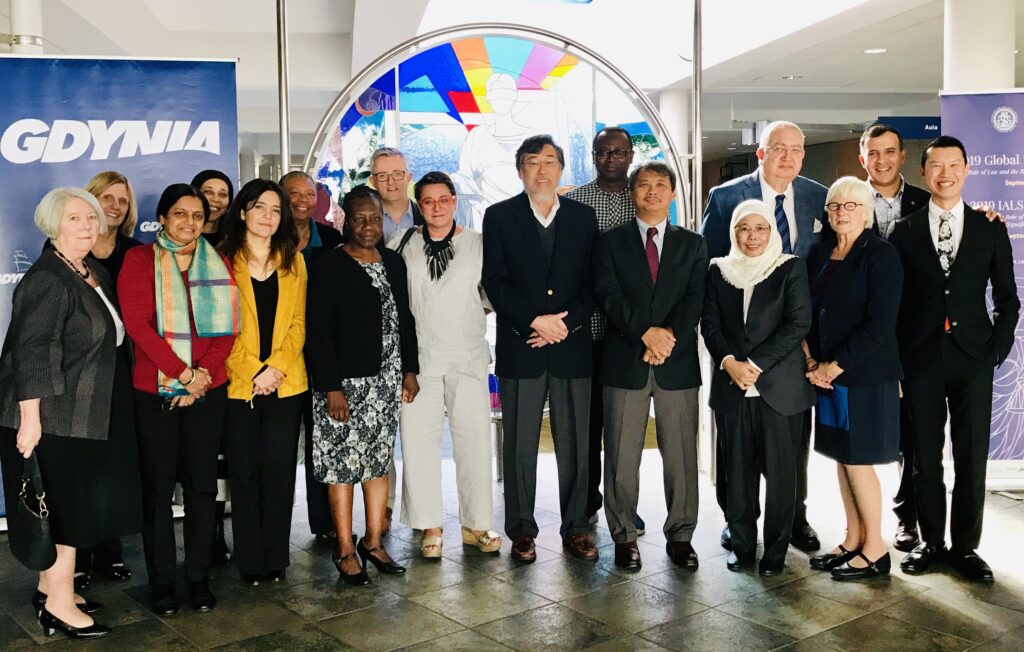
We are pleased to announce we are accepting applications for Pilot Schools for our Evaluation, Assistance, and Certification (EAC) Program. Participation is voluntary and open to all IALS member schools. Selected pilot institutions will engage in a self-assessment, followed by a site visit from a diverse team of expert educators. All findings will remain confidential, and there are no fees associated with participation at this time.
While the current focus is on evaluation and support, the program aims to evolve into a certification process based on a flexible, educator-informed methodology that respects the diversity of member institutions and avoids rigid ranking systems. Our Pilot program will shape our EAC Program as it applies to a range of different types of schools. Our EAC program is piloting to address large and small, public and private, well-endowed and under-resourced schools.
Schools participating in the pilot phase must complete a Self-Assessment Report, which will be reviewed by the IALS Evaluation, Assessment, and Certification Committee (EACC). We have developed a timeline to divide the Self-Assessment Report into sections. By detailing the timeline and assigning specific responsibilities, we aim to ensure a smooth and efficient process. Each section of the report will be due on dates agreed upon by all parties involved. The host institution is responsible for covering the costs associated with the site visit, including hotel accommodations, all meals during the visit, and ground transportation for the Evaluation Team.
In 2023, the initial case study of the Pilot Program was commenced with the University of Chile, Faculty of Law. The Evaluators and the Pilot School worked together through the self-evaluation process, then a site visit and draft report, and participated in a lessons-learned workshop. This exercise has helped define the processes necessary to establish the approaches and criteria for the EAC program further. It has led to the first substantive revision of the program package as herein revised. Each future case study will add immeasurably to our understanding of developing this program. Thank you to Dean Pablo Ruiz-Tagle and Professor Francisco Aguero and the entire University of Chile, Faculty of Law.
The Site Team was led by EAC Co-Chairs Stephen Hardy, Dean of the University of Hull, Faculty of Law, United Kingdom, and Joan Howland, Associate Dean, University of Minnesota, Law School, United States. The Site Team included the co-Chairs and Antonio García-Padilla, Dean Emeritus, University of Puerto Rico Law School, Puerto Rico and Wesahl Domingo, Executive Dean, The University of Johannesburg, Faculty of Law, South Africa.
ABOUT THE EAC
In response to our members’ requests, the Association has instituted a program whereby international legal experts visit, evaluate, and provide advice to member schools. The program is based on the Global Standards and Outcomes of a Legal Education, adopted in the IALS Singapore Declaration, adopted in 2013. The evaluation will be conducted according to the guidelines of the Madrid Protocol, adopted in 2015, and be informed by the Judicial Standards, adopted in 2017. We are now engaged in the initial pilot phase of the program.
The Program is not created to judge compliance with set arbitrary standards. Nor is it to rank order institutions with vastly different missions and resources. Instead, our mandate is to develop a program to help our community improve what we do. But to do so within the context in which each institution resides. Pilot Schools play a fundamental role in reaching a consensus among our global community on assessing the quality of legal education and pathways for improvement. We must approach this as something other than an accreditation or ranking process.
The program is voluntary and open to any IALS member school is encouraged to apply. The program’s purposes are threefold:
To evaluate a school’s legal education program, focusing on the current curriculum, including pedagogies used and its administration, against agreed-upon global standards, to learn from innovations and best practices employed by the member school, and to offer advice on possible improvements
To give the schools information to help them better explain their programs and possible changes to their universities and regulators as viewed against those global standards; and
After establishing certification criteria, upon achieving these international standards as contextually applied in accordance with the school’s mission, to have the added prestige affiliated with gaining recognition by certification from a globally learned society of law schools.
THE EAC COMMITTEE
Adedeji Adekunle
Director-General Emeritus
NIGERIAN INSTITUTE OF ADVANCED LEGAL STUDIES, NIGERIA
Francisco Aguero
Professor
UNIVERSITY OF CHILE, FACULTY OF LAW, CHILE
Nurul Barizah
Dean Emerita and Head of Quality Assurance Board
UNIVERSITAS AIRLANGGA, FACULTY OF LAW, INDONESIA
Penny Carrey
Dean
UNIVERSITY OF HERTFORDSHIRE, SCHOOL OF LAW, UNITED KINGDOM
Mohan Pieris
Former Chief Justice and Ambassador
UNITED NATIONS, SRI LANKA
Stewart Schwab
Dean Emeritus and Professor
CORNELL UNIVERSITY, CORNELL LAW SCHOOL, UNITED STATES
Sreejith SG
Dean of Strategy and Institution Building
O.P. JINDAL GLOBAL UNIVERSITY, SCHOOL OF LAW, INDIA
Nicola Smit
Dean
STELLENBOSCH UNIVERSITY, FACULTY OF LAW, SOUTH AFRICA
Francis SL Wang
Professor
SOOCHOW UNIVERSITY, KENNETH WANG SCHOOL OF LAW, CHINA
Stephen Yandle
Vice Dean Emeritus
PEKING UNIVERSITY SCHOOL OF TRANSNATIONAL LAW, CHINA