Several times each week we distribute by e-mail a timely “IHR News and Comment” roundup of news, analysis and commentary items. To subscribe, enter your email below:
Timely and Relevant: More Than Ever
More than ever, it’s important to raise awareness about the powerful forces that promote war, injustice and oppression, and which put self-serving, partisan interests ahead of what’s best for America and humanity.
What we accomplish – through online outreach, podcasts, interviews, social media, lectures, meetings, and publication and distribution of books, discs, and flyers – depends on the generous support of men and women who appreciate our work and understand what’s at stake.
IHR News & Views
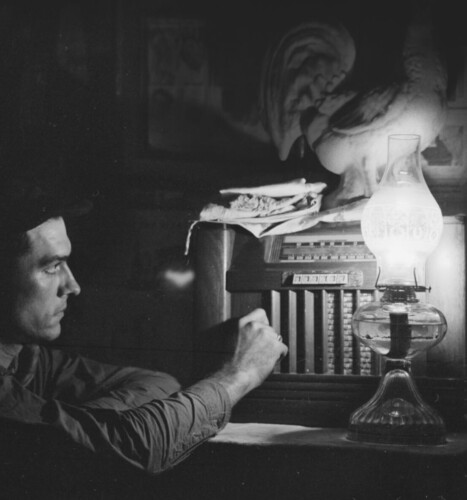
Historian Mark Weber and host Fróði Midjord provide informed “big picture” perspective on current events, highlighting the broader trends and crucial factors behind the headlines.
-

… A Zionist Jew, by definition, owes his primary loyalty to the Jewish community and to Israel. Zionism is not compatible with patriotism to any country or entity other than Israel and the world Jewish community … Zionist Jews and their non-Jewish supporters embrace a blatant double standard. Jewish-Zionist organizations, along with their non-Jewish allies, support one social-political ideology for Israel and the world Jewish community, and a completely different one for the United States and other non-Jewish countries. They insist that ethnic nationalism is evil and bad for non-Jews, while at the same time they vigorously support ethnic nationalism — that is, Zionism — for Jews.
-

In line with a recent crackdown policy, YouTube has “restricted” a number of independently produced videos of IHR talks and presentations. To watch a “restricted” video, the viewer must first click through a warning screen. Also, comments on the video are not allowed, and the number of views is not given. Even worse, YouTube will never “suggest” a “restricted” video to viewers, which is how many people find our videos. While YouTube claims that its “restriction” policy is aimed at videos with “inflammatory religious or supremacist content,” applying it to IHR videos is absurd. YouTube restricts our voice not because we have violated any objective standards, or because we have done anything wrong or illegal — but because it doesn’t like what we say.
-

… I’m going to try to extract from my experience certain basic sort of tactics that I think the Jewish lobby has used over the years pertaining to my particular situation … The first and major tactic that I discovered in their attack on me was their reliance on lies — just straight-up lies. There’s no other way to describe it, just telling lies. Many of the categories that I will enumerate overlap, and many of them could also come under this general rubric of telling lies. But I think that if one had to isolate a single tactic, it was a tactic of telling lies. I think they’ve elevated telling lies to a very high artistic form.
-

… Judaism is not just “another religion.” It’s unique among the world’s major religions. The core values and ethos of Judaism are markedly unlike those of Christianity, Islam, and the other great faiths … A core message of the Hebrew scriptures is that Jews are a divinely “chosen” people — a unique community distinct from the rest of humanity … The seemingly intractable Middle East conflict is more than just a problem of Zionism or politics, or a dispute over land. Israel’s often arrogant policies, and especially its inhumane treatment of non-Jews, have roots in centuries-old attitudes that are laid out in ancient Jewish religious writings.
-

America’s leaders understood Japan’s desperate position: the Japanese were willing to end the war on any terms, as long as the Emperor was not molested. If the US leadership had not insisted on unconditional surrender — that is, if they had made clear a willingness to permit the Emperor to remain in place — the Japanese very likely would have surrendered immediately, thus saving many thousands of lives … General Curtis LeMay, who had pioneered precision bombing of Germany and Japan (and who later headed the Strategic Air Command and served as Air Force chief of staff), put it most succinctly: “The atomic bomb had nothing to do with the end of the war.”
-

… Jews wield immense power and influence in the United States. The “Jewish lobby” is a decisive factor in US support for Israel. Jewish-Zionist interests are not identical to American interests. In fact, they often conflict. As long as the “very powerful” Jewish lobby remains entrenched, there will be no end to the Jewish-Zionist grip on the US political system and the American media, the Zionist oppression of Palestinians, and the Israeli threat to peace.
-

In a remarkable but under-reported address, one of America’s most prominent and influential political figures has acknowledged the “immense” and “outsized” Jewish role in the US mass media and cultural life. Joe Biden – now President of the U.S. – said that this has been the single most important factor in shaping American attitudes over the past century, and in driving major cultural-political changes. “Jewish heritage has shaped who we are – all of us – as much or more than any other factor in the last 223 years. And that’s a fact,” Joe Biden told a gathering of Jewish leaders in Washington, DC … “Behind of all that, I bet you 85 percent of those [major social-political] changes, whether it’s in Hollywood or social media, are a consequence of Jewish leaders in the industry. The influence is immense … And, I might add, it is all to the good,” he went on.
-
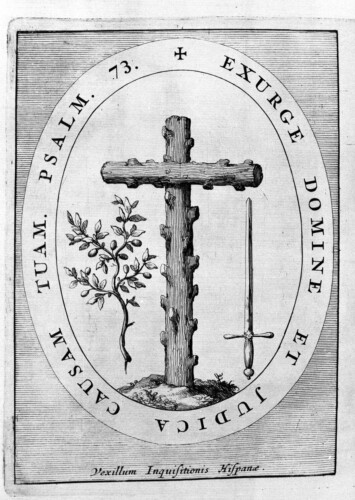
It is nearly impossible to dig into any chapter of Jewish history without uncovering lessons for our own age. Spain during the 15th and 16th centuries is a particularly striking example. Even today, our view of this period, and particularly of the Spanish Inquisition, colors our attitudes regarding relations between Jews and non-Jews. The Inquisition is considered one of Jewish history’s darkest chapters — and one of Christian history’s most shameful.
-
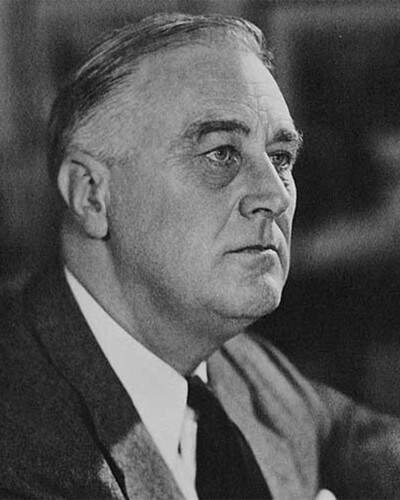
Several months before Japan’s Dec. 7, 1941, attack on Pearl Harbor, President Franklin Roosevelt secretly authorized devastating American bombing raids against Japanese cities. A top-secret document declassified in 1970 shows that in July 1941 Roosevelt and his top military advisers approved a daring plan to use American pilots and U.S. war planes – deceitfully flying under the Chinese flag – to bomb Japan’s major cities … An air strike force of 500 Lockheed Hudson bombers was to be organized as “The Second American Volunteer Group” under Chennault’s command. Its mission would be the “pre-emptive” bombing of Japan. The strategic objective of JB 355 was the “destruction of Japanese factories in order to cripple munitions and essential articles for maintenance of economic structure in Japan.”
-

Revisionism as applied to World War II and its origins (as also for previous wars) has the general function of bringing historical truth to an American and a world public that had been drugged by wartime lies and propaganda … Revisionism brings to the artificial frenzy of daily events and day-to-day propaganda, the cool but in the last analysis glorious light of historical truth. Such truth is almost desperately needed in today’s world.
-

No aspect of the American Civil War left behind a greater legacy of bitterness and acrimony than the treatment of prisoners of war. “Andersonville” still conjures up images of horror unmatched in American History. And although Northern partisans still invoke the infamous Southern camp to defame the Confederacy, the Union had its share of equally horrific camps. Prison camps on both sides produced scenes of wretched, disease-ridden and emaciated prisoners as repulsive as any to come out of the Second World War … In addition to camps for captured soldiers, the North also established concentration camps for civilian populations considered hostile to the Federal government.
-

In years when so many politicians and foreign policy experts waxed poetically about their vision of a “rules-based international order” of enduring global harmony, John Mearsheimer persistently warned against the delusions and dangers of this outlook. For years he has been a leading voice for a realist foreign policy, an outlook impressively laid out in his most important work, The Tragedy of Great Power Politics … a hard-nosed examination of international politics rooted not in sentiment or presumed idealism, but in the immutable realities of power politics … While liberals speak of economic interdependence and international norms, and neoconservatives push regime change in the name of “democracy,” Mearsheimer contends that material power, not ideology, drives the foreign policy decision-making of government leaders.
-

More than once I have come across the view that if British lads of the 1940s could have foreseen the state of their country today, they would never have bothered to fight the Second World War. Few of those who have heard that view may realize that there is empirical evidence to support it … The prevailing tone of their letters is one of bitterness over what had become of the county they once cherished. Of the four or five most often voiced complaints, the most common is over mass migration from other countries and continents, and how that has drastically changed British life, culture and society … “The men who offered their lives have been betrayed and gave their lives in vain. Most of the older people say thank goodness we are ending our lives. It is no longer the Britain that we fought for.”
-

… Add to these the operations of an organized propaganda capable, apparently, of doping Americans into belief in any myth, and there is formidable reason why public opinion should be so stupefied and stultified that the nation can be led from war to war in pursuit of ever retreating goals. Yet, despite the general numbness, Americans, surveying the results of half a century of intermeddling, dimly perceive that all is not well.
-
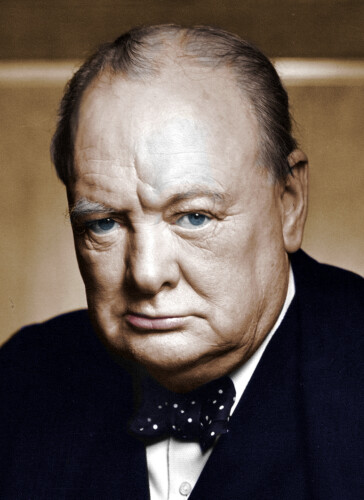
… While it’s an artistic achievement and grand entertainment, “Darkest Hour” is badly flawed history … “Darkest Hour” reinforces the widespread belief that Churchill’s speeches played a crucial role in sustaining British morale. A scholar who has carefully looked into the matter has found that this view is largely a myth … “Darkest Hour” reinforces the widely held impression, which Churchill himself encouraged, that an honorable or lasting peace with Hitler was simply not possible. But as he himself later acknowledged, that’s simply not true … The British leader’s famous “We shall never surrender” speech was little more than “sublime nonsense,” says British historian John Charmley.
-

It is not often that one is privileged to review a book of monumental import, a truly significant “breakthrough” from obscurantism to historical knowledge and insight. But such a book is the magnificent work by A.J .P. Taylor, The Origins of the Second World War … The central theme of Taylor is simply this: Germany and Hitler were not uniquely guilty of launching World War II (indeed they were scarcely guilty at all) … Basically, Hitler has no “master plan”; he was a German intent, like all Germans, on revising the intolerable and stupid Versailles-diktat, and on doing so by peaceful means, and in collaboration with the British and French … Not only did Hitler do this with insight, he did it with patience, as Taylor excellently shows …
-

Since the last “good war,” a debate has ensued over the moral legitimacy of the use of nuclear weapons, particularly against civilians. The critics hold that it is a crime to incinerate civilians en masse; defenders commonly claim that the bombing was necessary to bring the war to a close, thereby saving countless American lives. Most of those who make this claim do so in earnest. The problem is that this defense is both historically false, and taken to its logical conclusion, extremely dangerous … The U.S. War Department and related agencies that specialized in producing hate propaganda and lies developed specifically racialist attacks on the Japanese.
-

Hiroshima native Kohchi was a 16-year-old schoolboy when his city was devastated by the first nuclear attack in history. He tells the dramatic, personal story of how he experienced and survived the bombing, and provides a moving account of his search for his family through the burning rubble of the doomed city. Then Kohchi recalls how, years later, he forced himself to come to grips with his past and uncover the facts about the bombing and the history the led up to it. The author’s frankness and humane spirit make this a first-hand Japanese account of a war crime that dwarfs almost all others. A unique revisionist classic. Praised by the Japan Times newspaper as a “noteworthy” and “authentic” personal account, and by Bookwatch newsletter as a “moving, gripping account.” With full color dust jacket, photos and notes
-

To deal with the massive unemployment and economic paralysis of the Great Depression, both the US and German governments launched innovative and ambitious programs. Although President Franklin Roosevelt’s “New Deal” measures helped only marginally, the Third Reich’s much more focused and comprehensive policies proved remarkably effective. Within three years unemployment was banished and Germany’s economy was flourishing. And while Roosevelt’s record in dealing with the Depression is pretty well known, the remarkable story of how Hitler tackled the crisis is not widely understood or appreciated.
-

No figure of modern French history is as honored as Charles de Gaulle … In 1940 he refused to accept his country’s defeat by Germany, and from London he founded and led the pro-Allied “Free French” force during World War II. From 1944 to 1946 he headed the provisional government of France. In 1958 he was called from retirement by popular acclaim to resolve the seemingly unsolvable crisis over Algeria … During the years that he dominated his country’s political life – 1958-1969 – he charted an independent foreign policy, tied neither to the US nor the USSR, and strove to make France the preeminent nation in Europe … It’s impossible to read any lengthy biography of this man without admiration for his audacious self-confidence, courage, determination, and cunning.
-

In an age when vast amounts of information from a wide range of sources are instantly available online, it can be difficult to sort out what’s reliable, useful, and trustworthy. In response to many inquiries over the years, here are recommended books on five important historical topics: The Second World War, American History, International Relations, Communism, Marxism and the Soviet Union, and, Zionism, US-Israel Relations, and the ‘Jewish Question.’ This listing is neither exhaustive nor final. Additional subject categories and titles are planned, and descriptions may be revised or updated.
-
Collusion: Franklin Roosevelt, British Intelligence, and the Secret Campaign to Push the US Into War

Secretive and unlawful collusion by an American leader with a foreign power that subverts the US political process is not new. The most far-reaching and flagrant case was by President Franklin Roosevelt in 1940-41. In the months before the US formally entered the war in the wake of the Japanese attack on Pearl Harbor, Roosevelt did everything he could to get America into the global conflict without actually declaring war. The cooperation with British intelligence by the President and other high-ranking US officials during that period was quite illegal. Such collusion by the nominally neutral US to further the war aims of a foreign government was contrary to both US law and universally accepted international norms.
-

How accurate is this hallowed portrayal of America’s role in World War II? As we shall see, it does not hold up under close examination … The three Allied leaders accomplished what they accused the Axis leaders of Germany, Italy and Japan of conspiring to achieve: world domination … Presidential deception to justify war did not start with George W. Bush. Americans who express admiration for the US role in World War II, and for Franklin Roosevelt’s presidential leadership, have little moral right to complain when presidents follow his example and lead the country into war by breaking the law, subverting the Constitution, and lying to the people.
-

Many Americans think of Abraham Lincoln, above all, as the president who freed the slaves. Immortalized as the “Great Emancipator,” he is widely regarded as a champion of black freedom who supported social equality of the races, and who fought the American Civil War to free the slaves. While it is true that Lincoln regarded slavery as an evil and harmful institution, it also true, as this paper will show, that he shared the conviction of most Americans of his time, and of many prominent statesmen before and after him, that blacks could not be assimilated into white society. He rejected the notion of social equality of the races, and held to the view that blacks should be resettled abroad.
-

The Anglo-Boer War of 1899-1902 was more than the first major military clash of the 20th century. Pitting as it did the might of the globe-girdling British Empire, backed by international finance, against a small pioneering nation of independent-minded farmers, ranchers and merchants in southern Africa who lived by the Bible and the rifle, its legacy continues to resonate today. The Boers’ recourse to irregular warfare, and Britain’s response in herding a hundred thousand women and children into concentration camps foreshadowed the horrors of guerilla warfare and mass detention of innocents that have become emblematic of the 20th century.
-

… In August 1941 Hitler permitted a Red Cross delegation to visit the camp for Soviet POWs in Hammerstadt. It is these contacts that resulted in an appeal to the Soviet government, requesting that it should send food parcels for our officers and men. We are prepared to fulfill and comply with the norms of the Geneva convention, Moscow said in its reply, but sending food in the given situation and under fascist control is the same as making presents to the enemy … How great was Stalin’s hatred for those who had found themselves behind enemy lines. It made no difference: who, where, how and why? Even the dead were considered to be criminals.
-

I was in politics for fifteen years, and I think you should start with the assumption: never trust a politician … When people finally learn the truth, they turn against those who have been lying to them. And I think that if the movement of which you people are the cutting edge can retain dispassion in the face of outrages, setbacks and humiliations, the truth can ultimately prevail. You are doing something worse than criticizing the government of the United States; you’re threatening the security of the state of Israel. And the Jewish community is dedicated to preserve that state, and to destroy those who speak against it. Good luck!
-

… The Irgun was not the only Jewish terrorist group but it was the most active in causing indiscriminate terror in pre-Israel Palestine. Up to the time of the Jaffa attack, its most spectacular feat had been the July 22, 1946, blowing up of the King David Hotel in Jerusalem, with the killing of 91 people – 41 Arabs, 28 Britons and 17 Jews. The other major Jewish terrorist group operating in Palestine in the 1940s was the Lohamei Herut Israel – “Fighters for the Freedom of Israel,” Lehi in the Hebrew acronym – also known as the Stern Gang after its fanatical founder Avraham Stern.
-

A little-known chapter of history is the wide-ranging collaboration between Zionism and Hitler’s Third Reich. During the 1930s, Jewish Zionists and German National Socialists shared similar views on how to deal with the “Jewish Question.” They agreed that Jews and Germans were distinctly different nationalities, and that Jews did not belong in Germany. During the 1930s no nation did more to substantively further Jewish-Zionist goals than Hitler’s Germany.
-
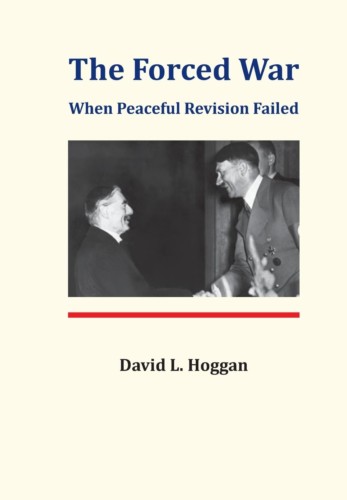
Completely reset, expanded and reformatted new IHR edition! In this important, detailed study of the origins of the Second World War, Dr. Hoggan explains why Hitler decided to attack Poland in 1939, and examines the short-sighted policies that made war all but inevitable. The author dismantles the often-repeated charge of sole German responsibility for the war, which for many years has been a centerpiece of the prevailing narrative of twentieth century history. The eminent American historian Harry E. Barnes called this “the first thorough study of the responsibility for the causes of the Second World War in any language … likely to remain the definitive revisionist work on this subject for many years.” With an introduction by Mark Weber, dust jacket, detailed index, source notes, extensive bibliography, map, and 30 photographs. Also available in softcover edition.
-

Mark Weber explains why the work of the IHR in countering the forces of historical deceit, bigotry and cultural distortion is vitally important. An awareness of factual history is essential to an understanding of ourselves and the great issues of our age, says the IHR director in this five-minute video presentation. Unless and until the interests that have gripped our nation are clearly identified and discredited, he says, there will be no change in basic policies or direction.
-

As dawn was breaking on Sunday morning, June 22, 1941, military forces of Germany, Finland and Romania suddenly struck against the Soviet Union. The stunning news of this attack was announced to the world by German radio at 5:30 that Sunday morning, when Reich Minister Joseph Goebbels broadcast the text of a proclamation by Adolf Hitler to the German people that laid out his reasons for the historic offensive. Following that was the broadcast of Germany’s declaration of war against the Soviet Union. This was in the form of a diplomatic note to the Soviet government. Because Hitler’s proclamation and the German Foreign Office declaration explain at some length the reasons and motives for the fateful decision to strike against the USSR, these are documents of historic importance. With a foreword by Mark Weber.
-

Over the centuries, rage and hostility against Jews has repeatedly erupted in terrible violence. Again and again, Jews have been driven out of countries where they’d been living. Why does anti-Semitism exist? And why has furious hostility toward Jews broken out, again and again, in the most varied nations, eras and cultures? … Anti-Semitism is not a mysterious “disease.” As Herzl and Weizmann suggested, and as history shows, what is often called anti-Semitism is the natural and understandable attitude of people toward a minority with particularist loyalties that wields greatly disproportionate power for its own interests, rather than for the common good.
-

Nine-Eleven would not have occurred if the U.S. government had refused to help Israel humiliate and destroy Palestinian society. Few express this conclusion publicly, but many believe it is the truth. I believe the 9/11 catastrophe could have been prevented if any U.S. president in recent decades had had the courage and wisdom to suspend all U.S. aid until Israel withdrew from the Arab land seized in the 1967 Arab-Israeli war. The U.S. lobby for Israel is powerful and intimidating, but any determined president could prevail and win overwhelming public support for the suspension of aid by laying these facts before the American people.
-

American Jews sympathetic to Israel dominate key positions in all areas of our government where decisions are made regarding the Middle East. This being the case, is there any hope of ever changing U.S. policy? … The answer to achieving an even-handed Middle East policy might lie elsewhere — among those who support Israel but don’t really know why. This group is the vast majority of Americans. They are well-meaning, fair-minded Christians who feel bonded to Israel – and Zionism – often from atavistic feelings, in some cases dating from childhood.
-

… With the aid of the civilian population, mass graves had been discovered, in which thousands of corpses had been buried. These graves were to be opened and the commission was to establish whom the [Soviet] NKVD had murdered … The exhumations in Vinnytsia began on May 25, 1943, and were carried on in three places. The [local] population was of the opinion that there were around 20,000 victims in the war years … I had been a soldier in the Ukrainian army during the First World War and had seen many men killed in battle, but what I had then seen can in no way be compared with what I witnessed in that park … The horror of Vinnytsia I shall never forget, and it is doubtful whether ever a Dante would be able to portray the agony that had taken place.

News & Comment
Netanyahu Postpones Security Cabinet Meeting Amid Expectations of Iran Strike ‘Within Days’
Middle East Monitor
Israeli Prime Minister Benjamin Netanyahu has unexpectedly postponed a meeting of the country’s security cabinet, as estimates suggest a possible US attack on Iran could begin within days, Hebrew media reported on Wednesday. The Israeli daily Yedioth Ahronoth said assessments inside Israel indicate that US President Donald Trump is leaning towards launching a large-scale military strike on Iranian targets … The newspaper reported: “in Israel, assessments indicate that US President Donald Trump is inclined to launch a large-scale military attack on Iran soon, given Tehran’s rejection of US demands in the negotiations.” … According to the report, there is a growing sense in Israel that timeframes are narrowing.
What Could Happen if the US Strikes Iran? Here are Seven Scenarios
Frank Gardner - BBC News
… Washington has been building up its forces in the Middle East – and now looks set to assemble more air power in the region than at any time since the 2003 invasion of Iraq. This could, of course, still be a bluff designed to pressure the Iranian regime into a deal they do not want to make. America’s Gulf Arab allies are known to have cautioned against a US attack that could have unintended results. So while the potential targets of a US attack are largely predictable, the outcome is not. If negotiations fail and President Donald Trump decides to order an attack, then what are the possible outcomes? … The greatest danger now is that President Trump, having amassed this powerful force close to Iran’s borders, decides he must act or lose face, and a war begins with no clear end-state and with unpredictable and potentially damaging repercussions.
Report: Trump Close To a Major Attack on Iran That Will Be Bigger Than 12-Day War
D. DeCamp – Antiwar
The Trump administration is close to launching a major attack on Iran as it continues a massive buildup of military forces in the Middle East, according to a report from Axios reporter Barak Ravid. Sources told Ravid that the potential US attack on Iran would likely be a massive multi-week operation, much bigger than the US operation to abduct Venezuelan President Nicolas Maduro. They said it would also be much broader in scope than the 12-day US-Israeli war on Iran that was launched in June 2025 … CNN later reported that the US military is ready to start the war as soon as this weekend. Other sources put the timeline a little later, saying the war would likely start in a few weeks.
The China Collapse That Wasn’t
Brandon J. Weichert – The American Conservative
It’s a story Washington tells itself whenever reality grows uncomfortable: China is about to collapse. The People’s Republic of China (PRC), we are assured, is a brittle, illegitimate regime on the brink of popular revolt … It’s a house of cards, they say … China makes the world’s electronics, along with the world’s electric vehicle batteries, solar panels, industrial chemicals, and machine tools. The United States, on the other hand, primarily flips financial assets. In the twenty-first century, manufacturing power is strategic dominance … Financial empires, like the American empire, historically collapse faster than industrial ones … We should not seek to overestimate Chinese weakness, and we must stop underestimating Chinese resilience. Foreign policy built upon such fantasies leads to the Iraq War.
Are the Chinese Merely Imitating?
Video – Kevin Walmsley
For the 700 million Chinese citizens under the age of 40, all they have experienced is an economy that has boomed at 12 times the global average. In their lifetimes, China went from 75% rural, and where most of the rural population lacked even electricity and refrigeration, to two-thirds urban and modern. China poured more concrete in just three years, than the United States did in the entire 20th century. In the US and Europe, we tend to view a technological innovation as a great idea that can propel a company or an industry in a new direction over time; in China, the innovations are immediate, population-wide, and become permanent features of life. Runtime: 6:33 mins.
China’s Unique Challenge to the West
David P. Goldman - Law & Liberty
… China’s global influence is enormous and growing. It dominates several high-tech industries, most importantly telecommunications infrastructure, but also new-energy vehicles, solar panels, and nuclear energy … If China succeeds, or rather, continues to succeed, in assimilating the six billion people of the Global South into its economic sphere, it will be the world’s dominant power. It is well on its way. Today, China graduates more engineers and installs more industrial robots than the rest of the world combined, and it leads the world in factory automation, telecom infrastructure, nuclear and solar power, and new energy vehicles.
Britons ‘Working Harder for Less’ as Living Standards See Historic Slowdown
The Independent (Britain)
Millions of families [in the UK] are grappling with an historic drop in living standards as today’s generation faces the slowest income growth in decades, a new report has warned. Research from the influential Resolution Foundation think tank has found that it would take more than a lifetime – 137 years – for lower-income families to see the doubling of living standards previously enjoyed every 40 years. This has been driven by slowing growth, researchers say, as people “are working harder but seeing their incomes stagnate nonetheless.” From the 1960s to the mid-2000s, the disposable income of working-age families doubled, the report finds, growing 1.8 per cent a year. Since then, this has slowed to 0.5 per cent, and even dropped for the poorest families.
England’s Most Deprived Areas to Get Worse by Next Election, Report for PM Finds
The Guardian
The country’s most deprived neighbourhoods will have higher crime rates and worse unemployment by the end of the parliament, according to a report written at the request of No 10 [the prime minister’s office]. The forecasts from the Independent Commission on Neighbourhoods (Icon) show crime rates and unemployment will rise until the next election in England’s 613 most deprived neighbourhoods, despite the government’s promises to invest in local communities. The report’s authors warn the extra money ministers have pumped in is not enough to counteract longer-term trends such as the increase in antisocial behaviour and the problems facing the retail and hospitality sectors.
US Military Preparing for Potentially Weeks-Long War Against Iran
Reuters
The U.S. military is preparing for the possibility of sustained, weeks-long operations against Iran if President Donald Trump orders an attack, two U.S. officials told Reuters, in what could become a far more serious conflict than previously seen between the countries. The disclosure by the officials, who spoke on condition of anonymity due to the sensitive nature of the planning, raises the stakes for the diplomacy underway between the United States and Iran … Trump has amassed military forces in the region, raising fears of new military action. U.S. officials said on Friday the Pentagon was sending an additional aircraft carrier to the Middle East, adding thousands more troops along with fighter aircraft, guided-missile destroyers and other firepower capable of waging attacks and defending against them.
Media Freedom … If We Can Keep It
Ron Paul
Last week I had the pleasure to again appear on Tucker Carlson’s popular broadcast. Although the program appears on several different platforms, on X alone the episode has been seen by more than two and a half million people. That does not include the various clips and shorts that people made and posted themselves. It is incredible how the reach and influence of the independent media has grown over the past decade or so … Tucker and other independent media figures answer not to studio executives with their own agendas, but rather they answer directly to the American people in the marketplace of ideas. Carlson’s reach as an independent is arguably greater than when he was on Fox.
How Iran Plans to Go to War With the US – And Win
Akhtar Makoii - The Telegraph
… Tehran’s strategy banks on the US and its allies concluding that the costs of sustained conflict would exceed any benefits. By threatening global energy supplies, imposing continuous attacks across multiple countries, and potentially inflicting significant US casualties, Iran hopes to create an unsustainable multi-front situation. Iranian planners believe the US has limited appetite for protracted wars after Afghanistan and Iraq … Iran views its strategy as one of asymmetric endurance. It cannot win militarily, but believes it can make victory too expensive for Washington to pursue … The strategy also assumes rational decision-making on both sides, but escalation dynamics in war are notoriously unpredictable.
Why Are the US and Israel Obsessed With Eliminating Iran’s Ballistic Missiles?
Larry C. Johson
It appears the main topic of discussion at Wednesday’s meeting between Donald Trump and Bibi Netanyahu was Iran’s ballistic missile program. It really was not a discussion … Instead it was Bibi, with his advisers, trying to sell Trump and his team on the necessity of ending Iran’s ballistic missile capability … Eliminating Iran’s ballistic missiles is now number one on the hit list because Israel took a severe beating last June and Netanyahu fears what Iran could do if Iran makes good on its threats to unleash its missile force if attacked … And, based on Rick Sanchez’s recent interview with Iran’s Foreign Minister Araghchi, Iran is willing to make concessions on the enrichment of uranium. While Trump will be loathe to admit it, if he accepts Iran’s offer then he is in effect reviving the JCPOA.
Will Cuba Return to US Colonial Rule?
Eric Margolis
… Today once gorgeous, sultry Havana is falling into ruins after seven generations of crushing embargo by the United States … Trump just took over Venezuela with the primary purpose of cutting off the essential oil aid Caracas was giving Havana. Cuba, out of oil, is now shutting down. Half of Cuba’s electricity is gone, so too factories, public transport, flights and military forces. Food shortages are everywhere. Cuba’s tourism business – its economic lifeline – is dying rapidly Major European, Canadian and US airlines have cancelled flights due to the growing fuel shortage. This strangulation of Cuba is intended to paralyze the island, then provoke uprisings against the government.
Trump’s Greenland, Foreign Policy Unpopular with Americans
K. Anzalone – Libertarian Institute
A new poll shows that President Donald Trump’s calls to take Greenland and his foreign policy overall are unpopular with Americans. Trump ran on an America First platform that would avoid unnecessary foreign entanglements and wars. According to a new AP-NORC poll, 72% of Americans disapprove of Trump’s handling of Greenland, including 91% of Democrats and 91% of independents. A narrow majority of Republicans approve of the President’s Greenland policy … Additionally, the AP poll found that Trump’s foreign policy is unpopular with Americans. Just 36% of Americans approve of Trump’s foreign policy, including 71% of Republicans. 88% of Democrats and 68% of independents disapprove of the President’s handling of foreign affairs.
Inside Europe’s Largest Neo-Nazi Gathering: The Quiet Normalisation of Fascism
Untold
… Every year the “Day of Honour” [in Budapest, Hungary] draws networks of extremists from across the continent. Countries such as Germany, Italy, Sweden, Russia and beyond, have all had some of their most violent and radical far-right groups attend this demonstration, making it one of the most persistent and internationally connected manifestations of European far-right mobilisation in the post-Cold War era. The day has also grown in notoriety over the years … [They] see the failed 1945 breakout as a foundational myth and as a last defence of western civilisation against the spectre of communism and Soviet domination … The estimated 4,000 participants who took part in the 2025 “memorial hike” procession through Budapest, were accompanied by banners, emblems and speeches.
Who Would Win a US-Iran War?
IntelSky
When we ask, “Who would win if war broke out?,” and weigh it against the technical data of the Iranian arsenal, the conventional answer of “overwhelming American superiority” becomes incomplete and dangerous. Yes, the United States holds absolute air sovereignty. However, Iran does not aim to compete with America in the skies. Instead, it has engineered its missile power to strike American “Centers of Gravity” (bases, ports, and aircraft carriers), and neutralize their advantage … If war erupts, the United States may ultimately “win” by destroying the Republic’s centers and institutions, but it will be a Pyrrhic Victory … America would “win” militarily, but Iran has succeeded in building an arsenal that makes the cost of that victory politically and economically “unacceptable” for Washington.
Trump Hasn’t Bombed Iran Yet. He Must Be Reading These Polls.
J. Hunter - Responsible Statecraft
When the George W. Bush administration invaded Iraq in March 2003, that war had 72% support among Americans, according to Gallup. If Donald Trump now wants to start a U.S. war with Iran, the president would not remotely enjoy that level of support. He doesn’t even have half of it. Scratch that, not even a quarter of Americans want him to bomb Iran today … So, there is not even a consensus in Trump’s own party. It’s split. Only 6% of Democrats favor an attack on Tehran at this time. 21% of independents favored intervention. The survey, which was taken between February 5-9 is not a one-off, however. An Economist / YouGov poll taken the week before revealed that between January 30 and February 2, 48% to 28% of Americans oppose rather than support the U.S. taking military action in Iran.
Why Trump Hesitates to Go to War with Iran
Arash Marzbanmehr – Aljazeera Centre for Studies
… It is crucial to understand why the United States has not yet engaged in military action against Iran. Washington is not hesitant because it lacks overwhelming military capability — far from it. It has hesitated because, in the case of Iran, power does not translate into speed, and speed is the currency Donald Trump values most … Trump is a gambler, but he is not suicidal … Iran, by contrast, needs only to ensure that its offensive arsenal remains larger than the defensive inventory arrayed against it. In this respect, Iran holds a decisive advantage … Trump knows how a failed military gamble can destroy a presidency … Trump is motivated by the desire to win and to win fast. While victory might be possible, it would come at an enormous cost, and expecting a quick, decisive outcome is unrealistic.
Iran is Not Iraq and it is Definitely Not Venezuela
M. A. Mohamad - Middle East Monitor
… Trump casts himself as the dealmaker, as if pressure automatically yields persuasion. Meanwhile, his partner in crime, Netanyahu, insists every negotiation is a trap unless Iran surrenders completely. Together, they reduce the region to a bargaining chip, one misstep away from full-scale war. Yet Tehran has drawn a hard line: nuclear talks and nothing else. That stance, in turn, puts it at odds with Washington and Tel Aviv, which want Iran’s missile program and regional influence on the table. That nuclear-only track is precisely what keeps Netanyahu up at night. For him, any deal that sidesteps ballistic missiles and proxies is unacceptable, and he worries Trump will settle for a partial win and sell it as historic. As a result, the issue is no longer only US-Iran friction but a US-Israel dispute over what “success” actually means.
Remember the Maine?
Adam Graham - The Libertarian Institute
February 15 marks the anniversary of the destruction of the USS Maine, a momentous event that precipitated America’s involvement in the Cuban independence movement and what eventually became known as the Spanish American War. Most Americans gloss over this period in their history … The Spanish American War very much established a blueprint and example of how to portray a crisis to justify proceeding toward a desired intervention. It also solidified a departure from the long-held American tradition and disposition of non-intervention and avoidance of imperial activity, in stark contrast to its closest global rivals like Spain, England, and France. By increasing our awareness of this pattern, we can better identify and avoid such problems in the future.
Netanyahu Postpones Security Cabinet Meeting Amid Expectations of Iran Strike ‘Within Days’
Middle East Monitor
Israeli Prime Minister Benjamin Netanyahu has unexpectedly postponed a meeting of the country’s security cabinet, as estimates suggest a possible US attack on Iran could begin within days, Hebrew media reported on Wednesday. The Israeli daily Yedioth Ahronoth said assessments inside Israel indicate that US President Donald Trump is leaning towards launching a large-scale military strike on Iranian targets … The newspaper reported: “in Israel, assessments indicate that US President Donald Trump is inclined to launch a large-scale military attack on Iran soon, given Tehran’s rejection of US demands in the negotiations.” … According to the report, there is a growing sense in Israel that timeframes are narrowing.
What Could Happen if the US Strikes Iran? Here are Seven Scenarios
Frank Gardner - BBC News
… Washington has been building up its forces in the Middle East – and now looks set to assemble more air power in the region than at any time since the 2003 invasion of Iraq. This could, of course, still be a bluff designed to pressure the Iranian regime into a deal they do not want to make. America’s Gulf Arab allies are known to have cautioned against a US attack that could have unintended results. So while the potential targets of a US attack are largely predictable, the outcome is not. If negotiations fail and President Donald Trump decides to order an attack, then what are the possible outcomes? … The greatest danger now is that President Trump, having amassed this powerful force close to Iran’s borders, decides he must act or lose face, and a war begins with no clear end-state and with unpredictable and potentially damaging repercussions.
Report: Trump Close To a Major Attack on Iran That Will Be Bigger Than 12-Day War
D. DeCamp – Antiwar
The Trump administration is close to launching a major attack on Iran as it continues a massive buildup of military forces in the Middle East, according to a report from Axios reporter Barak Ravid. Sources told Ravid that the potential US attack on Iran would likely be a massive multi-week operation, much bigger than the US operation to abduct Venezuelan President Nicolas Maduro. They said it would also be much broader in scope than the 12-day US-Israeli war on Iran that was launched in June 2025 … CNN later reported that the US military is ready to start the war as soon as this weekend. Other sources put the timeline a little later, saying the war would likely start in a few weeks.
The China Collapse That Wasn’t
Brandon J. Weichert – The American Conservative
It’s a story Washington tells itself whenever reality grows uncomfortable: China is about to collapse. The People’s Republic of China (PRC), we are assured, is a brittle, illegitimate regime on the brink of popular revolt … It’s a house of cards, they say … China makes the world’s electronics, along with the world’s electric vehicle batteries, solar panels, industrial chemicals, and machine tools. The United States, on the other hand, primarily flips financial assets. In the twenty-first century, manufacturing power is strategic dominance … Financial empires, like the American empire, historically collapse faster than industrial ones … We should not seek to overestimate Chinese weakness, and we must stop underestimating Chinese resilience. Foreign policy built upon such fantasies leads to the Iraq War.