


Review and comparison of the top Order Management Systems to help you select the best order management software for your small business:
Order Management System, which is also called a ‘Trade order management system’, is a type of software that is used in the management and execution of trade between two parties. The trade can be of securities, bonds, currencies, equities, etc.
Order management software helps maintain accuracy, transparency, and fairness in the trading of billions and trillions of dollars. When an order for securities or bonds or any other trading item is being placed, the buyers and sellers use the order management software. The software is used to track the execution process of their order.
Table of Contents:
Order Management System

The system can also be used for keeping a watch on the market prices in different currencies, covering all markets while saving their cost.

[image source]
In this article, we will look into the features and other details of the top 12 best Order Management Systems to help you make a clear decision on which one is the most suitable for you.
Recommended Reading =>> Top Thermal Shipping Label Printer
Facts Check: As per Markets and Markets research, the multichannel order management market is anticipated to expand from $1.34 billion in 2017 to $2.44 billion by 2023, at a Compound Annual Growth Rate (CAGR) of 10.8%. The base year considered for the research is 2017, and the forecast period is from 2018 to 2023.

List of Top Order Management Software
Here is a list of the best and even free order management software:
- QuickBooks Commerce
- Katana
- NetSuite
- Brightpearl
- Veeqo
- Adobe Commerce (previously Magento)
- Salesorder
- Orderhive
- LinnWorks
- Skubana
- Freestyle
- Zoho Inventory
- Odoo
- Hopstack
- Maropost
Comparison of the Best Order Management Software
| Tool name | Best for | Price | Free trial | Features |
|---|---|---|---|---|
QuickBooks Commerce | Single platform for all your business needs | Easy start- $10 per month Essentials- $20 per month Plus- $30 per month | Available for 30 days | • Access multiple channels • Track inventories and fulfilment process • Access from anywhere • Business intelligence |
Katana | Inventory management and built-in purchase ordering | Starts at $179/month (Billed annually) | Free demo available | • Easy set-up, • Automation, • Seamless integrations. |
NetSuite | Flawless and flexible fulfillment process | Contact for a quote | Free trial and demo offered | • Multichannel order management • Sales order management • Returns management |
Brightpearl | Manages online and offline orders in one place. | Customized quotes provided on request | Not available | • Easily manage orders • Automation feature for repeated orders • Sales reports • Partial fulfilment, drop shipping and other complex fulfilments done with ease |
Veeqo | Keeps you secured from overselling or missing orders | Accelerator- $195 per month High Growth- $253 per month Premium- $325 per month Enterprise- Custom Pricing | Available for 14 days | • Sync orders across channels • Invoicing • Integrate with other systems or market places • Performance reports • Warehouse management |
Adobe Commerce (previously Magento) | Creates smooth and effortless cross channel experiences | Customized quotes provided on request | Available | • Track inventories • Manage complicated fulfilment procedures • BOPIS facility (Buy Online and Pick up In Store) |
Salesorder | Exceptional online B2B customer experience | Starts at $199 per month | Available | • Multichannel sales management • Business intelligence • Automation features • Accounting features |
Orderhive | Simple and easy operation | Lite- $44.99 per month Starter- $134.99 per month Growth- $269.99 per month Enterprise- Customized pricing | Available for 15 days | • Pre-order, back order or partial order fulfilment • Multi currency conversion • Multichannel integration • Complete order history of customers |
Let us review the software below.
#1) QuickBooks Commerce
Best for handling all your business needs in one place.

QuickBooks is a big name in the accounting software market. This software gives a wide variety of features on a single platform so that you can access and do all your accounting work in a single integrated place.
Features:
- Expand your market and sell more by accessing multiple channels to increase brand awareness.
- Track the inventory and fulfillment process anytime, anywhere.
- Integrate with other e-commerce platforms.
- Business intelligence and reporting features to make sure you make the right decisions.
Pros:
- Flexibility
- Affordable
- Access from anywhere
Cons:
- Crashes frequently
- A limited number of users and transactions allowed
Verdict: Though QuickBooks is a big name in the accounting software market and gives a wide variety of features, it is the best small business order management software as it allows only a few transactions and a limited number of users can access it.
Price: The pricing plans are as follows:
- Easy start- $10 per month
- Essentials- $20 per month
- Plus- $30 per month
#2) Katana
Best for Inventory management and built-in purchase ordering.
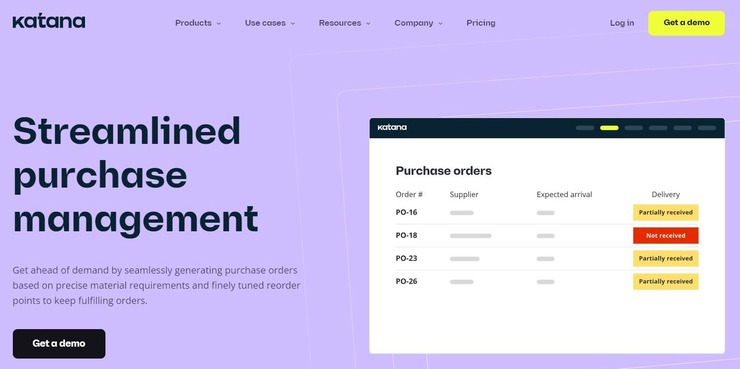
Katana is a cloud-based solution that can help businesses generate purchase orders based on exact material requirements and reorder points. The software facilitates automatic unit conversion while purchasing products. As such, it is capable of accommodating a plethora of packaging and sizing options. Katana is also excellent at providing valuable purchasing insights.
Features:
- Track spending, lead time, and supplier performance.
- Manage multiple currencies automatically.
- Flexible unit purchasing.
- Set customizable reorder points.
- Manage partial and fully outsourced manufacturing.
Pros:
- Easy set-up
- Seamless integration with some of the best e-commerce, CRM, and reporting apps.
- Automation
- Data-driven insights.
Cons:
- A recent surge in pricing has made the tool expensive.
Verdict: Katana is a software that companies can use to streamline their procurement process and avert risks associated with supply chain delays. Issuing purchase orders directly from the software is as easy as a walk in the park. Plus, the software’s integrations with some of the best reporting, CRM, and e-commerce tools give it an edge over so many of its contemporaries out there.
Price: Katana offers the following subscription plans:
- Starter: $179/month
- Standard: $359/month
- Professional: $799/month
- Professional Plus: $1799/month
A free demo is available upon request. All plans are billed annually.
#3) NetSuite
Best for flawless and flexible fulfillment process.

NetSuite is a multichannel order management software that takes care of your orders right from the time they are placed until they reach the customer with the help of some amazing automation features.
Features:
- Buy, Fulfill or Return from anywhere.
- The whole order management process can be automated.
- On-time delivery of orders.
- Direct shipment from warehouses, store fulfillment, drop-ship, and continuity/subscription features.
- Establish customer and currency-specific pricing to maximize your profits.
Pros:
- Consistent innovation
- Easy to use
Cons:
- Users find it costly
Verdict: NetSuite is a highly recommended order management system that can support businesses of all sizes.
Price: Starts at $499 per month.
#4) Brightpearl
Best for managing online and offline orders.

Brightpearl is one of the best order management software which is built to efficiently manage your orders with the features of automated ordering, fulfillment, shipping, and invoicing workflows.
Features:
- Manage your online and offline orders on one platform with much ease.
- The automation feature lets you focus on the exceptional orders that need your attention while the engine automates all repeatable tasks.
- Different types of fulfillment options like partial fulfillment, drop shipping, multi-location fulfillment, or fulfillment by Amazon.
- Know your sales channel performance with the help of business reports and plan accordingly.
- Uplift your operational competence with the help of features like inventory management, warehouse management, accounting, POS, CRM, and more.
Further Reading => How to Hide Your Amazon Order
Pros:
- Easy to use
- Excellent customer support services
- Data integration
Cons:
- Expensive
Verdict: Brightpearl is a highly recommended order management system but it can prove to be costly for small businesses if they want to have more features and go beyond the basic plan.
Price: Customized quotes provided on request.
Website: https://www.brightpearl.com/order-management-software
Further Reading => TOP eCommerce Development Companies
#5) Veeqo
Best for keeping you secure from overselling or missing orders.

Veeqo is a trusted order management software that syncs your orders across all your US sales channels and makes it easy for you to print shipping labels and ship to customers in America and all over the world.
Features:
- Sync orders covering all your sales channels, including your e-commerce website, marketplaces, and physical stores.
- Integrate with other e-commerce platforms, marketplaces, and POS systems.
- Create beautiful invoices and labels within seconds.
- Extra features for retailers, like performance reports, warehouse management, connect stores, streamline accounting, and manage purchase orders.
Pros:
- Excellent customer service
- Easy to use
- Cloud-based operation
Cons:
- Technical difficulties
Verdict: Veeqo is a highly recommended order management system with many positive reviews by its users. One difficulty that a user pointed out is about the technicalities, but Veeqo gives excellent customer service to compensate for that.
Price: Pricing Plan is as follows:
- Accelerator- $195 per month
- High Growth- $253 per month
- Premium- $325 per month
- Enterprise – Custom Pricing
Website: https://www.veeqo.com/us/order-management-system
#6) Adobe Commerce (previously Magento)
Best for creating a smooth and effortless cross-channel experience.

Adobe Commerce (previously Magento) order management allows you to sell or fulfill orders from anywhere and creates a smooth cross-channel experience. It is known for its flexibility to adapt to changes in types and size of operation.
Further Reading => Most Popular Facility Management Software Services
Features:
- Track and manage inventories across multiple channels.
- Manage complicated fulfillment procedures like refunds, cancellations, and backorders.
- The facility of BOPIS (Buy Online And Pick up In-Store).
- Integrate with Magento Marketplace extensions or other e-commerce platforms.
Pros:
- Flexibility
- Multiple pricing
- Supports any sized business
Cons:
- Costly
- Complex operations
Verdict: It is a great platform for those who need good software for order management. It is flexible and offers a large number of good features, but with this merit comes the problem of it being complex in operation.
Price: Customized quotes provided on request.
Website: https://business.adobe.com/products/magento/magento-commerce.html
#7) Salesorder
Best for exceptional online B2B customer experience.

Salesorder is a cloud-based and secure order management software that manages your sales, fulfillment, and accounting operations and thus lifts up your performance as a wholesaler.
Features:
- Manage your multichannel sales with the help of b2b and b2c eCommerce, EDI, CRM, and price management.
- Forecasting based on your current sales.
- Helps in fulfillment of orders by order process automation, inventory and warehouse management, and more.
- Accounting features, like Digital payments, Business intelligence tools, Multi-Currency general ledger, and Tax agnostic automation.
Pros:
- Customizable
- Reasonable pricing
Cons:
- Lack of features required by large business enterprises
Verdict: Salesorder is a small business order management software. It might be useful for large businesses too if they are satisfied with the number of features offered.
Price: $199 per month if your annual turnover is less than $500K and $477 per month if your annual turnover is above $500K.
Website: https://www.salesorder.com/
Further Reading => List of the BEST Retail Inventory Management Software
#8) Orderhive
Best for its simple and easy operation.

Orderhive is a simple, easy-to-use, and free order management software that lets you tackle the manual tasks of fulfillment that are most hated but absolutely necessary for a sales business enterprise. Paid versions are also available, having different pricing plans. You can opt for it, as and when required.
Features:
- Multichannel integration and order processing through FBA, dropshipping, and 3PL.
- Manage complicated fulfillment issues like pre-order, backorder, or partial order fulfillment.
- Custom tags to easily identify specific orders.
- Other necessary features like multi-currency conversion and customer details with his complete order history.
Pros:
- Wide variety of features
- Excellent customer support
- Reasonable pricing
Cons:
- Needs time to start with
- Complexity and bulkiness due to a large number of features.
Verdict: Most of the users of Orderhive usually recommend Orderhive to others. Once you get to learn its operations, you are going to love it.
Price: There is a free version. The paid plans are as follows:
- Lite- $44.99 per month
- Starter- $134.99 per month
- Growth- $269.99 per month
- Enterprise – Customized pricing
Website: https://www.ordoro.com/orderhive
#9) LinnWorks
Best for total commerce control in one platform.

LinnWorks is a single platform that lets you control all your order management needs. It lets you manage your orders from around the world and seize every possible revenue opportunity.
Features:
- Integrates with other e-commerce platforms.
- Multiple channels connected to one selling and fulfillment process.
- Adapts quickly as your company expands.
- A look through your business performance to help you in decision making.
- Automatic synchronization of your operations across dozens of marketplaces.
Pros:
- Customizable
Cons:
- Troublesome for new users
Verdict: LinnWorks is a customizable platform that adapts to your needs, but as pointed out by a user, this order management system has confusing and long operations that can be troublesome for new users.
Price: Price quotes provided on request.
#10) Skubana
Best if you need plenty of features on a single platform.

Skubana is one of the best order management systems which offers you the feature to manage your eCommerce entity efficiently by accurately doing the task of managing the orders and even gives forecasts based on your history, to help you grow.
Features:
- Track prices across suppliers and inventories across multiple marketplaces.
- Sales reports to help you in decision-making.
- One dashboard to show all your channels, warehouses, and products.
- Automatically route orders to fulfillment centers.
Pros:
- Pleasant forecasting tools
- Good customer service
Cons:
- The long and high learning curve
Verdict: Skubana is a recommended product, it offers plenty of features, but with this merit comes the difficulty in operating the system.
Price: Starts at $999 per month
#11) Freestyle
Best for a wide feature set to help you in order and inventory management.

Freestyle Solutions is an order and inventory management software that claims to provide you the biggest feature set in the industry at affordable prices.
Features:
- Business intelligence tools to assist you in decision-making.
- Add-on features to meet your requirements.
- Order and inventory management through features of automation and consolidation.
- eBooks on eCommerce management.
Pros:
- Affordable
Cons:
- Customer service not up to the mark
Verdict: One of the users is of the view that the software is affordable, as compared to its counterparts. But the customer service is very bad, due to which they had to face a lot of problems, plus, needs to grow more with time.
On the contrary, some users find the system extremely helpful because of the features offered by it.
Price: Price quotes provided on request.
#12) Zoho Inventory
Best for simplified order management for small to medium-sized enterprises.

Zoho Inventory is a cloud-based free order management software that assists you in managing your orders by following simple operations. There is also a paid version, which offers broad features at reasonable prices. Zoho Inventory is a great small business order management software.
Features:
- Track orders and inventories and get informative sales reports to help in decision-making.
- Multi warehouse management, invoicing, and digital payment options.
- Fulfilling backorders and drop shipments.
- Send updates to your customers about their orders.
Pros:
- Affordable price
- Can be linked with other Zoho products
- Consistent innovation
Cons:
- Cannot work offline
Verdict: Zoho Inventory is a small business order management software. The only major drawback is that you cannot work offline with the system.
Price: There is a free version. The paid versions are prices as under:
- Basic- $39 per month
- Standard- $79 per month
- Professional- $199 per month
#13) Odoo
Best for its simple and integrated applications.

Odoo is a known name in the field of order management systems, with 5 million+ users worldwide. It helps you work with the integrated Odoo apps and thus get rid of the complicated processes of integration with other eCommerce platforms.
Features:
- With the help of plenty of Odoo apps, you can perform all your business operations and get rid of troubling integration processes.
- Track prices, inventories, and purchases made from anywhere.
- Uplift your sales with the help of CRM, POS, and sales reports.
- Accounting and invoicing applications.
Pros:
- Wide variety of features that can fit different departments
Cons:
- Long installation process
- Complicated pricing
Verdict: One user points out that Odoo is a bit expensive, the reason being the wide range of features offered by the order management software. But a big business can cut its costs by having a system that offers solutions to most of your business needs on one single platform.
Price: There is a free version. Besides that, you can add the features you want and pay accordingly.
#14) Hopstack

Hopstack’s order management system streamlines the process for fulfillment centers by centralizing both offline and online orders, offering enhanced workflow adaptability and transparency. Hopstack OMS enables omnichannel order management with ease and flexibility through one dashboard.
The platform also provides comprehensive solutions for warehouse management, inventory optimization, order fulfillment, shipping and dispatching, and reverse logistics.
Platform Features:
- Multichannel management with 50+ ERP, ecommerce, and marketplace integrations
- AI-driven intelligent order batching algorithm
- Automated multi-warehouse order routing
- One dashboard for multiple stores and orders
- Combined order facility for the same customer/address
- Flexible fulfillment workflows powered by Hopstack’s rule engine
- Inventory synchronization across multiple warehouses
Pros:
- User-friendly interface for ease of use
- Wide range of hardware and software integrations
- Feature-rich platform to manage multiple operations
- Automation options enabling cost reduction
- Flexible pricing options
- Manage accessibility permissions and levels
- Robust 24/7 customer support
Cons:
- May not be ideal for micro businesses
Pricing: Contact the sales team to discuss custom pricing.
#15) Maropost
Best for Managing Multiple Marketplace Stores.

With Maropost, you get a platform that can help you create an online store as well as help you manage multiple stores through a single control panel. The platform presents eCommerce store owners with a comprehensive solution that facilitates order management, inventory management, fulfillment, etc. across multiple stores.
Features:
- Centralized Management of multiple eCommerce stores
- Custom Online Store Creation
- Integrated B2B Features
- Streamline Customer Management
Pros:
- Centralized Control Panel to manage multiple stores
- User-friendly interface
- Flexible Pricing
- Highly customizable
Cons:
- Not ideal for small businesses
Verdict: Maropost provides eCommerce store owners with a single back office solution that is capable of facilitating inventory management, multi-channel purchasing, order management, and fulfillment. It is simple to use and comes loaded with advanced eCommerce enabling features.
Price: Maropost offers 4 pricing plans and a 14-day free trial
- Essential: $71/month
- Essential Plus: $179/month
- Professional: $224/month
- Custom Enterprise Plan
Frequently Asked Questions
What does an order management system do?
This system looks after the pricing and execution of trades of securities, bonds, and other items between two dealing parties.
What is the process of order management?
The process consists of detecting the best possible price across markets, placing the order and then tracking the execution of the order delivery process, comprising order acceptance, packaging, shipping, and delivery.
What are the features of a good order management system?
A good order management system must have the following basic features:
– Easy to handle
– Easy to afford
– Cost-efficient
– Supports multiple currencies
– Multichannel order management
– Tracks orders
Conclusion
In this article, we studied the top 12 best order management systems. Based on our study, we can now conclude that out of the best available multichannel order management systems, Magento, NetSuite, and Orderhive are the overall best software that can fit any business size.
If you are a large enterprise and require wide features on a single platform, then go for Odoo, Freestyle, or Skubana. Odoo can even help you get rid of the long integration procedures with other e-commerce platforms.
Brightpearl is expensive but very easy to use, like Zoho Inventory. Sales Order provides exceptional b2b services but lacks some features required by large businesses.
QuickBooks Commerce, which is a known name in the industry, provides a lot of features but with the drawback of a limited number of transactions and users. Veeqo is tough to get along with, but the excellent customer service compensates for that.
Research Process:
- Time taken to research this article: We spent 10 hours researching and writing this article so you can get a useful summarized list of tools with a comparison of each for your quick review.
- Total tools researched online: 25
- Top tools shortlisted for review: 10
Was this helpful?
Recommended Reading
-

List and Comparison of the Top 10 Commercial and Free Business Management Software to Manage Your Business Efficiently: Top Business Management Tools for Small to Large-Sized Businesses. Business Management Software includes a wide range of solutions. It is an application that will help you in managing your business. We can…
-
This tutorial compares the best Accounting Software. Select the Bookkeeping Software that meets your needs: Accounting software saves time and hassles in recording financial transactions. Using the accounting app allows accounting personnel and business owners to focus on strategic aspects of managing a business. It automates the task of generating…
-
List of Top QuickBooks Alternatives With Features And Comparison. Read this Detailed Review To Choose The Best Alternative To QuickBooks For Your Business: Most of us have heard about the QuickBooks accounting software which has gained high popularity in the small business market worldwide. Small business owners and entrepreneurs are…
-

List and Comparison of the Top Free Workflow Management Software. Organizations handle a large amount of data and documents. It would be a nightmare if they have to do them manually, but in today’s digital world we have software to handle the business process, document holidays, and many more things.…
-
Here we will review and compare the best Purchase Order Software to help you choose the ideal Purchase Order Management System for your business needs: A Purchase Order can be defined as a commercial document that issues an order for goods and services to vendors on behalf of the business.…
-
Comparison of popular Small Business Accounting Software with features & pricing to help you select the best Business Accounting Software: Business Accounting Software is an application that records all the company’s transactions and generates reports. These accounting tools offer the functionalities to prepare financial reports that will give you visibility…
-
List and review of the Top POS Systems for Small Businesses with features and price comparison: Small Business POS software is the system for small retailers to help with the retail management process. It also helps with creating product entries, calculating total costs & taxes, accepting payments, and creating bills.…
-
A comprehensive review and comparison of the Top Bulk Email Services. Select the best Bulk Email Marketing Service based on features, pricing, and comparison: Bulk Email Service is the platform provided by the company to connect with new audiences or potential customers by sending mass email messages. These services will…


