Free Media through stolen property
August 31, 2006
 If someone takes a photo with a stolen camera, who owns the picture?
This is from a post about a chap who had his mobile phone stolen, which was signed up to a phone-to-web service called Flickr.com.
Apart from the hilarity of the thief almost giving away their identity (I will presume this is their dog, and not the dog of someone they sold the phone onto), there’s something very cool about the way that open media can authenticate your identity.
The Data Protection Act was supposed to ‘protect’ an individuals identity, thus giving us all reassurance that we are safe, our privacy safe, our personal lives, safe. Like any protection system, insurance or racket, the ‘service’ is based upon fear. Being allocated rights of privacy, we feel that we must protect them.
Now, with the case of the stolen phone, (which I’ll take as genuine, and not a stunt by Shozo), there’s something reassuring about the role of Free Media, media that is, free to flow through a public system, and not hampered, restricted or protected by the likes of DRM. It becomes part of a trail of activity.
Comments in response to the chaps blog, point out that it’s a shame that photos don’t show the address or identity of the thief, but if the thief knew that the phone would leave a trail of activity (even with the SIM card replaced), surely you would think twice about stealing the personalised device.

Regardless, the photos now exist in a world of limbo. The copyright of the images should be with the ‘photographer’, though they will never come forward and claim them. At present they sit on Flickr under the owners account (with all rights reserved). If the phone wasn’t worth stealing in the first place, the displacement of media ownership wouldn’t be an issue.
Protection services, for media and identity are surely coming to an end (I’ll post about Identity2.0 soon). Once these services thrived on the ability of individuals not being able to share information freely – because a suitable accessible technology wasn’t available. Now that this exists, do the devices that connect us to Internet need protecting, or should they be as free as the data that runs across the network? Perhaps the answer is in disposable phones? Is relinquishing our desire for media rights as hard as giving up our beloved gadgets? Do we desire gadgets more than our freedom? Do we need free data more than identity?
links for 2006-08-31
August 31, 2006
-
Ever since the birth of the free software movement, its defenders have struggled to explain just what “free software” is. If it is free, how do coders eat? And how do businesses that support the software – IBM, Hewlett-Packard – make any money from it
-
The fact that Heil Honey I’m Home, an ill-judged sitcom that pitched Adolf Hitler and Eva Braun moving in next door to a Jewish couple, failed to make the top 10 should serve warning of the horrors that lurk within a new list of the worst TV shows of all
-
Laugh along with CHARLES ALLEN, CHIEF EXECUTIVE, ITV
-
SpiralFrog.com, which is set to launch this year from New York, is being backed by the world’s biggest record label, Vivendi Universal. Between them they hope to give away music by some of the world’s most popular artists, including Eminem and Kaiser Chie
-
DrupalART is a site dedicated to helping people build and develop Drupal sites for artists and musicians. The goals are to show (through examples) various ways Drupal can be used to build artist websites, and build documentation aimed at newbies trying to
-
A while ago I posted some advice for young planners that I contributed to a Romanian advertising blog. It got a few mentions out there and a nice person from the US called Stacy asked if she could use it to send to client agenices in the US – she helps tr
links for 2006-08-30
August 30, 2006
-
Eventsites is simply a client to other web-services. Eventsites uses EVDB for authentication and data storage, Google Maps for mapping and Flickr for photos. All the interface logic is done using AJAX in the browser. Since the heavy-lifting of Eventsites
-
A group dedicated to promoting group creativity and art that can be shared and built upon.
-
The entertainment industry’s open-ended war against online piracy — both real and imagined — has spawned its share of unintended consequences. But perhaps the most interesting of the bunch, and arguably the most troubling for groups such as the RIAA and
-
The rise of the internet is as revolutionary as the invention of the printing press, a senior Google Inc. executive said on Saturday – but old media like television should not fear it.
-
The world of graphics and graphics processors is a complex one, based largely on what we refer to as ‘rasterization.’ This is our industry’s overly-complex way of saying that we can’t quite make it happen the way it should, so there’s a series of “best gu
Designed to be made
August 29, 2006

The previous post about Chumby reminded me about 2 other Human Interface controllers that have never broken through to the mainstream. First, Lemur, (shown here on the right) which is a multi-touch screen with customisable interface design. The other is monome (below), which is ‘a reconfigurable grid of sixty-four backlit buttons’.
Both devices are aimed at the music and visual performance sector, though there is no reason why their application is not more wide spread. The price points are high for the casual purchaser, but the opportunities for media interaction are incredibly diverse. These are devices designed to be reinvented by the user.
The unholy trinity of mouse, keyboard and screen are modes of interaction that have been ushered into the mainstream use of communications, using office mechanics (namely, Word processing) to engage home audiences to participate in media collaboration and co-production, mainly around Text (blogs), Video (Vlogs) and Audio (Podcasting).
 As data is made more and more available, the ability to use data will rise, and the way the audience will make use of data has yet to be realised. Already, through the use of RSS, we are seeing Mashup web projects, numerous web2.o concepts that make good use of available commercial and public domain data. Yet, these services, which are now being to look like each other (how many individual Google Map projects need branding?).
Data is there to be used as the life blood to systems, systems that make our lives more ‘enjoyable’.
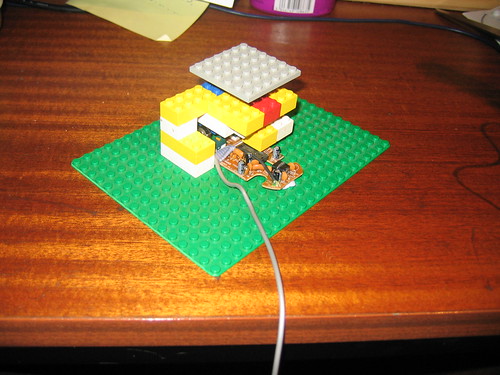
For example, have a look at the Lego alarm clock (below right) by Greg Mccarroll. Greg is genius. Built from code, data and lego, his alarm clock knows when his train will be late, adjust the alarm time acordinly so that he doesn’t hang around the railway station in the cold, and emails his boss if the train is really late – leaving him to sleep on, if required. Full details (and it’s a brilliant read, like the rest of his blog) here.
Ideo have had a fair run at inventing gadgets over the past 20 years, many have failed due to pursuing proprietary code lock-outs/lock-ins. Apple succeed with the Ipod because they know how to sell ‘lifestyle’. The Ipod/iTunes offering is closed off and thus doesn’t offer possibilities for the audience to integrate their (iTune) music collection with the rest of their lifestyle – it just acts like a 70’s disco chest medallion. Even with the newly announced Sony Mylo these ‘mistakes’ are still being played out.
What is required is flexible hardware to work with the flexibility of software and the reuse value of code. Manufactures who offer this will begin to have a larger influence over the communication and network industries because the sum effort of the ‘audience as community’ is the driver for the telcom and information sectors. This raises the question about the current relationship that the manufacturing industries has with the audience. Perhaps the over reliance of User Focus Groups (run traditionally by marketing departments) is the problem. If focus groups do bring value to ‘product design’, where is it? A focus group will not see/think of the other possibilities for an invention, they are there to provide feedback on the quality of the object in front of them. Why not have the audience involved with product development instead of concept testing? Why cant marketing be the facilitators of a value-adding process BEFORE the release of a product?
Design, at it’s best, is evolutionary, and if that factor is not embodied into the product – as a feature – then you should expect a product to face extinction.
links for 2006-08-29
August 29, 2006
-
Long Tail review with a focus on Amazon
-
the monome 40h is a reconfigurable grid of sixty-four backlit buttons. see the demonstration video. or this one.
Chumby – Let it be…
August 28, 2006
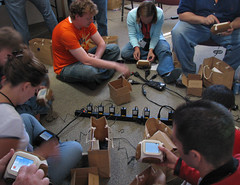 Open, hackable and commercial available (well, almost..) is Chumby’s offering. A simple client machine with wireless capabilities. The idea is that you can customise the software (and the casing) so that the gadget is what ever you want it to be – Radio player, photo album, news reader. There doesn’t seem to be any commercial restrictions so the diversity of use, so expect a whole host of brand-funded applications to roll in, that’s if brands ever understand Open source.. www.chumbly.com
The picture to the left is the first outing of the device at the O’reilly FooCamp weekender. Details here, and worth a scan to see what they taked about.
links for 2006-08-28
August 28, 2006
-
In this post, we survey a range of client applications which utilize the new web platform. This is a follow-up to our Web Platform Primer post a few days ago, in which we explained the building blocks of the new Web infrastructure:
links for 2006-08-27
August 27, 2006
-
Myowndb is a web application with the goal to let you manage your data easily. You can view it as a database with which you get an interface to enter, modify, delete and search data once you’ve define its structure.
-
Bebo, the popular social network that leads the pack in the UK, is set to be the focus of a new TV show on the UK’s Channel 4.
-
In this post, I’ve categorized the Web platform into 6 infrastructure building blocks and I will briefly outline some of the products that define each one. The common thread is that each product mentioned has an API, which means it can be integrated as a
-
168 is the order of the group PSL(2,7), the second smallest nonabelian simple group. From Hurwitz’s automorphisms theorem we know that 168 is the maximum possible number of automorphisms of a genus 3 Riemann surface, this maximum being achieved by the Kle
-
What common English slang phrase alludes to the number 168? I won’t tell you – not right away. But, I’ll tell you a bunch of other cool stuff about this number, and eventually the answer should jump out at you.
-
Project 168 is aimed at making musicians more productive. The concept is to make an EP in 7 days (168 hours). All the music you hear on this site has been made within that time.
-
The Buddha was the most optimistic of all spiritual teachers. He believed that every one of us is capable of complete and total enlightenment in this very life. Each of us was born with the capacity to be generous, kind and wise. We act with greed, anger
-
In mathematics, particularly in complex analysis, a Riemann surface, named after Bernhard Riemann, is a one-dimensional complex manifold. Riemann surfaces can be thought of as “deformed versions” of the complex plane: locally near every point they look li
-
OMG – the whole book – online for free
-
Klein’s quartic curve is a surface of genus 3 (a three-holed torus) of constant negative curvature. It can be constructed by specifying a 14-gon in the hyperbolic plane and identifying pairs of edges. However, it can also be constructed as the solution to
links for 2006-08-25
August 25, 2006
-
Simple screen capture and grab tools
links for 2006-08-24
August 24, 2006
-
In the last few months, trade groups representing music publishers have used the threat of copyright lawsuits to shut down guitar tablature sites, where users exchange tips on how to play songs like “Knockin’ on Heaven’s Door,” “Highway to Hell�
-
SAN FRANCISCO, Aug. 22 — Sony Pictures Entertainment plans to announce on Wednesday that it has acquired Grouper, a Web site featuring videos contributed by users, for $65 million.
-
A new line of 3-D televisions by Philips uses the familiar trick of sending slightly different images to the left and right eyes — mimicking our stereoscopic view of the real world.
Relakks – Don’t do it
August 23, 2006
Relakks.com is a new service (a Virtual Private Network) for those who want to send information over the Internet with anonymity. The encrypted connection service is fully supported by the Swedish Political ‘Pirate Party‘ – who have been know to support the activity of the Bit Torrent site – Pirate Bay.By producing this darknet for those who don’t want to be tracked, regardless of legal or illegal activity, the impact on culture as a whole is far more disruptive. The users of Relakks will, on the whole be the web savvy youngsters who are actively creating and sharing cool innovation and ideas. Once this is removed from the public domain and shown only through a darknet we are likely to suffer a drought of fresh ideas.
It could be argued that a service like this is driven by the pressure of copyright holders who don’t want their movies and music being shared. By supplying a commercial available darknet
Like Pirate Bay this is an extremely well organised project, they know what they’re doing. Any they will have records on what you do. It’s an incredible amount of trust and freedom for the bargain cost of 5 Euros a month.
Adding any layer of encryption is a kin to Digital Rights Management system, except now, sub cultures can reverse the effect and lock out media owners.
If the darknet is the answer to online freedom, then the main losers will not be those who demand copyright be upheld and respected, but everyone who thrives on a rich and varied culture of sharing.
This article was first published on openbusiness.cc
The “Relakks – Don’t do it” article is part of wider research available here.
The Bowie Bonds
August 23, 2006
 The value of stocks will rise and fall with popularity. As a producer this plays havock on the value of your productions, and thus you use copyright to protect access and thus control, to a degree, the value of your work. With file sharing at notably high levels, contolling access is at an all time low..
Now, what if you could lease your works for a 10 year period for a fixed financial amount in exchange for a guaranteed return?
Bowie did this in 1997, a deal facilitated by Pullman, which he went on to repeat with a host of acts including James Brown. The Bowie Bonds, which basically is a royality securities deal that relies on his projected sales of his back catalogue – a fairly non-dismissive collection of hits spanning 30 years, and collects roughly £1m per year.
That was until Napster became the file sharing tool of choice for mainstream Internet use. This sudden interest in acquiring music for free had sever impact on the ability to monetize Bowie’s catelogue. Until iTunes came along. Now, with popular business theories such as The Long Tail in circulation showing content owners a way forward in online sales and asset management, the Bowie Bonds seem like a real no-brainer.
Why should an artist have to constantly worry about piracy when he can sell the risk to someone else?
Of course, producers can worry about how the assets are exploited, but why would any owner of the rights try to sabotage their value? Meanwhile the artists is off producing new works..
This article was first published on openbusiness.cc
The Bowie Bonds article is part of wider research available here.
Photograph courtesy of RazingCulture.
Sharing business models
August 23, 2006

I’ve been asked by the lovely folk at OpenBusiness to contribute to their blog on a regular basis, and so I’ve kicked it off this week with a couple of posts. I’ll reblog them here too for reference, especially as the articles are summaries of a larger pool of research – which you can see on the wiki.
“OpenBusiness is a platform to share and develop innovative Open Business ideas- entrepreneurial ideas which are built around openness, free services and free access. The two main aims of the project are to build an online resource of innovative business models, ideas and tools, and to publish an OpenBusiness Guidebook.”
What a great idea.
My first posting is about the Bowie Bonds – where the Thin White Duke leased his back catalogue for 10 years in return for $55m. Simply a fantastic way to avoid the issues of copyright infringement in this online-peer-2-peer age – just sell on the risk..
The second posting is about the Relakks service, a VPN for anyone wanting anonymity online – which is apparently handy if you want to share pirated media. This has a downside as the article explains.
Steal this Film, please..
August 23, 2006

Steal this Film is a documentary produced by ‘The league of noble peers’ covering the Pirate Bay website: its begininngs, its crew and its impact on Hollywood.
Featuring interiews with the Pirate Bay crew, Swedens Pirate Pary and a host of (uncleared?) copyrighted Hollywood material, it’s an excellent introduction to the concerns over filesharing and the movie industries fear of not keeping up with the distribution oppotunities afforded by the internet – highlighted by the proposed WTO trade embargos against Sweden, where Pirate Bay is run.
This seems to have opened an interesting political angle, where the Swedish goverenment fear losing voters if they were to shut down the service. Even if they could, the server redundancy is now (alegedly) so organised, the Bay will be up and runnning again with 4 or so minutes.
“We wanted to make a film that would explore this huge popular movement in a way that excited us, engaged us, and most importantly, focussed on what we know to be the positive and optimistic vision many filesharers and artists (they are often one) have for the future of creativity. Hopefully you’ll enjoy the first part of Steal This Film.”
Collaboration and funding is being requested to continue the documentary, so if you want to participate in the development check out the wiki. The main site is here and links through to the Bit Torrent files of the movie.
The movie itself doesn’t declare itself under any licence, presumably because of all the uncleared media in the movie (Films: The Day After Tomorrow, They Live and Zabriskie Point. Music: Why Must I Be The Thief and She Brings the Rain, both by Can.. so it would be interesting to see if the movie industry responds through remixing this movie..but first thay have to steal it.
We are the Web
August 23, 2006
If ‘Net Neutrality!’ needs promotion, then this is one way. Spread the word song and dance.
Much of the ‘crisis’ over the the prioritising of data packets is understandably a technical concern. Both the Wikipedia entry on the subject and the cited website by Tim Wu are worth studying. The economics are focused on giant technology players gleaning preferential treatment (or not) on the Internet. What doesn’t seem to be discussed is the relationship to Information Theory.
Every network has operational concerns and external influencing obstacles ranging from terrorism to tollbooths; the Internet is unlikely to ever to be free (as in problem free) as it too takes on the same dynamics as any transport networks.
Just as with the above Internet celebrity song and dance routine, the amount of data actually required, not desired, should be the focus of improvements to the use of the Internet. Networks like efficiency and if the Inernet fails to deliver to the users then the users will find another system to adopt. From canals to railways to roads, different forms of networks bring specific results and problems. There’s no such thing as a free-way.
At present, with the rise of video distribution, this has kept the Telcoms excited – lots of data being moved around. With the attraction of VoIP, a realtime data exchange, the arguements arise over what needs priorotising. If Microsoft Office ever gets to realtime business being contucted over the communication networks (as opposed to document writing and sending), then yes – you’ll see commerce ‘bunging up the tubes.’
But this is mapping the current use of media over a system and expecting the processes of communication not to be refined. Look at txting, emoticons and rss feeds. These light data communications are the effecient forms of transfering information and they’re capable of being rich in personal expression.
Just as the transport networks in London are plagued by overcrowding, the rise of the cyclist has increased commerce where it didn’t exist before. Cyclists find a freedom in being able to go anywhere and more importantly stop anywhere – this leads to bars and cafes and shopping areas being accessed by new customers thus creating new communities.
What has been realised with the Internet is that ‘the communities are the network’ and the relationships between participants will be maintained by their own needs not regulations that support commerce that is no longer persued.
I’ll finish with the post with a documentary-in-the-making called ‘In Your Car No-one Can Hear You Scream!’, that investiagtes London’s traffic. Both the documentary and the comments posted on the YouTube page are worth reading and relating to our Internet neutrality debate.


![[Page 227] Stephen Wolfram: A New Kind of Science | Online](https://live.staticflickr.com/3642/3507361849_5caa3d8dae_s.jpg "[Page 227] Stephen Wolfram: A New Kind of Science | Online")


 Zero influence
