-
-
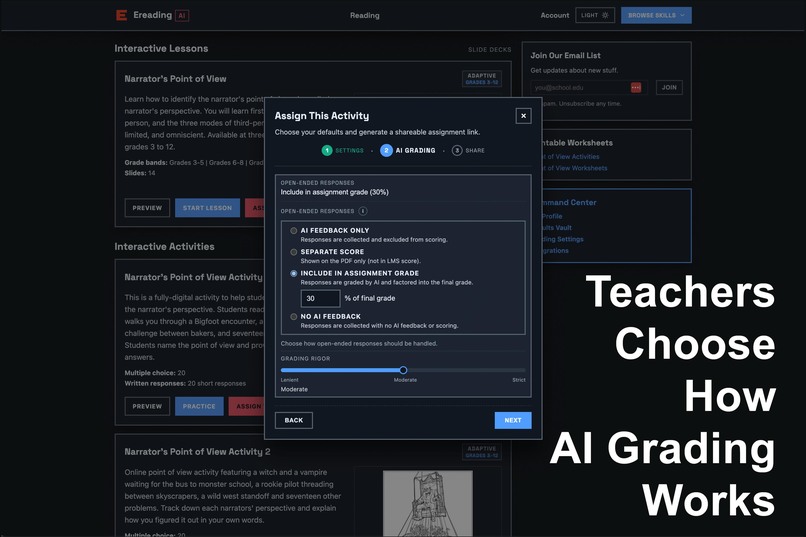
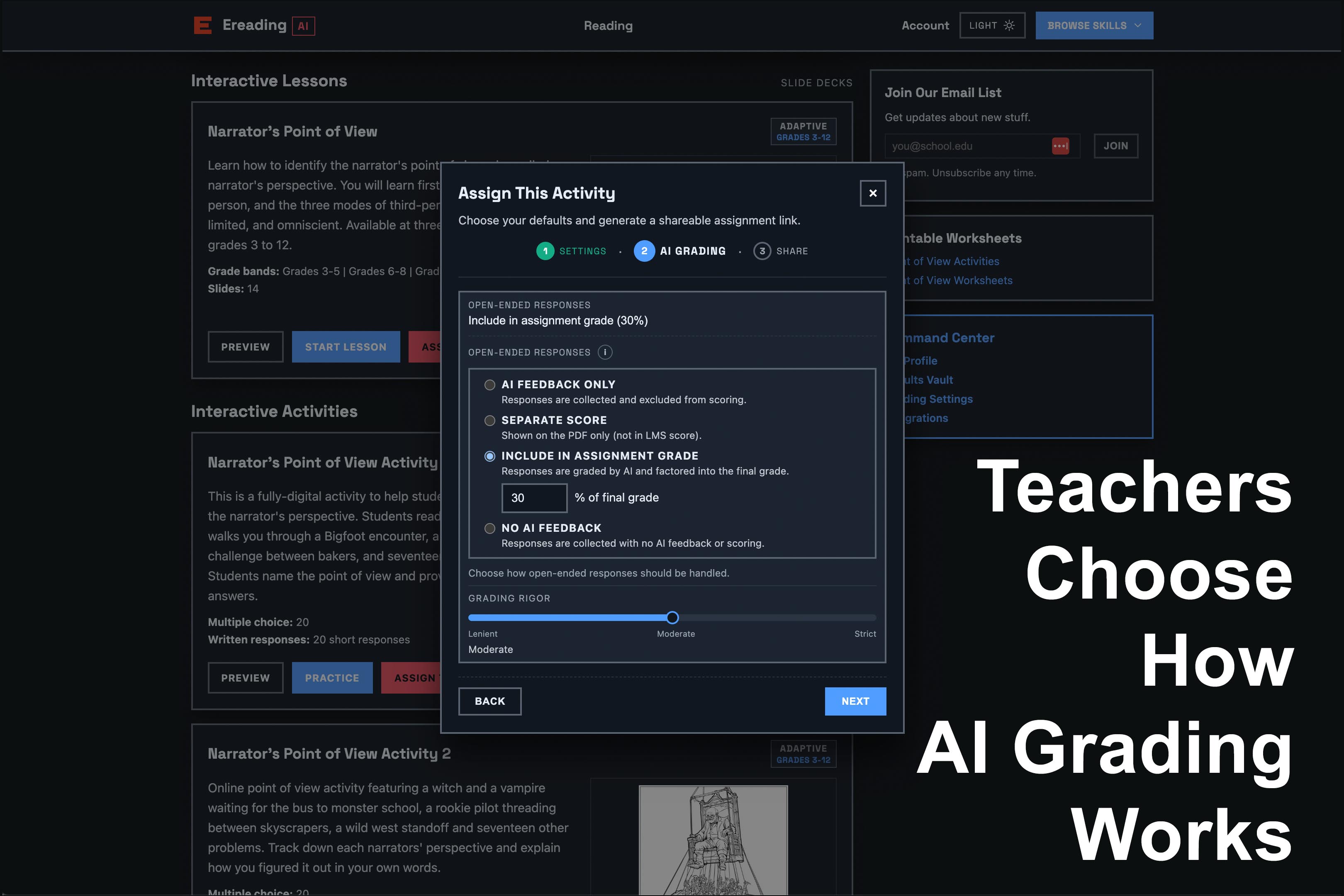
Teachers choose how AI grading works.
-
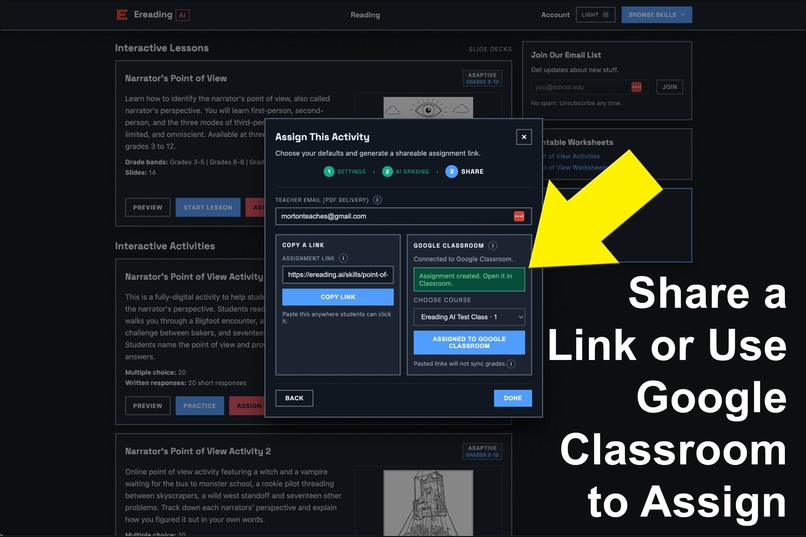
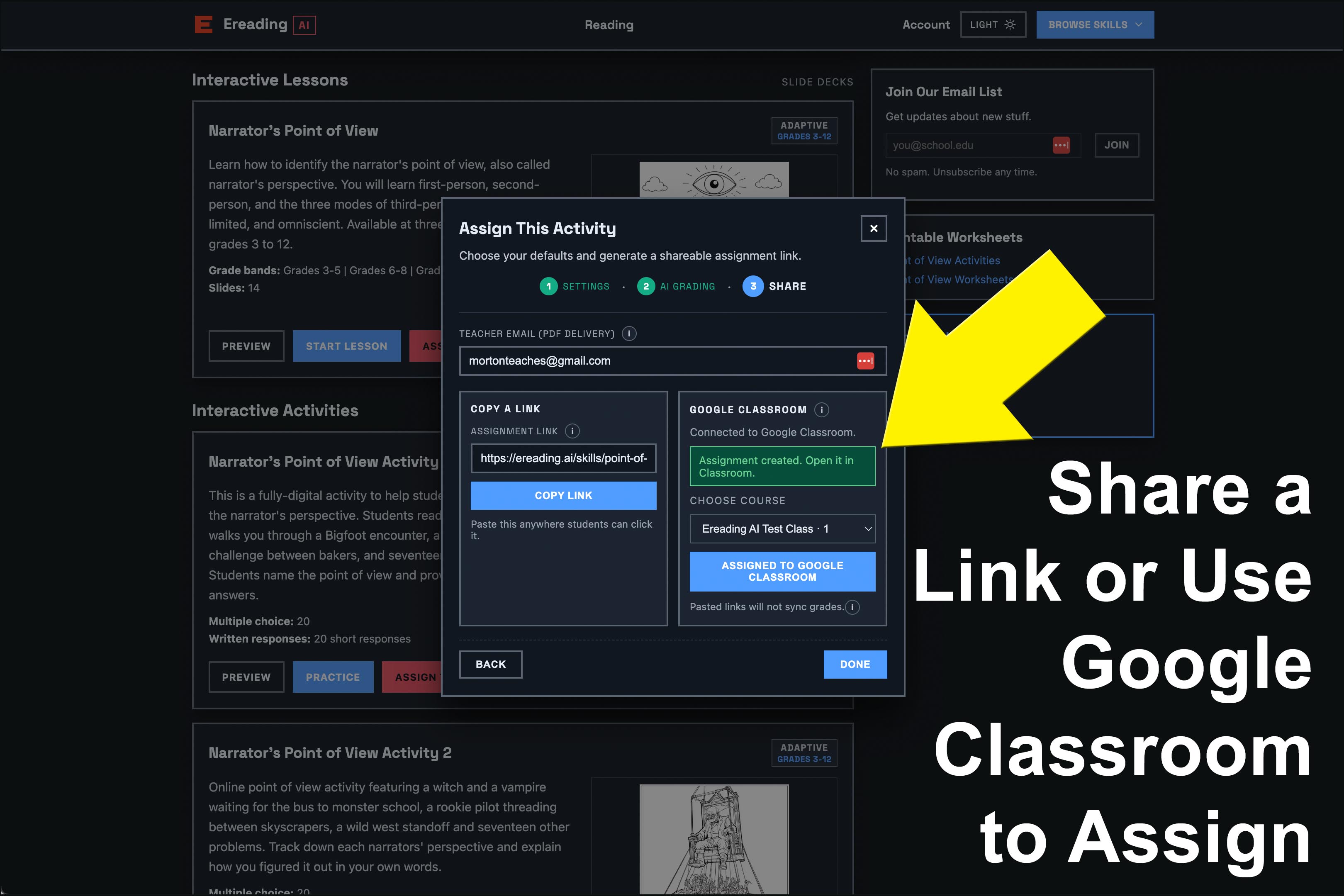
Assign activities by sharing a context-bearing link or directly through Google Classroom.
-
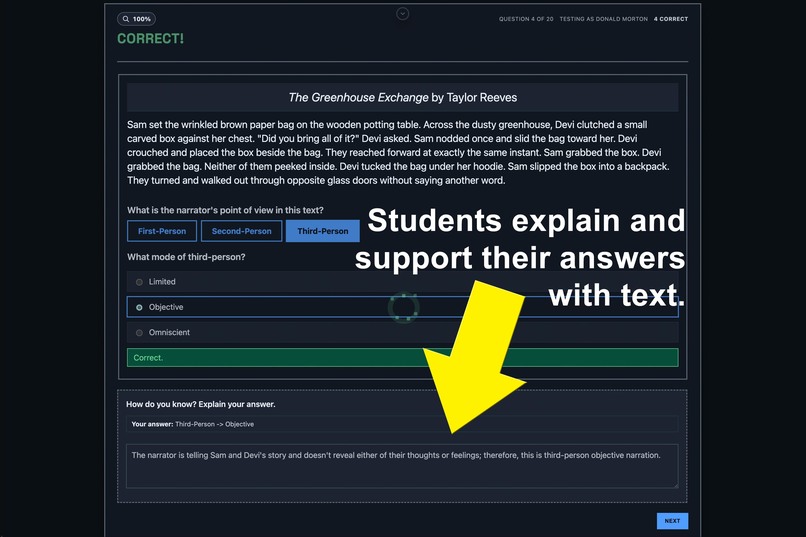
Students answer multiple-choice questions and then explain their responses using textual support.
-
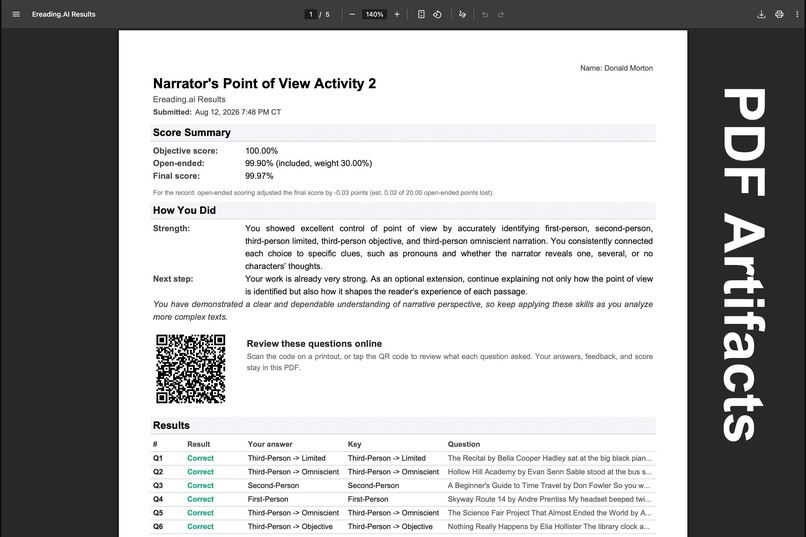
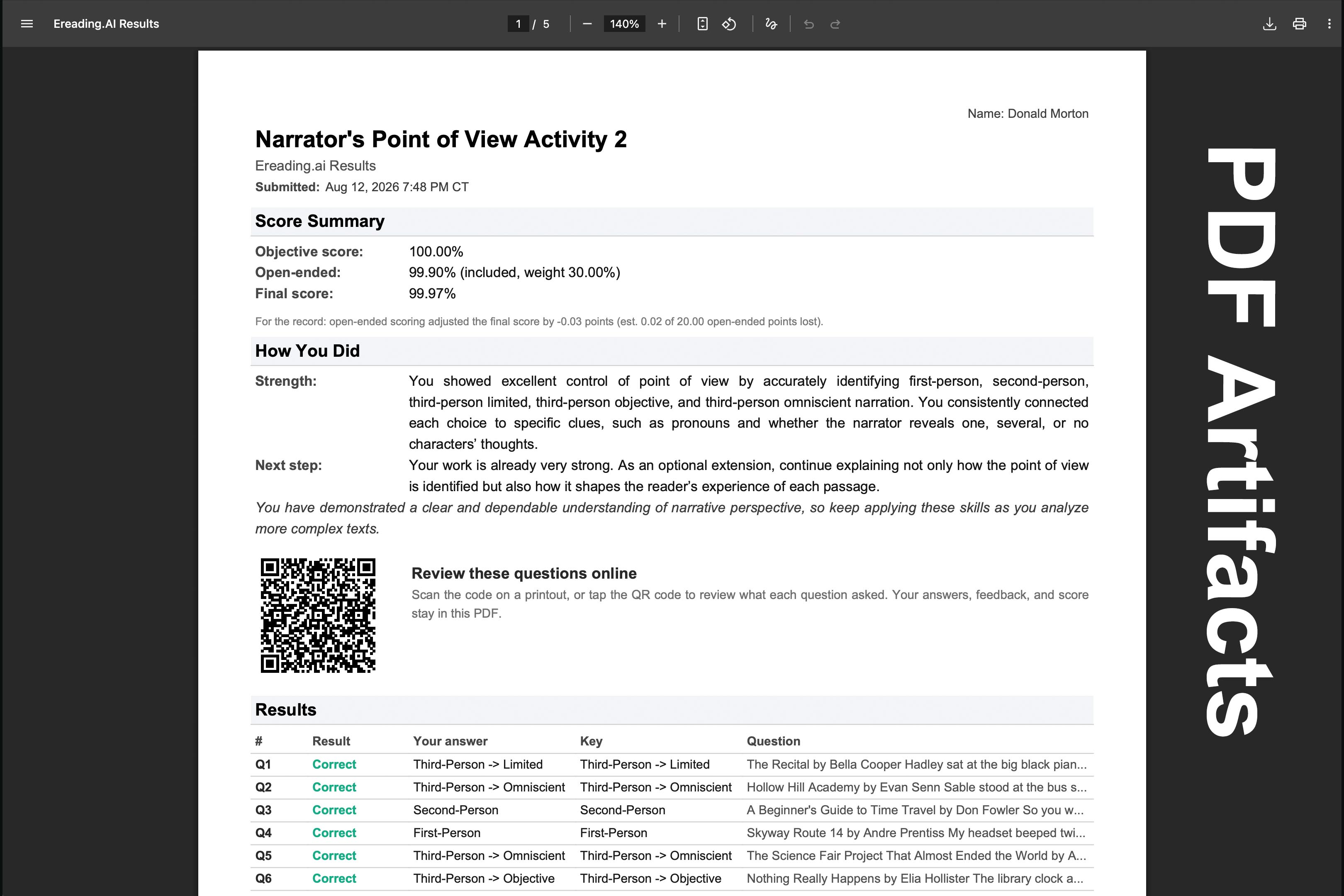
The program creates a PDF artifact of the student's responses and the AI's feedback.
-
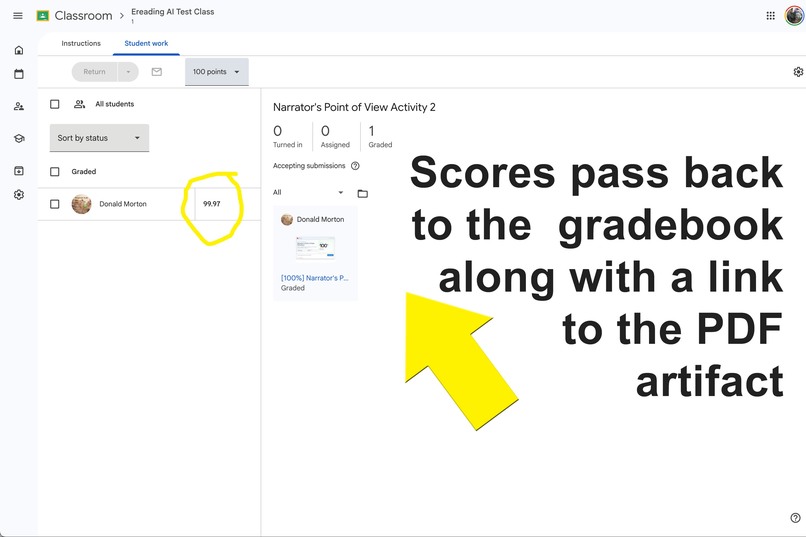
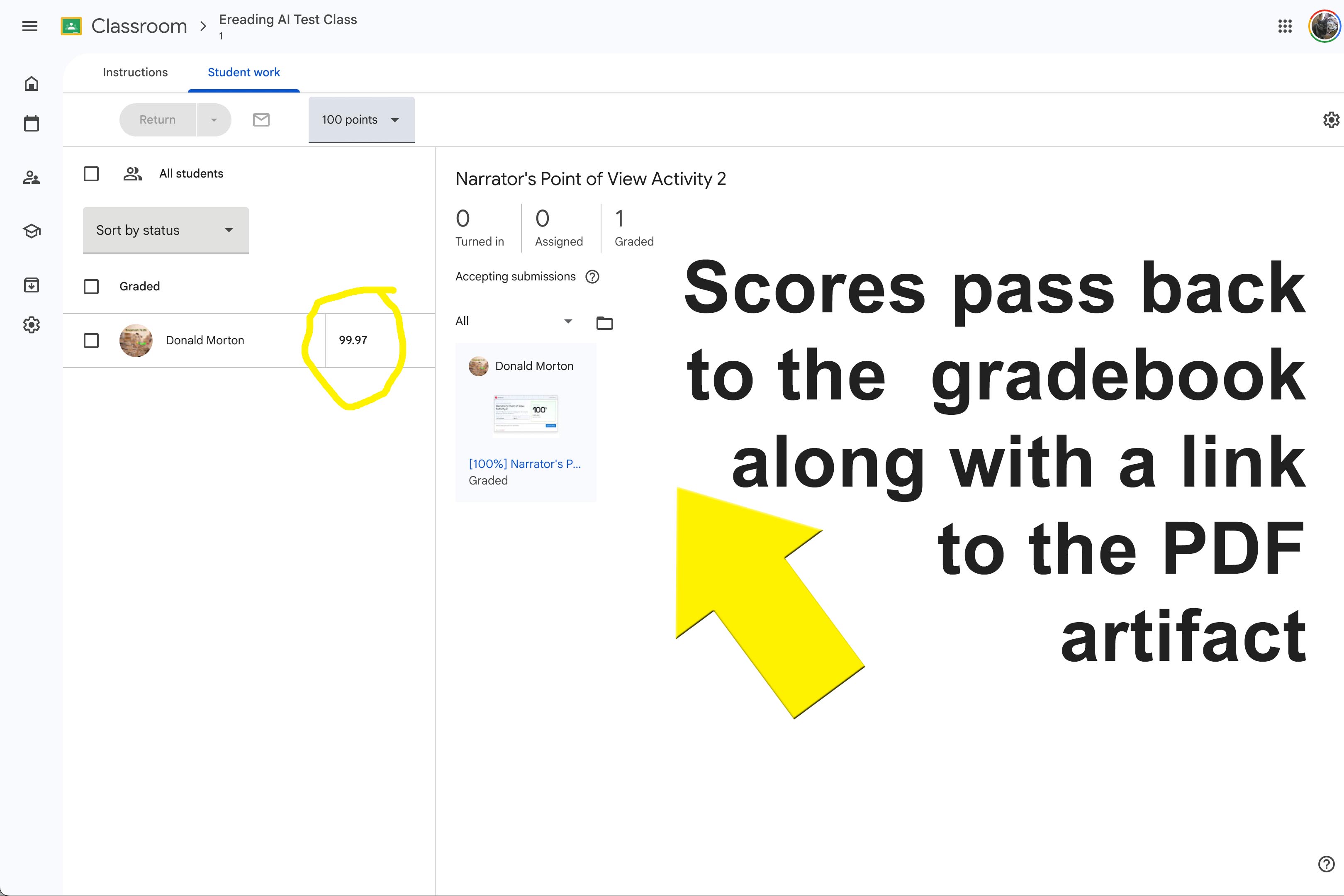
Scores pass back to Google Classroom with a link to the PDF artifact.
-
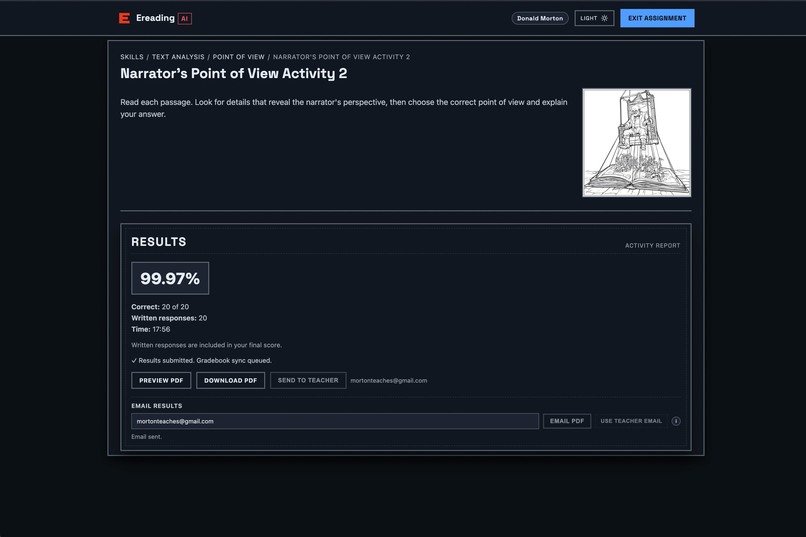
Students can also email or download the PDF from the results screen. The teacher’s email address is pre-populated on assignment creation.
-
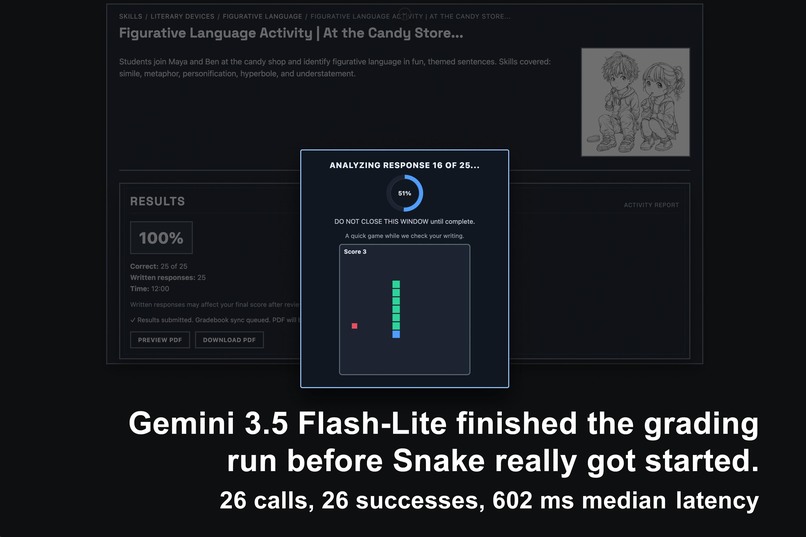
Turns out that the Snake Game needs a slower model.


Inspiration
I have spent more than 20 years teaching and publishing free, ad-supported ELA resources for students and educators.
Having watched ad revenue decline and classrooms become increasingly digital, I realized that I needed to create a more sustainable, future-facing product, one that could do more than a printable worksheet or static webpage.
I've been thinking about the right response for a long time. Ereading.ai is that response: a modern learning engine that preserves the reading, writing, and evidence-based reasoning that teachers trust and value, while also using AI to provide timely written-response feedback at scale.
What it does
Ereading.ai is a content library and learning engine for ELA teachers. Teachers choose a skill, select an activity, configure it for their students, and assign it either through a context-bearing link or directly through Google Classroom.
Students receive the assignment, answer multiple-choice questions, and then support their responses by referring to the text and explaining their reasoning. This structure requires students to think beyond the selected answer.
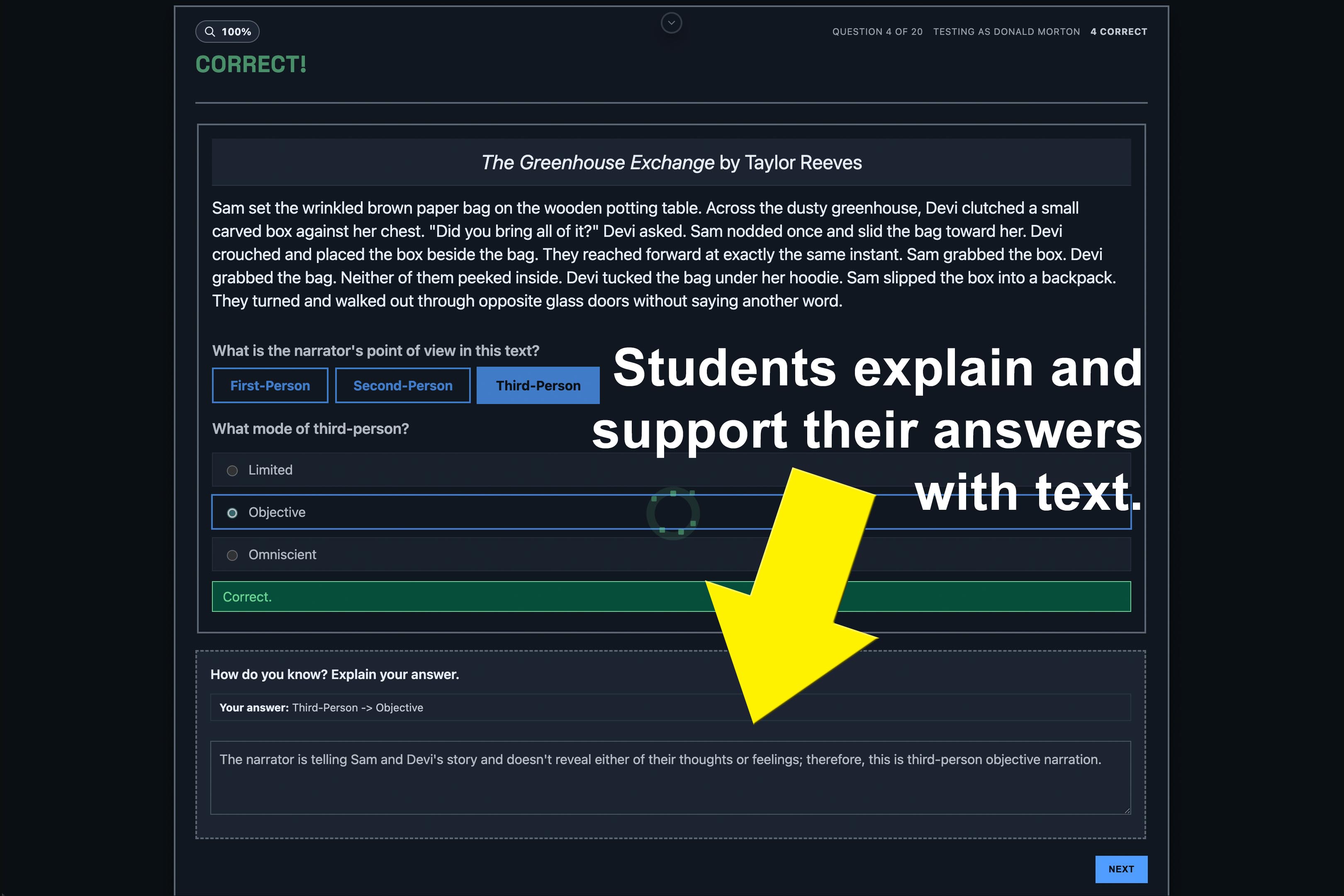
The AI does NOT do the work for students. Students still read, answer, return to the text, and explain as they always have. The breakthrough is that AI tightens the feedback loop for written-response practice. It evaluates student explanations and returns timely feedback, making this kind of practice much more practical at classroom scale.
Gemini functions as the primary production model for grading, feedback, tutoring, and assessment summaries. Additional providers are configured as sequential fallbacks if the primary provider is unavailable.
Schools and teachers differ in their policies, goals, and readiness for AI-assisted instruction and grading. For that reason, Ereading.ai keeps the teacher in control of how AI evaluation is used. The product provides the knobs and switches teachers need to use AI at their own level of readiness.
Teachers can choose from the following options:
Factor AI-generated written-response scores into the total assignment grade at a teacher-selected weight.
Return those scores separately from the objective multiple-choice score.
Provide students with AI feedback without assigning a score.
Disable AI grading entirely.
Though not featured in the demo video, ereading.ai also offers premium student accounts. These student accounts unlock context-aware AI tutoring functions. Before submitting an answer, a student can request a hint. The tutor is instructed to help without giving away the answer. After an incorrect response, it can review the question and the student’s reasoning, explain the underlying concept, and provide additional reinforcement at the moment the misunderstanding appears. This is the point of impact, exactly where misunderstandings should be addressed, and now we can provide those corrections in real time.
In addition to the AI-powered tutoring features, premium student memberships unlock a reward area with all of the popular learning games from ereadinggames.com as well as new games and fun features. Students earn coins by completing learning activities and spend them to play arcade-style games or purchase virtual items for their customizable digital spaces such as an aquarium or bedroom.
Parents and guardians can manage premium student memberships through the family portal, monitor student progress, and configure recurring reports. The system emails family report PDFs at the interval they select. These reports contain AI-generated suggestions for the next skills the learner may benefit from practicing, based on recent performance.
Protecting student privacy
Because Ereading.ai works with student writing, privacy could not be an afterthought. At the AI boundary, the system separates student identity from the educational content needed to perform the task. Gemini receives the relevant passage or activity context, the question, the student's written response when required, and any applicable rubric or instructional criteria. If fallback routing is triggered, the same minimized prompt may be transmitted to a configured backup provider.
We do not add the student's name, email address, Ereading.ai account ID, teacher or school identity, class code, LMS identifiers, IP address, billing data, or result-PDF access token to the model prompt. Our AI telemetry records operational details such as the provider, model, status, and latency, but it does not store prompt text, student answers, or model output.
We also minimize what Ereading.ai retains after the work is complete. A student's display name can remain on our side and appear in the final result PDF, where it is useful to the student and teacher, without being included in the model request. In stored-result workflows, that PDF becomes the canonical detailed record and is delivered through an expiring, high-entropy access link. After the PDF is successfully generated, the system scrubs the raw response, AI feedback, difficulty-tracking, and PDF-generation payloads from its working tables.
Direct anonymous free submissions create neither a stored attempt nor a stored result file. Free LMS and class-code results expire after 14 days, while paid result artifacts follow capped retention windows. I describe this architecture as data-minimized and pseudonymous at the AI boundary, rather than guaranteed anonymous, because a student can still type personal information into a free-form response. I believe we can strengthen this architecture further by adding a local, narrowly scoped PII-detection step that flags or redacts likely identifying information before a student response is transmitted to any model provider. That is an improvement I intend to explore but it is not part of the current submission.
How I built it
I built Ereading.ai with AI coding agents operating under a deliberately structured workflow. I defined the architecture, requirements, constraints, and acceptance criteria. Agents helped plan and implement the work. Additional agents peer-reviewed important changes. I tested the result and made the final decisions.
I wanted to avoid large frameworks and an unnecessary dependency tree, so the core application uses server-rendered PHP, vanilla JavaScript, and CSS. Every third-party dependency required explicit approval, and specialized libraries were used only where they provided clear value.
This approach kept the codebase fast, legible, and easier to inspect. It also reduced dependency churn and supply-chain risk.
Challenges we ran into
I had a lot of fun bringing this product together and launching it. The largest challenge has been expanding the content library without sacrificing quality.
LLMs can accelerate drafting, adaptation, and text leveling, but I don't consider the raw model output publication-ready for learners. I believe that every passage, question, answer, and explanation needs human review and often substantial revision before it is ready to present to learners.
That deliberate review process makes the library grow more slowly, but it protects instructional quality. Each new skill added to the library increases the value of our learning engine. The library is still young, so expanding it carefully and responsibly is the next major task. I want to preserve the magic that won over users and propelled EreadingWorksheets.com to the top of the SERPs. Now that we are utilizing AI-assisted content production, human editorial oversight is the primary bottleneck, but one that I believe is worth preserving.
Accomplishments that we're proud of
I am especially proud of the Google Classroom integration. Teachers can select a class, publish an Ereading.ai assignment, receive the resulting grade back in Google Classroom, and open a linked PDF artifact showing the student’s responses and AI feedback. That technological magic closes the loop between assignment, assessment, feedback, and the teacher’s gradebook.
I have been building educational products for years and had always wanted to create that complete assignment-to-gradebook workflow. The Classroom API previously felt beyond what I could responsibly build and maintain alone. But with the help of AI coding agents and a great deal of testing and review, I was finally able to make it work the way I had always dreamed.
What we learned
I learned many things while working on this project. Perhaps the most valuable thing I learned, however, is that coding agents are extraordinarily capable, but they are not self-governing. My workflow uses multiple frontier coding agents to plan, implement, inspect, and peer-review one another’s work. I define the product requirements, architecture, constraints, and acceptance criteria, and I remain the final reviewer. The agents provide extraordinary speed and technical range. I provide classroom experience, product judgment, and the human sensibility needed to catch UX and instructional blind spots.
That combination works remarkably well. AI allows me to take on integrations and systems that previously would have required a larger technical team. My role is to ensure that what gets built is coherent, useful, safe, and appropriate for teachers and students.
One unexpected UX lesson came from model speed. I built a Snake mini-game to occupy students while an AI grading request was processing. After configuring Gemini 3.5 Flash-Lite as the primary model, I tested it by grading a Figurative Language assignment in production.
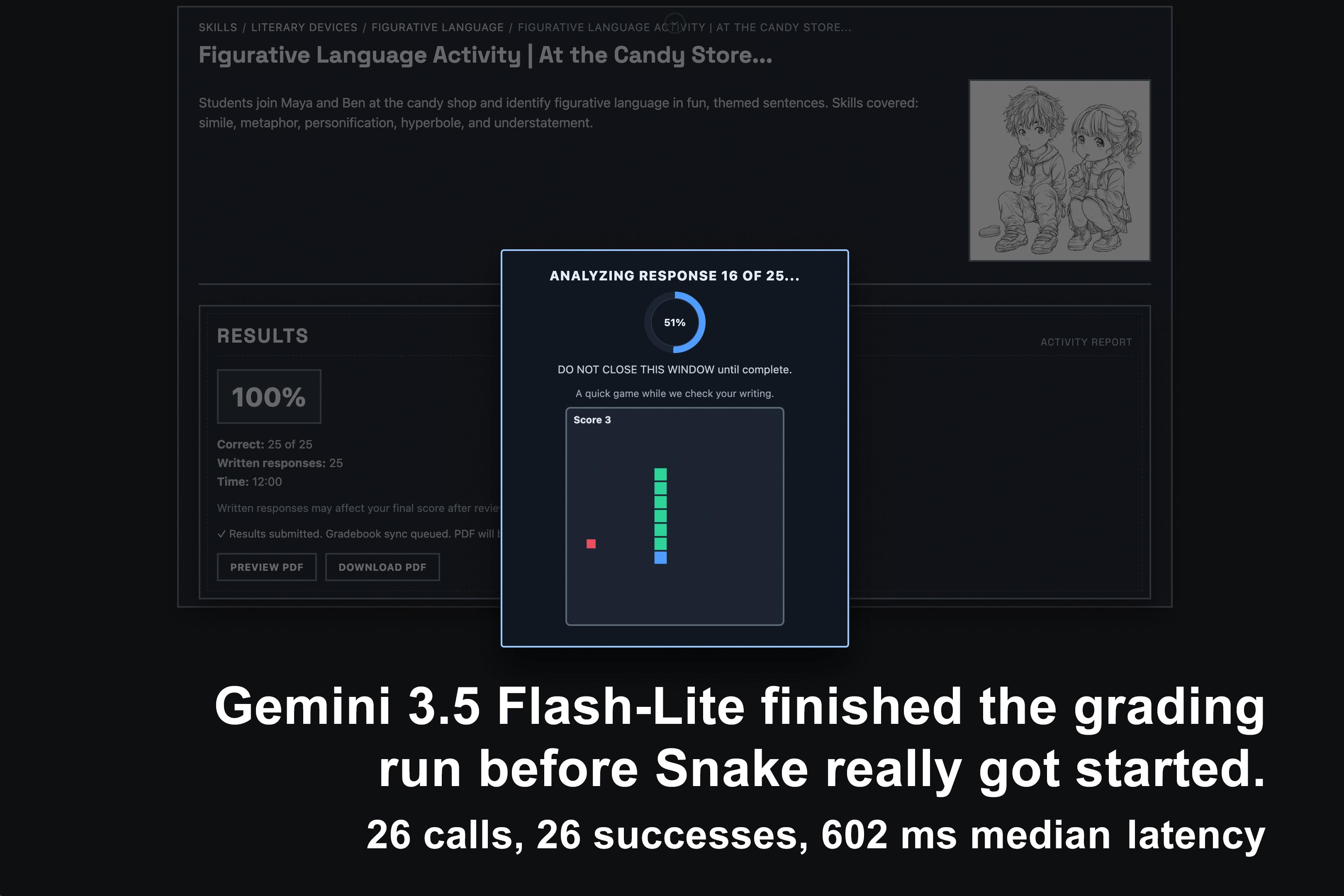
The evaluation returned so quickly that the Snake game barely had time to begin.
That is a good problem to have. It suggests that the wait experience should become progressive: provide feedback immediately when the model responds quickly, and introduce the mini-game only when a request takes long enough to need a diversion. More importantly, the experience demonstrated how close the written-response feedback loop is becoming to real time.
What's next for Ereading AI
My first priority is to make the content library more robust. I know the skills and activity types teachers need. I know how to drill these skills with a blend of objective assessments and written response fields that encourage the use of higher-order thinking skills. The real limiting factor is the time required to write, review, and curate them responsibly.
Growth will be patient and organic. I will continue introducing Ereading.ai to the existing audience of EreadingWorksheets.com as the library expands into the skills and grade bands those users need.
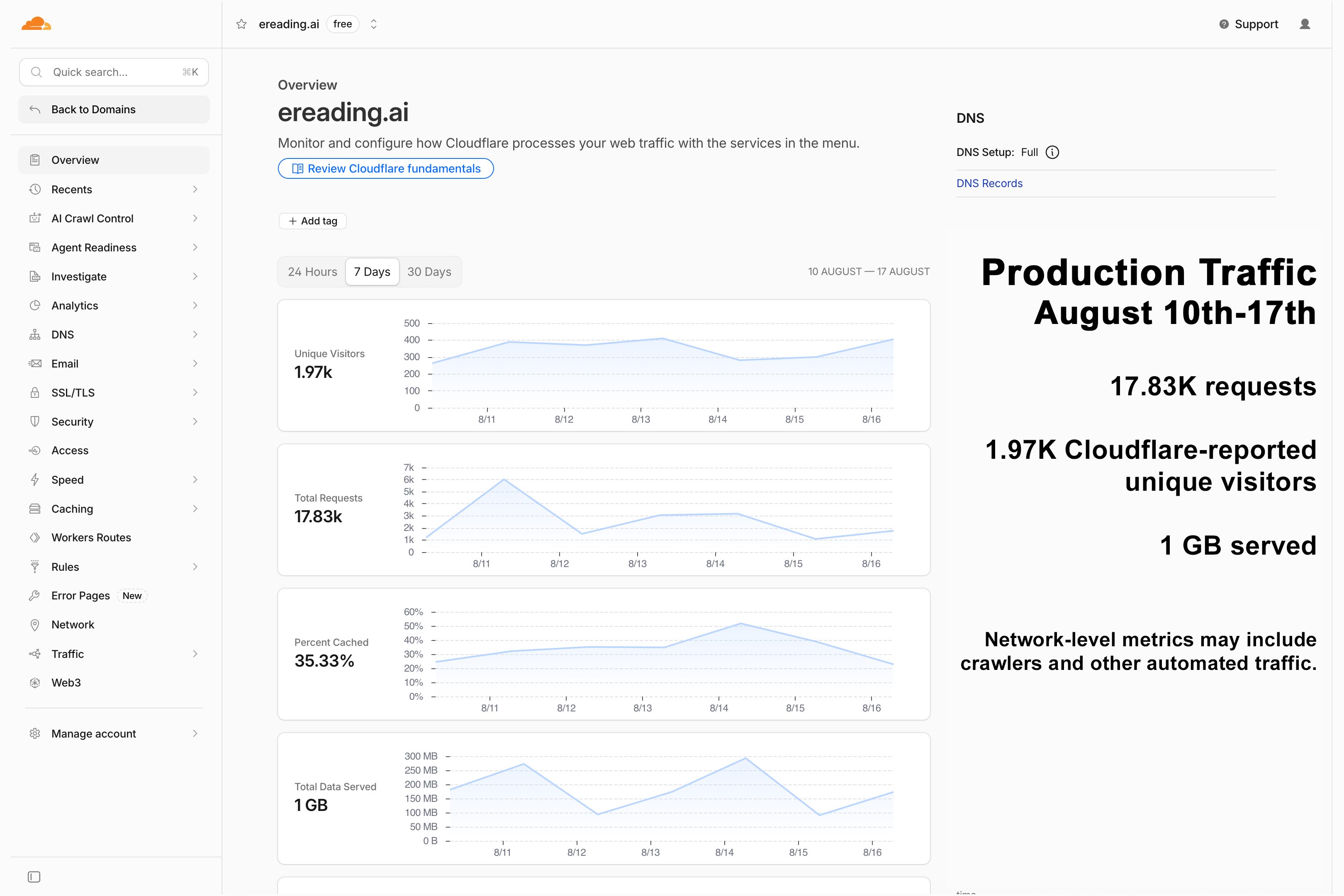
The core product will remain free. Premium teacher memberships unlock AI grading and additional workflow controls. Premium student memberships unlock context-aware tutoring, progress features, and the reward center. Longer term, the same platform creates an opportunity for school and district licensing.
I don't need to force growth before the product earns it. My strategy is to continue improving the library, demonstrate value to the educators already using my resources, and allow adoption and monetization to develop organically.


Log in or sign up for Devpost to join the conversation.