-
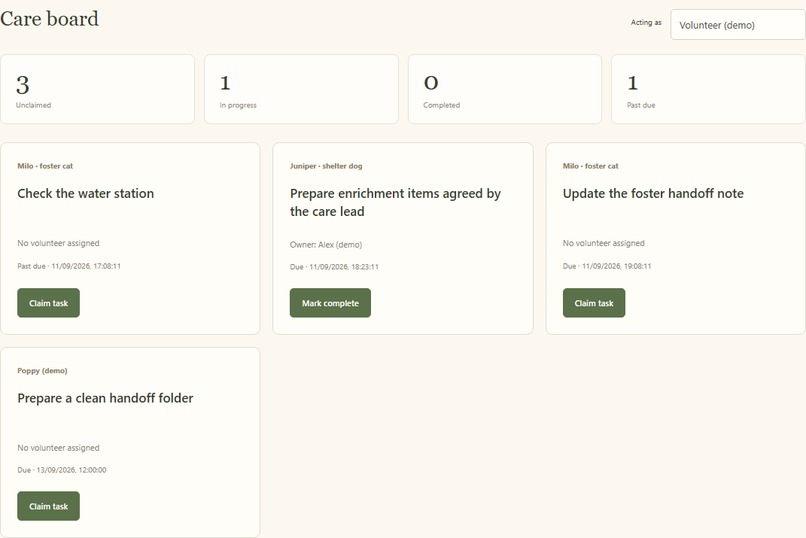
Foster Ledger: working prototype screenshot; demonstration data only.
-
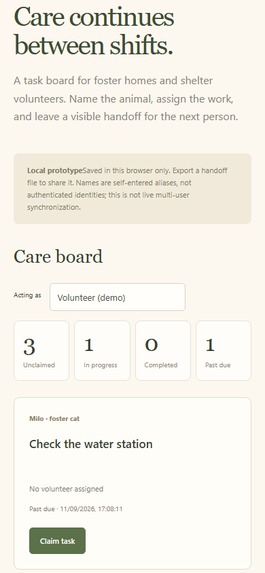
Foster Ledger: working prototype screenshot; demonstration data only.
-
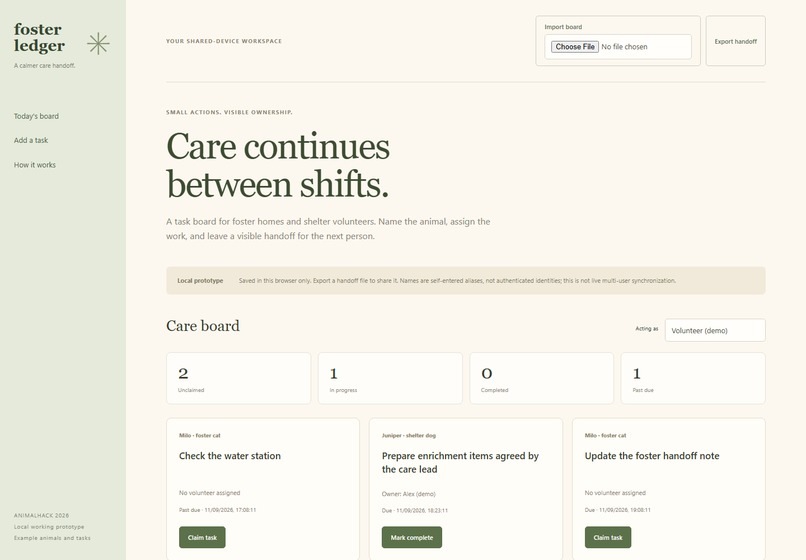
Foster Ledger: working prototype screenshot; demonstration data only.


Foster Ledger
Working prototype · Presentation slides · Source and tests
Inspiration
Foster homes and shelter volunteers need to hand off small responsibilities between people and shifts. A task may be visible without having a clear owner or completion record. Foster Ledger explores that problem as a design hypothesis; no shelter interviews, adoption figures or measured animal-welfare improvements are claimed.
What it does
The working prototype organizes tasks by animal or group, due time, owner and state. A volunteer enters a name or alias, claims an open task, marks claimed work complete, or reopens completed work. The board distinguishes unfinished past-due tasks from completed work. An activity list records the entered actor and action. Users can add tasks agreed by their care lead and export a JSON handoff containing the board and activity.
The board saves in the current browser. A validated JSON import can replace it after confirmation; users should export a backup first. Stale browser tabs are blocked from overwriting a changed board. This is a shared-device and file-handoff prototype, not a real-time collaboration service.
How it was built
The new interface uses HTML, CSS and JavaScript modules with no hosted backend. A separate board model validates imports, enforces state transitions and calculates due-time counts. Input limits cover board size, file size, text lengths, valid dates, required owners and unique identifiers. Displayed task text is inserted as text rather than executable HTML.
Prior work and new AnimalHack contribution
This adapts my existing SlothDO repository, a general task application. Its original Node/Express/MongoDB source and Git history remain available. The original backend is not running in this browser demo.
New AnimalHack work completed September 11, 2026 includes the animal-specific task schema, explicit claim/complete/reopen ownership transitions, due-time review, local persistence, validated handoff import/export, stale-tab write protection, responsive interface, tests, screenshots and presentation. All new application code is under foster-ledger/. Commits record actual work without backdating. OpenAI Codex assisted with implementation, tests and documentation.
Validation and limitations
Four model tests cover ownership transitions, invalid actions, overdue counts and malformed imports. Browser checks cover claim/complete/reopen, persistence across reloads, stale-tab protection, adding a task, export, invalid and valid imports, and mobile layout.
Example animals and tasks are fictional. Names are self-entered aliases, not authenticated identities. Local storage and exported files are editable, so the activity list is not an immutable audit trail or proof that care occurred. Concurrent writes are not a distributed transaction system. Do not enter sensitive adopter or veterinary records. There are no veterinary recommendations, medication instructions, emergency alerts or automatic monitoring.
Next steps and presentation
The next step is to interview volunteer coordinators and test whether explicit ownership and portable handoffs reduce missed responsibilities without adding excessive administration. Authentication and reliable shared synchronization would need a separate implementation and evaluation. No pilot has been conducted yet.
The live prototype and three-slide presentation are ready for the AnimalHack online presentation. The entrant is available for online judging on September 13. Presentation registration and attendance are separate organizer requirements; this project description does not claim they have already occurred.
Built With
- css
- html
- javascript
- node.js
- openai-codex
- playwright


Log in or sign up for Devpost to join the conversation.