-
-
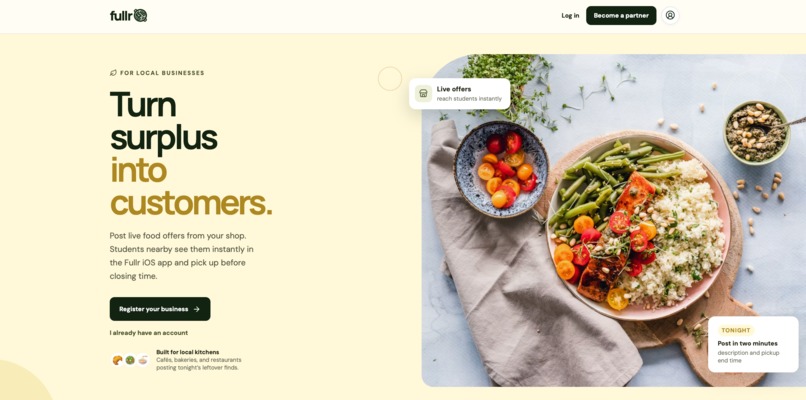
web landing page
-
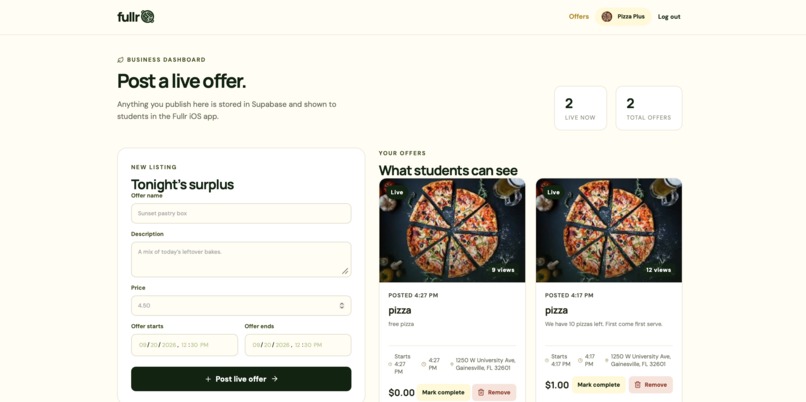
business dashboard
-
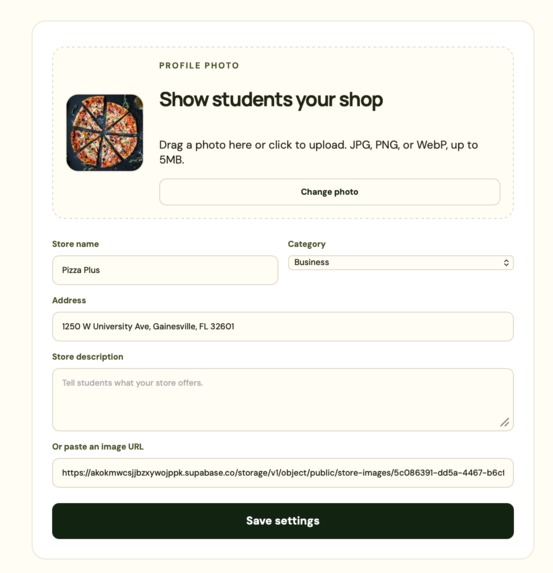
business profile settings
-
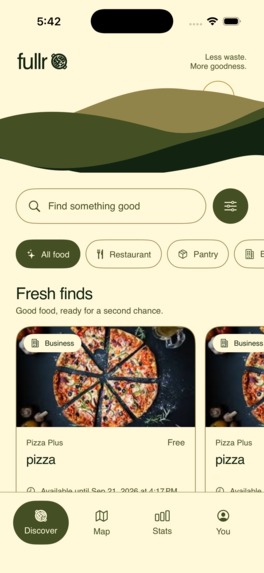
iOS home page
-
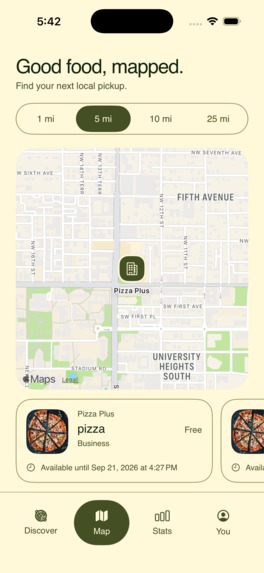
food map
-
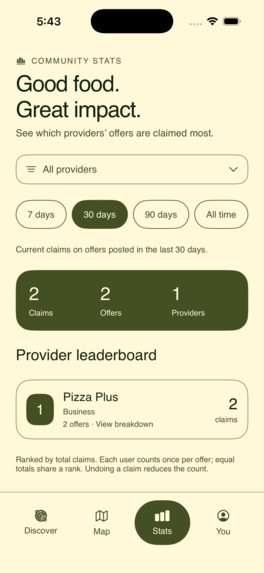
community stats and top provider leaderboard


Inspiration
At the end of the day, restaurants and businesses have to throw away their leftover food, resulting in about 120 billion pounds of food being wasted annually in the United States (30-40% of the food supply according to the USDA). Meanwhile, there are countless food-insecure college students looking for discounts and cheap food around campus.
College students experience food insecurity at disproportionately high rates, often because the costs of tuition, housing, transportation, and food place significant strain on limited student budgets. Across campuses in the U.S. it is reported that 19% to 56% of students are impacted by food insecurity. Because food insecurity can affect students’ academic performance, physical health, and mental well-being, it is a vital issue that needs to be addressed.
For many students, the perceived stigma of being food insecure can be a reason for them not to seek assistance. Thus, we designed Fullr specifically to feel like a high-quality food delivery app in order to subvert this stigma, with branding that doesn’t make direct reference to food insecurity.
The app is targeted towards local businesses, giving them an opportunity to recover revenue from food that would otherwise go to waste and build rapport with their community. At the same time, students can access affordable food from businesses in their area. Students register using their school-affiliated email addresses and receive a confirmation email to verify their student status.
What is Fullr?
Fullr is an app designed to connect local businesses with college students while helping reduce food waste. Businesses can register on the Fullr website and post discounted offers for food that they have left over and would otherwise have to throw away. These offers are then made available through the Fullr app, where students can browse nearby deals and visit the business to claim them.
The mobile app is oriented around the student experience. The home page provides students with a quick overview of available offers, including offers from their favorite businesses, a compact map showing nearby offers, featured listings from local businesses, and a leaderboard highlighting participating businesses.
Students can tap into each section to access a more detailed view. The map can be expanded to show nearby offers and their locations, while the leaderboard can be expanded to provide more information about participating businesses.
By bringing these features together in one platform, Fullr aims to make it easier for students to find affordable food while helping local businesses recover revenue and reduce the amount of food they throw away.
How we built it
Fullr was built using Swift for the iOS app for consumers, and JavaScript for the web app for businesses. It's backed by Supabase and deployed on Firebase.
The project is split into two repositories, one for the mobile app (built entirely in Xcode using native Swift) and one for the website (built with ReactJS and Vite). Databasing was accomplished with Supabase, which houses users, stores, and offers. Both the web and mobile app interact with the same instance of Supabase for atomicity of information. Supabase also handles email verification for both registration flows. All assets were developed in Figma and imported directly into the repositories for the website and app.
Challenges we ran into
Finding an acceptable schema for the database was a challenge, as initially we wanted all users to be registered in the same table for simplicity. This posed challenges for distinguishing between authentication flows when logging a user into each app, and there were several iterations of the schema during the development process before settling on the current implementation which designates a separate table for owners (titled “users”) and students (titled “students) and using specific triggers to route registration and login to the right table.
Another challenge was geocoding. Business owners may freely type their address upon registration, which poses challenges for accurately mapping locations to the iOS native maps using the Swift Geocoding library.
Accomplishments we're proud of
• Working user authentication and verification
• Comprehensive and ACID compliant database
• Successfully implemented mobile geocoding
• Visually appealing user interface that feels integrated with the Apple design ecosystem
• Leaderboard system that rewards businesses for continually offering their surplus
Overall, we're proud to be able to play a small role in reducing global food wastage and giving back to our college community.
What's next?
The initial roll-out of the app will be catered towards University of Florida students. However, given that the app succeeds at UF, we would like to expand the app to other schools and businesses across the country, in the hopes of reducing the effects of food insecurity and waste nationwide.
Built With
- firebase
- html
- javascript
- node.js
- plpgsql
- supabase
- swift


Log in or sign up for Devpost to join the conversation.