-
-
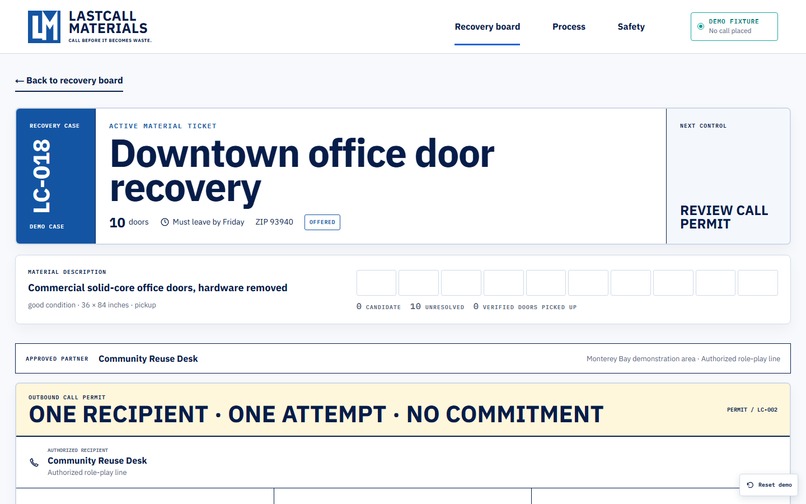
One-recipient CALL-E permit: approved partner, narrow questions, no commitment, and explicit human authorization.
-
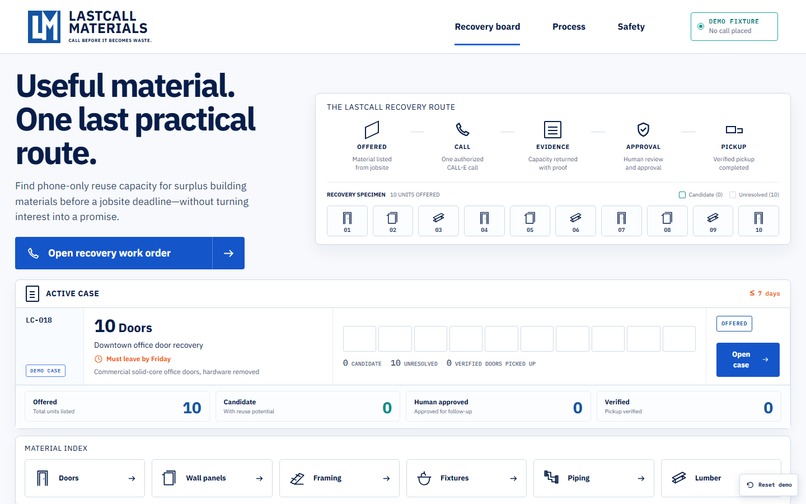
Recovery dashboard: 10 offered, 0 candidates, 10 unresolved, and 0 verified before the CALL-E workflow.
-
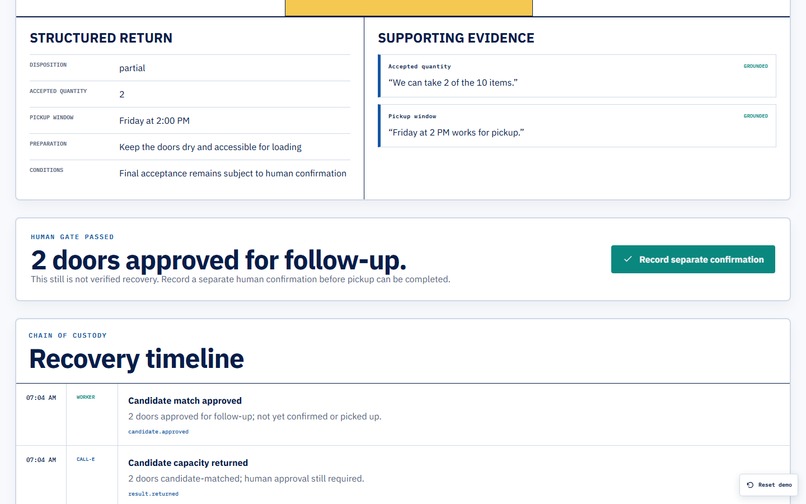
A worker approves 2 candidates for follow-up; the verified recovery total remains 0.
-
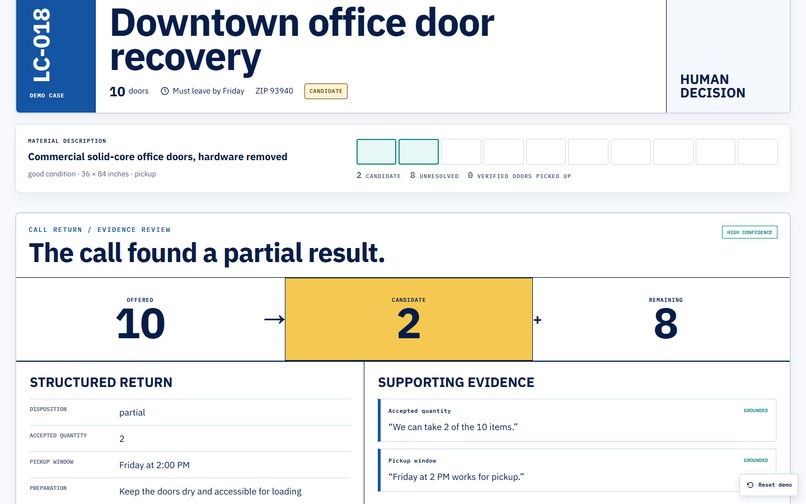
CALL-E evidence returns a partial result: 10 offered → 2 candidates + 8 unresolved, with supporting evidence.
-
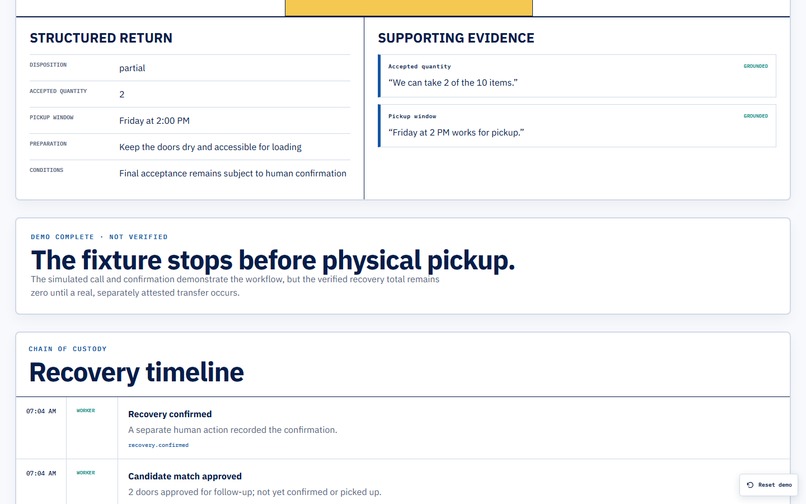
The demo stops before physical pickup. Only separately attested pickup can increase verified recovery.


Inspiration
Usable building materials are often discarded because crews face a hard removal deadline while reuse organizations’ real capacity, preparation rules, and pickup windows exist only on the phone. Small community organizations should not need another portal for a contractor to get a useful answer.
What it does
LastCall Materials lets a contractor describe a safe, non-hazardous material lot, select an approved reuse partner, review a narrow call brief, and authorize one CALL-E discovery call.
CALL-E asks only about quantity, condition, preparation, timing, and pickup or drop-off. Its response becomes a structured, evidence-backed candidate—not an automatic commitment.
The signature case starts with 10 reusable office doors that must leave before Friday. A partial response for 2 doors becomes:
- 2 candidate-matched
- 8 still unresolved
- 0 verified picked up
The same workflow supports wall panels, non-structural framing, fixtures, piping, lumber, and other reusable components.
How we built it
The application uses Next.js, React, strict TypeScript, Zod, and a worker-centered interface inspired by work orders, dispatch tickets, blueprint markings, and material ledgers. Pure domain transitions keep offered, candidate, approved, confirmed, and picked-up quantities separate.
A shared provider contract supports deterministic fixtures and a server-only adapter for the official authenticated CALL-E CLI. The public Fly.io deployment is intentionally fixture-safe: judges can test the complete workflow without credentials or dialing anyone. Every fixture screen states that no call was placed. For live proof, a protected loopback-only website action invokes the same server route and provider contract.
Vitest and Playwright cover partial allocation, invalid provider results, authorization invalidation, idempotency, hazardous-material exclusions, evidence handling, mobile behavior, and the complete judge path.
CALL-E at runtime
A protected local website action invokes the official CALL-E CLI for one allowlisted, role-play-authorized phone number. The operator must use the loopback-only site, enter a private key, review the permit, and explicitly authorize one call. The browser never receives the phone number, authentication token, provider run ID, or raw provider payload.
CALL-E performs the disclosed natural-language conversation. Its sanitized structured result returns through the website, where deterministic TypeScript validates evidence and changes the quantity state. We completed an authorized one-phone proof call for the demo scenario: the role-play reuse center could potentially accept 2 of 10 doors with pickup Friday at 2 PM.
Safety and human control
- Approved or explicitly authorized recipients only
- One recipient, one attempt, and duplicate-call protection
- AI identity and narrow purpose disclosed
- No arbitrary phone-number input
- No hazardous, contaminated, structural, or regulated materials
- No reservations, payments, valuations, tax statements, or automatic promises
- Unknown or contradictory answers stop for human review
- Only a separately attested physical pickup can increase verified recovery
Challenges we ran into
The hard part was not merely making a phone call. It was turning a variable conversation into trustworthy application state without overstating impact. Partial acceptance, conflicting evidence, duplicate events, and the difference between interest and completed pickup all needed explicit rules.
Public hosting also cannot safely rely on a developer’s local CALL-E authentication. We solved that with one provider boundary: a protected local live action and deterministic public fixtures that exercise the same validated domain path.
Accomplishments that we're proud of
- A real authorized CALL-E proof call
- Honest 10 → 2 candidate + 8 unresolved + 0 verified accounting
- Evidence and confidence beside consequential facts
- Human approval before any commitment
- A public judge experience that is safe and testable at any time
- An original white-and-labor-blue design built for tradespeople and community reuse work
How we used AI and Codex
CALL-E handles the disclosed, narrow phone conversation and returns structured evidence. It does not control commitments, pickup confirmation, or quantity accounting. Codex helped scope, implement, test, red-team, document, and prepare the project. Deterministic application code—not a language model—owns validation, authorization, idempotency, and the material ledger.
What we learned
Phone automation becomes useful when the product around it is disciplined. The call can discover fast-changing capacity, but deterministic software must own validation, quantity math, authorization, and accountability.
What's next
Next we would onboard additional reuse organizations, add durable multi-user storage, support human-reviewed material photos, and extend the controlled live integration while preserving allowlists, consent, and human approval.
Built With
- call-e
- fly.io
- next.js
- playwright
- react
- typescript
- vitest
- zod

Log in or sign up for Devpost to join the conversation.