-
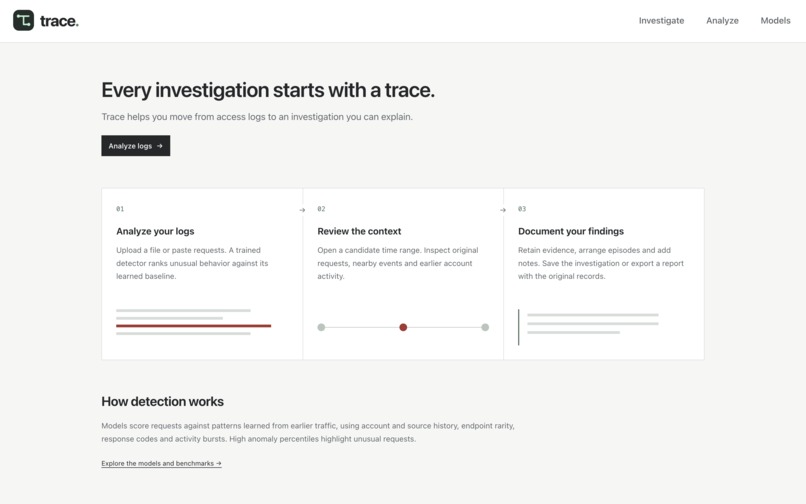
Home page
-
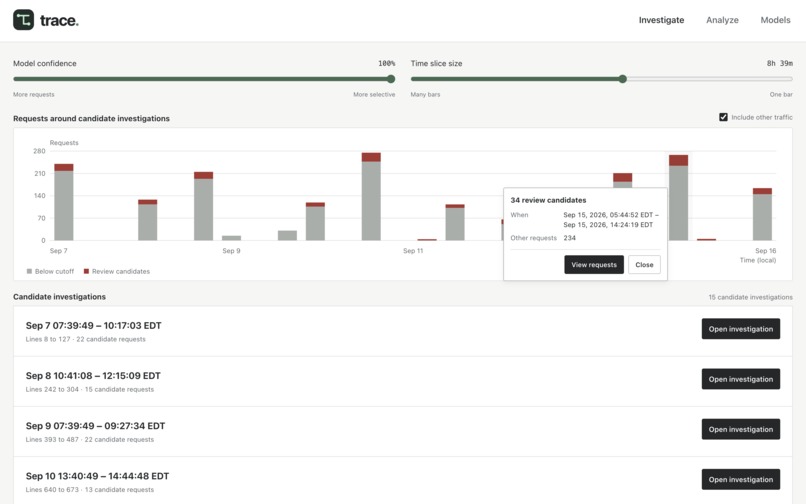
Analysis page
-
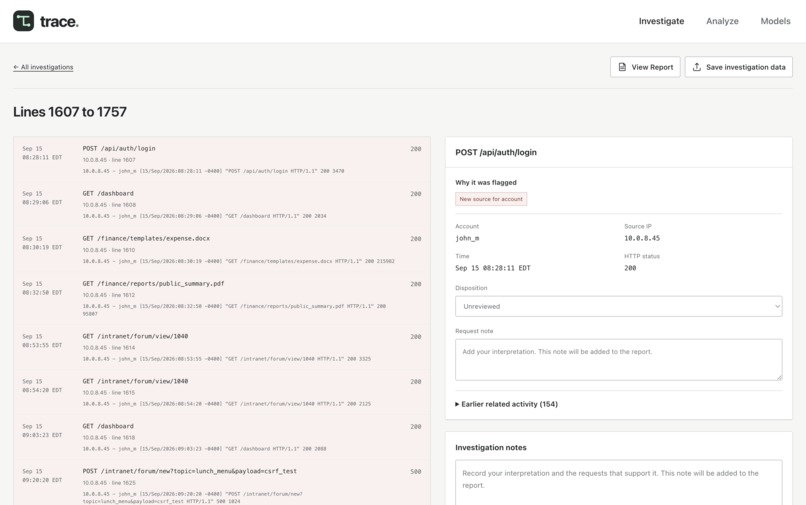
Investigation page
-
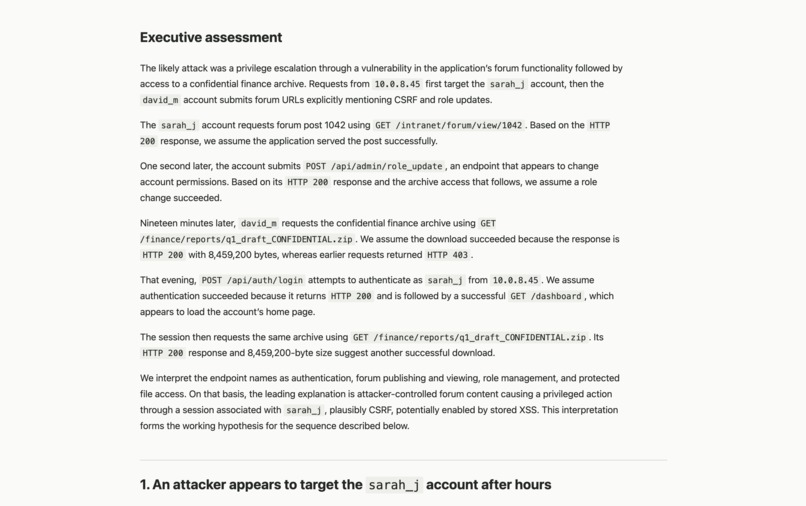
Example report


Inspiration
Humans need help analyzing data logs. Doing this is tedious work, which is why automation and AI for completing these kinds of tasks is really useful in saving time and money for professionals.
How we built it
We did a comparative analysis of different models and different architectures. Below are some of the results that we obtained:
| Model | View | PR-AUC | 95% CI | Recall@50 | Notes |
|---|---|---|---|---|---|
| Deep AE ensemble (×7) | CTX | 0.918 | [0.79, 1.00] | 20/22 | GPU, best recall (21/22 at op point) |
| GMM (k=4, diag) | CTX | 0.909 | [0.77, 1.00] | 20/22 | trains in <1s, no GPU, recommended |
| Ensemble | CTX | 0.907 | [0.77, 1.00] | 20/22 | no better than GMM alone |
| RuleNovelty (no ML) | CTX | 0.867 | [0.71, 1.00] | 19/22 | interpretable, best ROC (0.990) |
| ECOD | CTX | 0.862 | [0.70, 0.99] | 19/22 | |
| KMeans | CTX | 0.836 | — | 20/22 | |
| GPT-5 (blind LLM) | — | 0.324 | — | 10/22 | recall 0.77, precision 0.07, $4.72/run |
| Claude Opus 5 (blind LLM) | — | ≤0.11* | — | 6/22 | recall 0.77, precision 0.03, 614 FPs; *partial run (154/192 windows, credit exhausted) |
| KMeans | RAW | 0.646 | — | 16/22 | same algorithm, naive features |
From this analysis, we chose to use GMM and Deep AE as the model architectures that are best suited for this task. To further enhance the performance of the GMM model, we also added OpenAI API (GPT-5) capabilities for further triage assistance to reduce the number of false positives that the GMM model could potentially provide.
Challenges we ran into
- Frontend design/implementation
- Connecting the backend and frontend together
- Sleep...
Accomplishments that we're proud of
We were able to build a fully functional and ready-to-go product that provides real insights (reports) and that is 100% scalable (can be also used for other data types/structures as well).
What we learned
AI is a cool tool to implement and use for cyber security logging, monitoring and analysis and is useful in helping detecting anomalies and driving decisions and impacts for humans to make.
What's next for Trace
What's next is to continually improve the frontend and obtain feedback from professionals who could potentially use this tool for their own logs and hook this up with existing services and platforms.
Additionally, maybe we could import some datasets with labels and train supervised learning models (depending on data availability).
Furthermore, we could also scale the backend further, caching past investigations/results as well as having users accounts and so on.
Lastly, for the unsupervised learning models, more data and more logs are necessary to make further model improvements.
Challenge Dataset
View the full report at https://trace.cooking/final_htn26_report
Built With
- css
- flask
- html
- javascript
- numpy
- pandas
- pyod
- python
- pytorch
- railway
- scikit-learn
- scipy
- vercel


Log in or sign up for Devpost to join the conversation.