-
-
Welcome Screen
-
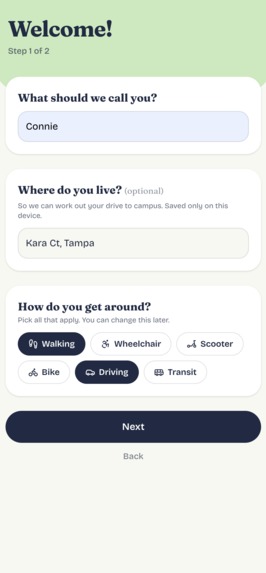
Welcome: Tell us your name, where you live, and how you usually get around
-
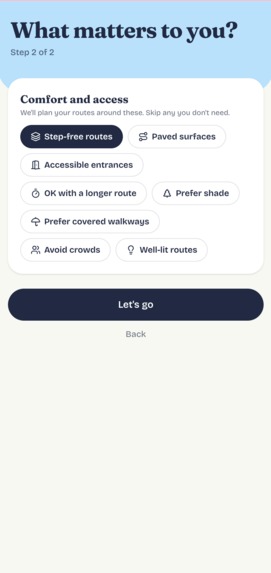
What matters to you: Pick what you need: step-free paths, wheelchair mode, whatever fits
-
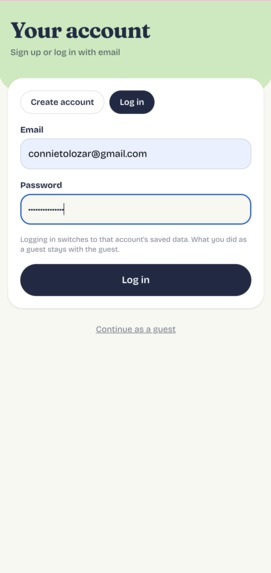
Your account: Sign up or just continue as a guest, your stuff stays either way
-
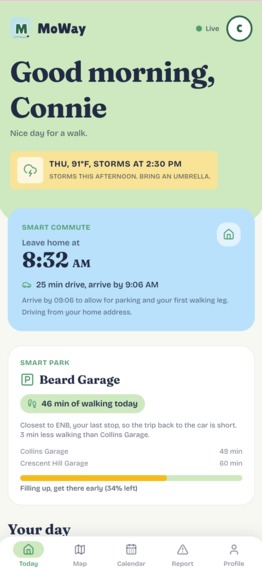
Today (greeting). Your day at a glance: leave by time, live weather, and Smart Park in one screen.
-
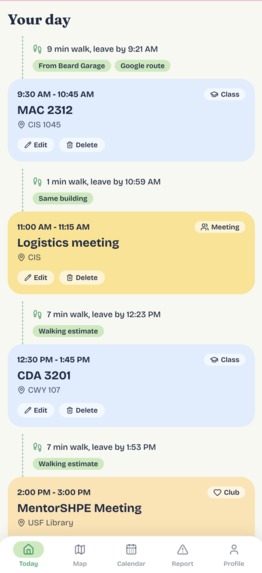
Your day: Your whole schedule with walk times between classes built in
-
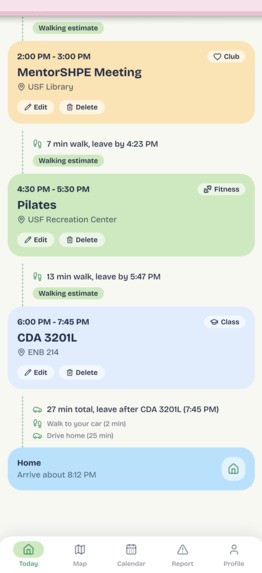
Timeline: Color-coded so you can tell what's a class, meeting, or club at a glance
-
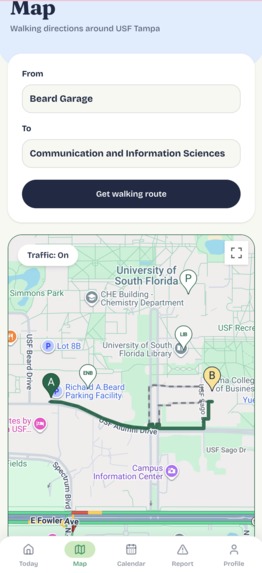
Map with traffic/pins: Traffic overlay plus every building nearby, so you always know where you're going
-
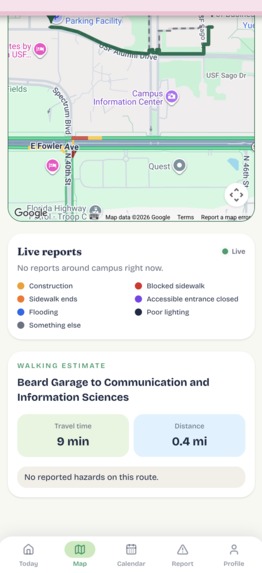
Live reports card: Nothing reported near campus right now — legend shows what to watch for if something pops up
-
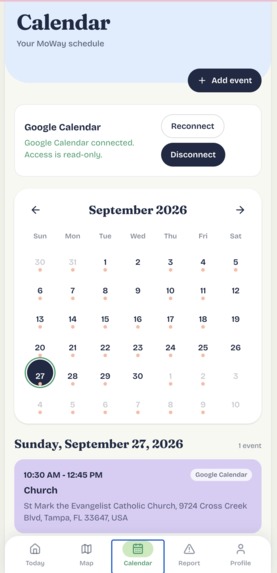
Calendar integration with Google
-
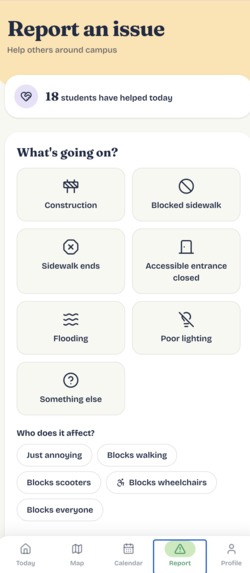
Report tab: Pick what's wrong and who it affects, from construction to a blocked entrance
-
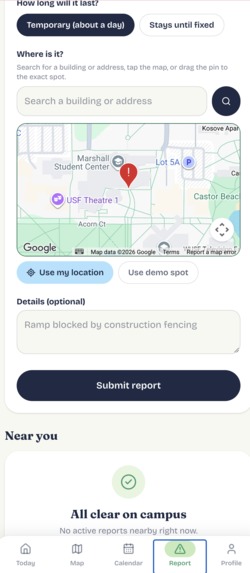
Pin the location: Search for the spot or drop a pin yourself, right where the problem is
-
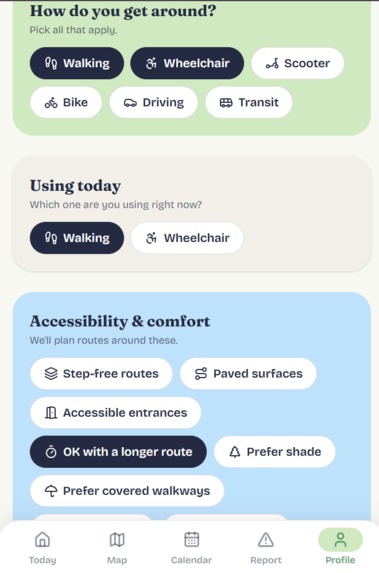
Profile containing your transportation preference. Route recommendation takes this informaiton into consdieration.
-
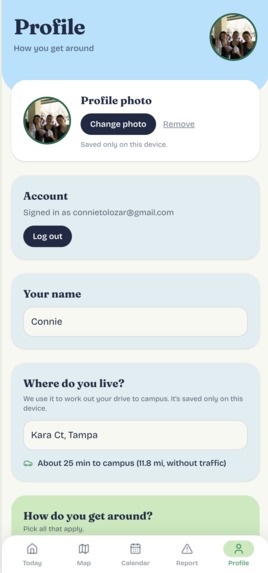
Profile
-
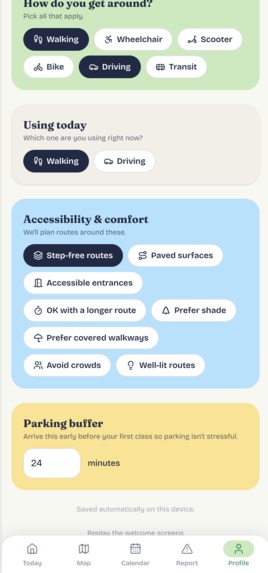
Accessibility & comfort: How you get around, today's mode, and how much buffer you want before parking fills up


Inspiration
Transportation on and around campus can be harder than it looks. One of us regularly uses a scooter at USF, and we have run into situations where a route suddenly leads somewhere that is easy to cross on foot but unsafe or impossible on a scooter. A pedestrian can sometimes cut through grass or uneven terrain, but someone on a scooter or using another mobility method needs an actual accessible path.
That started our idea, but we quickly realized we didn't want MoWay to solve transportation for only one type of person. Students walk, drive, bike, scooter, and have different accessibility needs and preferences. Even something as simple as wanting to avoid walking in the Florida sun can change what the "best" route means.
Google Maps can tell us how to get somewhere, but it doesn't understand our entire day as students or everything happening on campus. We wanted transportation to adapt to the student, instead of students constantly having to adapt their day around transportation.
What it does
MoWay is a campus mobility assistant that connects your schedule, transportation preferences, campus conditions, and commute to help plan how you move throughout your day.
Students can connect their Google Calendar and see their schedule alongside events created directly in MoWay. Based on where they need to be, MoWay helps plan their day, recommends parking based on their destinations, and adjusts transportation and route information based on how they prefer to travel.
Community reporting was inspired by the idea behind Waze. Students can report things happening around campus, including transportation and accessibility blockers. Those reports can then affect route decisions for other students instead of everyone discovering the same problem individually.
The goal isn't just to answer "How do I get there?" It's to answer "Given my schedule, how I travel, where I should park, and what's happening on campus, what's the best way to get through my day?"
How we built it?
We built MoWay with Next.js, TypeScript, Supabase, Google Maps, and Google Calendar. Google Calendar gives MoWay context about a student's day, while our routing, transportation modes, Smart Park recommendations, and community reports help determine how they should move through campus. We also built persistent Google Calendar synchronization so schedules can stay up to date instead of relying on a one-time import.
Challenges we ran into
This was our team's first 36-hour hackathon away from home. Between sleeping on air mattresses, finding time to shower at the rec center, and building through the night, it was definitely memorable.
Our project also grew quickly from one transportation idea into several connected systems. Keeping up with everyone's work and making Calendar, maps, reports, parking, routing, and the UI feel like one product became one of our biggest challenges.
Accomplishments that we're proud of
Our favorite accomplishment was seeing MoWay affect a real decision. While testing, MoWay recommended Connie park in a different garage based on the locations of her classes. She realized it actually made more sense for her day and plans to change where she parks.
We're also proud of watching everything come together: changing from walking to scooter changes the route experience, reports can influence trips, and a connected calendar gives MoWay context about the whole day.
What we learned
We realized there are a million ways to get somewhere—the challenge is choosing the right one for that person and that moment.
We also learned a lot technically, especially through building Google Calendar synchronization, while learning how to collaborate quickly on a project where everyone's work depended on everyone else's.
What's next for MoWay?
We built MoWay around USF, but we don't want the idea to stop at one campus. We imagine a version where a student selects their university and MoWay adapts to that campus's buildings, parking, transportation options, and community—similar to how campus-based platforms personalize themselves around a student's school.
At USF, one of our biggest next steps would be deeper parking integration. Anyone who commutes here knows that finding parking can become part of the morning routine. We'd love for Smart Park to eventually consider live parking availability alongside a student's schedule, so it could recommend not only the best garage for their day, but one where they can actually find a spot.
We also want to support additional calendar providers, expand accessibility-aware navigation, incorporate more official campus transportation and construction information, and grow the community reporting system. The more students participate, the more useful those real-time reports become for everyone else. Ultimately, we want MoWay to understand enough about a student's day that transportation becomes one less thing they have to plan.
Students already have enough to think about. Their transportation should adapt to their day—not the other way around.
Built With
- api
- calendar
- maps
- next.js
- oauth
- react
- supabase
- typescript


Log in or sign up for Devpost to join the conversation.