-
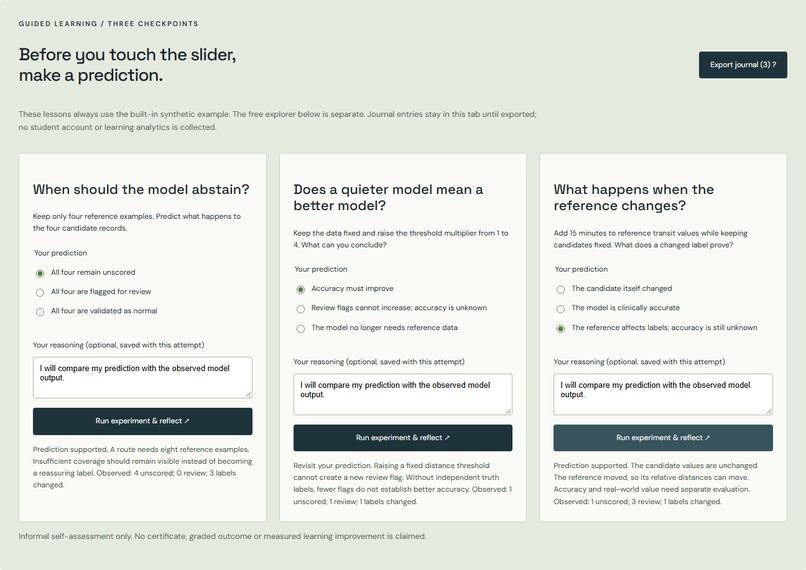
Reference Classroom: working prototype screenshot; demonstration data only.
-
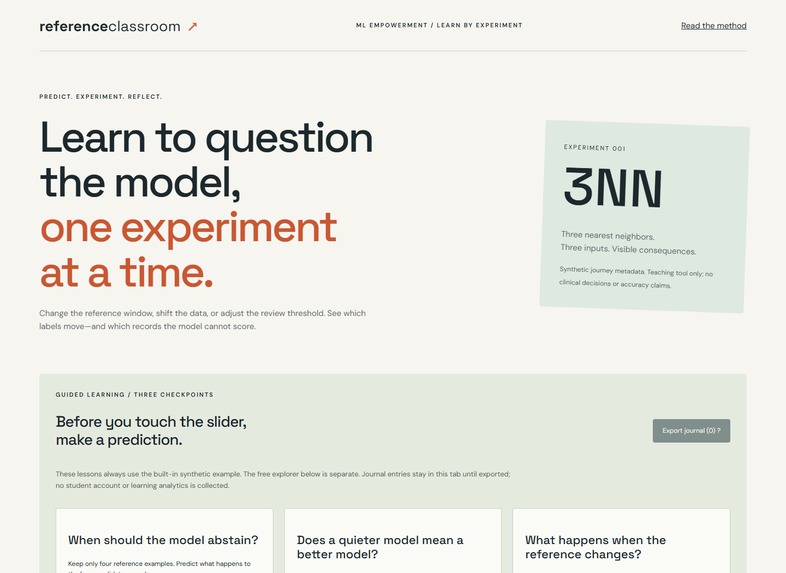
Reference Classroom: working prototype screenshot; demonstration data only.
-
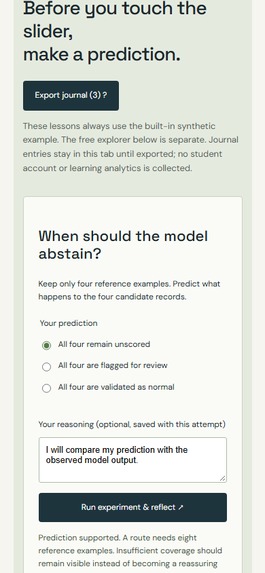
Reference Classroom: working prototype screenshot; demonstration data only.


Reference Classroom
Working classroom · Source, tests and provenance
Problem and target users
Students can learn to operate an AI interface without learning when to question its output. Reference Classroom is a free browser-based teaching prototype for students and educators exploring anomaly detection. Its intended social contribution is accessible, hands-on model literacy. It has not been evaluated in a classroom, and no learning improvement is claimed.
Solution and key features
Three guided lessons ask learners to make a prediction before seeing a computed result. Learners explore insufficient reference coverage, raising a review threshold and shifting reference data. They can write an optional explanation, run the model, compare their prediction with the actual result, and export a learning journal containing predictions, feedback, reflections, parameters and outputs.
Incorrect predictions remain in the journal so they can support discussion. The journal is informal self-assessment, not a certificate or a grade. Guided lessons always use the built-in synthetic dataset. A separate free explorer allows reference-window, threshold and shift experiments, nearest-reference inspection and dataset imports.
AI/ML and technology
The working model is route-specific three-nearest-neighbor anomaly detection with robust feature scaling and a reference leave-one-out threshold. Too few references produce an unscored result. The application uses JavaScript modules, HTML and CSS, with Node tests and Playwright browser checks. It runs without a hosted inference service or student account. Reflection text stays in the current tab until the learner exports it; the app collects no analytics.
New ML Empowerment contribution and prior work
This extends my Reference Lab Hyperbloom project. Its free explorer and experiment engine are prior work, and the underlying model comes from Custody Lens/MED-BLACKBOX. Original source history and attribution are preserved.
New ML Empowerment work on September 11, 2026 includes the guided prediction workflow, model-backed lesson feedback, retained incorrect answers, optional reasoning fields, exportable learning journal, classroom interface, lesson tests and documentation. The new files are reference-lab/lessons.mjs and classroom.mjs, with changes to the teaching interface. OpenAI Codex assisted with implementation, testing and documentation. Amrit Lahari, BITS Pilani, is the sole entrant.
Validation, limits and next steps
Four new lesson tests check actual abstention results, incorrect-answer preservation, reproducible shift parameters and invalid inputs. Inherited model and experiment tests also pass. Browser checks cover the three lessons, feedback, journal contents and mobile layout.
All examples are synthetic. There are no independently labeled outcomes, accuracy claims or clinical decisions. The reference window is order-dependent and may be biased. Names and routes in imported files are not anonymized; learners should use non-sensitive teaching data. The next step is educator review followed by consented usability sessions, accessible lesson refinement and an evaluation of learning outcomes. These activities are planned, not completed.
Built With
- css
- html
- javascript
- k-nearest-neighbors
- node.js
- openai-codex
- playwright


Log in or sign up for Devpost to join the conversation.