-
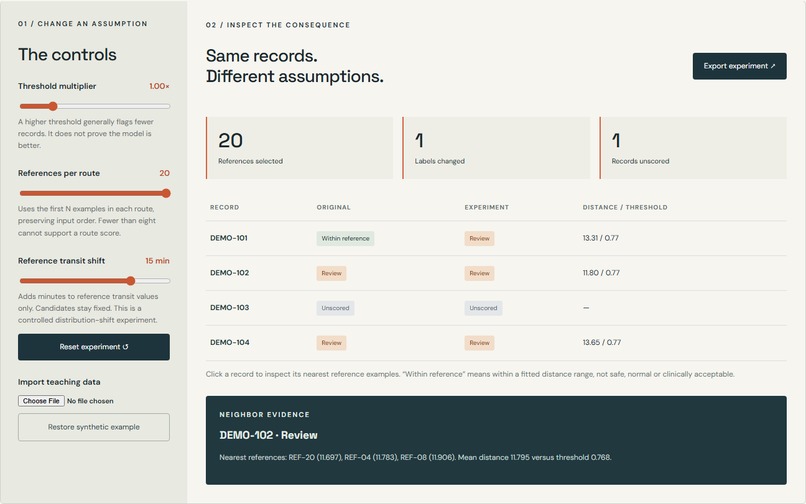
Reference Lab: working prototype screenshot; demonstration data only.
-
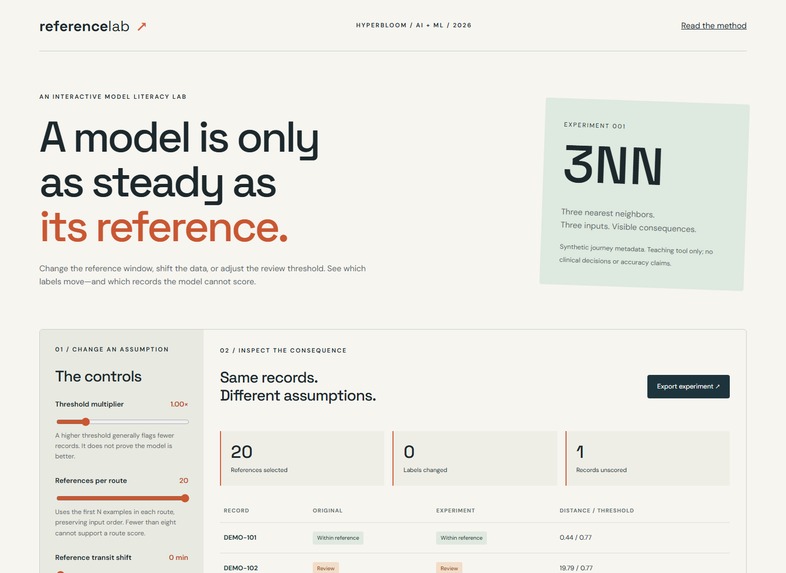
Reference Lab: working prototype screenshot; demonstration data only.
-
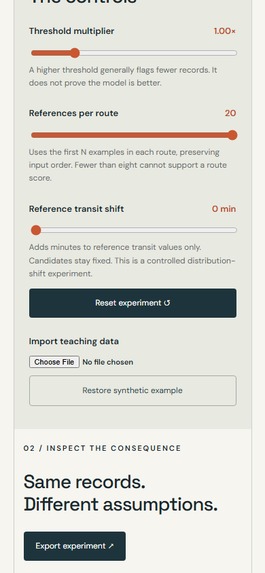
Reference Lab: working prototype screenshot; demonstration data only.


Reference Lab
Interactive experiment · Source, tests and prior-work record
Problem and intended users
Students learning anomaly detection can mistake a model flag for an objective truth. Reference Lab makes three hidden assumptions visible: which examples define the reference, how reference values shift, and where a review threshold is placed. It is an interactive model-literacy tool, using synthetic journey metadata instead of patient records.
What works
Adjust the per-route reference window, add a controlled transit-time shift to references while keeping candidates fixed, and change the distance-threshold multiplier. Compare original and experimental labels side by side, inspect nearest reference examples, and export the exact dataset, parameters and results as a reproducible JSON experiment. Import other synthetic teaching datasets or reset the example. Unsupported routes stay unscored.
AI/ML at the core
The model computes mean three-nearest-neighbor distance over transit minutes, queue minutes and missing scans. It uses robust feature scaling and a leave-one-out reference 95th-percentile threshold. Each route requires eight examples. The lab demonstrates how reference selection and threshold choices affect model behavior; a higher threshold is not evidence of better accuracy.
Prior work and new contribution
The model is prior work from my Custody Lens UnivaBio adaptation, itself based on MED-BLACKBOX. Original source, attribution and history are preserved. New Hyperbloom work on September 11, 2026 is the experiment engine, controlled reference-shift simulation, parameter interface, label comparison, neighbor inspection, reproducible export and teaching documentation. It is not a claim that the underlying model was first created here.
Validation, limits and team
Four experiment tests cover baseline reproduction, sparse-reference abstention, threshold monotonicity, reference shifts and invalid settings. Browser checks cover controls, evidence selection, imports, export, reset and mobile layout. All examples are synthetic. There are no truth labels, clinical accuracy figures, user-study results or health decisions. The window is order-dependent, and imported identifiers are not anonymized. Processing stays in the current browser tab.
Amrit Lahari, BITS Pilani, is the sole entrant. OpenAI Codex assisted with implementation, testing and documentation. Next steps are student usability sessions and lessons on reference bias and evaluation with independently labeled data. The organizer's post-event tools survey remains a future follow-up.
Built With
- css
- html
- javascript
- k-nearest-neighbors
- node.js
- openai-codex
- playwright


Log in or sign up for Devpost to join the conversation.