-
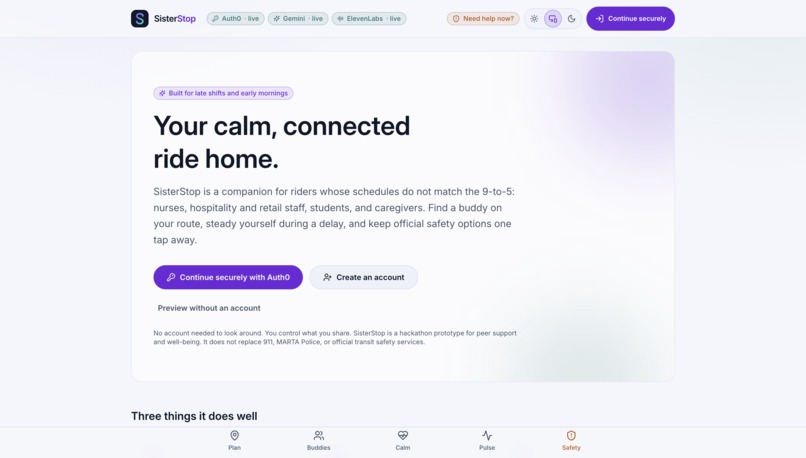
homepage
-
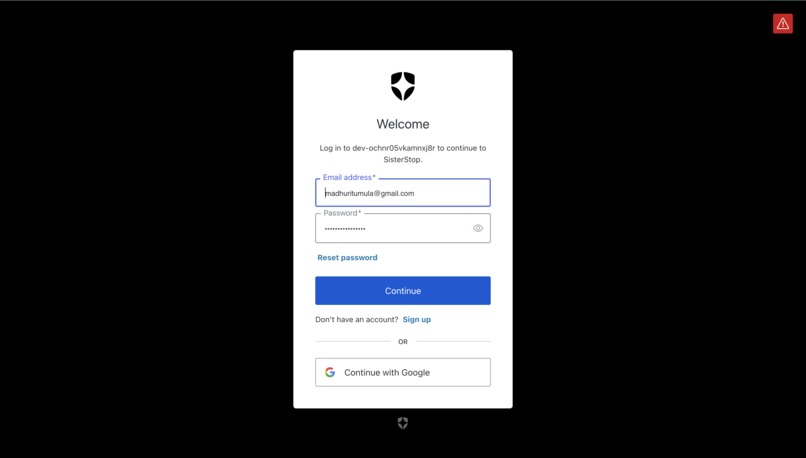
Auth0 sign in
-
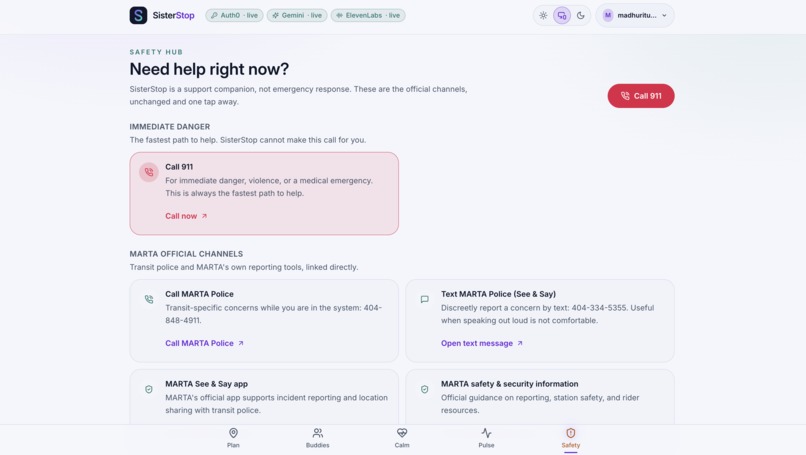
Quick call page
-
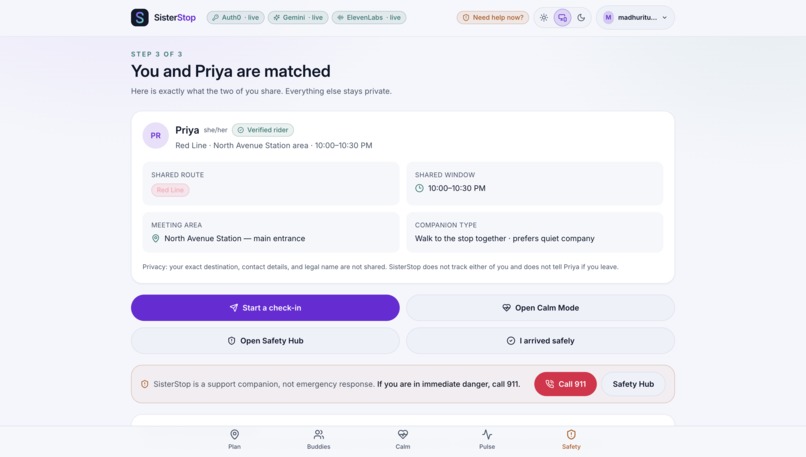
buddy matched
-
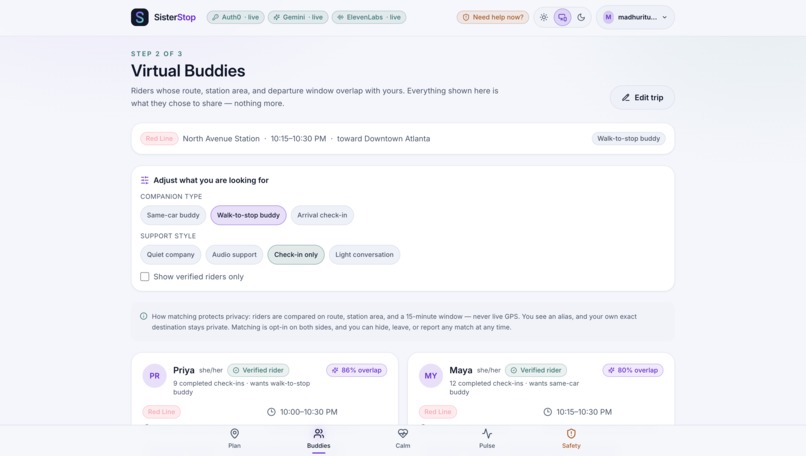
find buddies
-
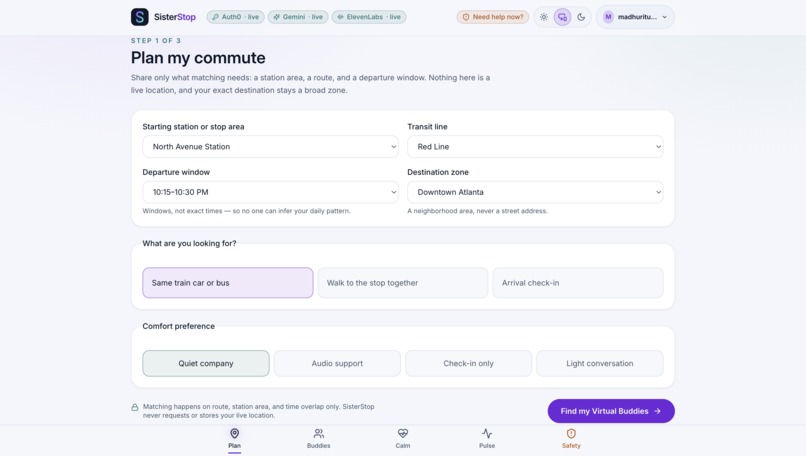
planning commute
-
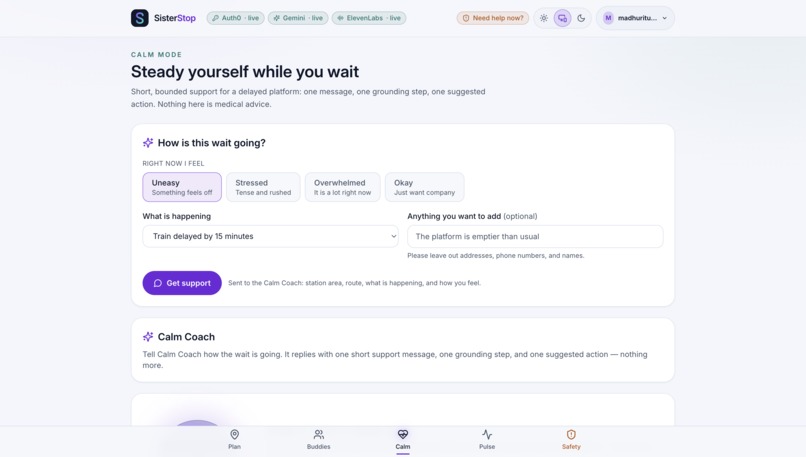
Calm mode


Inspiration
Atlanta is a sprawling city where many people rely on MARTA to get to work, school, appointments, and home. For women working nontraditional hours—including healthcare workers, hospitality staff, retail workers, home health aides, students, and gig workers—the ride home can involve late-night waiting, transit delays, isolation, and anxiety.
We were inspired by the space between an ordinary commute and a true emergency. Official transit safety systems and emergency services are essential when urgent help is needed. But many stressful moments happen before an emergency: someone may feel uneasy while waiting alone, uncertain during a delay, or disconnected while navigating an unfamiliar station area after dark.
Sisterstop was created to provide a supportive layer around those moments. Our goal is not to promise safety or replace official resources. Instead, we help riders feel more connected, grounded, and in control through opt-in peer support, calming tools, and clear access to official safety options.
What it does
Sisterstop is a privacy-conscious safety and mental-wellness companion for women and gender-expansive riders commuting during late-night or nontraditional work hours.
The app helps a rider:
- Plan a commute using a station area, route, departure window, and preferred support style.
- Find Virtual Buddies: opt-in riders traveling on compatible routes during similar time windows.
- Choose a support type, such as a same-car companion, walk-to-station buddy, or arrival check-in.
- Match using aliases, broad station zones, route overlap, and time windows rather than publicly sharing a precise live location or home address.
- Open Calm Mode when a delay or uncomfortable moment creates anxiety.
- Receive a concise grounding prompt from the Gemini-powered Calm Coach.
- Play supportive ElevenLabs-powered audio: a friendly check-in, comfort audio, or guided grounding exercise.
- Open a Safety Hub with clear pathways to official transit safety resources, MARTA Police options, and emergency guidance.
- End a trip with an arrival check-in.
- View an optional Community Pulse dashboard that uses only anonymous, aggregated commute-support events.
Sisterstop does not guarantee a user’s safety, contact emergency services, or make emergency decisions. If someone is in immediate danger, they should call 911 and use official transit safety resources.
How we built it
We built Sisterstop as a responsive web MVP that demonstrates one complete commuter journey:
Plan a trip → find a compatible Virtual Buddy → receive support during a delay → access official safety resources → confirm arrival.
Frontend and experience
- React, TypeScript, Vite, and Tailwind CSS power the responsive, mobile-first interface.
- Seeded rider profiles and realistic route/time-window data make the matching flow reliable for a hackathon demo without exposing real commuters.
- Route and departure-window overlap power transparent matching instead of precise GPS tracking.
- Calm Mode includes a breathing exercise, grounding interactions, and a persistent path to the Safety Hub.
Sponsor technology
- Google Gemini API powers Calm Coach. The app sends minimal, privacy-conscious context such as a station area, route, delay context, and user-selected feeling. Gemini returns a short structured response with a supportive message, grounding prompt, suggested in-app action, and urgent-help guidance when appropriate. It also creates the fake call text using the user data.
- ElevenLabs powers the Comfort Audio Suite. We use natural-sounding speech for a friendly check-in, comfort audio, and a guided grounding exercise. These clips are clearly labeled as comfort tools, not official transit, police, or emergency communications. It uses the text data created by Gemini API and voices it out like a human on call.
- Auth0 supports secure sign-in, protected user actions, and separation of private account identity from public aliases used in Virtual Buddy matching.
- Vercel deploys the app and server-side API endpoints, keeping API keys outside the browser.
Challenges we ran into
- Balancing safety with honesty: We wanted a compelling safety-oriented product without claiming that an app can guarantee safety, reliably detect danger, or replace official emergency systems.
- Protecting privacy in peer matching: Matching is more useful with location data, but exposing precise locations, home addresses, phone numbers, or routines creates unnecessary risk. We designed around aliases, station areas, routes, and broad time windows instead.
- Making AI helpful without making it authoritative: We constrained the AI experience to concise grounding prompts and suggested in-app actions rather than unrestricted advice or emergency decision-making.
- Integrating sponsor technologies under hackathon time pressure: We selected integrations that each contribute visible user value and designed graceful fallbacks so the MVP remains demoable if an external service is unavailable.
- Keeping the MVP focused: We intentionally did not build public real-time maps, live stranger chat, exact GPS tracking, or emergency dispatch. Those features would add major complexity and safety risks beyond a responsible hackathon prototype.
Accomplishments that we're proud of
- We created a complete end-to-end commuter journey rather than a collection of disconnected safety features.
- We designed privacy into the matching model using aliases, broad station zones, route compatibility, and time windows instead of public precise-location sharing.
- We combined human connection, emotional regulation, and official safety-resource access in one product flow.
- We used Gemini in a bounded, structured way that improves the user interface rather than functioning as an unmoderated chatbot.
- We gave Sisterstop a human, supportive voice with ElevenLabs while maintaining clear boundaries against impersonating emergency or transit authorities.
- We used Auth0 to demonstrate that trust starts with secure account access and responsible identity handling.
- We designed Community Pulse as an anonymous aggregate-analytics concept, showing how community-level insight can be useful without making individual commuters visible data points.
- We made the app resilient for a hackathon demo with seeded data and fallback behavior for external APIs.
What we learned
Building Sisterstop taught us that safety technology requires more than an SOS button or alert feature. It requires clear product boundaries, consent, privacy-preserving defaults, careful language, and honest communication about what software can and cannot do.
We learned that a strong safety-oriented experience should preserve user agency. In Sisterstop, riders choose whether to match, what type of support they prefer, what information they share, whether to use audio or grounding tools, and when to end a match.
We also learned that structured AI output can make AI features more responsible and useful. Instead of asking a model to make an open-ended judgment about danger, we use it to provide short, predictable support inside a carefully designed interface.
Finally, we learned that sponsor technologies work best when each one has a visible and necessary role in the user journey—not when they are added only as logos or disconnected features.
What's next for Sisterstop
Before a production launch, Sisterstop would require sustained user research, safety review, moderation planning, accessibility testing, and collaboration with transit agencies, rider advocates, employers, and community organizations.
Our next steps include:
- Integrating official real-time transit schedules and service-alert information.
- Conducting co-design sessions with late-shift riders, especially healthcare, hospitality, retail, and service workers.
- Building multilingual, accessible, and low-bandwidth versions of the experience.
- Adding user-controlled trusted-contact check-ins and notification preferences.
- Developing stronger verification, moderation, blocking, and reporting safeguards for a real peer-matching network.
- Establishing transparent governance for how anonymous aggregate data may be collected, retained, and used.
- Partnering with hospitals, universities, late-shift employers, and community organizations to pilot the product responsibly.
- Measuring whether Sisterstop improves riders’ sense of support, ability to find official resources, and confidence navigating late-night commutes.
Our guiding principle: Sisterstop should never ask a rider to trade privacy for support.


Log in or sign up for Devpost to join the conversation.