-
-
-
01 SizzlePress - Where Stories Hit Play
-
-
-
-
-
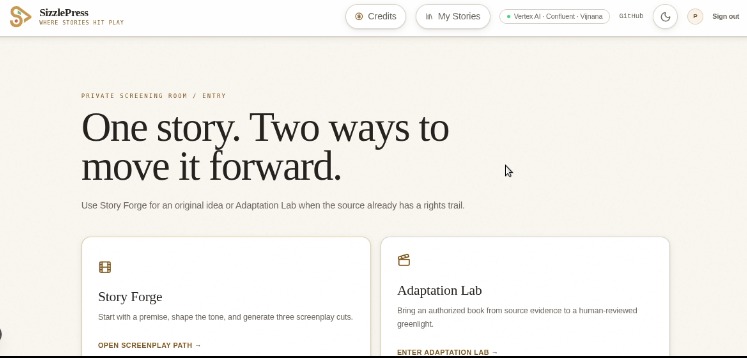
SizzlePress - One Story. Two ways to move it forward
-
-
-
-
-


SizzlePress
Where stories hit play.
Inspiration
Great stories often fail before production begins—not because the idea is weak, but because the decision process is fragmented.
A producer may have a source manuscript, adaptation ideas, rights questions, audience assumptions, budget concerns, screenplay drafts, visual references, and distribution hypotheses spread across different documents and tools. Generative AI can accelerate each individual task, but it can also make the overall process less trustworthy by producing confident answers without clear evidence.
SizzlePress was created to address that gap.
I wanted to build more than a screenplay generator. I wanted to create a private, evidence-grounded workspace that helps creative teams decide whether a story is ready to move toward production—and shows them why.
The result is SizzlePress: a pre-greenlight decision system for stories.
What it does
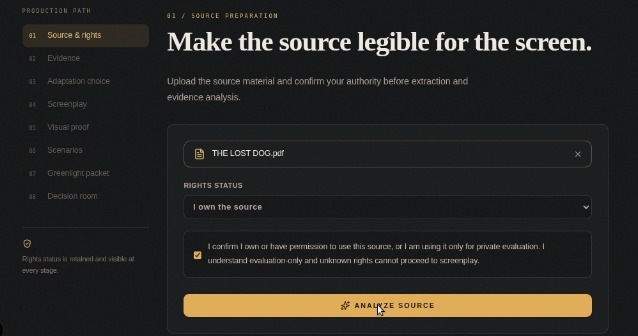
SizzlePress guides a story through an Greenlight Adaptation Lab:
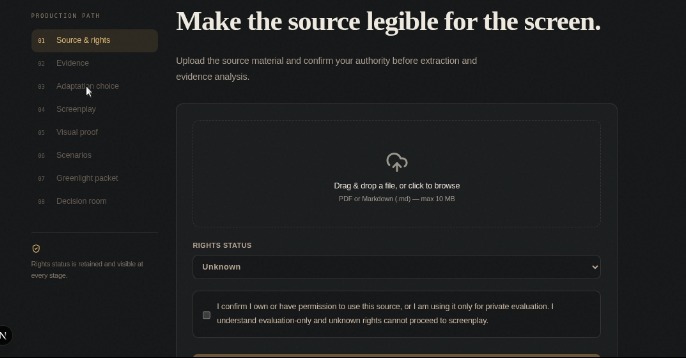
- A user uploads or enters source material such as a synopsis, screenplay, PDF, or Markdown document.
- The system extracts source evidence and preserves its provenance.
- Gemini analyzes the material and identifies grounded story elements, production signals, and adaptation opportunities.
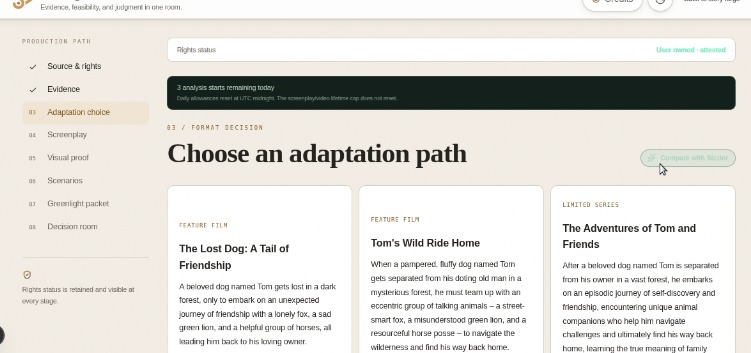
- The user compares multiple adaptation paths, including a faithful feature, a more commercial feature, and a limited-series direction.
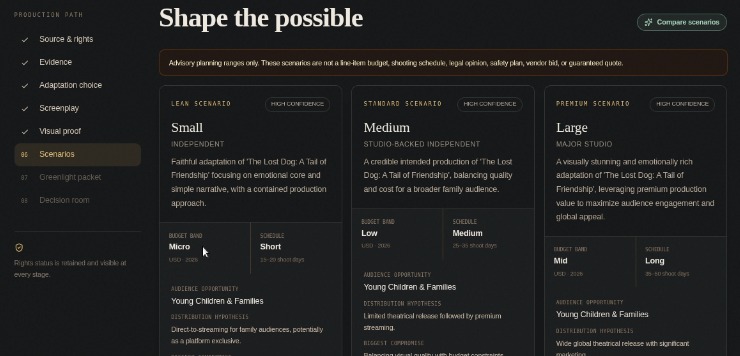
- The system evaluates production scenarios across lean, standard, and premium approaches.
- It organizes audience, market, positioning, comparable-title, and distribution considerations.
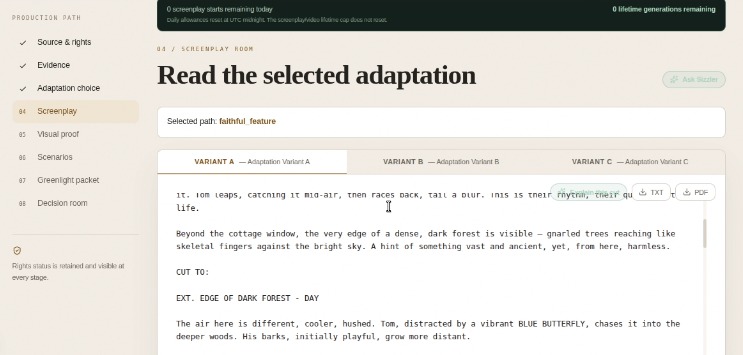
- Gemini generates screenplay variants for creative comparison.
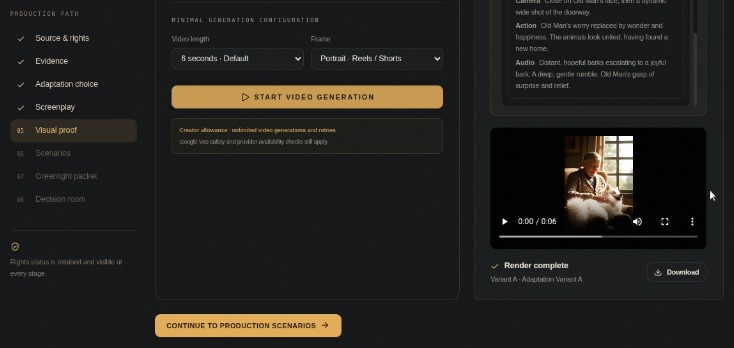
- The user can create visual proof through reel planning and Veo-powered rendering. Veo helps in generating a visual proof of a sizzlereel / quick short video (** this is the goosebump moment when the screenwriter himself is the user and sees his screenplay as a video output that sizzles especially when the source is a human written screenplay and is used as-is)
- SizzlePress assembles the findings into a Greenlight Packet.
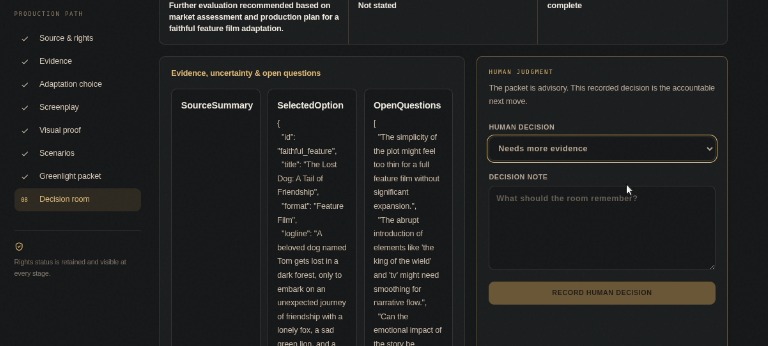
- A human producer makes the final decision.
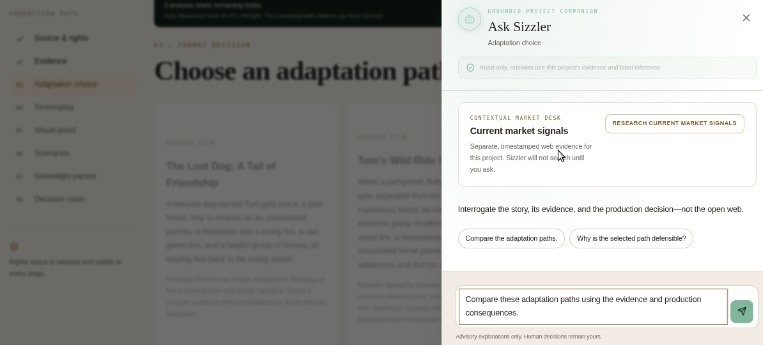
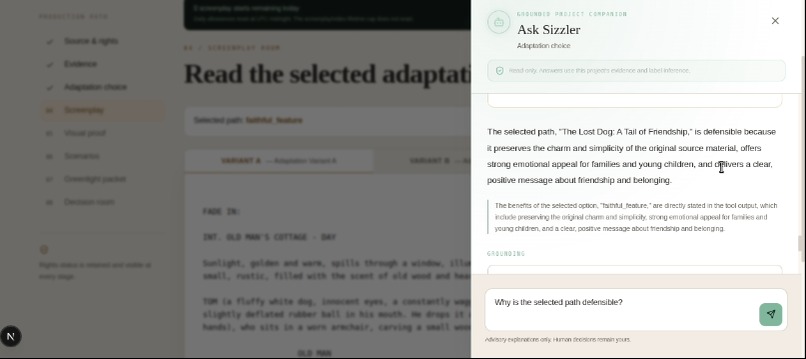
SizzlePress also includes Sizzler, a contextual, read-only Gemini assistant. Sizzler does not behave like a generic chatbot. It answers questions about the current private project using only the relevant evidence, adaptation options, screenplay excerpts, production scenarios, visual proof, and Greenlight Packet data.
For example, a producer can ask:
- “Show me the evidence behind this recommendation.”
- “Compare the lean and premium production scenarios.”
- “What changes between these screenplay variants?”
- “What are the creative risks of this adaptation path?”
- “Why is this project not ready for a greenlight?”
Sizzler provides citations, grounding labels, and caveats. It does not invent rights clearances, audience sizes, revenue forecasts, platform commitments, or legal conclusions. It also cannot make or record a human greenlight decision.
How we built it
SizzlePress began as a project developed with IBM Bob. IBM Bob helped establish the initial application foundation and supported the architecture and implementation process. Bob as a true AI SDLC Development Partner which gave birth to Vijnana - AI SDLC Decision Intelligence Service. When Bob credits were exhausted (40 bobcoins), development continued in Replit, where I completed the application building capabilities, adding features, testing, authentication, and deployment.
Vijnana - the AI SDLC Decision Intelligence Service provides the control-plane thinking behind the project. Its architecture guard helps AI-assisted development stay aligned with approved decisions instead of repeatedly reconstructing the entire system context.
The application is built with:
- Next.js and TypeScript for the user interface
- FastAPI and Python for the backend
- Google Gemini on Gemini Enterprise Agent Platform / previously Vertex AI for structured story analysis, adaptation reasoning, screenplay generation, and Sizzler responses
- Google Veo for visual-proof generation when video rendering is enabled
- Google Cloud Storage for private screenplay, video, and project manifests
- IBM Confluent Kafka for asynchronous screenplay and video workflow events
- Replit recommended Clerk for authentication and private per-user story ownership
A central design decision was to keep durable project state in private Google Cloud Storage manifests while using Kafka for compact, versioned workflow events. Screenplay text and video bytes are not placed directly on IBM Confluent Kafka. Workers retrieve the appropriate private artifact, perform their work, and publish progress and result events.
Sizzler uses a deterministic grounding layer before calling Gemini. The backend selects only the tools relevant to the current Adaptation Lab stage, such as source evidence, adaptation options, screenplay excerpts, scenarios, or decision history. The resulting citations are checked against durable evidence IDs before they reach the interface.
Uploaded source material is treated as untrusted data rather than instructions. This prevents hidden instructions inside a manuscript or document from changing Sizzler’s behavior.
Challenges I ran into
Turning unstructured stories into reliable evidence
Creative source material is not naturally organized as a database. It can contain chapters, scenes, incomplete descriptions, conflicting details, and formatting differences.
I had to preserve the original material while extracting structured evidence that could still point back to a specific page, chapter, scene, or source location.
Preventing confident but unsupported AI answers
A creative assistant is useful only if the producer can understand where its claims came from.
I designed validation around stable evidence IDs, grounded excerpts, source locations, confidence labels, and explicit distinctions between source evidence, user assumptions, market evidence, and model inference. Unsupported citations are rejected instead of silently reaching the user.
Balancing creativity with decision discipline
The system must encourage creative transformation without pretending that every model-generated idea is a fact.
SizzlePress separates creative options from source evidence, and advisory recommendations from human decisions. It helps a producer explore possibilities while keeping rights, production risks, assumptions, and open questions visible.
Building reliable asynchronous workflows
Screenplay generation and video rendering can take time and may fail partway through. We needed to support progress updates, resumable state, private artifacts, and safe retries without losing the user’s selections.
Using private manifests as the durable source of truth and Kafka as the event layer gave us a clearer boundary between workflow coordination and artifact storage.
Continuing development across tools
Moving from IBM Bob to Replit after running out of Bob credits created a continuity challenge. I had to preserve the architectural intent, carry forward the Vijnana - AI SDLC Decision Intelligence governance approach, and continue development without turning the project into a collection of disconnected AI-generated features.
Accomplishments that I,m proud of
- I evolved the project from a screenplay generator into an evidence-grounded pre-greenlight workspace. As the initial idea was to generate a book trailer from a book that could be submitted for a potential film adaptation with hollywood production houses.
- I created a complete path from source material to adaptation analysis, screenplay variants, visual proof, production scenarios, and a Greenlight Packet.
- I built Sizzler as a focused decision-support assistant rather than an unrestricted chatbot.
- I made Sizzler read-only, owner-scoped, citation-aware, and explicit about uncertainty.
- I created a source-evidence boundary that preserves stable source text while attaching provenance and extraction quality.
- I designed private project ownership so users cannot access another user’s stories or artifacts.
- I separated Kafka workflow events from private screenplay and video content.
- I kept the producer responsible for the final greenlight decision.
- I added tests for grounding, citation validation, owner scoping, missing projects, and endpoint behavior.
- I verified the backend, frontend production build, and workflow startup before preparing the submission.
Most importantly, SizzlePress makes the reasoning behind a creative decision visible. It does not simply ask AI to say “yes” or “no.” It helps a human understand what is known, what is assumed, what is inferred, and what still needs to be resolved.
What I learned
The most valuable output of generative AI is not always the generated asset. In many professional workflows, the more important output is a trustworthy explanation of how a decision was reached.
I learned that:
- Evidence must be validated on the server, not trusted because a model returned it.
- AI assistants need a small, deterministic tool surface rather than unlimited access to project state.
- Uploaded content must be treated as data, not as system instructions.
- Creative exploration and production governance can coexist when the system labels uncertainty clearly.
- A durable manifest is often a better source of truth than an event stream.
- Human decisions should remain explicit and auditable.
- AI-assisted development benefits from architecture guardrails, especially when work continues across multiple coding environments.
- A good creative product should help users move faster without hiding the risks of moving quickly.
What's next for SizzlePress
The next stage is to make SizzlePress more useful for real creative teams and publishers.
Planned improvements include:
- Exporting a polished Greenlight Packet for review and sharing
- Adding reviewer and collaborator roles
- Supporting comments, approvals, and decision history across a team
- Expanding rights-readiness workflows and source provenance
- Adding stronger usage limits and resource controls for public launch
- Improving screenplay comparison and review-mode navigation
- Expanding visual proof from a teaser into more complete production planning
- Adding clearer retention, deletion, AI-output, privacy, and copyright policies
- Introducing hosted-service features such as managed storage, rendering credits, collaboration, and enterprise controls
The long-term goal is for SizzlePress to become the trusted decision layer between an idea and a greenlight: a place where stories can be explored boldly, evaluated honestly, and moved toward production with greater clarity.
Built With
- ai-agents
- apache-kafka
- clerk
- confluent
- evidence-grounding
- fastapi
- gemini
- generative-ai
- google-cloud
- ibm-bob
- model-context-protocol
- next.js
- production
- python
- react
- replit
- screenplay-generation
- source-provenance
- story-adaptation
- typescript
- veo
- vertex-ai
- video-generation
- vijnana


Log in or sign up for Devpost to join the conversation.