-
-
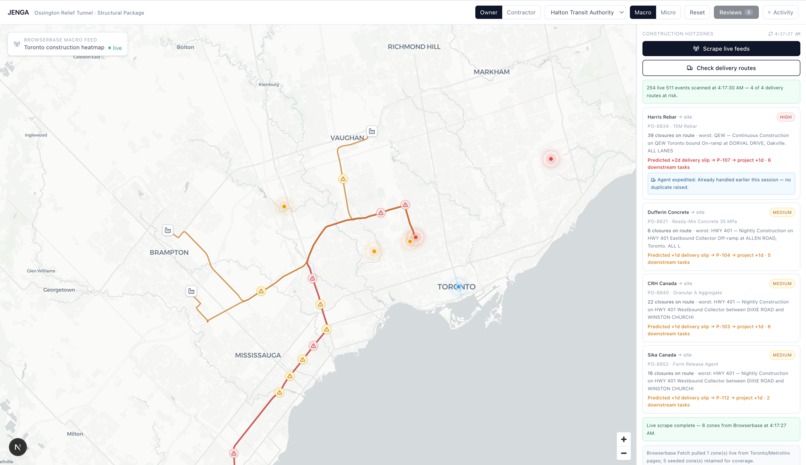
Map Graphic with construction sites + delayed routes for procurement (browserbase scraped)
-
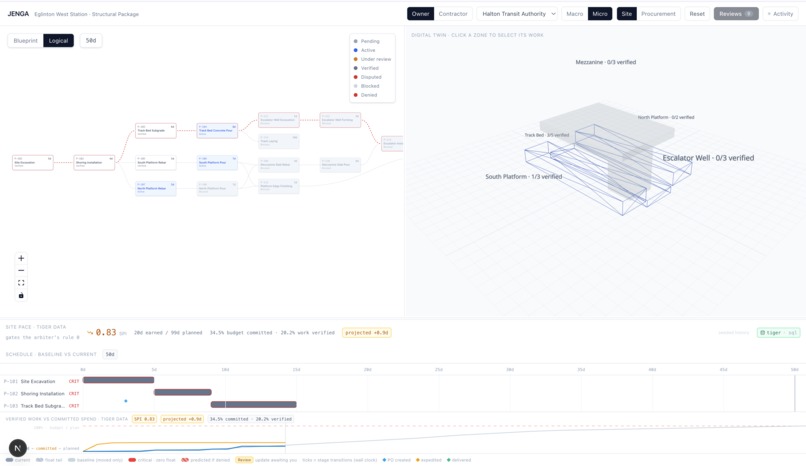
Construction timeline view + Ticketed tasks and 3d rendering of actual construction based on weekly reports
-
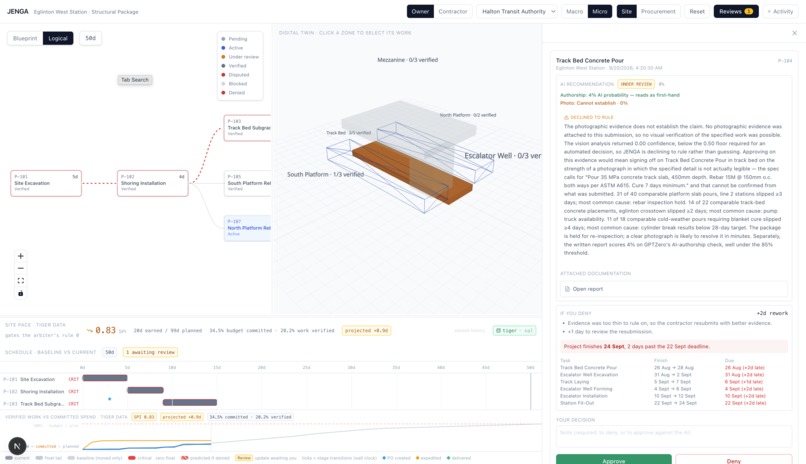
Owner ability to approve/deny a contractors report submission to validate the work
-
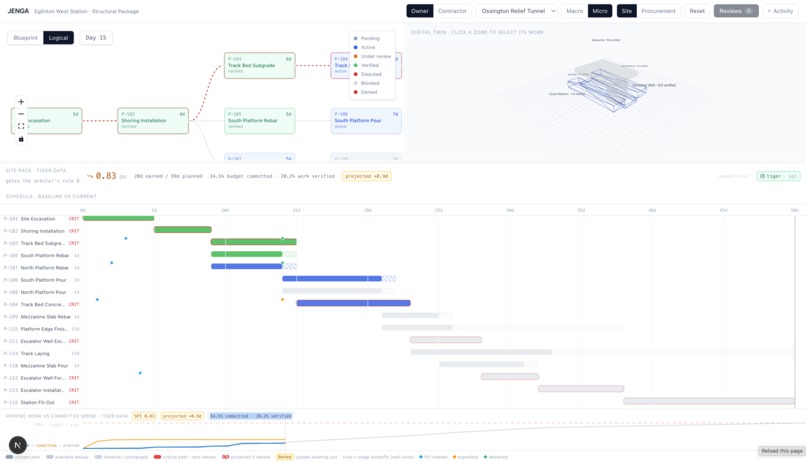
Timeline tracking with tigerdata and zip procurement
-
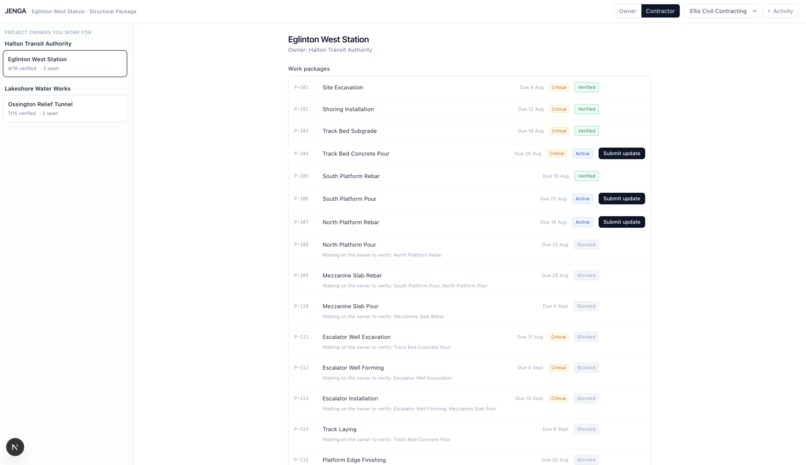
Contracter view to complete pdfs
-
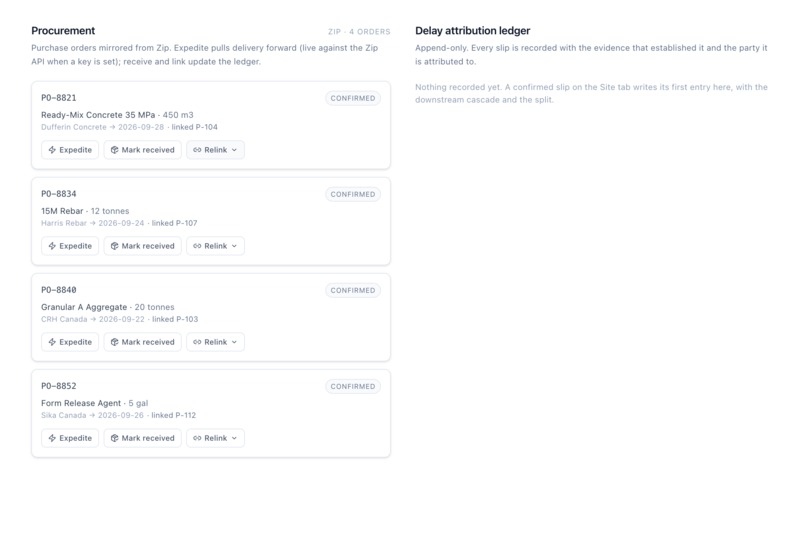
ZIP procurement tracking tab
-
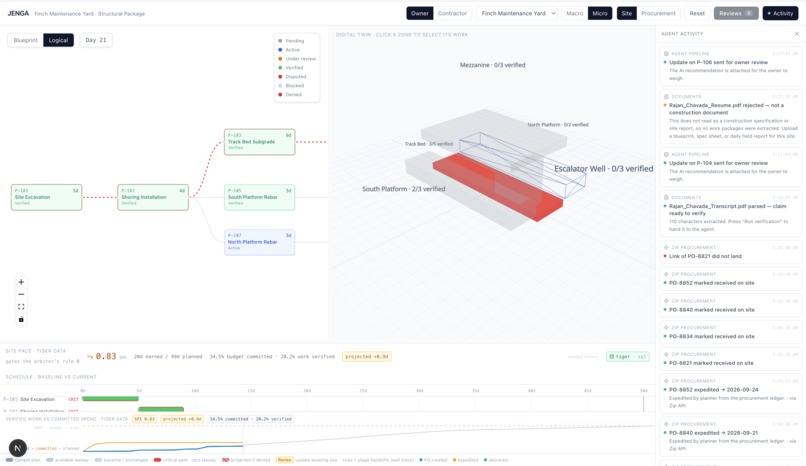
Agent activity (parsing documents using GPTZero)
-
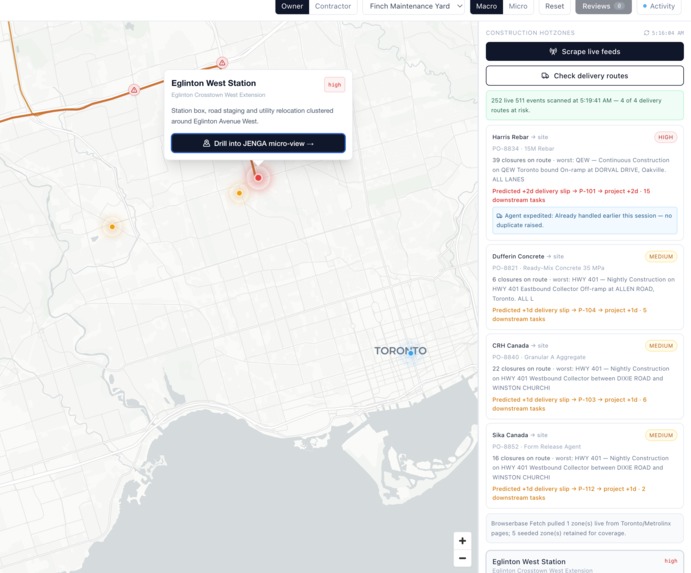
Expedited already


🚊Inspiration
Have you seen the construction downtown? In Waterloo? The TTC? The LRT?
Big transit projects keep dying the same slow death. Toronto's Eglinton Crosstown took ~19 years and lost billions, not because nobody had data, but because nobody could trust it. Progress reports get written to sound good (increasingly by AI), witness accounts contradict each other, permits stall, and every dispute decays into a "he said, she said" court case years after the concrete set. Physical defects hide inside confident paragraphs until it's too late to fix them cheaply.
That's the actual problem: data is abundant, but claims are unreviewable — and even when someone catches a problem, the follow-up action (reschedule, reorder, escalate) happens weeks later by email. So we built JENGA around two promises: every claim gets verified against evidence the moment it's made, and the consequences, schedule math, procurement, escalation — fire automatically, on real systems, with a visible paper trail.
💭 What it does
JENGA is a JIRA-style construction tracking platform for project owners, in two views.
Macro: a live MapLibre heatmap of Toronto. Press "Scrape live feeds" and Browserbase pulls municipal road restrictions and Metrolinx updates on the spot — the panel shows exactly which sources were fetched and honestly labels what came back live vs. seeded. Click a hotzone to drill into its site.
Micro: the site itself, a dependency graph of work packages locked onto the 2D blueprint, a synchronized 3D digital twin, and a schedule that has become the site's financial-physical timeline: task bars with real-timestamp stage ticks, procurement diamonds on the rows they feed, and an analysis band where three curves tell the story — planned work, verified work, and committed spend.
When a contractor submits a daily update (PDF, photo, or voice note), a five-node agent pipeline takes over, and you watch it run: authorship gate (GPTZero) → media analysis (vision + Gemini) → historical memory → site pace → arbiter. Clear contradiction → Disputed. Ambiguous evidence → Under Review the agent refuses to rubber-stamp, and says exactly what field record it needs. Every source's read is shown in one evidence strip; nothing is a black box.
Then the owner decides. Our teammates built the owner portal: approve or deny a request to close a ticket, with the predicted schedule impact shown before you click, rework days, downstream risk, the projected extension sitting right in the schedule. Denying a ticket actually moves the timeline; the graph and 3D twin update with it, and the delay lands in an append-only attribution ledger.
🤩 The three moments we're proudest of
Procurement that acts (Zip). A voice note says the aggregate delivery never showed. The agent catches the shortage, plans a bill of materials, picks the vendor, and creates a real purchase order on Zip's staging environment, line items and all, you can open it in Zip's own UI. Above single POs sits spend governance: JENGA is the only system that knows both what was bought (Zip) and what was actually built (verification), so when committed spend hits 42% while verified work sits at 28%, it escalates, quoting the tenant's real approval workflow threshold, delivered as a real comment on Zip. Every individual PO was compliant; the cumulative pattern was not. That's the catch a human approver structurally cannot make.
The site's time axis (Tiger Data). Every verdict, every PO lifecycle event, every escalation lands as a timestamped row in a TimescaleDB hypertable on Tiger Cloud. time_bucket rollups turn that stream into real earned-value management — the planned-vs-verified S-curve, an SPI, and a projected finish date — the same math construction PMs run in Primavera, computed live from verified evidence instead of self-reported percentages. And it feeds back into verification: the pace rule holds any completion claim that outruns the site's measured pace. (Click the badge on the strip, the actual SQL is right there.)
The supply-line radar (Browserbase). Materials travel highways, and highways close. On demand, the agent pulls Ontario 511's live event feed through Browserbase, traces each vendor's route to the site via OSRM (real GTA suppliers, Dufferin Concrete, Harris Rebar, CRH Canada, Sika), and flags any closure within 500 m of a route. Then it previews the cascade, "PO slips 2 days → P-104 pour slips → project +2 days, critical path" — and acts. During our verification run it caught a real overnight QEW full closure, traced it to the rebar delivery, and raised a real expedite PO on Zip staging, before any human knew the truck would be late.
Everything the agents do, scrapes, verifications, PO creation, escalations, route checks, is confirmed in one activity rail, created "running" and resolved with what actually happened.
👷 How we built it
Next.js 15 frontend: React Flow nodes locked to blueprint coordinates, a Three.js twin driven by the same Zustand store as the graph (one state, two projections), Framer Motion, and a deliberately minimal white theme.
Python FastAPI backend. The verification pipeline is LangGraph (Python): GPTZero as the authorship gate, OpenAI vision plus Gemini media analysis for submitted evidence, Backboard for historical memory, a pace check reading Tiger, and a deterministic arbiter with an auditable rule order. Procurement goes through the Zip REST API (with the ziphq-mcp server configured so agents can drive Zip directly); Zip staging POs turned out to be immutable, which forced a better design, expedites create new POs, so every action leaves an artifact. Browserbase Fetch API powers both the municipal scrape and the 511 feed; OSRM draws the routes. Tiger Cloud TimescaleDB holds the site_events hypertable and a continuous aggregate.
One engineering rule everywhere: one honest fallback per integration. No key, or a dead API mid-demo, degrades to a clearly-labeled mock, source badges say live or seeded, and the app never fakes a success it didn't earn.
🎯 Challenges we ran into
Live sponsor systems bite back. Zip's staging POs are immutable (redesign: create-not-mutate). Ontario 511 counts cancelled and ramp-only works as "closures", our first radar pass expedited every PO on the board until we calibrated severity and capped actions per pass (it's a shared tenant; be polite). We killed our own feature. Our original Tiger integration was a simulated curing-temperature "cold snap", technically cute, but it took a physics lecture to explain. We deleted it the night before judging and rebuilt Tiger as the EVM time axis, which lands in one sentence.
Building this much surface area against five sponsor systems meant ruthlessly skipping everything else: auth, role segregation, real drone ingestion.
🏆Accomplishments that we're proud of
The honesty of the system. The agent refuses to rule on thin evidence instead of guessing; every verdict ships with its full trace; every integration admits when it's degraded. And the wow moments aren't mockups, the POs, the Zip comments, the QEW closure, the hypertable rows all exist on real external systems you can open and check.
🙇♂️ What we learned
Immutable APIs are a feature: being unable to mutate Zip POs gave us an audit trail for free. Determinism matters as much as generative AI in enterprise tools, LLM extraction wrapped in hardcoded rules and honest fallbacks is what makes the product safe.
Tiger's hypertables drop into a normal Python/Postgres stack almost embarrassingly easily. Kill your darlings: if a demo beat needs explaining twice, replace it with one that explains itself.
What's next for JENGA
- Live drone-feed ingestion replacing uploaded evidence.
- Authentication and real owner/contractor role separation.
- The radar's next move: a Stagehand browser agent that hunts alternate suppliers when a route goes high-risk, and weather-aware pour scheduling off Environment Canada alerts. Deeper Zip governance: invoice three-way matching against verified field work, approve what the site confirms, hold what it doesn't.


Log in or sign up for Devpost to join the conversation.