




4 X (Twitter) Scrapers on GitHub That Still Work in 2026
Four surviving X scraper repositories compared by coverage, account requirements, maintenance, and infrastructure burden, plus why older projects died.
requests / month
success rate
data / month
enterprises
Pick the tool. We handle the rest: proxies, browsers, retries, billing.
Web Scraping API
Cloud Browser
Screenshot API
Extraction API
Crawler API
AI Browser Agent
MCP Server
Web Scraping API
Fetch public URLs at production scale with managed proxy rotation and a JS rendering toggle. Clean HTML or markdown, stable JSON.
POST https://api.scrapfly.io/scrape
Cloud Browser
Drive a real managed Chromium over CDP. Full Playwright / Puppeteer compatibility. Hosted, scaled, production-grade.
wss://browser.scrapfly.io/cdp?key=...
Screenshot API
Full-page, viewport, or element screenshots. PNG / JPEG / WebP. Ad-block, cookie-banner dismiss, custom viewport.
POST https://api.scrapfly.io/screenshot
Extraction API
Turn HTML into typed data with a prompt or a JSON schema. LLM-powered, built-in templates for products, articles, reviews, jobs.
POST https://api.scrapfly.io/extraction
Crawler API
Traverse entire sites with depth limits, follow rules, rate control. Streams URLs as discovered; every page runs through the Web Scraping API.
POST https://api.scrapfly.io/crawler
AI Browser Agent
Managed Chromium tuned for autonomous agent loops. Browser Use, Stagehand, and Vibium compatible. Pay only for the actions that succeed.
POST https://api.scrapfly.io/agent
MCP Server
Connect any MCP client (Claude, Cursor, Cline, Windsurf, ChatGPT) to scrape, screenshot, extract, and crawl with one API key.
mcp.scrapfly.io
One parameter. No per-target configuration. Step-by-step guides for the targets developers ask about most.
Success rate, throughput, latency.
Your API call. Our stack. From clean JSON all the way down to the exit IP.
One API key. Stable JSON envelope. Seven endpoints for scrapers, browsers, and AI agents.
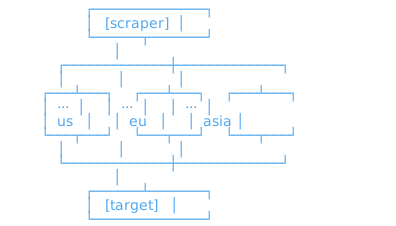
Two proprietary engines, auto-routed per target. Browser-grade HTTP and DOM behavior, engineered in-house.
Global proxy mesh across 190+ countries. Geo-aligned DNS, Accept-Language, and client-hints coherence on every request.
Plug Scrapfly into your favorite AI agents, workflow automations, and first-class SDKs.
What you get with us versus what you get with the rest of the category.
98% on the hardest public targets, measured weekly by the Scrapeway benchmark.
Failed requests are free. You only pay for successful scrapes.
Credits scale with the actual complexity of each target.
One API key covers scraping, browser automation, screenshots, extraction, crawling, agents, and MCP.
Owns the entire stack: in-house proxy mesh, proprietary HTTP engine (Curlium), and managed browser (Scrapium).
Often well below 60% on the same targets.
Failed requests still consume credits.
Tiered pricing with premium-domain surcharges and rigid plans.
Most cover scraping only. Browser or extraction usually means a second vendor.
Resells someone else's stack.
Teams pick Scrapfly after testing the alternatives. Here is why they stay.
It helped me automate a very difficult task that would have been nearly impossible to complete manually. The performance is consistent, the API responses are fast, and the documentation made integration simple.
I use Scrapfly as part of a larger AI research platform for web content extraction and data gathering. It was easy to integrate into our Node.js backend.
Ran a 74k URL scraping job without major issues. Good value with the 200k credits on Discovery plan.
Same API key across every Scrapfly product. Pick a credit budget, every product shares the pool. No per-product lock-in, no surprise line items.
Full plan details on the pricing page. No annual contract required, upgrade or downgrade anytime.
From price monitoring to AI training corpora. One API, every vertical.
New tutorials and deep-dives every week.
Four surviving X scraper repositories compared by coverage, account requirements, maintenance, and infrastructure burden, plus why older projects died.
A fixture based comparison of Html Agility Pack and AngleSharp for C# HTML parsing, covering XPath versus CSS selectors, malformed markup, DOM behavior, and when each parser fits a project.
A practical guide to scraping DHL parcel tracking status and shipment events in Python, covering Track & Trace page inspection, JSON/XHR discovery, response classification, event normalization, and the official tracking API.
Scrape public Twitter (X.com) profiles and tweets with Python in 2026, and learn why guest tokens and doc_ids break DIY scrapers.
Learn the differences between JSON and JSONLines, their use cases, and efficiency. Why JSONLines excels in web scraping and real-time processing
A web scraping API is a service that fetches public URLs with managed proxy rotation and JavaScript rendering on every request, without you maintaining headless browsers or proxy stacks. Scrapfly's Web Scraping API delivers this with one HTTP call returning HTML, markdown, plain text, or structured JSON. You only pay for successful requests.
98% on the hardest public targets, measured weekly by the independent Scrapeway benchmark and tracked daily against production traffic. See the success-rate benchmarks for current numbers.
Set unblocker=true (formerly asp=true, still accepted) on any request. Scrapfly analyzes the target and routes through the right engine: Curlium (high-performance real-browser HTTP layer) or Scrapium (managed Chromium for JavaScript-heavy pages). Both share the same network stack, so sessions stay consistent from first request to last. One parameter, no per-target configuration.
Two managed options. Use Scrapfly's built-in pools: datacenter (1 credit per request) or residential (25 credits per request, 190+ countries) with auto-rotation, IP cooling, and optional session stickiness. Or bring your own provider via Proxy Saver, which plugs Bright Data, Oxylabs, Webshare, SmartProxy, DataImpulse, or any SOCKS5 / HTTP proxy into the same Web Scraping API endpoint. Either way, smart routing, session management, and automatic retry sit on top.
Yes. The MCP Server connects any MCP-compatible client (Claude, Cursor, Cline, Windsurf, ChatGPT, and others) to scrape, screenshot, extract, and crawl. The AI Browser Agent supports Browser Use, Stagehand, and Vibium agent loops on managed Chromium. Native integrations also exist for LangChain, LlamaIndex, and CrewAI.
Multiple formats from a single API call: HTML (raw or sanitized), Markdown (with link / image stripping for LLM contexts), plain text, JSON (parsed or as the API envelope), screenshots in PNG / JPEG / WebP via the Screenshot API, structured JSON via the Extraction API using LLM prompts, CSS / XPath rules, or pre-trained models, and WARC archives for crawl jobs.
Bright Data and Oxylabs are proxy-first platforms with scrapers built on top: strong on proxy infrastructure and managed datasets, heavier configuration per target. Zyte is built around Scrapy and managed services for high-protection enterprise targets. Scrapfly is single-endpoint: one API call with unblocker=true handles session management, proxy rotation, JavaScript rendering, and structured output with no per-target setup. You pay only for successful requests. See per-vendor comparisons on the comparison hub.
Yes. Scrapfly holds SOC 2 Type I, SOC 2 Type II, and SOC 3 certifications, plus ISO 27001, HIPAA, and GDPR attestations. A HIPAA Business Associate Agreement (BAA) is available to Custom-plan customers. See Compliance for the full list of attestations.
Yes. The Enterprise tier is $500 / month (5.5M credits, 100 concurrent requests, premium support, team management). Custom plans above 5.5M credits / month include MSA, DPA, BAA, and HIPAA, dedicated residential proxy pools, committed concurrency, premium support, and custom log retention. Contact sales@scrapfly.io. See pricing for the full grid.
You are not charged. Failed requests do not consume API credits. The API returns a structured error response with retry guidance. Transient failures on demanding targets are automatically retried within the same request before returning an error.
Usage-based, priced per API credit. Free tier: 1,000 credits, no card, no time limit. Paid plans start at $30 / month (Discovery, 200k credits, 5 concurrent) and scale to $500 / month (Enterprise, 5.5M credits, 100 concurrent), with custom contracts above 5.5M credits / month. Credit cost per call scales with features used (1 credit for HTTP, +5 for JavaScript rendering or Unblocker, +25 for residential proxies, 60 for screenshot). Failed requests are free. See pricing for the full plan grid and credit matrix, or use the cost estimator to size your project.
Free account, 1,000 credits, no credit card. One key, every product.