September 21st updates
See what changed in Sourcegraph.
See what changed in Sourcegraph.
See what changed in Sourcegraph.

Take control of your codebase with Agentic Batch Changes.
Codebases are growing and changing faster than ever, but the problem of maintaining systems - old and new - is not going away for codebase owners. More of the code is written by agents now, and fewer people can hold the whole codebase in their head. The changes that touch everything (migrations, upgrades, security fixes) are the ones that keep getting deferred.
See what changed in Sourcegraph.
See what changed in Sourcegraph.

Code Finder now supports searching a specified branch, tag, or commit.
Code Finder can now search a specified revision, including a branch, tag, or commit.
Use it to investigate regressions at exact commits, find code on non-default release branches, or explore older release tags.
The minimum supported GitHub Enterprise Server version is now 3.4.
Read moreSee what changed in Sourcegraph.
Our fast, efficient MCP tool for finding relevant code is now generally available.
Following the Code Finder Beta period, Code Finder is now generally available through the Sourcegraph MCP server. Code Finder is an agent optimized specifically for code search that helps coding agents quickly locate relevant implementations, configuration, tests, or documentation within a repository. It returns a concise summary with links and line ranges, giving your agent focused results it can immediately use.
Visit Enterprise Portal to learn more about this feature's credits usage, or see the documentation.
See what changed in Sourcegraph.

Understand large diffs with a guided tour.
Large diffs are hard to review because there's no natural order to follow. Guided diff tour groups related files into sections, orders them into a suggested reading path, and adds short explanations so you can review quicker and with more confidence.
See what changed in Sourcegraph.

Sourcegraph is reinforcing the technical safeguards that enforce geographic access restrictions.
We are reinforcing the technical safeguards that enforce our geographic access restrictions. These updates are in line with the supported access you already expect from Sourcegraph, to meet Sourcegraph and your obligations under applicable law and requirements from the AI providers our products rely on.
As always, access to Sourcegraph products is permitted in supported regions only. These updates are solely designed to make it easier for Sourcegraph and our customers to meet their contractual and legal obligations.
See what changed in Sourcegraph.

See what's happening in your repository at a glance.
AI agents are changing everything.
Code is written in "factories", partially by humans, partially automated. The pace of change is relentless, and we've got to keep up with it.
Deep Search can now cross-reference and aggregate larger result sets, and write its findings to downloadable CSV, JSON, and SVG files.
Ask Deep Search for codebase wide inventories, audits, or migration reports that would be too large to present cleanly in an answer. Deep Search summarizes the key findings in chat and attaches the full structured output for further analysis or tracking.
Deep Search can also read generated CSV and JSON files in follow-up investigations. This allows it to filter, join, or enrich previously collected results without repeating the original codebase searches.
Give Deep Search durable instructions and task-specific skills tailored to your organization.
Deep Search can now follow your organization’s conventions on every run. Add durable AGENTS.md-style guidance for standards and preferences, plus task-specific skills that help the agent handle specialized workflows with the right instructions.
Configure customization globally, for an organization, or in your personal settings. Guidance and skills can be entered directly or loaded from an explicitly configured Sourcegraph repository location, with an optional path and branch or revision. Repository sources can contain AGENTS.md and skills at skills/<name>/SKILL.md or .agents/skills/<name>/SKILL.md; they are not automatically discovered from every repository involved in a search.
See what changed in Sourcegraph.
Control which files and repos Deep Search can access with context filters.
Deep Search now honors an admin-defined exclusion list. Anything matched by a context filter is invisible to the agent. The excluded content never shows up in Deep Search's answers, and it can't be read, diffed, or resolved by any Deep Search tool.
A site admin can configure filters under Admin → Configuration → Advanced configuration, inside the experimentalFeatures block. Each rule can match repositories by name, file paths, or both
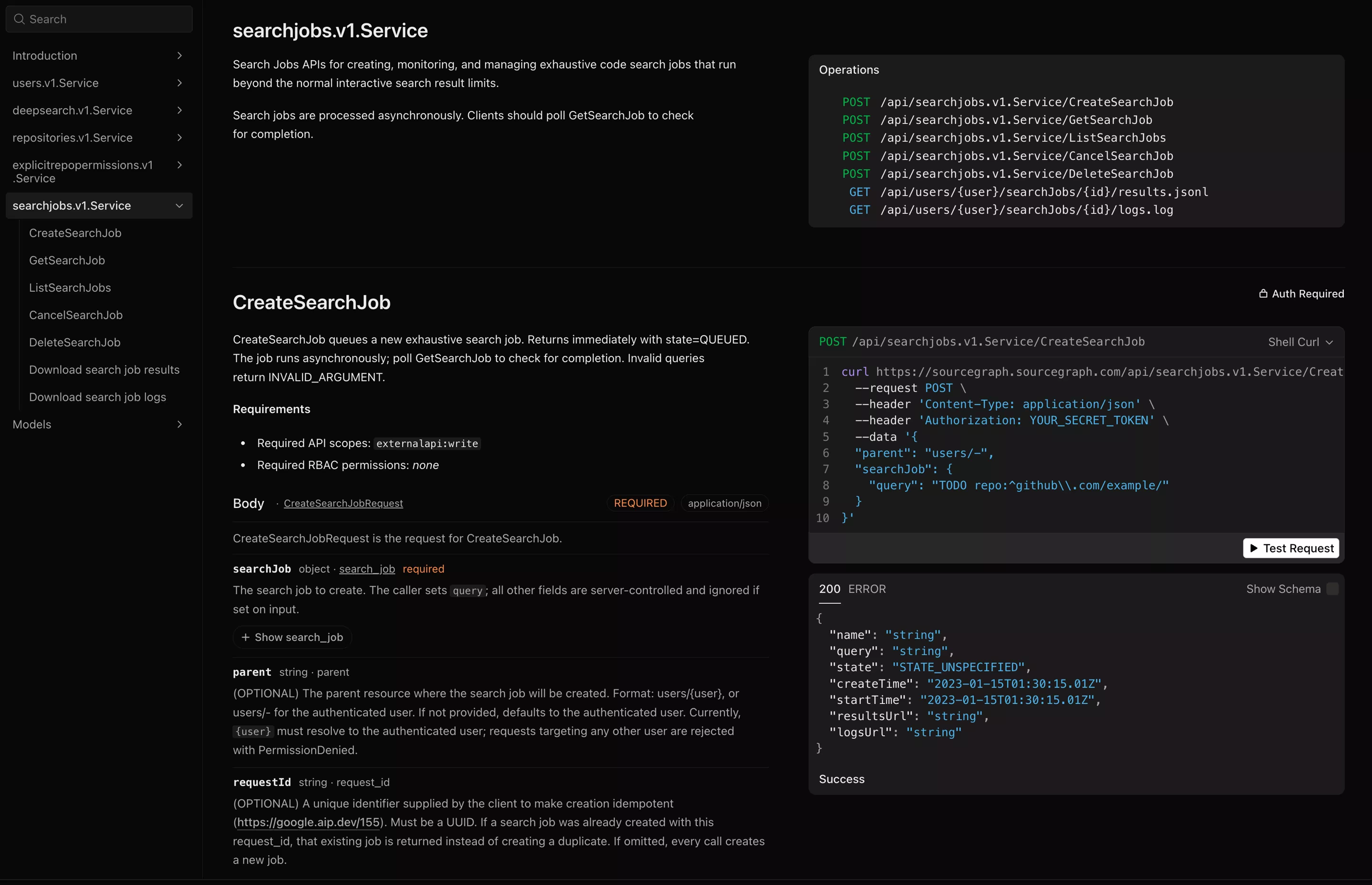
Run exhaustive, codebase-wide searches from your own integrations with Search Jobs in the Sourcegraph API.
Search Jobs have landed in the Sourcegraph API. A Search Job runs your query across every repository, branch, and revision in your codebase. Use it for audits, security reviews, and large scale migrations.
Analyze topics explored by your team's Deep Search usage.
You can now go one layer deeper than general Deep Search intents, such as understanding, debugging, and security, to discover the specific topics your team is exploring in Sourcegraph Analytics.
These topics reveal the specific projects, technologies, and areas of work your team uses Deep Search to explore. For each topic, Sourcegraph Analytics shows the total number of mentions and unique users.
See what changed in Sourcegraph.
Our new MCP tool finds relevant code faster with lower token usage.
Code Finder, a fast and efficient agent optimized specifically for code search, is now available in Beta through the Sourcegraph MCP server.
Code Finder is a tool that helps coding agents quickly locate relevant implementations, configuration, tests, or documentation within a single repository. It returns a concise summary with links and line ranges, giving your agent focused results it can immediately use.

See exactly what changed, at any scale.
Following its Beta period, the redesigned compare page is now generally available. It's a ground-up rebuild of how you view changes between two revisions — fast, complete, and built to stay useful even on very large diffs.
See what changed in Sourcegraph.
See what changed in Sourcegraph.

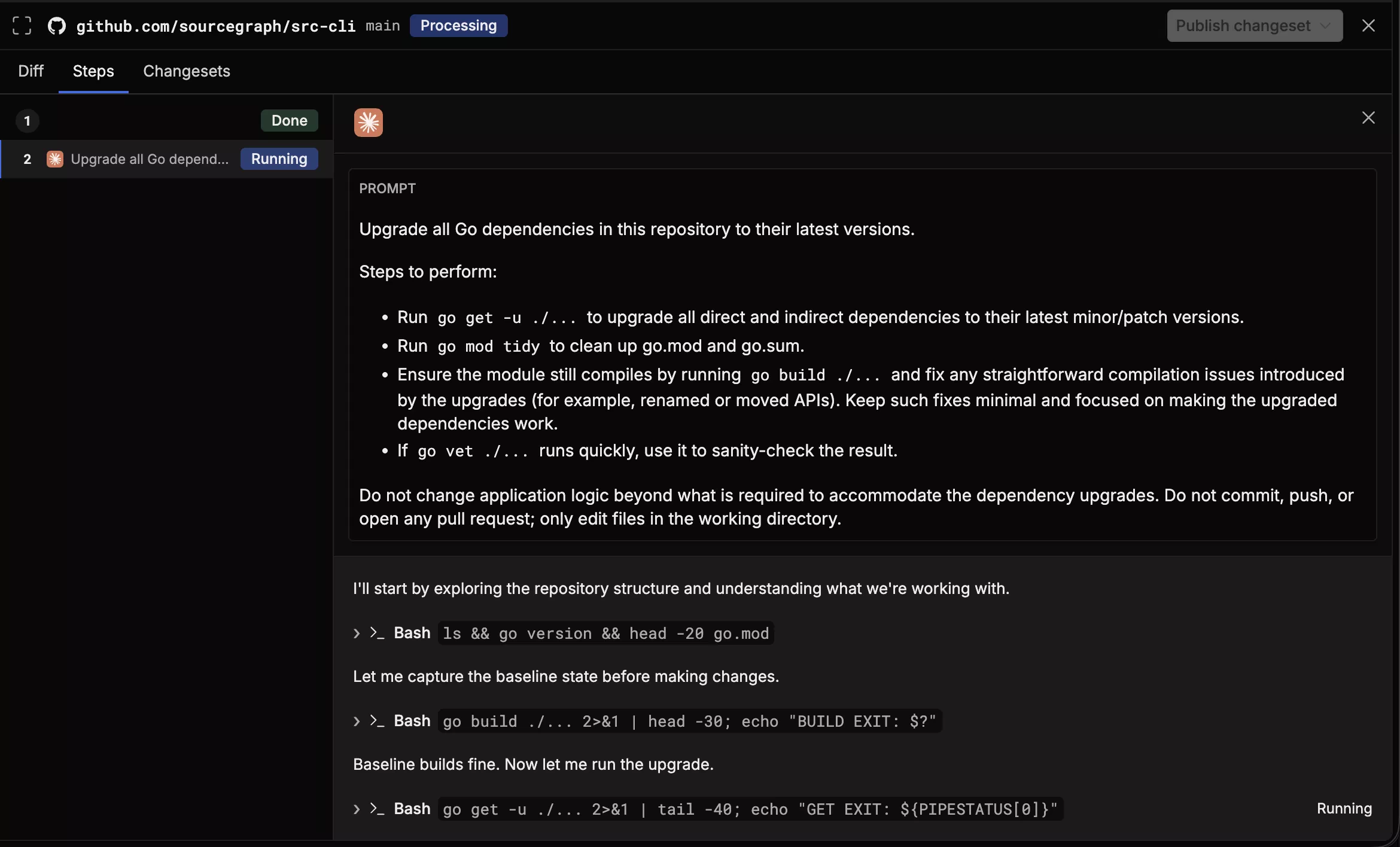
Making it easier for humans to follow the progress of coding agents.
In the Agentic Batch Changes Beta, steps utilizing inner-loop coding agents now stream thinking and progress in real time.
Explore per-user credit consumption with the new user cohorts explorer.
Sourcegraph Analytics now includes a User Cohorts Explorer on the Users page, giving admins visibility into per-user credit consumption alongside feature activity.
Search and filter users, save custom cohorts, and analyze SKU usage and feature activity for any cohort.
See what changed in Sourcegraph.
Usability improvements to help you deploy your changes more effectively.
If you haven't heard already, Agentic Batch Changes is now available in Beta. This is a completely re-imagined way to apply code change at scale.
We're releasing a slew of new improvements to the Beta experience this week.
See what changed in Sourcegraph.

Take control of your codebase.
Codebases are growing and changing faster than ever, but the problem of maintaining systems - old and new - is not going away for codebase owners. If anything, it is becoming more important than ever. Today, we're taking the next step to meet this new era of software development with Agentic Batch Changes, available now in Beta: the frontier agent for code change at scale, built on technology designed for the world's largest codebases.
See what changed in Sourcegraph.

Smart hover summaries leverage precise code intelligence data to show key architectural details of your code on hover.
Following the smart hover summaries Beta period, smart hover summaries are now generally available. When precise code intelligence is available, you get a summary of the meaning of the symbol and usage of the symbol across the codebase, directly in the hover. Summaries are powered by a small, fast model, but only compiler-grade precise code intelligence data is used to inform the LLM of actual usage patterns across your repositories, allowing the LLM to cite factual usage locations in its answers.
Visit Enterprise Portal to learn more about this feature's credits usage, or see the documentation.
