1. X
  2. American Physical Society
Log inSign up
American Physical Society
19.6K posts
American Physical Society profile banner
user avatar

American Physical Society

@APSphysics
Fostering a vibrant, inclusive, and global community dedicated to science and society. Join us: go.aps.org/2NWWEeY
aps.org
Joined June 2009
258
Following
256.2K
Followers
RepliesRepliesMediaMedia

Log in or sign up for X

See what’s happening and join the conversation

Continue with phone
or
Log in with username or email
Terms·Privacy·Cookies·Accessibility·Ads Info·© 2026 X Corp.
  • user avatar
    American Physical Society
    @APSphysics
    8h
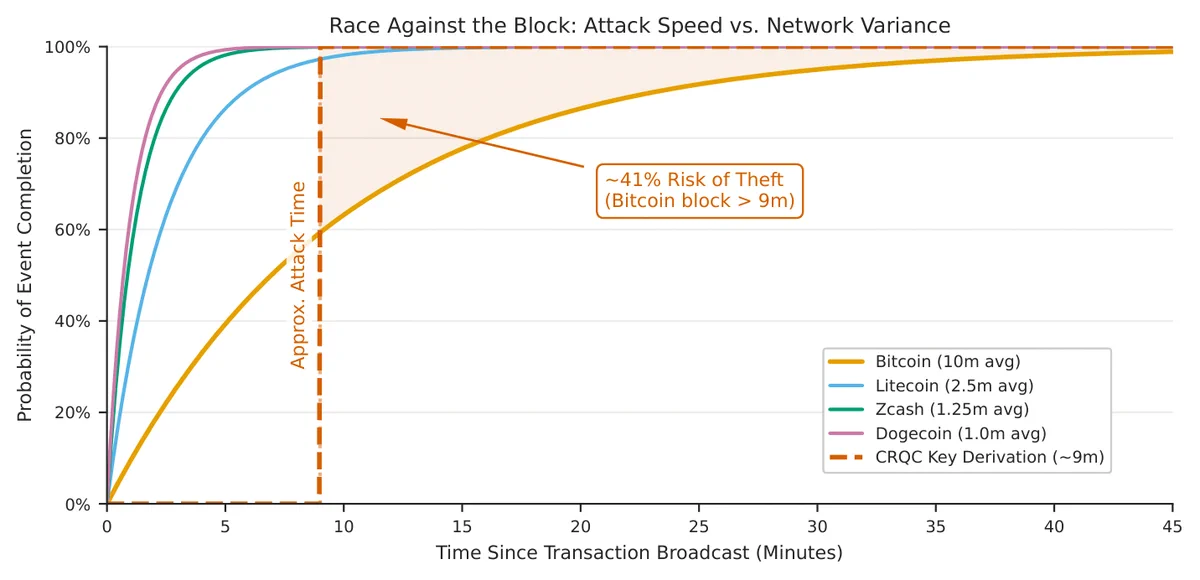
    How easily could quantum computers break blockchain cryptography? New estimates show the resources needed keep shrinking, and some transactions could be attacked before they even confirm. More in PRX Quantum: go.aps.org/4wHJkzA
    Line chart titled "Race Against the Block: Attack Speed vs. Network Variance" showing probability of a successful quantum attack over time for four cryptocurrencies. Bitcoin's curve (orange) rises slowly, reaching about 41% risk of theft at the roughly 9-minute mark where a quantum computer could derive a private key, while Litecoin, Zcash, and Dogecoin curves rise much faster toward 100% due to their shorter block times.
  • user avatar
    American Physical Society
    @APSphysics
    Aug 26
    🐶 It’s #NationalDogDay! Drop an emoji to tell us what physics phenomenon your dog is: 🌀 Chaotic system — unpredictable zoomies ⚡ Kinetic energy — never walks 🌡️ Thermodynamic system — seeks warmth 🪐 Orbital mechanics — follows you everywhere
    A black dog is standing on grass near a small blue pool, looking up to catch a tennis ball in its mouth. Text on the image reads, "What kind of physics phenomenon is your dog?" The top right corner has "#NationalDogDay.
  • user avatar
    American Physical Society
    @APSphysics
    Aug 25
    A new all-optical scheme teleported a 100-pixel image at once via quantum entanglement, beating the classical fidelity limit. All 100 channels transfer simultaneously instead of one by one — a step toward scalable quantum networks. More in @PhysRevLett: go.aps.org/4gbp98g
    Diagram of a neural network layer showing three blocks. The left block has dots connected by lines to the center block, which in turn connects by lines to the right block. The lines represent connections between nodes in the network.
  • user avatar
    American Physical Society
    @APSphysics
    Aug 24
    This October, APS will become the U.S. institutional representative to @IUPAP_physics, an international organization founded in 1922 to foster collaboration among physicists worldwide. Read more in #APSNews: go.aps.org/3S20kTa
    Several dozen assembly attendees, wearing name tag lanyards, pose in front of a screen with additional attendees on Zoom.
    A convention center hall shows concentric rings of seating, filled with attendees watching a speaker present.
  • user avatar
    American Physical Society
    @APSphysics
    Aug 21
    Research published in @physrevelett reports new measurements showing how niobium-94 absorbs neutrons — data that helped models reproduce the unexpectedly high molybdenum levels seen in presolar grains: go.aps.org/4qvbLj2
    Line and scatter plot titled with y-axis “MACS [mb]” and x-axis “kT [keV]”. A black curve labeled KADoNiS decreases steadily from upper left to lower right. It's surrounded by a gray shaded band (CERN n_TOF ±1σ_stat), a narrower red shaded band (CERN n_TOF ±1σ_sys), and blue (ENDF/B-VIII.1), green (JEFF-4), and orange (TENDL-2025) curves that follow similar declining trends. Scattered data points represent data from earlier studies: an orange pentagon (J. Holmes 1976), red square (M. Harris 1981), black circle (T. Rauscher 2000), blue star (S. Goriely 2002), and gray diamond (S. Goriely 2005).
    Photo of a scientific detector setup in a lab. A large octagonal array of gray metal detector modules surrounds a central circular sample holder Above the array, a large cylindrical metal chamber with a flanged bottom hangs from above. Bundles of red, blue, black, and dark wires run through the setup and connect to instrumentation racks on the right side of the frame.
Advertisement
Advertisement