Did you know you can reliably query 10X larger-than-RAM datasets with Python dataframes thanks to @duckdb? The threshold for "big" data is larger than ever.
We're excited to announce the release of Ibis v4.1.0🌱
Here's a thread of some of our favorite features🚀🔥
1. `get_backend`: Keep track of which backend you're using! Here's an example of reading a CSV file with @duckdb (our default backend) and then switching to @DataPolars✅
Ibis 9.0 is out! This wraps up a massive refactor of the internals and a complete adoption for @TobikoData's SQLGlot library for SQL generation! Plus, a ton of new features and bug fixes. Check out the blog:
2. DuckDB as a default backend
@duckdb is now the default backend for Ibis. It is used when doing things like executing in-memory dataframes where the user may not have explicitly chosen a backend.
Duckdb is performant and feature rich🦆
duckdb.org
Ibis 3.0.0 brings some incredible new features including the ability to mix SQL with Ibis expressions and ibis compatibility with a @duckdb backend.
Read about the most important changes in our latest blogpost ibis-project.org/docs/3.0.2/blo…
We've got new Ibis tutorials. 🎉🎉🎉
Learning how to perform data analysis in Python directly querying SQL databases or big data systems is now easier than ever.
ibis-project.org/docs/tutorial/…
We have our first public roadmap! Check out the blog -- streaming backends, more geospatial operation supports in backends (like @duckdb), and a new ML library or two are on the way or already released!
We're starting to get excited about the 5.0.0 release🚀
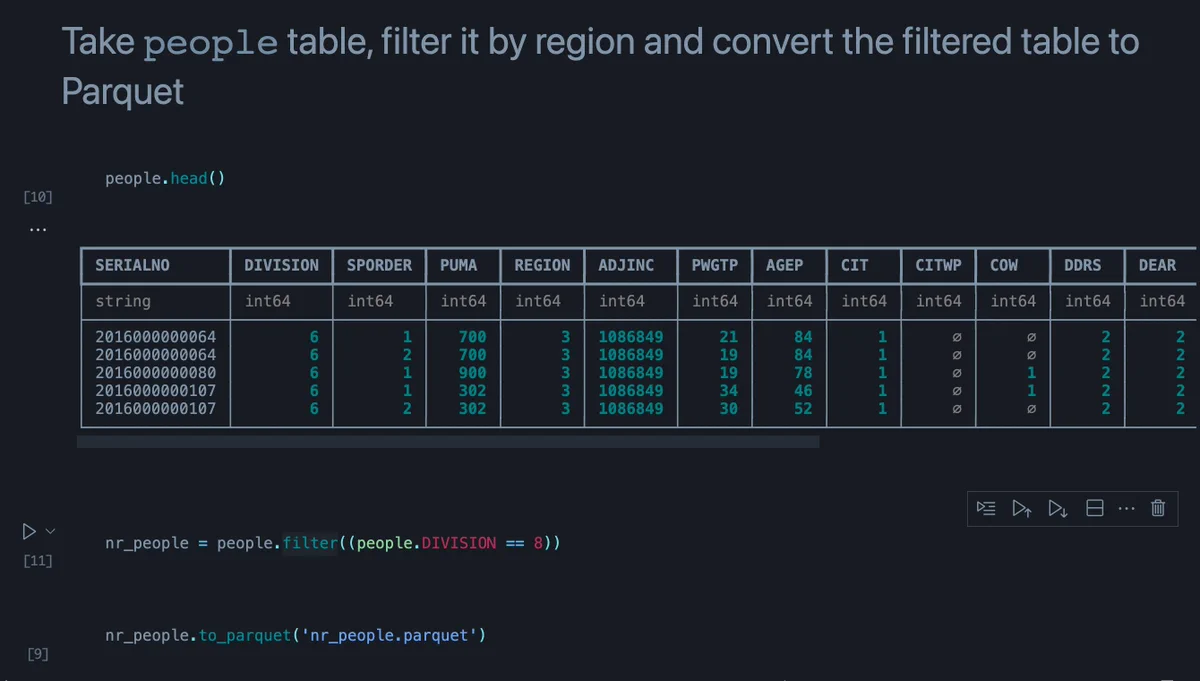
Here's a sneak peak of one of the many additions to our library👀
`to_parquet` let's you take any Ibis table and convert it into a Parquet file. Ibis makes working with millions of rows of data a breeze☁️ #portablepython