
Microsoft Foundry Blog
Your source for learning and building with our models, agents, and tools.
Latest posts
Introducing Toolboxes in Foundry


Available in Public Preview Today Toolbox is a new way to curate, configure, and reuse tools across all of your AI agents without rewiring them every time from Foundry. Today, teams build agents across different frameworks and runtimes. Each agent often wires tools directly, with its own authentication, credentials, and integration code. As organizations scale agent usage, this leads to duplicated work, inconsistent behavior, and fragile production deployments. Toolbox fixes this by letting you define a curated set of tools once, manage them centrally in Foundry, and expose them through a unified endpo...
From Local to Production: The Complete Developer Journey for Building, Composing, and Deploying AI Agents


When we launched Microsoft Agent Framework last October, we made a promise: building production-grade AI agents should feel as natural and structured as building any other software. Today, we’re delivering on that promise — with the v1.0 release of Microsoft Agent Framework and the general availability of Foundry Toolkit for Visual Studio Code (formerly AI Toolkit for VS Code), new capabilities in memory (preview) in Foundry Agent Service, Toolbox in Foundry (preview) to give your agents the right tools, a faster and more secure hosted agents experience in Foundry Agent Service (preview), and Observability in ...
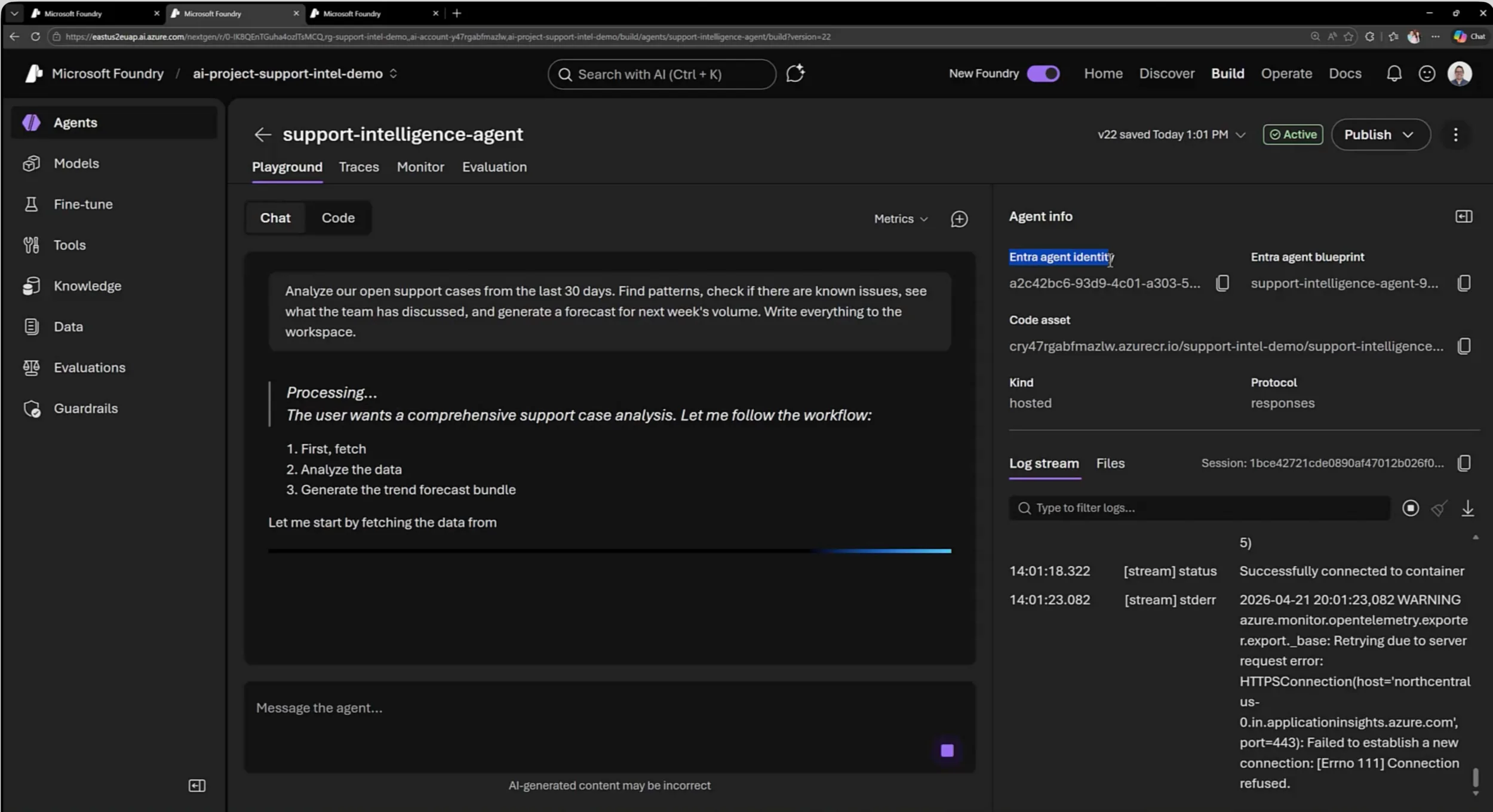
Introducing the new hosted agents in Foundry Agent Service: secure, scalable compute built for agents

Agents are already transforming how developers solve problems. Whether it's a coding agent that refactors your repo overnight, a research agent that synthesizes hundreds of documents into a brief, or an ops agent that monitors and remediates infrastructure — the pattern is clear. Developers are building agents that don't just answer questions, they go do things. Agents of today don’t just execute from a list of tools. They access the underlying file system, write and execute code, and persist files and memories for long running and complex tasks. Today, it is easy to build agents locally. But how do you tak...
What’s New in Microsoft Foundry Fine-Tuning | April 2026

April 2026 brings three major Reinforcement Fine-Tuning updates: Global Training for o4-mini with lower per-token rates across 12+ regions, new GPT-4.1 model graders for richer reward signals, and a comprehensive RFT best practices guide to help you ship specialized models faster.
What’s new in Microsoft Foundry | March 2026

March ships Foundry Agent Service GA with private networking, GPT-5.4 and GPT-5.4 Mini, Priority Processing, Phi-4 Reasoning Vision, SDK 2.0 GA across Python, JS/TS, Java, and .NET, Fireworks AI and NVIDIA Nemotron models, and third-party guardrails from Palo Alto and Zenity.
Foundry Local is now Generally Available

Ship local AI to millions of devices - fast, private on-device inference with no per-token costs.
Foundry Agent Service is GA: private networking, Voice Live, and enterprise-grade evaluations

The next-gen Foundry Agent Service is generally available today with end-to-end private networking, Voice Live integration, expanded MCP authentication, GA evaluations with continuous monitoring, and hosted agent deployments in six new Azure regions.
What’s new in Microsoft Foundry | February 2026
February brings Anthropic's Claude Opus 4.6 and Sonnet 4.6 with 1M-token context, GPT-Realtime-1.5 and GPT-Audio-1.5, Grok 4.0 GA, the Microsoft Agent Framework reaching Release Candidate, and the Foundry REST API quietly going GA — laying the foundation for imminent SDK GA announcements across Python, .NET, JS/TS, and Java.

Microsoft Agent Framework Reaches Release Candidate

We're happy to announce that Microsoft Agent Framework is now in Release Candidate status for both .NET and Python. Release Candidate is an important milestone on the road to General Availability — it means the API surface is stable, and all features that we intend to release with version 1.0 are complete. Whether you're building a single helpful assistant or orchestrating a team of specialized agents, Agent Framework gives you a consistent, multi-language foundation to do it. Microsoft Agent Framework is the easy and most powerful way to build agents and agent systems using Microsoft Foundry or any model or AI s...
What’s new in Microsoft Foundry | Dec 2025 & Jan 2026
Catch up on all the new models, audio updates, fine-tuning expansions, and SDK updates from Microsoft Foundry spanning December 2025 and January 2026 — including GPT-5.2, Codex Max, DeepSeek V3.2, FLUX.2, and the azure-ai-projects v2 beta consolidation.
DPO Fine-Tuning Using Microsoft Foundry SDK

In the rapidly evolving landscape of large language models (LLMs), achieving precise control over model behavior while maintaining quality has become a critical challenge. While models like GPT-4 demonstrate impressive capabilities, ensuring their outputs align with human preferences—whether for safety, helpfulness, or style—requires sophisticated fine-tuning techniques. Direct Preference Optimization (DPO) represents a breakthrough approach that simplifies this alignment process while delivering exceptional results. This comprehensive guide explores DPO fine-tuning, explaining what it is, how it works, when t...
Beyond the Prompt – Why and How to Fine-tune Your Own Models

Large Language Models (LLMs) have reached a point where general intelligence is no longer the bottleneck. The real challenge in enterprise AI systems behavioral alignment ensuring models that produce consistent, reliable, policy-compliant outputs on a scale. Prompt engineering and Retrieval-Augmented Generation (RAG) are powerful but they do not change model behavior. Fine-tuning will solve this by customizing a pretrained AI model with additional training on a specific task or dataset to improve performance, add new skills, or enhance accuracy. This post explores what Microsoft Foundry fine-tuning is, when us...

Building an AI Skills Executor in .NET: Bringing Anthropic’s Agent Pattern to the Microsoft Ecosystem

We welcome guest author, Matt Kruczek, to share how to build a complete Skills Executor in .NET, combining Azure OpenAI with the Model Context Protocol (MCP) C# SDK to bring the same agentic patterns to the Microsoft ecosystem. You’ll see how to define reusable skills, connect local and external tools, and orchestrate intelligent agent loops—so enterprise teams can standardize AI behavior without hardcoding business logic.
What’s new in Microsoft Foundry | October and November 2025

Azure AI Foundry is now Microsoft Foundry. Read the latest announcements about agents, models, tools and more.
Foundry IQ in Microsoft Agent Framework


Build enterprise-grade RAG agents with Foundry IQ Knowledge Bases in ~20 lines of Python. Learn how the Azure AI Search Context Provider brings intelligent, multi-hop retrieval to the Microsoft Agent Framework—no fragmented pipelines, just plug in the knowledge your agent needs.
Announcing Foundry MCP Server (preview) in the cloud, speeding up AI development with Microsoft Foundry

MCP (Model Context Protocol) is a standard protocol that enables AI agents to securely connect with apps, data, and systems, supporting easy interoperability and seamless platform expansion. At Ignite, Microsoft Foundry introduced Foundry Tools, which serves as a central hub for discovering, connecting, and managing both public and private MCP tools securely, simplifying integration across more than 1,400 business systems and empowering agents. Microsoft Foundry also upleveled Foundry Agent Service to empower developers to securely build, manage, and connect AI agents with Foundry Tools, enabling seamless integra...

⭐Upcoming Virtual Event⭐ AI Dev Days, Level-Up Your AI Skills with Microsoft Reactor
Join us for AI Dev Days, a two-day virtual event exploring the latest Microsoft Azure, Foundry and GitHub innovations. Whether you’re modernizing legacy apps, building with agents, or exploring the newest AI models, this is your moment to skill up, ship faster, and connect with experts.
Introducing Memory in Foundry Agent Service


Give your agents the power to remember Imagine your agent never asks the same question twice. Until now, most agents have been stateless. Each conversation resets to zero, forgetting what users said just minutes ago or weeks ago. Developers tried to bridge this gap with homegrown solutions — storing embeddings in databases, manually retrieving prior messages, or stuffing entire chat histories into prompts. These workarounds add latency, cost, and complexity, and still fall short of delivering truly personal, context-aware interactions. At Ignite 2025, we introduced the public preview of memory in Foundry Ag...
