


 Report an issue with this product or seller














![Computer Networking Bible: [3 in 1] The Complete Crash Course to Effectively Design, Implement and Manage Networks. Including Sections on Security, Performance and Scalability](https://m.media-amazon.com/images/I/41H4YJnxKgL._AC_SR100,100_QL65_.jpg)



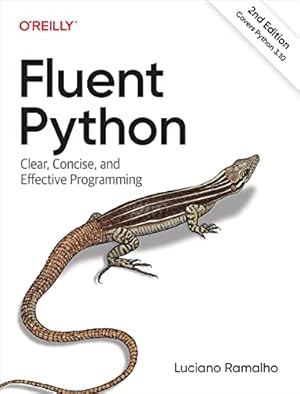
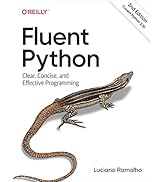
As the title and description suggest, this book truly is to achieve 'fluency' in Python. It touches on nearly every point of the language that is pythonic, describing not just the how and the what, but the why. This book is definitely not a good beginner book for Python (however, someone extremely well versed in Java or C++ could probably benefit from it, if they relied on more basic information from alternative sources), but I wouldn't say it's only for expert users. This book touches on a very wide selection of subjects, from some pretty common Python concepts, like Duck Typing, generators, and function and class decorators to more advanced subjects like abstract base classes, multiple inheritance, mixins, and meta programming. The prose is easy to read and even entertaining. It may be the first programming book I read for enjoyment, and not just reference.
Luciano demonstrates that he truly is fluent in Python, and while probably 25% of the chapters were not on any subject that is useful to me, all of them yielded new information and helpful hints, and even tips and tricks to increase performance or readability of the code. I would think that, given the wide range of topics, at least 30% of the book will be extremely helpful to your specific use case, regardless of what that is.
Customers who viewed this item also viewed
$3.99 delivery Saturday, May 2

$3.99 delivery Saturday, May 2

$6.44 delivery Tuesday, May 5
$6.44 delivery Tuesday, May 5

Download the free Kindle app and start reading Kindle books instantly on your smartphone, tablet, or computer - no Kindle device required.
Read instantly on your browser with Kindle for Web.
Using your mobile phone camera - scan the code below and download the Kindle app.

Follow the author
Get new release updates & improved recommendations
Something went wrong. Please try your request again later.
There is a newer edition of this item:

Deals on related products
Page 1 of 1Start over
From the brand

-

Learn Python
-
Python performace
-
Python for Data Science
-
Sharing the knowledge of experts
O'Reilly's mission is to change the world by sharing the knowledge of innovators. For over 40 years, we've inspired companies and individuals to do new things (and do them better) by providing the skills and understanding that are necessary for success.
Our customers are hungry to build the innovations that propel the world forward. And we help them do just that.
From the Publisher

From The Preface
An experienced programmer may start writing useful Python code in a matter of hours. As the first productive hours become weeks and months, a lot of developers go on writing Python code with a very strong accent carried from languages learned before. Even if Python is your first language, often in academia and in introductory books it is presented while carefully avoiding language-specific features.
As a teacher introducing Python to programmers experienced in other languages, I see another problem that this book tries to address: we only miss stuff we know about. Coming from another language, anyone may guess that Python supports regular expressions, and look that up in the docs. But if you’ve never seen tuple unpacking or descriptors before, you will probably not search for them, and may end up not using those features just because they are specific to Python.
This book is not an A-to-Z exhaustive reference of Python. Its emphasis is on the language features that are either unique to Python or not found in many other popular languages. This is also mostly a book about the core language and some of its libraries. I will rarely talk about packages that are not in the standard library, even though the Python package index now lists more than 60,000 libraries and many of them are incredibly useful.
Who This Book Is For
This book was written for practicing Python programmers who want to become proficient in Python 3. If you know Python 2 but are willing to migrate to Python 3.4 or later, you should be fine. At the time of this writing, the majority of professional Python programmers are using Python 2, so I took special care to highlight Python 3 features that may be new to that audience.
However, Fluent Python is about making the most of Python 3.4, and I do not spell out the fixes needed to make the code work in earlier versions. Most examples should run in Python 2.7 with little or no changes, but in some cases, backporting would require significant rewriting.
Having said that, I believe this book may be useful even if you must stick with Python 2.7, because the core concepts are still the same. Python 3 is not a new language, and most differences can be learned in an afternoon. What’s New in Python 3.0 is a good starting point. Of course, there have been changes since Python 3.0 was released in 2009, but none as important as those in 3.0.
If you are not sure whether you know enough Python to follow along, review the topics of the official Python Tutorial. Topics covered in the tutorial will not be explained here, except for some features that are new in Python 3.
Who This Book Is Not For
If you are just learning Python, this book is going to be hard to follow. Not only that, if you read it too early in your Python journey, it may give you the impression that every Python script should leverage special methods and metaprogramming tricks. Premature abstraction is as bad as premature optimization.
About the author

Customers say
Customers find this Python book excellent, with deep knowledge of advanced topics and easy-to-read prose. The book is well-written and covers many language features, making it suitable for experienced programmers. While customers appreciate its comprehensive coverage of advanced Python topics, they note it is not suitable for beginners.
AI Generated from the text of customer reviews
Select to learn more
70 customers mention content, 69 positive, 1 negative
47 customers mention informative, 43 positive, 4 negative
...It even gave informative background and explanations at the end of each chapter....Read more
Amazing overview of a wide range of Python topics....Read more
Advanced programmers will want this. Well-written and useful.Read more
...programmer, and I am so far finding this book both readable and highly informative....Read more
31 customers mention readability, 27 positive, 4 negative
Well written, easy to understand and with clear and concise explanations on how and why x does y, in addition to the inclusion of some internal...Read more
...It's a pretty thick book, yet concise and well-written. It goes into plenty of detail, so it's great for experts and novices alike....Read more
Excellent read. A great intermediate to advanced python book, with few titles offering the same level and depth into the language specifics....Read more
...It's a pleasure to read, and I found that reading it in byte-sized sessions while commuting made a big impact on my Python fluencyRead more
22 customers mention writing style, 21 positive, 1 negative
Well written, easy to understand and with clear and concise explanations on how and why x does y, in addition to the inclusion of some internal...Read more
...It's a pretty thick book, yet concise and well-written. It goes into plenty of detail, so it's great for experts and novices alike....Read more
I study this book and I enjoy it's content as well as its prose....Read more
...This is very well written and hits all the key topics.Read more
16 customers mention language understanding, 15 positive, 1 negative
...one that gets to some of the Python magic that makes it such an incredible language. Work through each example....Read more
Author has a deep understanding of the language and is a gifted instructor....Read more
...I also love the fact that he is not so dogmatic about the programming language and often compares various features to other languages to explain...Read more
The book is well written, clear, includes examples, author clearly knows the language very well and the way he talks about it shows how the...Read more
15 customers mention coverage, 13 positive, 2 negative
Amazing overview of a wide range of Python topics....Read more
...This is very well written and hits all the key topics.Read more
...This book essentially saves you that time and effort - it presents many aspects of Python that are hard to grasp and explains them, gifting you a...Read more
...This book touches on a very wide selection of subjects, from some pretty common Python concepts, like Duck Typing, generators, and function and...Read more
10 customers mention programming, 10 positive, 0 negative
...like abstract base classes, multiple inheritance, mixins, and meta programming. The prose is easy to read and even entertaining....Read more
This book is great if you already program in Python and want to learn how to make the best use of the language's built-in features that are not...Read more
...sampling of procedural and idiomatic nuances that is accessible by intermediate programmers. Well worth the money.Read more
Started out easy then blew my mind with concurrency and meta programing. A good read despite the length.Read more
16 customers mention suitable for beginners, 6 positive, 10 negative
...This book is certainly not for beginners but it is enjoyable to work with if you are familiar with the language to take your expertise to the next...Read more
Started out easy then blew my mind with concurrency and meta programing. A good read despite the length.Read more
...This is not a book for beginners. It assumes a fair bit of knowledge....Read more
...to either programming or Python, I would say this is not a great beginner book because it covers more advanced features....Read more

Python In Fluency..
Definitely big book with full of deep Knowledge of Python Advanced topics. Highly recommend for those like me who are looking to improve their Python skills from a Systems Engineer to Software Engineer grade.
Top reviews from the United States
There was a problem filtering reviews. Please reload the page.

Top reviews from other countries
-
- ToonReviewed in the Netherlands on April 15, 2017
A bit slow but with interesting topics covered
-
-
S. StevensonReviewed in Germany on February 15, 2018
This should be your second book on Python
Format: PaperbackVerified Purchase - AmrReviewed in the United Arab Emirates on February 24, 2021
Failed to return item
Format: PaperbackVerified Purchase


