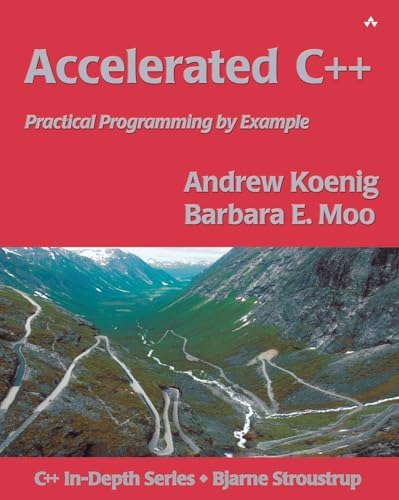

























The authors are widely considered to be among the world's foremost authorities on C++. What is perhaps even more important for the purposes of this review is that the authors are not only knowledgeable, but are also great teachers: they have used the material in this book for their professional-education course at Stanford University, and their pedagogic skills show on every page. It comes as no surprise, then, that "Accelerated C++" is consistently recommended to programmers who wish to learn C++.
The Good: This book does not talk down to the reader. It assumes that you are intelligent and implicitly expects you to have previously come into contact with either procedural or object-oriented programming. Many different topics are covered in a short space (around 300 pages in total), but the text is highly readable owing to the authors's relaxed tone, as well as their many cross-references and their detailed explanations of the examples (after all, the book's subtitle is "practical programming by example"). Equally important, the authors have provided on their website the source code for all the examples in the book (and more), packaged for different platforms. As should be obvious, modifying, compiling, and running the code in parallel to reading the text is integral to understanding the concepts being introduced. In contradistinction to many other popular volumes, this book teaches real C++, not "C with classes". To illustrate this point, let me note that pointers and arrays are only introduced in Chapter 10 (of 16). "Accelerated C++" jumps right in and describes a variety of topics that are of use to professional C++ programmers, such as standard library algorithms, templates, allocators, dynamic binding, and more.
The Bad: Some readers may find the student-grading and character-pictures examples a little boring (though what simple example isn't somewhat boring?). Also, the difficulty level of the exercises is not consistent (e.g. some have already been worked out in the provided source code). This book isn't really great as a reference: new concepts are introduced when they are needed for the purposes of the examples. This means that the chapters cannot really be read out of order. Futhermore, certain things like bitsets, switches, enums, and multiple inheritance are either relegated to the Appendices or are not mentioned at all. In a similar vein, object-oriented programming is not thoroughly discussed (as can be expected from such a short book): e.g., inheritance is introduced in chapter 13 (of 16). Finally, this book was published in 2000 and quite a bit has changed in the meantime. Most notably, we are now expecting a new standard to come out (still known as C++0x). Unfortunately, this book doesn't talk about TR1 (a specification for functionality being added to C++'s standard library) or boost (a collection of libraries offering TR1 implementations and much more), or threading in C++. A new edition of "Accelerated C++" apparently is in the works.
Lest the reader feel that I am being too negative, I note that it is impossible for one book to please everyone and cover everything, while being always up-to-date and still remaining short. In a nutshell, this book is great at what it intends to be: a fast-paced, authoritative, and pedagogically sound introduction to (1998/2003) standard C++ . This book definitely deserves 5 stars.
----------------
My two cents on recommended follow-ups:
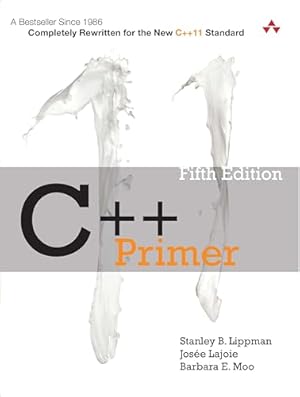
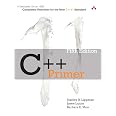
* C++ Primer, 4th edition, by Stanley B. Lippman, Josee Lajoie, Barbara E. Moo
A great second book which can be used to solidify and expand your understanding. The "C++ Primer" is over 800 pages long, but it is so well written that it can either be read cover-to-cover or used as a reference (see also my review of it on amazon).
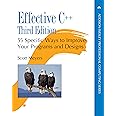
* Effective C++, 3rd edition, by Scott Meyers
This assumes you have already come across all of the material contained in "Accelerated C++" and in the "C++ Primer". It offers solid advice on numerous aspects of effective C++ development. Meyers also describes a few design patterns as well as more modern topics like TR1.
Alexandros Gezerlis
Customers who viewed this item also viewed
FREE delivery Monday, April 27

FREE delivery Monday, April 27

$3.98 delivery Wednesday, April 29
$3.98 delivery Wednesday, April 29

Download the free Kindle app and start reading Kindle books instantly on your smartphone, tablet, or computer - no Kindle device required.
Read instantly on your browser with Kindle for Web.
Using your mobile phone camera - scan the code below and download the Kindle app.

Follow the authors
Get new release updates & improved recommendations
Something went wrong. Please try your request again later.
Frequently bought together
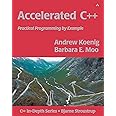
This item: Accelerated C++: Practical Programming by Example (C++ In-Depth Series)
$37.70
Get it as soon as Monday, Apr 27
Only 1 left in stock - order soon.
+
$41.38
Get it as soon as Monday, Apr 27
In Stock
+
$36.67
Get it as soon as Monday, Apr 27
Only 1 left in stock - order soon.
Total price: $00
To see our price, add these items to your cart.
Choose items to buy together.
Deals on related products
Page 1 of 1Start over
Related products with free delivery on eligible orders
Sponsored | Try Prime for unlimited fast, free shipping
Page 1 of 1Start over
Customers say
Customers find this C++ book to be the best introduction to the language, with clear explanations and concise content that gets them up to speed quickly. Moreover, the book is well-suited for those with programming experience, and one customer notes it encourages good programming practices. However, the readability and clarity receive mixed feedback, with some customers finding it easy to understand while others struggle with comprehension. Additionally, the language coverage is also mixed, with some customers appreciating the comprehensive language coverage while others note it requires prior programming knowledge.
AI Generated from the text of customer reviews
Select to learn more
65 customers mention content, 55 positive, 10 negative
I wouldn't recommend this to a first time programmer, but it's a great book if you've already learned another language and want to get started...Read more
...techniques and iterative and OO style programming, this is a good book to get you through the C++ way of doing things. Why minus 1 star?...Read more
This is one of the best programming books I have used. It is dense though, so take your time. It is packed full of examples and practice questions....Read more
It is a great little book that has helped me get a handle on C++ right away....Read more
12 customers mention concise, 10 positive, 2 negative
This is one of the best programming books I read. It is concise and compact like C programming language by Brian W.Kernighan and Dennis M....Read more
There is something about a well written dense book that makes you look forward to each chapter and every exercise....Read more
...The book is concise, no rambling like most programming books. So you can grab the most important thing and will not lost in non- sense....Read more
...The "C++ Primer" is over 800 pages long, but it is so well written that it can either be read cover-to-cover or used as a reference...Read more
10 customers mention pacing, 7 positive, 3 negative
...In a nutshell, this book is great at what it intends to be: a fast-paced, authoritative, and pedagogically sound introduction to (1998/2003)...Read more
Accelerated C++ is refreshingly practical, teaching the basics of the STL and language features using a simple data processing application that gets...Read more
...But again, this kind of ties into this book's problems. Each chapter is not stand-alone, which is a pain....Read more
...It does teach at an accelerated pace so I needed to reread many parts. It's not out of date, except for the new C++11.Read more
10 customers mention programming experience, 8 positive, 2 negative
...and clear, and teach you not only the basic C++ language, object-oriented programming, and STL features such as copy() and find() that are standard...Read more
...Its also good for fast learners with no programming experience.Read more
...from its standard library aspect can make you a productive programmer in much much shorter time than learning from the traditional approach, which...Read more
The book teaches you C++ right off the bat. It assumes you already know programming. It guides by example programs. Some are pretty cool....Read more
7 customers mention length, 6 positive, 1 negative
Informative and short. Recommended if you want a quick read and already know some object oriented languageRead more
They have got magic lamp to capture C++ gene in a very small book....Read more
...So, what is good about the book? It's short. If you look at most books on C++, they are very big, because C++ is very big....Read more
...The length is not so large as to scare away; some similar books are so long that it would take a year to seriously plow through them....Read more
19 customers mention readability, 13 positive, 6 negative
...The explanations are all excellent and clear, and teach you not only the basic C++ language, object-oriented programming, and STL features such as...Read more
...that with the approach used in this book, pointer and array are easier to understand than learning from the traditional approach....Read more
...(though it is a very dry and dense read)....Read more
...Readable Cons NoneRead more
15 customers mention clarity, 9 positive, 6 negative
...The explanations are clear, and the authors are clearly experts that know exactly what every feature does....Read more
...They talk Ad infinitum about very simple and obvious things yet are very vague and especially incomplete in explaining the C++ language concepts as...Read more
...absolutely no time getting you into understanding C++ mode, and simple terms and things most programmers take for granted take quickly as you're...Read more
...Also it does not cover everything about C++, but if you have programed in another language before it will get you right into the C++ without wasting...Read more
11 customers mention language coverage, 7 positive, 4 negative
...The explanations are all excellent and clear, and teach you not only the basic C++ language, object-oriented programming, and STL features such as...Read more
...obvious things yet are very vague and especially incomplete in explaining the C++ language concepts as if they don't want to scare anyone....Read more
...with useful abstractions and solving problems in a modern, idiomatic C++ fashion then proceeding deeper into the language once the contextual...Read more
It's a good introduction to C++ language for novice programmers. It covers basics but it doesn't describe the language in depth....Read more
Top reviews from the United States
There was a problem filtering reviews. Please reload the page.
Top reviews from other countries
-
-
- peter nguyenReviewed in Australia on January 16, 2022
item as described
Format: PaperbackVerified Purchase - Leong CKReviewed in Singapore on July 18, 2022
It is what I needed.
Format: PaperbackVerified Purchase Good for learning C++ programming.Leong CK
It is what I needed.
Reviewed in Singapore on July 18, 2022
Images in this review