Buy New
$79.99$79.99
FREE delivery Monday, April 27
Advertisement
Advertisement
Ships from: Amazon Sold by: INSTA_Granny Book Sales
Used - Very Good
$8.26$8.26
FREE delivery April 30 - May 4
Advertisement
Advertisement
Ships from: ThriftBooks-Phoenix Sold by: ThriftBooks-Phoenix
Sorry, there was a problem.
There was an error retrieving your Wish Lists. Please try again.Sorry, there was a problem.
List unavailable.
Download the free Kindle app and start reading Kindle books instantly on your smartphone, tablet, or computer - no Kindle device required.
Read instantly on your browser with Kindle for Web.
Using your mobile phone camera - scan the code below and download the Kindle app.
Follow the author
OK
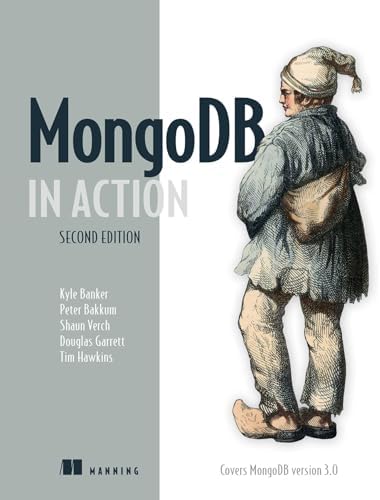
MongoDB in Action: Covers MongoDB version 3.0 2nd Edition
Purchase options and add-ons
MongoDB in Action, Second Edition is a completely revised and updated version. It introduces MongoDB 3.0 and the document-oriented database model. This perfectly paced book gives you both the big picture you'll need as a developer and enough low-level detail to satisfy system engineers.
Purchase of the print book includes a free eBook in PDF, Kindle, and ePub formats from Manning Publications.
About the Technology
This document-oriented database was built for high availability, supports rich, dynamic schemas, and lets you easily distribute data across multiple servers. MongoDB 3.0 is flexible, scalable, and very fast, even with big data loads.
About the Book
MongoDB in Action, Second Edition is a completely revised and updated version. It introduces MongoDB 3.0 and the document-oriented database model. This perfectly paced book gives you both the big picture you'll need as a developer and enough low-level detail to satisfy system engineers. Lots of examples will help you develop confidence in the crucial area of data modeling. You'll also love the deep explanations of each feature, including replication, auto-sharding, and deployment.
What's Inside
- Indexes, queries, and standard DB operations
- Aggregation and text searching
- Map-reduce for custom aggregations and reporting
- Deploying for scale and high availability
- Updated for Mongo 3.0
About the Reader
Written for developers. No previous MongoDB or NoSQL experience is assumed.
About the Authors
After working at MongoDB, Kyle Banker is now at a startup. Peter Bakkum is a developer with MongoDB expertise. Shaun Verch has worked on the core server team at MongoDB. A Genentech engineer, Doug Garrett is one of the winners of the MongoDB Innovation Award for Analytics. A software architect, Tim Hawkins has led search engineering at Yahoo Europe. Technical Contributor: Wouter Thielen. Technical Editor: Mihalis Tsoukalos.
Table of Contents
PART 1 GETTING STARTED
- A database for the modern web
- MongoDB through the JavaScript shell
- Writing programs using MongoDB
PART 2 APPLICATION DEVELOPMENT IN MONGODB
- Document-oriented data
- Constructing queries
- Aggregation
- Updates, atomic operations, and deletes
PART 3 MONGODB MASTERY
- Indexing and query optimization
- Text search
- WiredTiger and pluggable storage
- Replication
- Scaling your system with sharding
- Deployment and administration
- ISBN-101617291609
- ISBN-13978-1617291609
- Edition2nd
- PublisherManning
- Publication dateApril 15, 2016
- LanguageEnglish
- Dimensions7.38 x 1 x 9.25 inches
- Print length480 pages
Products related to this item
Editorial Reviews
About the Author
Peter Bakkum is a developer with expertise using MongoDB for building and scaling data infrastructure in large commercial deployments.
Shaun Verch has worked at MongoDB on the core server team, and has been part of other educational efforts, such as the M101JS online course about using MongoDB with Node.js.
Doug Garrett, a speaker at the first MongoDB World conference in NYC and one of the winners of the MongoDB Innovation Award for Analytics, is a software engineer in the Bioinformatics department of Genentech Research and Early Development.
Tim Hawkins served as the Head of European Search Engineering for Yahoo and later as a lead solutions architect focused on internationalization and scalability.
Product details
- Publisher : Manning
- Publication date : April 15, 2016
- Edition : 2nd
- Language : English
- Print length : 480 pages
- ISBN-10 : 1617291609
- ISBN-13 : 978-1617291609
- Item Weight : 1 pounds
- Dimensions : 7.38 x 1 x 9.25 inches
- Best Sellers Rank: #4,486,120 in Books (See Top 100 in Books)
- #833 in Software Design Tools
- #929 in JavaScript Programming (Books)
- #1,274 in Data Modeling & Design (Books)
- Customer Reviews:
About the author

Discover more of the author’s books, see similar authors, read book recommendations and more.
Related products with free delivery on eligible orders
Customer reviews
Customer Reviews, including Product Star Ratings help customers to learn more about the product and decide whether it is the right product for them.
To calculate the overall star rating and percentage breakdown by star, we don’t use a simple average. Instead, our system considers things like how recent a review is and if the reviewer bought the item on Amazon. It also analyzed reviews to verify trustworthiness.
Learn more how customers reviews work on AmazonTop reviews from the United States
There was a problem filtering reviews. Please reload the page.
- Reviewed in the United States on July 31, 2016Format: PaperbackVerified PurchaseI've really enjoyed this book. My favorite part by far is the tech comparison in the early chapters. The authors go over the pros and cons of MongoDB and describe the use cases for it, and it's competitors. The examples are all in Ruby, but are readable (even for a JS dev). I was up and running in ~5 minutes and followed along in each chapter. At about 1/3 of the way in, I felt I had a firm enough grasp to be able to implement it into my own project.
Coming from a relational (MySQL) background, the concept of a NoSQL DB was intriguing but took a bit of getting used to ("you don't have to design your schema up front?"). Storing and receiving data in a JSON-based format felt right at home after working with web frameworks and this book provides some great samples.

- Reviewed in the United States on August 11, 2017Format: PaperbackVerified PurchaseGreat book for developers and database administrators as well. I really like the way the book it's organized.
- Reviewed in the United States on December 23, 2016Format: PaperbackVerified PurchaseGreat read, but I am a MongoDB novice. I have not finished the book, but what I have read has helped move me forward with my MongoDB project.
- Reviewed in the United States on April 28, 2016Format: PaperbackThis updated edition is aimed at software developers, but it doesn't ignore those of us who are more "casual" users of MongoDB. Indeed, this is an excellent book for newcomers to MongoDB, especially if you are patient and willing to read through an introductory chapter focusing on "MongoDB's history, design goals, and application use cases." Many people, of course, just want to jump straight into downloading software, running it, and playing with it for a while before getting down to serious stuff such as application use cases. So Appendix A is the place to go for getting MongoDB onto Linux, Mac, or Windows PCs. Then, once you have MongoDB installed, you can jump back to Chapter 2 to start learning how to use the JavaScript shell. After that, things start getting more "practical." For example, Chapter 3 introduces "Writing programs using MongoDB." Here, Ruby is used to work with the MongoDB API, but the author notes: "MongoDB, Inc. provides officially supported, Apache-licensed MongoDB drivers for all of the most popular programming languages. The driver examples in the book use Ruby, but the principles we’ll illustrate are universal and easily transferable to other drivers. Throughout the book we’ll illustrate most commands with the JavaScript shell, but examples of using MongoDB from within an application will be in Ruby."
I won't try to sum up everything in this well-written, 13-chapter book. I have used older, 2.X versions of MongoDB in MEAN stack applications. And, separately, I have worked a bit with Ruby and MongoDB. But in each case, I haven't needed to learn all that much about MongoDB itself, mainly just ensure that it is storing data that can be accessed in the right place and updated, saved or deleted as needed. So this book, written for 3.0.X (and later, as well as earlier) MongoDB releases is an eye-opener for me and one that I will keep around for reference and more learning now that I have upgraded to 3.2.
Part 1 of this 2nd edition "provides a broad, practical introduction to MongoDB." Part 2 offers "a deep exploration of MongoDB’s document data model." And Part 3 examines MongoDB "from the database administrator’s perspective. This means we’ll cover all the things you need to know about performance, deployments, fault tolerance, and scalability."
One cautionary note: The author points out that "as of MongoDB v3.0, 32-bit binaries will no longer be supported." Of course, some 3.X 32-bit binaries are still out there, and you can install them, but you will get a lot of warning messages from MongoDB. Download a 64-bit binary if your system will support it.
The author realizes that many readers who have some MongoDB experience will not read the book straight through but will jump around to chapters in many different orders and will even skip some chapters. And this is okay. MongoDB in Action: Second Editon is a book many of us will be happy to have handy whenever we need to get a better grip on some new aspect of working with this great open-source, document database.
(My thanks to Manning for providing a review copy.)
- Reviewed in the United States on November 17, 2020Format: PaperbackVerified PurchaseExcellent read and details concepts in granular details
Top reviews from other countries
NikolasReviewed in Germany on July 2, 20175.0 out of 5 stars Great Introduction in MongoDB
Format: PaperbackVerified PurchaseI started reading the book as a complete novice in NoSQL and MongoDB in particular. It helped me understand how to efficiently set up and query a MongoDB, to great results. I really have a sense of gratitude to the authors.
-
salvatoreReviewed in Italy on September 5, 20195.0 out of 5 stars Mongo dB in action
Format: PaperbackVerified PurchaseIl prodotto ha soddisfatto pienamente le mie aspettative
-
RangelsReviewed in France on October 4, 20165.0 out of 5 stars Parfait pour une entrée en matière
Format: PaperbackVerified PurchaseAvec quelques bases en Json et en bases de données plutôt relationnelles j'ai facilement pris le livre en main. Le contenu est facile à lire et les exemples sont clairs (il faut avoir des notions d'anglais). Le livre suit une progression que je trouve bien adaptée, même si je n'ai pas encore attaqué les derniers chapitres.
Je ne sais pas si le livre couvre tout le potentiel de MongoDB mais il me semble qu'il fournit tous les outils pour produire des bases de données bien structurées et optimisées.
-
AndreaReviewed in Italy on January 24, 20174.0 out of 5 stars Quasi ottimo...
Format: PaperbackVerified PurchaseE' veramente un ottimo libro: i dettagli di mongodb vengono presi e spiegati con dovizia di particolari. Anche se non si conosce nulla di questo database, gli autori accompagnano il lettore dalle basi fino all'utilizzo più avanzato. Utile anche il confronto continuo con i database relazionali (si presuppone che chi acquista questo libro abbia almeno le basi sul mondo dei database). Tratta in modo approfondito anche la configurazione dei cluster e dello sharding (anche se in quest'ultimo caso sono state fatte delle modifiche dalla versione 3.* di mongodb e la configurazione è leggermente differente).
I difetti di questo libro? Gli esempi avanzati sono fatti in Ruby (un capitolo intero è dedicato ad un esempio avanzato con questo linguaggio - IMHO: non potevano scegliere tecnologie come nodejs più vicine al mondo di MongoDb?). Inoltre, questa nuova edizione si basa sulla versione 3.0 di mongodb quando siamo alla versione 3.5. Questo comporta che ci sono molte mancanze soprattutto a riguardato le aggregation; un capitolo intero è dedicato a questo argomento, ed è un bene leggerlo per farsi un'idea, ma sono così tante le novità introdotte che è meglio rivolgersi subito dopo alla documentazione ufficiale - per esempio, dalla versione 3.2 è stato introdotto il comando $lookup che permette le join tra collection in modo facile.
Ben fatti i capitoli riguardanti il text serch e gli index... molto dettagliati quelli che descrivono la configurazione del replica-set e lo sharding.
Consigliato.