

Buy New
-25%
$32.99$32.99
$3.78 delivery Monday, May 4
Advertisement
Advertisement
Ships from: betterlife24 Sold by: betterlife24
Used - Like New
$30.94$30.94
$3.99 delivery April 28 - 30
Advertisement
Advertisement
Ships from: techknowbooks Sold by: techknowbooks
Sorry, there was a problem.
There was an error retrieving your Wish Lists. Please try again.Sorry, there was a problem.
List unavailable.
Download the free Kindle app and start reading Kindle books instantly on your smartphone, tablet, or computer - no Kindle device required.
Read instantly on your browser with Kindle for Web.
Using your mobile phone camera - scan the code below and download the Kindle app.
Follow the authors
OK
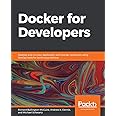
Docker for Developers: Develop and run your application with Docker containers using DevOps tools for continuous delivery
Purchase options and add-ons
Learn how to deploy and test Linux-based Docker containers with the help of real-world use cases
Key Features
- Understand how to make a deployment workflow run smoothly with Docker containers
- Learn Docker and DevOps concepts such as continuous integration and continuous deployment (CI/CD)
- Gain insights into using various Docker tools and libraries
Book Description
Docker is the de facto standard for containerizing apps, and with an increasing number of software projects migrating to containers, it is crucial for engineers and DevOps teams to understand how to build, deploy, and secure Docker environments effectively. Docker for Developers will help you understand Docker containers from scratch while taking you through best practices and showing you how to address security concerns.
Starting with an introduction to Docker, you'll learn how to use containers and VirtualBox for development. You'll explore how containers work and develop projects within them after you've explored different ways to deploy and run containers. The book will also show you how to use Docker containers in production in both single-host set-ups and in clusters and deploy them using Jenkins, Kubernetes, and Spinnaker. As you advance, you'll get to grips with monitoring, securing, and scaling Docker using tools such as Prometheus and Grafana. Later, you'll be able to deploy Docker containers to a variety of environments, including the cloud-native Amazon Elastic Kubernetes Service (Amazon EKS), before finally delving into Docker security concepts and best practices.
By the end of the Docker book, you'll be able to not only work in a container-driven environment confidently but also use Docker for both new and existing projects.
What you will learn
- Get up to speed with creating containers and understand how they work
- Package and deploy your containers to a variety of platforms
- Work with containers in the cloud and on the Kubernetes platform
- Deploy and then monitor the health and logs of running containers
- Explore best practices for working with containers from a security perspective
- Become familiar with scanning containers and using third-party security tools and libraries
Who this book is for
If you're a software engineer new to containerization or a DevOps engineer responsible for deploying Docker containers in the cloud and building DevOps pipelines for container-based projects, you'll find this book useful. This Docker containers book is also a handy reference guide for anyone working with a Docker-based DevOps ecosystem or interested in understanding the security implications and best practices for working in container-driven environments.
Table of Contents
- Introduction to Docker
- Using VirtualBox and Docker Containers for Development
- Sharing Containers Using Docker Hub
- Composing Systems Using Containers
- Alternatives for Deploying and Running Containers in Production
- Deploying Applications with Docker Compose
- Continuous Deployment with Jenkins
- Deploying Docker Apps to Kubernetes
- Cloud-Native Continuous Deployment Using Spinnaker
- Monitoring Docker Using Prometheus, Grafana, and Jaeger
- Scaling and Load Testing Docker Applications
- Introduction to Container Security
- Docker Security Fundamentals and Best Practices
- Advanced Docker Security - Secrets, Secret Commands, Tagging, and Labels
- Scanning, Monitoring, and Using Third-Party Tools
- Conclusion - End of the Road, but not the Journey
- ISBN-101789536057
- ISBN-13978-1789536058
- PublisherPackt Publishing
- Publication dateSeptember 14, 2020
- LanguageEnglish
- Dimensions7.5 x 1.06 x 9.25 inches
- Print length468 pages
Frequently bought together

Similar items that may deliver to you quickly
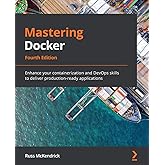
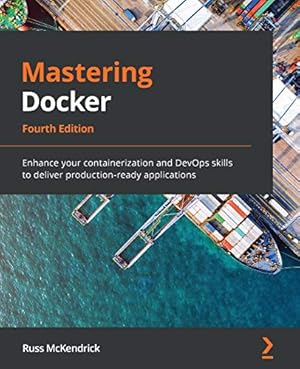
Mastering Docker: Enhance your containerization and DevOps skills to deliver production-ready applications, 4th EditionPaperbackFREE Shipping by AmazonGet it as soon as Tuesday, Apr 28
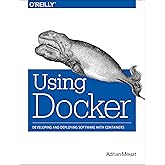
Using Docker: Developing and Deploying Software with ContainersPaperbackFREE Shipping on orders over $35 shipped by AmazonGet it as soon as Monday, Apr 27Only 1 left in stock (more on the way).
Docker: Up & Running: Shipping Reliable Containers in ProductionPaperbackFREE Shipping by AmazonGet it as soon as Monday, Apr 27Only 19 left in stock (more on the way).
Kubernetes for Developers: Use Kubernetes to develop, test, and deploy your applications with the help of containersJoe HeckPaperbackFREE Shipping by AmazonGet it as soon as Monday, Apr 27
Docker and Kubernetes for Java Developers: Scale, deploy, and monitor multi-container applicationsJaroslaw KrochmalskiPaperbackFREE Shipping by AmazonGet it as soon as Tuesday, Apr 28
Customers also bought or read
- Docker: Practical Guide for Developers and DevOps Teams - Unlock the Power of Containerization: Skills for Building, Securing, and Orchestrating with Docker (Rheinwerk Computing)
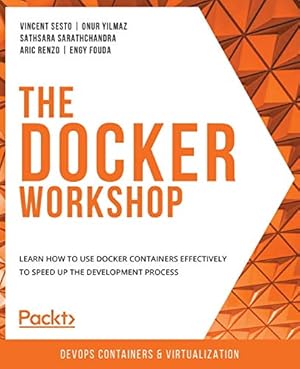
Paperback$49.95$49.95FREE delivery Mon, Apr 27 - The Docker Workshop: Learn how to use Docker containers effectively to speed up the development process
Paperback$43.99$43.99FREE delivery Tue, Apr 28 - How Linux Works, 3rd Edition: What Every Superuser Should Know
Paperback$33.64$33.64$3.99 delivery Wed, May 13 - Kubernetes and Docker - An Enterprise Guide: Effectively containerize applications, integrate enterprise systems, and scale applications in your enterprise
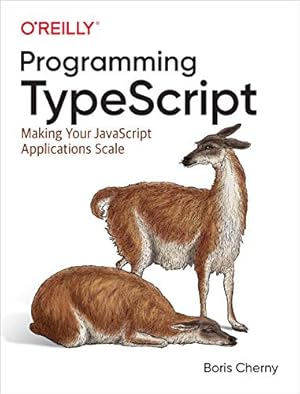
Paperback$50.98$50.98FREE delivery Mon, Apr 27 - Programming TypeScript: Making Your JavaScript Applications Scale
Paperback$29.43$29.43Delivery Apr 30 - May 1 - Container Security: Fundamental Technology Concepts that Protect Containerized Applications
Paperback$54.32$54.32FREE delivery Mon, Apr 27 - Mastering Docker: Enhance your containerization and DevOps skills to deliver production-ready applications, 4th Edition
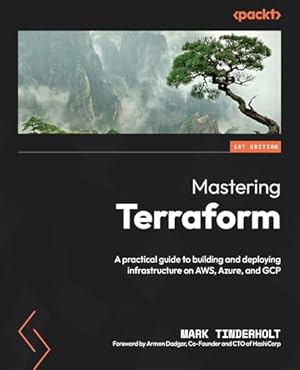
Paperback$43.99$43.99FREE delivery Tue, Apr 28 - Mastering Terraform: A practical guide to building and deploying infrastructure on AWS, Azure, and GCP
Paperback$39.99$39.99FREE delivery Tue, Apr 28 - Game Development with Blender and Godot: Leverage the combined power of Blender and Godot for building a point-and-click adventure game
Paperback$59.99$59.99FREE delivery Tue, Apr 28 - Efficient Linux at the Command Line: Boost Your Command-Line Skills
Paperback$37.53$37.53FREE delivery Mon, Apr 27 - Ansible for DevOps: Server and configuration management for humans
Paperback$19.99$19.99Delivery Tue, Apr 28 - Docker: Up & Running: Shipping Reliable Containers in Production
Paperback$26.62$26.62$3.99 delivery May 4 - 7 - Shell Scripting: How to Automate Command Line Tasks Using Bash Scripting and Shell Programming
Paperback$14.99$14.99Delivery Tue, Apr 28
Editorial Reviews
About the Author
Richard Bullington-McGuire is a software architect and DevOps practitioner with more than 28 years of professional experience in information technology. He has operated internet services continuously since 1995 when he established The Obscure Organization. He has used Docker to build, deploy, and run applications in production, including operating the Freezing Saddles winter cycling event since 2018. Richard is a member of the IEEE and the ACM. He holds 6 AWS certifications, including all of the Foundational, Associate, and Professional level certifications. He works at Modus Create, Inc. as director of engineering. You can find him on Twitter and GitHub at obscurerichard. Richard lives in Arlington, VA, with his wife and four children.
Andrew K. Dennis is a full stack and cybersecurity architect with over 17 years' experience who currently works for Modus Create in Reston, VA. He holds two undergraduate degrees in software engineering and creative computing and a master's degree in information security. Andy has worked in the US, Canada, and the UK in software engineering, e-learning, data science, and cybersecurity across his career, and has written four books on IoT, the Raspberry Pi, and supercomputing. His interests range from the application of pataphysics in computing to security threat modeling. Andy lives in New England and is an organizer of Security BSides CT.
Michael Schwartz is a full stack software engineer, architect, and embedded engineer for Modus Create, with over 45 years' experience as a professional. He founded one of the first public ISPs in the SF Bay Area, Best Internet Communications, and an early internet advertising agency, MediaPlex. He was one of the early developers of video games, including the upright coin-operated machines and consoles. His most recent project is RoboDomo, a home automation system built around Node.js, Docker containers, MQTT, and React.js. Originally from Chicago, IL, Mike resides in the Palm Springs area of California.
Product details
- Publisher : Packt Publishing
- Publication date : September 14, 2020
- Language : English
- Print length : 468 pages
- ISBN-10 : 1789536057
- ISBN-13 : 978-1789536058
- Item Weight : 1.76 pounds
- Dimensions : 7.5 x 1.06 x 9.25 inches
- Best Sellers Rank: #4,183,569 in Books (See Top 100 in Books)
- #492 in Linux & UNIX Administration (Books)
- #695 in Software Design Tools
- #762 in Linux Networking & System Administration
- Customer Reviews:
About the authors

Discover more of the author’s books, see similar authors, read book recommendations and more.

Richard Bullington-McGuire (B. 1972) is a technologist and author who has been using and writing about computers since the early 1990s. He has founded multiple for-profit companies and a non-profit, The Obscure Organization. Richard is a member of both the IEEE and the ACM.
In 1995 he founded The Obscure Organization and started giving free Internet accounts to anyone who asked nicely. In 2002 he formally incorporated the organization and filed for 501(c)(3) public charity status, refocusing the mission to promote creativity and community through technology.
His first book, Docker for Developers, was published by Packt in 2020. He has also published articles in Linux Journal, and given many presentations at meetups and conferences.
Richard lives in Arlington, Virginia with his wife and four children.

Michael Schwartz is a full stack software engineer, architect, and embedded engineer for Modus Create, with over 45 years' experience as a professional.
He founded one of the first public ISPs in the SF Bay Area, Best Internet Communications, and an early internet advertising agency, MediaPlex.
He was one of the early developers of video games, including the upright coin-operated machines and consoles.
His most recent project is RoboDomo, a home automation system built around Node.js, Docker containers, MQTT, and React.js.
Originally from Chicago, IL, Mike resides in the Palm Springs area of California.
Products related to this item
Customer reviews
Customer Reviews, including Product Star Ratings help customers to learn more about the product and decide whether it is the right product for them.
To calculate the overall star rating and percentage breakdown by star, we don’t use a simple average. Instead, our system considers things like how recent a review is and if the reviewer bought the item on Amazon. It also analyzed reviews to verify trustworthiness.
Learn more how customers reviews work on AmazonReviews with images
Great Content, Bad Kindle Formatting
Top reviews from the United States
There was a problem filtering reviews. Please reload the page.
- Reviewed in the United States on February 20, 2021Format: PaperbackVerified PurchaseVery completed with practical examples, tools and use cases.

- Reviewed in the United States on August 9, 2021Format: KindleVerified PurchaseAs others have said, this book covers a lot of good material.
Unfortunately, the code samples in the Kindle version are poorly formatted, and seem to be missing line breaks, resulting in difficult to read, run-on blobs of text. It's still technically possible to parse and understand the examples, but it's definitely more difficult than it should be.
I think it may be due to a recent change in the Kindle app because I don't remember it being this way the first time I read the book, but referring back to it today, I see this problem on read.amazon.com (in Firefox and Chromium), and on the Kindle app for iPad.
4.0 out of 5 starsAs others have said, this book covers a lot of good material.Great Content, Bad Kindle Formatting
Reviewed in the United States on August 9, 2021
Unfortunately, the code samples in the Kindle version are poorly formatted, and seem to be missing line breaks, resulting in difficult to read, run-on blobs of text. It's still technically possible to parse and understand the examples, but it's definitely more difficult than it should be.
I think it may be due to a recent change in the Kindle app because I don't remember it being this way the first time I read the book, but referring back to it today, I see this problem on read.amazon.com (in Firefox and Chromium), and on the Kindle app for iPad.
Images in this review
- Reviewed in the United States on September 14, 2020Format: KindleThe first section, chapters 5, 6 and 7 will look back on the history behind containerization. They will give you a very nice and humble introduction to Docker and container orchestration with a series of very minimalist and practical examples which lay down the foundation upon which the rest of the examples in the book will grow. I personally found them a very pleasant reading. From my experience as a professional developer working in projects built around Docker, the basic tools taught in these chapters pretty much sum up all that is needed to perform most if not all of the day-to-day tasks you may find in your own projects.
Chapters 8, 9, 10 and 11 are going to give you a glance over what is necessary to get a professional Kubernetes cluster up on AWS with examples built on top of the work done thus far. There is a lot to digest in that and the knowledge is passed in a much faster pace, with less context as opposed to the previous chapters of the book. Don't get me wrong, there are tons of valuable information for those who haven't been exposed before to the Kubernetes and the wider ops world. However I didn't found them to be as didactic as the material I read to that point due to the very nature of the subject which is way denser, having a lot of non-trivial concepts to grasp which are not straightforward to tinker with. They will nonetheless give you a hands on exposure to the current industry best-practices, expand your perspective over the subject and leave you in a good place where you can continue learning on your own.
The remaining pages will then finally give you a complete look on what to keep in mind when it comes to security in a container-based environment. You'll enjoy the tips in this third and last section which is full of practical advice to keep you, your company and your users protected from silly mistakes and the most common threats. You will learn about the security model around Docker and how to monitor your deployments with an eye on security. Overall the book seemed pretty worthy. As a developer myself, with daily tasks not really focused on most of the topics put forth in depth here, I found the reading very interesting. It has certainly improved my understanding around the topics covered. I recommend it.
- Reviewed in the United States on October 4, 2020Format: KindleWhen reading articles, tutorials and even books, that is very common that at the end of the reading you struggle about how to translate that to a real production situation. Believe me, this book is different. You get to the end with a sense that you are very likely to know what are the next steps to apply what you learned to your existent or new projects. And this means a lot. The book has some great balance from history, concepts, example and practice.
Although there is a lot of cont to grasp and the book is not exhaustive about the subjects, it gives you the most important information and real-world scenarios. You will be confident about the path you need to go to improve your local environment, to prepare a CI/CD pipeline and ship your product to production with a high-quality workflow. The authors are careful enough to list different solutions and approaches because there is not a single tool that solves all the problems and this book give you enough to understand which stack could fit better to your software needs.
If you want to know more about Docker on your local environment, how containers relate to production, container orchestration with Docker swarm or Kubernetes, container image publishing, etc, you need this book.
I highly recommend it.
- Reviewed in the United States on December 10, 2020Format: PaperbackI read this book over the course of a week and deployed docker containers into our repositories over a two week period following that. Then, the week after that, I gave a lunch n learn to the company, using what I had l learned from the book and experience from practice. Now we have containers for clean e2e testing, gitlab docker runners to run and scale to more runners without new VMs, they build containers for us, and it’s quickly become normal in our company. I’ll be reviewing the kuberneties sections over the new week to keep down the path. Thanks Richard. This book cuts to the chase and lives up to the title!
- Reviewed in the United States on September 17, 2020Format: PaperbackThe most appealing chapters for me were about Security. Docker for Developers provides an introduction to security then goes onto describing high-level concepts over multiple chapters. Citing resources online for further understanding into specific security topics. Helping the reader understand the breadth of considerations of what goes into security with docker when deploying. Wrapping understanding of the ecosystem that exists for different software solutions used to lock down systems running docker and protect against malicious intent
- Reviewed in the United States on April 10, 2022Format: PaperbackDoesn't really teach you how to use Docker. It just introduces a bunch of somewhat related technologies (at a shallow layer) that you can use Docker and Kubernetes with.
Top reviews from other countries
-
Kunde aus BremerhavenReviewed in Germany on February 5, 20235.0 out of 5 stars Masterwork!
Format: PaperbackVerified PurchaseI ch bin ganz begeistert.
Just Some GuyReviewed in the United Kingdom on November 4, 20214.0 out of 5 stars A Good Overview of Docker's Ecosystem - but NOT a Deep Developer Resource
Format: PaperbackVerified PurchaseThis is a good book - it's just not what I expected. What I _thought_ I'd get, based on the title, was a hands-on low-level nitty gritty ultra-geek caliber technical tour of all the ins and outs of working with Docker as a developer, in a day-to-day way (i.e. the best way to write docker files for various essential scenarios, the best coding practices, etc.).
That's not what this book is. It does contain a bunch of pretty good technical information - but it's much more a guided tour of the entire Docker ecosystem (including a long list of related libs, products and services like Kubernetes, Jenkins, Grafana, Envoy, etc.), than it is a low-level developer guide.
That's not bad, it's just not what I expected.
It actually does a nice job of introducing just how broad the Docker-centric ecosystem really is, and outlining many of the most popular, useful, and important products/services/libs therein. If anything, it just covers too much breadth, and sacrifices depth as a result.
My biggest complaint about this book is that the authors offloaded a TON, and I mean a LOOOOOT, of work to external sources (3rd party docs, etc.). It covers so much ground that if it didn't do that it would be a 900 page monster – but by lazily offloading SO MUCH lifting to external links, the book ends up being just a brief high-level intro to almost 2/3 of the various products and services it introduces - before pointing you to their external docs with a note like, "To learn about [this], go [here] and read [this page]." ... then immediately after the URL on the page they continue with , "...OK, so now that you've learned how to do [that], let's move on to [the next thing]...".
In too many cases, this book doesn't actually *teach* you much of anything. It just sorta explains that this product can do this thing, and you can read about it here, and this is why that's important and you should learn and use it in your container app. The authors assume those third parties will explain all you need to know about how their stuff works, and that you'll be resourceful enough to dig thru their external docs to answer any questions you may have, etc.
Beyond Docker itself, the book's best coverage is around Kubernetes, Jenkins, and AWS EKS - and these are massively useful and important. But the rest of the products it refers to are, to borrow a term the authors themselves use more than once, a very quick "whistle stop tour."
There's plenty of value in this book, and I do recommend it. I just want you to know what it is, and what it is not.