
The Jacobian Method, also known as the Jacobi Iterative Method, is a fundamental algorithm used to solve systems of linear equations. It is useful when dealing with large systems where direct methods (like Gaussian elimination) are computationally expensive.
- The Jacobian Method works by breaking down a complex set of equations into simpler parts, making it easier to approximate the solutions.
- The Jacobian method leverages the properties of matrices to find solutions efficiently.
Here's a simple way to understand it:
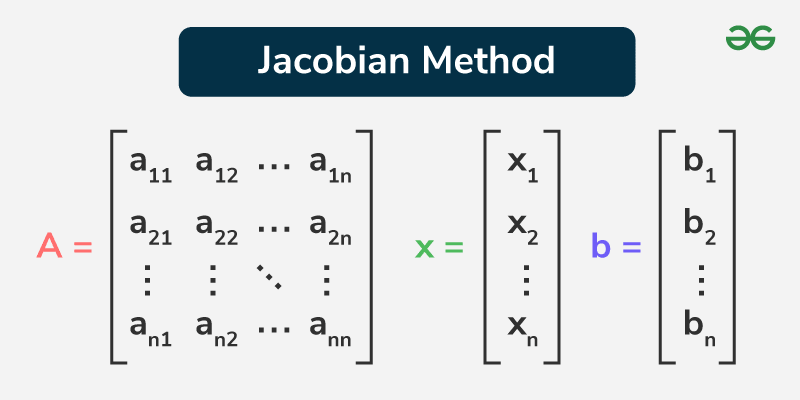
Basics of Jacobian Method
The method is used to solve a system of linear equations of the form:
Ax = b
Where A is a square matrix, x is the vector of unknowns, and b is the right-hand side vector.
The Jacobi Method decomposes the matrix A into its diagonal component D and the remainder R, such that:
A = D + R
The system of equations can then be rewritten as:
Dx = b − Rx
The iterative formula for the Jacobi Method is:
xk+1 = D−1(b − Rxk)
Where xk is the approximation of the solution at the kth iteration.
Jacobi Iterative Implementation of Jacobian Method
The Jacobi iterative method is a specific implementation of the Jacobian method. It assumes that the system of linear equations can be written in the form Ax = b, where A is the coefficient matrix, x is the vector of unknown variables, and b is the vector of constants. The Jacobi method proceeds as follows:
- Assumption 1: The system of linear equations has a unique solution.
- Assumption 2: The coefficient matrix A has no zeros on its main diagonal.
- Assumption 3: The system is diagonally doominant( i.e., the absolute value of the diagonal elemnet in each row must be greater than or equal to the sum of the absolute values of the other elements in that row.)
Steps for Jacobi Iterative Method
We can use the following steps:
- Check if the equations are idagonally dominant: if not rearrage the equations to make it diagonally dominant.
For example, in the first equation: ∣a11∣ ≥ ∣a12∣ + ∣a13∣, where a11 is the coeffiecient of x, a12 is the coeffiecient of y, and a13 is the coeffiecient of z. - Rewrite the system of linear equations in the form:
x_i = (b_i - ∑_{j≠i} a_{ij} x_j) / a_{ii} - Make an initial guess of the solution, x(0) = (x1(0), x2(0), ..., xn(0)).
- Compute the first approximation, x(1), by substituting the initial guess into the rewritten equations.
- Repeat step 3, using the previous approximation to compute the next approximation, until the desired accuracy is achieved.
Let's consider an example for better understanding:
Example : Consider the system of linear equations:
- 2x + y + z = 6
- x + 3y - z = 0
- -x + y + 2z = 3
Checking if the equations are diagonally dominant:
∣2∣ ≥ ∣1∣ + ∣1∣ = 2- true
∣3∣ ≥ ∣1∣ + ∣-1∣ = 2- true
∣2∣ ≥ ∣-1∣ + ∣1∣ = 2- trueRewriting the system in the Jacobi form, we get:
x = (6 - y - z) / 2
y = (0 - x + z) / 3
z = (3 + x - y) / 2Starting with the initial guess , the first approximation is:
Iteration 1: with p(0) = (0, 0, 0)
x(1) = (6 - 0 - 0) / 2 = 3
y(1) = (0 - 0 + 0) / 3 = 0
z(1) = (3 + 0 - 0) / 2 = 1.5Continuing the iterations, we obtain the following approximations:
Iteration 2: with p(1) = (3, 0, 1.5)
x(2) = (6 − 0 − 1.5) / 2 = 2.25
y(2) = (−3 + 1.5) / 3 = −0.5
z(2) = (3 + 3 − 0) / 2 = 3Iteration 3: with p(2) = (2.25, -0.5, 3)
x(3) = (6 + 0.5 − 3) / 2 = 1.75
y(3) = (−2.25 + 3) / 3 = 0.25
z(3) = (3 + 2.25 + 0.5) / 2 = 2.875Iteration 4: with p(3) = (1.75, 0.25, 2.875)
x(4) = (6 - 0.25 - 2.875) / 2 = 1.4375
y(4) = (0 - 1.75 + 2.875) / 3 = 0.375
z(4) = (3 + 1.75 - 0.25) / 2 = 2.25The values are converging slowly.
Therfore after 4 iterations we got: x ≈ 1.75, y ≈ 0.25, z ≈ 2.875.
After more iterations, you'll get a solution with more precision.
Jacobian Method in Matrix Form
Let the system of linear equations be Ax = b, where A is the coefficient matrix, x is the vector of unknown variables, and b is the vector of constants.
We can decompose the matrix A into three parts:
A = D + L + U
Where D is the diagonal matrix, L is the lower triangular matrix, and U is the upper triangular matrix.
The Jacobi iteration can then be written as:
x(k+1) = D(-1) (b - (L + U)x(k))
Where x(k) and x(k+1) are the kth and (k+1)th approximations of the solution, respectively.
The element-based formula for the Jacobi method can be written as:
xi(k+1) =
(b_i - ∑_{j≠i} a_{ij} x_j^{(k)}) / a_{ii}
This formula shows how the (k+1)th approximation of the ith variable is computed using the kth approximations of the other variables.
Jacobian vs Gauss-Seidel Method
The difference between Jacobian and Gauss-Seidel method is given below:
Jacobi Method | Gauss-Seidel Method |
|---|---|
Variables are updated simultaneously after each iteration using the values from the previous iteration. | Variables are updated immediately after each variable is computed, allowing for quicker convergence. |
Typically slower convergence compared to Gauss- Seidel method. | Generally faster convergence compared to Jacobian's method. |
Requires more iterations to converge to the solution. | Requires fewer iterations to reach a certain degree of accuracy. |
Easier to implement due to the simultaneous update of variables. | Slightly more complex to implement due to the immediate variable updates. |
Computationally more challenging for parallel computations due to simultaneous updates. | Allows for easier parallel computations as variables are updated immediately. |
Related Articles
Solved Examples on Jacobian Method
Question 1: Consider the system of linear equations:
4x + y − z = 3
2x + 5y + z = 9
x + y + 3z = 7
Checking if the equations are diagonally dominant:
∣4∣ ≥ ∣1∣ + ∣-1∣ = 2- true
∣5∣ ≥ ∣2∣ + ∣1∣ = 3- true
∣3| ≥ ∣1∣ + ∣1∣ = 2- trueWe can rewrite this system in the Jacobi form as:
x = (3 - y + z)/4
y = (9 - 2x - z)/5
z = (7 - x - y)/3Starting with the initial guess p(0)=(0,0,0)
Iteration 1:
Substitute the initial guess into the Jacobi equations:
x(1) = (3 − 0 + 0)/ 4 = 0.75
y(1) = (9 − 0 − 0)/5 = 1.8
z(1) = (7 − 0 − 0)/3 = 2.3333First approximation: p(1)=(0.75, 1.8, 2.33)
Iteration 2:
Substitute the first approximation into the Jacobi equations:
x(2) = (3 − 1.8 + 2.33)/ 4 = 0.8833
y(2) = (9 − 2(0.75) − 2.33)/5 = 1.033
z(2) = (7 − 0.75 − 1.8)/3 = 1.4833Second approximation: x(2)=(0.8833, 1.033, 1.4833)
Iteration 3:
Substitute the second approximation into the Jacobi equations:
x(3) = (3 − 1.033 + 1.4833)/ 4 = 0.8625
y(3) = (9 − 2(0.8833) − 1.4833)/5 = 1.1500
z(3) = (7 − 0.8833 − 1.033)/3 = 1.6944The values are converging slowly.
Therfore after 3 terations we got: x ≈ 0.8625, y ≈ 1.1500, z ≈ 1.6944.
After more iterations, you'll get a solution with more precision.
Question 2: Consider the following system of linear equations:
3x + 2y - z = 7
2x - y + 4z = 13
x + 3y + 2z = 12
Checking if the equations are diagonally dominant:
∣3∣ ≥ ∣2∣ + ∣-1∣ = 3- true
∣-1∣ ≥ ∣2∣ + ∣4∣ = 6- false
∣2| ≥ ∣1∣ + ∣3∣ = 4 - falseSwapping the equations we get,
3x+2y−z=7(1)
x+3y+2z=12(2)
2x−y+4z=13(3)∣3∣ ≥ ∣2∣ + ∣-1∣ = 3- true
∣3 ≥ ∣1∣ + ∣2∣ = 3- true
∣4| ≥ ∣2∣ + ∣-1∣ = 3 - trueWe can rewrite this system in the Jacobi form as:
x = (7−2y+z) / 3
y = (12−x−2z) / 3
z = (13−2x+y) / 4Let's start with the initial guess p(0)=(0,0,0)
Iteration 1: Substituting the initial guess into the Jacobi equations, we get:
x(1) = (7 - 2(0) + 0)/3 = 7/3 = 2.333
y(1)= (12 - 0 + 2(0))/3 = 4
z(1)= (13 - 2(0) + 0)/4 = 13/4 = 3.25Therefore, the first approximation is p(1)=(2.333, 4, 3.25)
Iteration 2: Substituting the first approximation into the Jacobi equations, we get:
x(2) = (7 - 2(4) + 3.25)/3 = 0.75
y(2)= (12 - 2.333 + 2(3.25))/3 = 1.0556
z(2)= (13 - 2(2.333) + 4)/4 = 3.0833Therefore, the second approximation is p(2)=(0.75, 1.0556, 3.0833)
Iteration 3: Substituting the second approximation into the Jacobi equations, we get:
x(3) = (7 - 2(1.0556) + 3.0833)/3 = 2.6574
y(3)= (12 - 0.75 + 2(3.0833))/3 = 1.6945
z(3)= (13 - 2(0.75) + 1.0556)/4 = 3.1389Iteration 4: Substituting the third approximation into the Jacobi equations, we get:
x(4) = (7 - 2(1.6945) + 3.1389)/3 = 2.25
y(4)= (12 - 2.6574 + 2(3.1389))/3 = 1.0216
z(4)= (13 - 2(2.6574) + 1.6945)/4 = 2.3449The values are converging slowly.
Therfore after 4 iterations we got: x ≈ 2.25, y ≈ 1.0216, z ≈ 2.3449.
After more iterations, you'll get a solution with more precision.
