
Custom field validations ensure that data entered into a model field meets specific rules before being saved to the database. They extend Django’s built-in validations, allowing developers to enforce additional rules.
- Can verify formats, length limits, or complex conditions (such as ensuring an email belongs to a certain domain).
- Run automatically when creating or updating model instances.
- Help maintain clean and consistent data without adding extra validation logic in forms or views.
- Builds on Django’s built-in field validations.
Syntax
field_name = models.Field(validators=[validator_function1, validator_function2])
- validators is a list of validator functions that will be executed when the field value is set.
- Each validator function accepts a single argument, value, which is the data entered for the field.
Understanding Django Custom Field Validation
Consider a project named 'geeksforgeeks' having an app named 'geeks'. Let’s create a custom validator that accepts only email addresses ending with @gmail.com.
1. Define the Model
In models.py, start with a simple model having a CharField for email:
from django.db import models
from django.db.models import Model

class GeeksModel(Model):
    geeks_mail = models.CharField(max_length = 200)
2. Create a Validator Function
Create a custom validator function that will check whether the email address ends with @gmail.com. If it doesn't, the function will raise a ValidationError.
from django.core.exceptions import ValidationError

def validate_geeks_mail(value):
    if not value.endswith("@gmail.com"):
        raise ValidationError("This field accepts only Gmail addresses.")
3. Attach the Validator to the Model Field
Attach this validator function to the geeks_mail field in model using the validators parameter.
from django.db import models
from django.core.exceptions import ValidationError

def validate_geeks_mail(value):
    if not value.endswith("@gmail.com"):
        raise ValidationError("This field accepts only Gmail addresses.")

class GeeksModel(models.Model):
    geeks_mail = models.CharField(max_length=200, validators=[validate_geeks_mail])
- The custom validator ensures that the geeks_mail field only accepts email addresses ending with @gmail.com.
- Any email address not ending with @gmail.com will trigger a ValidationError.
- This approach allows applying any type of custom validation to a field’s value.
After every change in models.py, run these commands makemigrations and migrate commands to update the changes in database.
Opening Django Shell
Validation can be tested interactively by the Django shell:
python manage.py shell
This allows creating model instances and checking how Django responds to valid and invalid input.
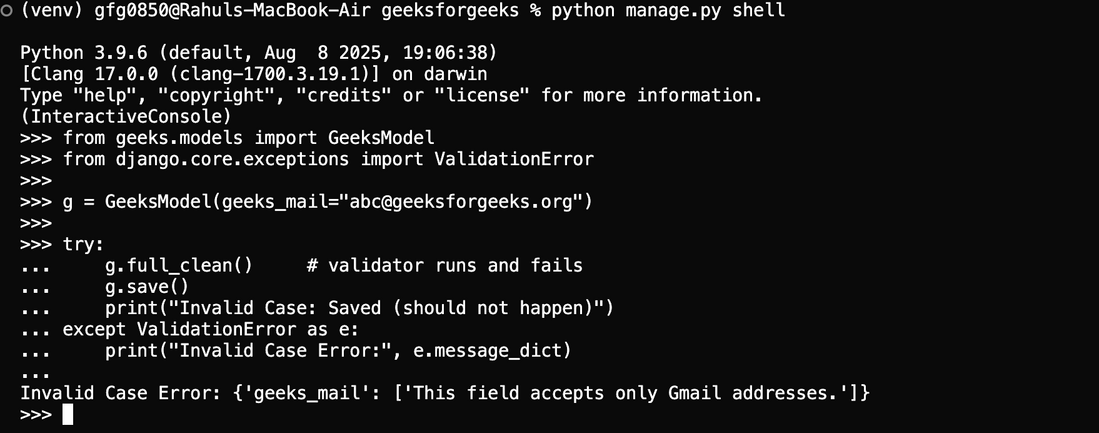
Invalid Case : Passing a non-Gmail address
If a value like "abc@geeksforgeeks.org" is used for geeks_mail, the custom validation system will raise an error, as only addresses ending with @gmail.com are allowed.
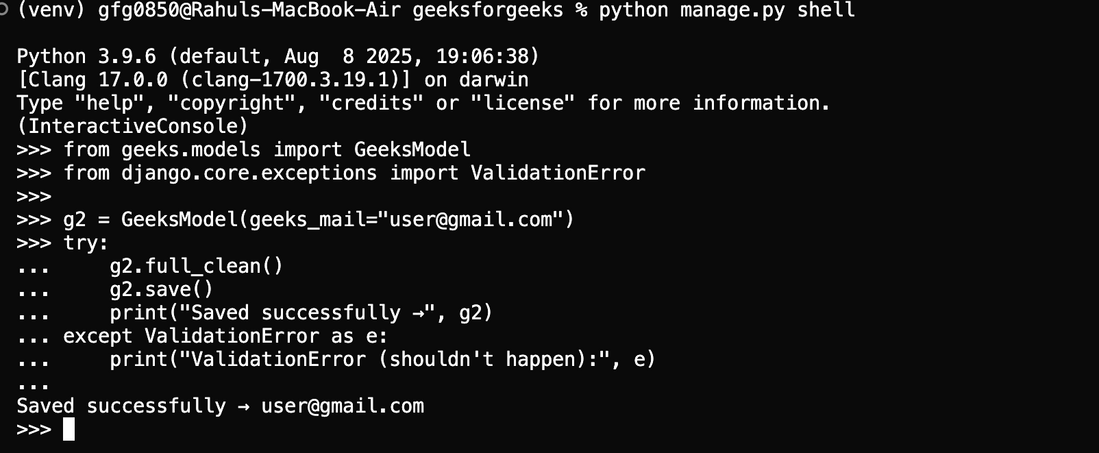
Valid Case: Passing a Correct Gmail Address
Values that satisfy the custom validator (ending with @gmail.com) will not raise any ValidationError.
The Django admin interface can be used to verify that non-Gmail email addresses are automatically rejected, as the custom validator enforces the required validation rule.
