
Given a text file. The task is to reverse as well as stores the content from an input file to an output file. This reversing can be performed in three ways.
- Full reversing: Reverse all characters in the file completely.
- Line-wise Reversing: Reverse the order of lines in the file.
- Word to word reversing: Reverse the order of words in each line.
Example: Full Reversing
Input:
Hello Geeks
for geeks!
Output:
!skeeg rof
skeeG olleH
Example 2: Line-wise Reversing
Input:
Hello Geeks
for geeks!Output:
for geeks!
Hello Geeks
Example 3: Word to word reversing
Input:
Hello Geeks
for geeks!
Output:
Geeks Hello
geeks! for
Sample Input File:
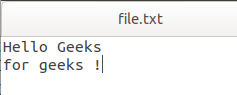
Full Reversing Using String Slicing
This method reads the entire file as a single string and reverses it using Python slicing. It is simple and fast but not suitable for very large files due to memory usage.
with open("file.txt", "r") as infile:
    data = infile.read()

with open("output1.txt", "w") as outfile:
    outfile.write(data[::-1])
Output
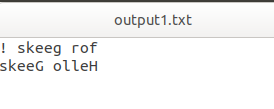
Explanation:
- read(): Reads the entire file as a string
- data[::-1]: Reverses all characters
- write(): Writes reversed content to output file
Reversing Order of Lines Using readlines()
This approach reverses the order of lines instead of characters. It reads all lines into a list and reverses the list.
with open("file.txt", "r") as infile:
    lines = infile.readlines()

with open("output2.txt", "w") as outfile:
    outfile.writelines(lines[::-1])
Output
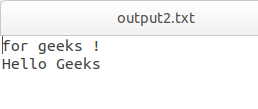
Explanation:
- readlines(): Reads file into a list of lines
- lines[::-1]: Reverses line order
- writelines(): Writes reversed lines
Word-to-Word Reversing
This method reverses words in each line while keeping line order intact. Useful when sentence structure must be preserved.
with open("file.txt", "r") as infile, open("output3.txt", "w") as outfile:
    for line in infile:
        outfile.write(" ".join(line.split()[::-1]) + "\n")
Output

Explanation:
- split(): Splits line into words
- [::-1]: Reverses word order
- join(): Combines words back into a line
