
SQL (Structured Query Language) is a standard language used to create, manage, update and retrieve data from relational databases such as MySQL, Oracle, SQL Server and PostgreSQL. It is widely used across industries, making it an essential skill for developers, data analysts and data scientists. It helps in:
- Managing and organizing data used by modern applications and businesses.
- Supporting multiple job roles, including Data Science, Business Analysis and Full-Stack Development.
- Building practical skills through structured learning and daily practice.
- Solving real-world problems using database queries and analysis.
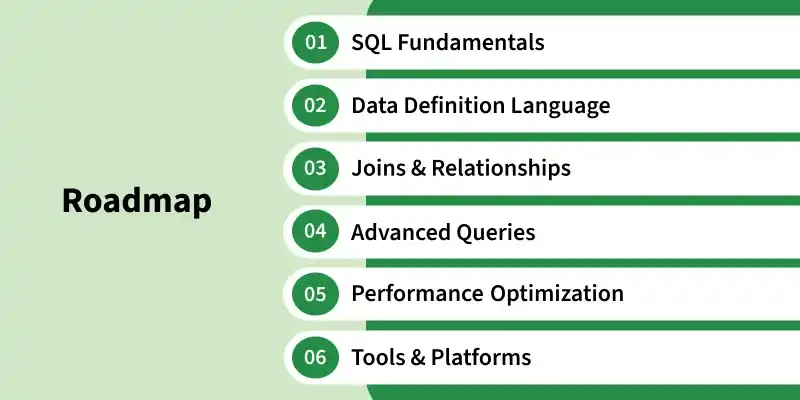
Complete roadmap to learn SQL in 30 days
Master SQL step-by-step from basics to advanced queries and real-world database operations in just 30 days.
Day 1 to Day 6 : Basic SQL Concepts
- Creating Database: Create a new database.
- Creating Tables and adding data: Create tables and insert data.
- SELECT Clause: Retrieve data from a database.
- FROM Clause: Specify the table to select data from.
- WHERE Clause: Filter data based on conditions.
- DELETE Statement: Remove data from a table.
- INSERT INTO: Add data into a table.
- Operators : Apply conditions using AND, OR, etc.
- Drop and Truncate: Delete entire table or its data.
Day 7 to Day 12 : Advanced Queries and Clauses
- WITH Clause: Used to create a temporary named result (CTE).
- FETCH Clause: Used to limit the number of rows returned.
- Arithmetic Operators: Perform basic calculations in queries.
- Wildcard Operators: Used for pattern matching in data.
- UPDATE Statement: Modify existing data in a table.
- ALTER Table: Change the structure of a table.
- LIKE Clause: Search data based on patterns.
- CASE Statement: Apply conditions and return values.
- EXISTS: Check if a subquery returns any data.
Day 13 to Day 18 : Aggregate Functions
- DISTINCT Clause: Select unique values from data.
- Count Function: Return total number of records.
- Sum Function: Calculate total of values.
- Average Function: Find average of values.
- Minimum Function: Return smallest value.
- Maximum Function: Return largest value.
- ORDER BY: Sort data in ascending or descending order.
- GROUP BY: Group data based on a column.
- ALL and ANY Clause: Compare values with subquery results.
- TOP Clause: Fetch limited number of rows.
Day 19 to Day 24 : Joins in SQL
- Union Clause: Combine results from multiple tables.
- Intersection Clause: Return common data from tables.
- Aliases: Give temporary names to tables or columns.
- Cartesian Join and Self Join: Join a table with itself or combine all rows.
- Inner, Left, Right and Full Joins: Used to combine data from multiple tables.
- Division Clause: Find records related to all values in another table.
- Using Clause: Specify common columns for joining tables.
- Combining values: Use joins and window functions to combine results.
- MINUS Operator: Return data from one table excluding another.
- Joining 3 or more tables: Combine multiple tables in a single query.
Day 25 to Day 30 : Advanced SQL Concepts and Miscellaneous
- Views: Virtual table created from a query.
- Creating Roles: Used to manage user permissions.
- Constraints: Rules to ensure data accuracy.
- Transactions: Group of operations executed together.
- Mathematical functions: Perform numeric calculations.
- Date functions: Handle date and time values.
- Conditional Expressions: Apply conditions in queries.
- General functions: Perform common operations on data.
- String functions: Manipulate text data.
- Conversion Function: Convert data from one type to another.
- Top-N Queries: Fetch limited number of rows.
- Advanced Functions: Used for complex data analysis.
Practice
Practice questions, interview problems and MCQs to strengthen your SQL and DBMS skills.
